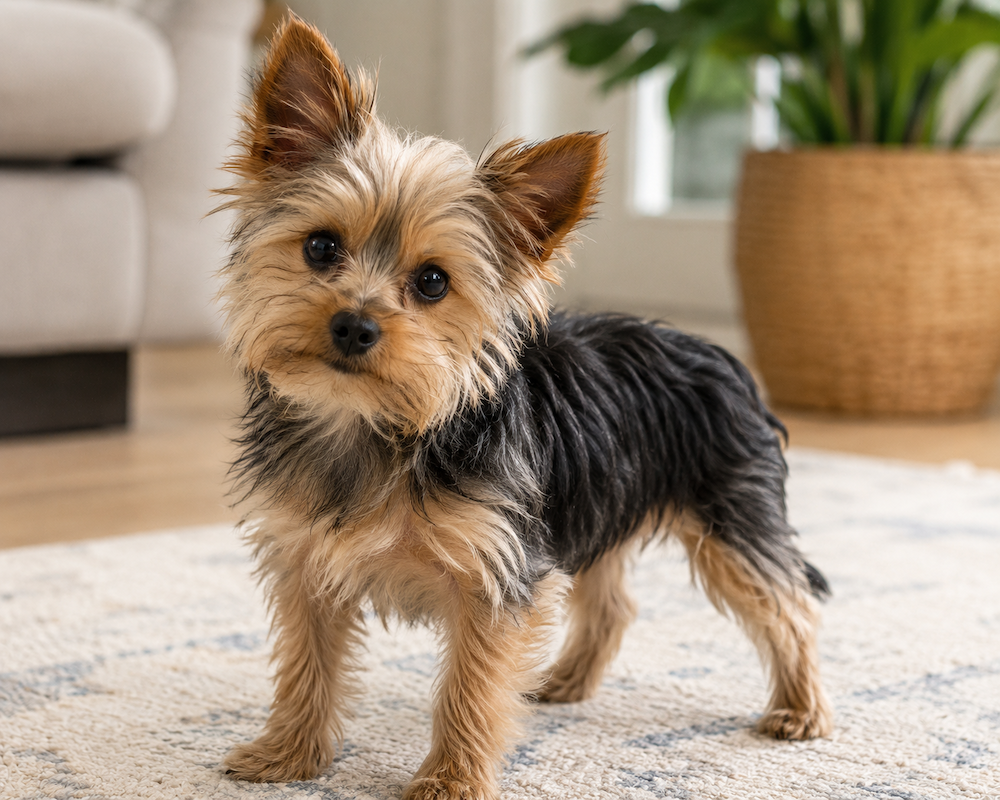






Tiny, confident, and bursting with personality — a spirited companion that combines the charm of the Chihuahua with the boldness of the Yorkshire Terrier.
🧠 QUICK SNAPSHOT
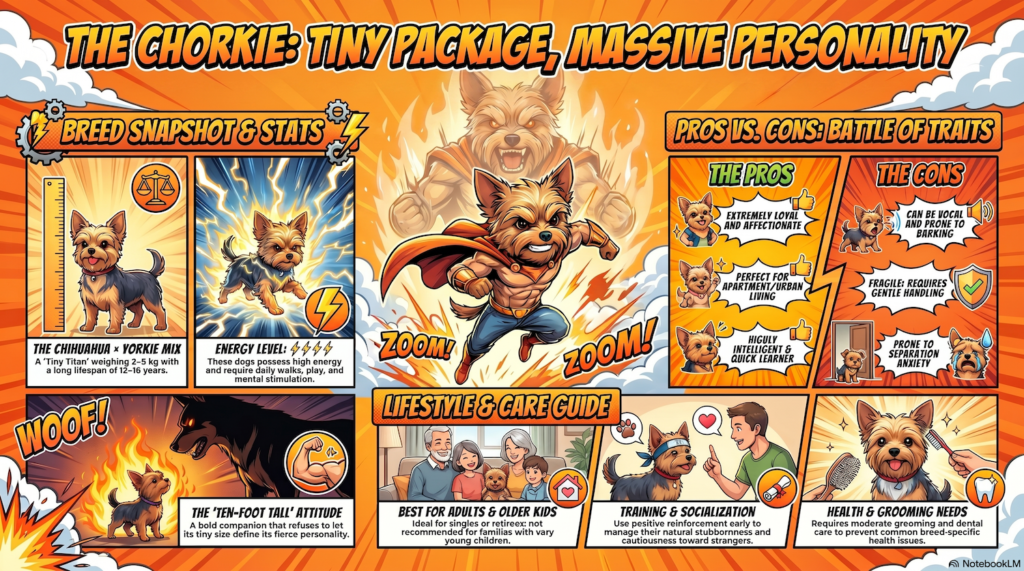
- Temperament: Affectionate, confident, lively
- Energy Level: Moderate
- Size: Small
- Good With Families: Yes
- Trainability: Moderate
- Grooming: Moderate
- Best For: Apartments, companionship, families with older children
📚 OVERVIEW
The Chorkie is a cross between a Chihuahua and a Yorkshire Terrier, resulting in a small dog with a huge personality. These lively companions are affectionate, playful, and devoted to their owners, often forming an especially close bond with one person while still enjoying family life.
Despite their tiny size, Chorkies are fearless and alert, making them excellent little watchdogs. They thrive on attention and love being involved in everything their family is doing.
✅ PROS & CONS
Pros
- Extremely affectionate and loyal
- Compact size suits apartment living
- Intelligent and entertaining
- Alert and excellent watchdog
Cons
- Can be vocal
- May be stubborn during training
- Doesn’t enjoy being left alone for long periods
- Small size requires careful handling around young children
Is a Chorkie a Good Family Dog?
Yes, a Chorkie can be an excellent family companion, particularly for households wanting a tiny, affectionate dog with a big personality.
A Chorkie is a cross between a Chihuahua and Yorkshire Terrier. Both parent breeds tend to bond closely with their owners, so Chorkies are often devoted and highly people-oriented.
They are better suited to respectful older children than very young children because their tiny bodies can be injured accidentally.
They may be small, but Chorkies rarely seem to realise it.
How Much Exercise Does a Chorkie Need?
Most Chorkies need around 30–45 minutes of daily activity, usually divided between short walks and play.
They’re energetic little dogs but don’t require enormous amounts of physical exercise.
Indoor games, scent activities, training and puzzle toys can provide valuable mental stimulation.
Their tiny size makes them easy to exercise in relatively small spaces, but they still benefit from getting outside and exploring the world.
Is a Chorkie Easy to Train?
Chorkies are intelligent but can be independent and stubborn.
Yorkshire Terriers have genuine working-terrier ancestry, while Chihuahuas are clever dogs with strong personalities.
Positive reinforcement usually produces the best results.
Toilet training can sometimes require patience, particularly with very small puppies.
Owners should also establish consistent rules rather than overlooking unwanted behaviour simply because the dog is tiny.
Does a Chorkie Shed?
Chorkies can be low-to-moderate shedders, but coat type varies considerably.
Yorkshire Terriers have long, fine hair that sheds relatively little, while Chihuahuas can have either Smooth or Long Coats and shed more noticeably.
A Chorkie may inherit anything from a short coat to long, silky hair.
Crossbreeding doesn’t guarantee the low-shedding Yorkshire Terrier coat.
Is a Chorkie Hypoallergenic?
No Chorkie can be guaranteed to be hypoallergenic.
Yorkshire Terriers are often tolerated better by some allergy sufferers because of their low-shedding coats, but Chihuahuas shed normally.
More importantly, dog allergies are caused by proteins in saliva, dander and skin secretions rather than simply hair.
An individual Chorkie may shed very little without being allergy-free.
How Often Does a Chorkie Need Grooming?
Grooming requirements depend heavily on the Chorkie’s coat.
Long-haired Chorkies may need brushing several times each week or even daily to prevent tangles.
Short-coated individuals require much less coat maintenance.
Professional grooming may be useful for dogs with longer Yorkie-like coats.
Dental care, nail trimming and ear checks are important regardless of coat type.
What Health Problems Are Common in Chorkies?
Chorkies can potentially inherit health conditions from both Chihuahuas and Yorkshire Terriers.
Potential concerns include patellar luxation, dental disease, tracheal collapse, heart disease, eye problems and Legg-Calvé-Perthes disease.
Yorkshire Terrier ancestry can also contribute a predisposition to portosystemic liver shunts.
Very small puppies may be vulnerable to hypoglycaemia.
Responsible breeding should focus on health rather than producing extremely tiny dogs.
How Long Do Chorkies Live?
Chorkies commonly live around 12–16 years, with some potentially living longer.
Both parent breeds are relatively long-lived.
Maintaining a healthy weight, providing good dental care and scheduling regular veterinary checks become particularly important as these dogs age.
A tiny puppy may look like a short-term commitment to someone unfamiliar with small breeds, but a healthy Chorkie can potentially remain part of the family for well over a decade.
How Big Does a Chorkie Get?
Most Chorkies are very small dogs, commonly weighing approximately 2–5 kg.
Size varies because both parent breeds differ between individuals and there is no standardised Chorkie breed size.
Some may be considerably sturdier than others.
Extremely small size shouldn’t automatically be considered desirable because excessive miniaturisation can increase health and injury risks.
Is There Such a Thing as a Teacup Chorkie?
No. “Teacup Chorkie” isn’t an officially recognised breed or size classification.
It’s generally a marketing term for an unusually small Chorkie.
Both Chihuahuas and Yorkshire Terriers are already tiny breeds.
Deliberately breeding for increasingly extreme miniaturisation can increase the risks of fragile bones, dental problems, hypoglycaemia and other health issues.
Healthy structure is far more important than achieving an exceptionally low number on the scales.
Can a Chorkie Live in an Apartment?
Yes. Chorkies are excellent apartment dogs from a space perspective.
Their tiny size means they don’t require a large home or backyard.
They still need walks, play and mental stimulation.
Barking is potentially the greater challenge because both parent breeds can be highly alert.
Teaching calm behaviour around neighbours, hallway noises and visitors is particularly useful for apartment living.
Can a Chorkie Be Left Alone?
Chorkies generally prefer plenty of human companionship and may not enjoy being alone for long periods.
Both Chihuahuas and Yorkshire Terriers can form extremely strong bonds with their owners.
Some Chorkies develop separation-related distress.
Gradual independence training from puppyhood can help prevent the dog becoming excessively dependent on one person.
Do Chorkies Bark a Lot?
Chorkies can be very enthusiastic barkers.
Both parent breeds have strong alert tendencies.
Yorkshire Terriers were once working ratters, while Chihuahuas are famously attentive to changes in their surroundings.
A Chorkie may therefore consider it necessary to report visitors, neighbours, delivery drivers and occasionally things that apparently exist only in the Chorkie’s imagination.
Early training can keep barking under better control.
Are Chorkies Good With Children?
Chorkies can be good with gentle, respectful older children.
Their extremely small size makes them vulnerable to accidental injury from dropping, squeezing or rough play.
Very young children may not yet understand how carefully such a tiny dog needs to be handled.
Supervision is therefore essential.
The dog’s resting areas should also be respected rather than allowing children to continually pick it up.
Are Chorkies Good With Other Dogs?
Yes, Chorkies can live successfully with other well-matched dogs.
Early socialisation is important.
Some Chorkies display enormous confidence around dogs many times their own size.
That confidence can become dangerous if they provoke a much larger dog.
Owners need to remember the Chorkie’s actual physical size even when the Chorkie itself apparently doesn’t.
Are Chorkies Good With Cats?
Chorkies can often live successfully with cats, especially when raised together.
Yorkshire Terrier ancestry can contribute some prey drive because Yorkies were historically used to hunt rats and other vermin.
However, a familiar household cat may be treated completely differently from a small animal encountered outdoors.
Careful introductions are important.
A large, confident cat may actually outweigh a Chorkie considerably.
Do Chorkies Like to Cuddle?
Many Chorkies are extremely affectionate and love cuddling.
Chihuahuas frequently form intense bonds with their favourite people, while Yorkshire Terriers are also devoted companions.
A Chorkie may happily spend considerable time curled up on someone’s lap or burrowed under a blanket.
Individual personalities vary, but this cross is generally well suited to someone wanting a dog that enjoys close companionship.
Why Does My Chorkie Follow Me Everywhere?
Chorkies often follow their owners because both parent breeds are strongly people-oriented.
Some develop a particularly intense attachment to one favourite person.
Following someone from room to room isn’t necessarily problematic.
However, if the dog becomes distressed whenever that person disappears, independence training may be needed.
There’s an important difference between an affectionate companion and a dog that feels unable to cope alone.
Why Does My Chorkie Shake?
Chorkies can tremble because they’re cold, excited, nervous or highly stimulated.
Their tiny bodies lose heat quickly, particularly if they inherit a short Chihuahua-style coat.
However, shaking shouldn’t automatically be dismissed as normal.
Pain, hypoglycaemia and other medical problems can also cause trembling.
Sudden, severe or persistent shaking warrants veterinary attention.
Do Chorkies Get Cold Easily?
Yes, many Chorkies feel cold relatively easily, particularly small or short-coated individuals.
Their tiny bodies lose heat quickly.
Warm bedding and appropriately fitted clothing can be useful during cold weather.
Longer Yorkie-like coats provide some additional protection but don’t necessarily make the dog suited to prolonged exposure to low temperatures.
Do Chorkies Have a Strong Prey Drive?
Some Chorkies can have a surprisingly strong interest in small moving animals.
Yorkshire Terriers may look like glamorous lap dogs today, but their ancestors were genuine working terriers used for controlling rats and other vermin.
A Chorkie can inherit some of that instinct.
The degree varies substantially between individuals.
Small rodents should therefore be securely separated from dogs showing strong chasing behaviour.
Why Can Chorkies Be So Feisty?
Both parent breeds pack considerable confidence and determination into very small bodies.
Yorkshire Terriers retain classic terrier characteristics, while Chihuahuas can be bold, alert and highly devoted to their owners.
Combined, these traits can produce an extraordinarily confident little dog.
Good socialisation helps ensure confidence doesn’t become fear-based reactivity or inappropriate aggression.
A Chorkie’s personality can occupy considerably more space than the Chorkie itself.
What Does a Chorkie Look Like?
There is no single standard Chorkie appearance.
Some strongly resemble Yorkshire Terriers with silky coats and terrier-like faces.
Others inherit the Chihuahua’s large ears, rounded head and shorter coat.
Many fall somewhere between the two.
Even littermates can differ substantially because first-generation crossbreed puppies inherit different combinations of genes from their parents.
Can a Chorkie Have Long Hair?
Yes. Many Chorkies develop medium-to-long coats, particularly when a Yorkshire Terrier or Long Coat Chihuahua contributes the relevant genetics.
Others have relatively short coats.
Long-haired puppies may develop silky furnishings around the face, ears and body.
Adult coat type isn’t always obvious in very young puppies, particularly in a crossbreed where several different coat combinations are possible.
What Colours Can Chorkies Be?
Chorkies can occur in many colours, including black, tan, brown, fawn, cream, gold and combinations of these colours.
Yorkshire Terrier coat colours can also change considerably as dogs mature.
Chihuahua ancestry adds even greater colour variation.
A dark puppy may therefore look quite different as an adult.
Colour should always be considered far less important than health and temperament.
Does a Chorkie’s Coat Change Colour as It Gets Older?
Yes, some Chorkies can change colour substantially as they mature.
Yorkshire Terrier puppies are typically born much darker than their eventual adult colouring.
Their coats often transition towards blue-grey and tan or gold as they grow.
A Chorkie inheriting these colour genetics may undergo a similar transformation.
The final adult colour can therefore be difficult to predict accurately from a young puppy.
What Is an F1 Chorkie?
An F1 Chorkie is generally a first-generation cross between a Chihuahua and Yorkshire Terrier.
F1 puppies can vary substantially because each receives a different combination of genes from the two breeds.
One may inherit a long Yorkie-like coat while another has a shorter Chihuahua-style coat.
The F1 label describes parentage — it doesn’t guarantee appearance, shedding level, temperament or health.
What Is an F1B Chorkie?
An F1B Chorkie is generally produced by breeding an F1 Chorkie back to either a Chihuahua or Yorkshire Terrier.
The characteristics will therefore depend heavily on which breed is used for the backcross.
An F1B bred back to a Yorkie may have a greater probability of developing Yorkie-like characteristics, but genetics remain variable.
Generation labels should never be treated as guarantees.
Is a Chorkie a Recognised Dog Breed?
No. The Chorkie is generally considered a designer crossbreed rather than a formally recognised pedigree breed.
Major kennel clubs recognise the Chihuahua and Yorkshire Terrier separately but not the Chorkie as an established breed.
There is therefore no universal standard governing Chorkie size, coat, colour or appearance.
This explains why individual Chorkies can look remarkably different from one another.
Is a Chorkie Healthier Than a Chihuahua or Yorkshire Terrier?
A Chorkie can benefit from increased genetic diversity, but crossbreeding doesn’t automatically make a dog healthier.
A puppy can still inherit disease-associated genes from either parent.
Some conditions also occur in both small breeds.
Responsible breeders should health-test the Chihuahua and Yorkshire Terrier parents appropriately rather than relying on “hybrid vigour” as a substitute for health screening.
Is a Chorkie the Same as a Yorkie-Chi?
Usually, yes. Chorkie, Yorkie-Chi and Yorkie Chihuahua mix are names commonly used for the same Chihuahua–Yorkshire Terrier cross.
Because the Chorkie isn’t governed by a major kennel-club breed standard, naming isn’t completely standardised.
“Chorkie” has become one of the most widely recognised names.
Prospective owners should always confirm the actual parentage rather than relying solely on a designer name.
Why Is It Called a Chorkie?
The name Chorkie combines elements of Chihuahua and Yorkie, the common nickname for the Yorkshire Terrier.
Like Cavoodle, Chiweenie and other designer-cross names, it provides a simple way to identify the two parent breeds.
It’s certainly easier than repeatedly saying “Chihuahua–Yorkshire Terrier cross” — although the dog itself probably has no opinion on the matter.
Where Does the Chorkie Come From?
The Chorkie is a modern Chihuahua–Yorkshire Terrier cross associated particularly with the designer-dog movement of the late 20th and early 21st centuries.
There is no well-documented individual breeder who can confidently be credited with creating the first Chorkie. Chihuahua–Yorkshire Terrier crosses almost certainly existed accidentally before the name became popular.
Its parent breeds have dramatically different histories: the Chihuahua has deep roots in Mexico and ancient American dog populations, while the Yorkshire Terrier emerged from British working terriers used for vermin control.
The result is a tiny modern companion carrying the heritage of two remarkably confident little dogs — which may explain why nobody ever managed to tell the Chorkie that it’s small.