






Friendly, intelligent and famous for their expressive crests and whistles, Cockatiels are among the world's most popular pet birds. They're affectionate companions, but they need daily interaction, enrichment and proper avian care.
🧠 QUICK SNAPSHOT
| Trait | Cockatiel |
|---|---|
| Scientific Name | Nymphicus hollandicus |
| Pet Type | Parrot / Companion bird |
| Origin | Australia |
| Typical Lifespan | Around 15–25 years |
| Adult Size | Around 30–33 cm including tail |
| Typical Weight | Around 80–120 g |
| Diet | Balanced formulated diet plus suitable vegetables and other fresh foods |
| Activity | Diurnal |
| Temperament | Social, gentle, curious and playful |
| Noise Level | Moderate |
| Social Needs | High |
| Trainability | Good |
| Beginner Friendly? | Generally yes, with proper care |
📚 OVERVIEW
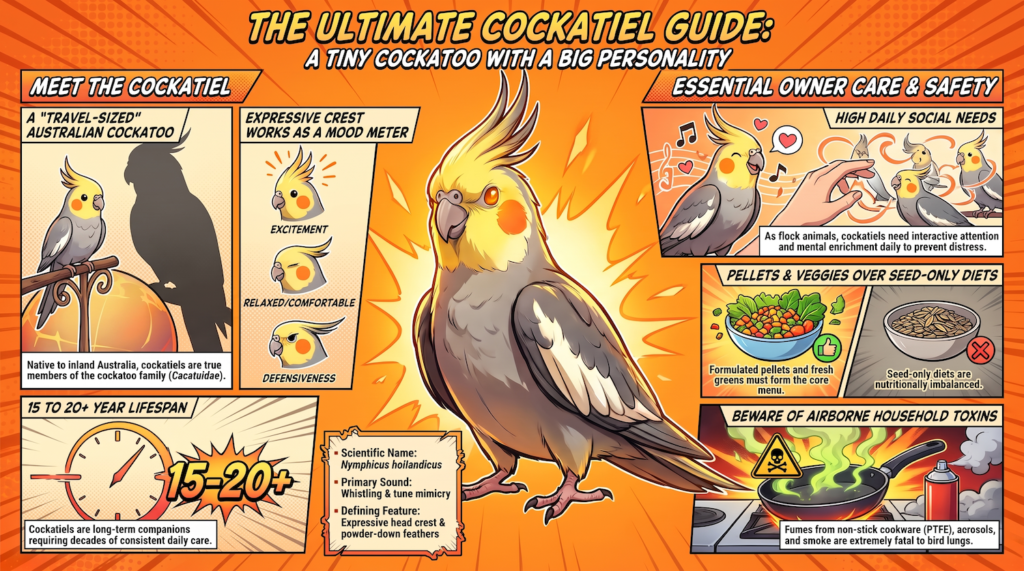
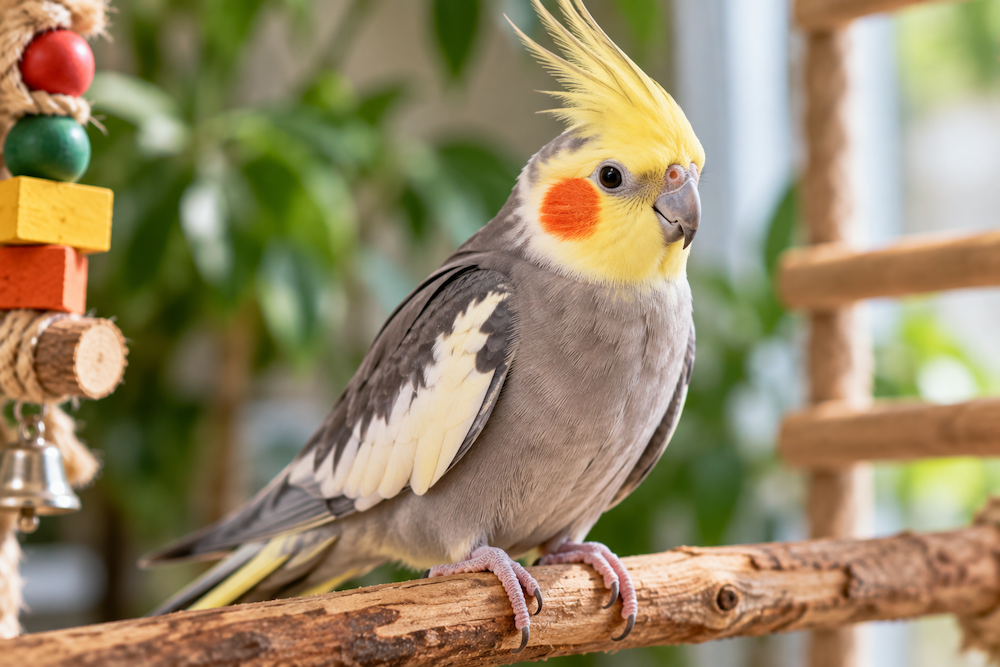
The Cockatiel (Nymphicus hollandicus) is a small Australian parrot instantly recognisable by its long tail, prominent crest and — in the classic wild colouring — bright orange cheek patches.
Cockatiels are popular companion birds because they’re generally social, intelligent and relatively gentle. Many become strongly attached to their owners, enjoy head scratches and learn distinctive whistles or household sounds.
Their crest is also a useful communication tool. Its position can help indicate whether a Cockatiel is excited, curious, relaxed or frightened.
Despite their manageable size, Cockatiels aren’t low-maintenance cage pets. They need daily social interaction, safe exercise, mental stimulation, an appropriate diet and regular avian veterinary care.
With good care, a Cockatiel can remain part of the family for 15–25 years or more.
✅ PROS & CONS
Pros
- Friendly and highly social
- Often enjoys interacting with people
- Intelligent and trainable
- Can learn whistles and household sounds
- Usually quieter than many larger parrots
- Expressive body language
- Manageable size
- Long potential lifespan
- Often suitable for first-time bird owners
Cons
- Needs substantial daily interaction
- Can become noisy when calling for attention
- Produces noticeable feather dust
- Requires regular out-of-cage exercise
- Can become bored without enrichment
- Needs a large, properly equipped cage
- Long lifespan is a major commitment
- Birds can hide signs of illness until they’re seriously unwell
Are Cockatiels Good Pets?
Yes. Cockatiels can make excellent companion birds for people prepared to meet their social and environmental needs.
They’re generally gentle, interactive and intelligent, making them popular with both experienced and first-time bird owners.
Are Cockatiels Good Pets for Beginners?
Cockatiels are often considered one of the better parrots for beginners.
They’re relatively manageable in size and can become very tame.
However, new owners still need to understand bird nutrition, cage requirements, enrichment, handling and the importance of avian veterinary care.
How Long Do Cockatiels Live?
Cockatiels commonly live around 15–25 years with excellent care, and some individuals can live longer.
Diet, genetics, exercise and veterinary care can all influence lifespan.
They’re therefore a much longer commitment than many people expect from a small pet.
How Big Do Cockatiels Get?
Adult Cockatiels are generally around 30–33 cm long, much of which is their distinctive long tail.
They typically weigh around 80–120 grams.
Despite their relatively small bodies, they need enough space to fully stretch and exercise their wings.
Do Cockatiels Talk?
Some Cockatiels can learn words and short phrases, but they’re generally better whistlers than talkers.
Individual ability varies considerably.
Males are often particularly enthusiastic about vocalising, whistling and imitating sounds.
Can Cockatiels Learn Songs?
Yes. Many Cockatiels can learn recognisable whistles and melodies through repetition.
Some become remarkably accomplished whistlers and may reproduce tunes they’ve heard repeatedly.
Whistling can also become an important form of interaction between a Cockatiel and its owner.
Are Cockatiels Loud?
Cockatiels are usually quieter than many larger parrots, but they’re certainly not silent.
They may whistle, chirp, call loudly or make contact calls when looking for their owners.
Noise levels vary considerably between individual birds.
Are Cockatiels Affectionate?
Many are extremely affectionate.
A tame Cockatiel may actively seek its owner’s company, sit on shoulders and request head and neck scratches.
However, individual personalities vary, and interaction should always respect the bird’s body language.
Do Cockatiels Recognise Their Owners?
Yes. Cockatiels can recognise familiar people and learn voices, routines and patterns of interaction.
Many develop strong preferences for particular people and become noticeably excited when a favourite person enters the room.
Do Cockatiels Like Being Held?
Cockatiels generally prefer perching on a hand, finger, arm or shoulder rather than being physically restrained.
Many enjoy gentle scratches around the head and neck.
Grabbing or enclosing a bird unnecessarily can cause fear and damage trust.
What Do Cockatiels Eat?
A balanced formulated bird food can provide the nutritional foundation, supplemented with appropriate vegetables and other suitable fresh foods.
A diet based entirely on seeds isn’t ideal because birds can selectively consume their favourite high-fat seeds and develop nutritional deficiencies.
Fresh clean water should always be available.
Can Cockatiels Eat Fruit and Vegetables?
Yes. Suitable vegetables and smaller amounts of appropriate fruit can add variety and nutrition.
Dark leafy greens and a range of bird-safe vegetables are useful options.
Owners should learn which human foods are unsafe for parrots before sharing food with their bird.
What Foods Are Toxic to Cockatiels?
Several everyday foods can be dangerous to parrots.
Important examples include avocado, chocolate, alcohol and caffeine.
Owners should check unfamiliar foods before offering them rather than assuming that something safe for humans is also safe for birds.
How Big Should a Cockatiel Cage Be?
A Cockatiel needs a cage large enough to fully extend its wings, climb and move comfortably between perches.
Bigger is generally better, particularly when the bird spends significant periods inside.
Bar spacing must also be appropriate to prevent the bird’s head becoming trapped.
Do Cockatiels Need Time Outside Their Cage?
Yes. Cockatiels benefit from regular supervised time outside their cage in a bird-safe environment.
Flying, climbing, exploring and interacting provide important exercise and mental stimulation.
Windows, ceiling fans, open doors, hot surfaces and other pets need careful management.
Can Cockatiels Live Alone?
A Cockatiel can live without another Cockatiel if it receives substantial daily social interaction from its human family.
However, they’re naturally social birds and shouldn’t simply be left alone in a cage for most of their lives.
Owners who are frequently absent should consider how the bird’s social needs will be met.
Is It Better to Have One or Two Cockatiels?
Either arrangement can work.
Two compatible Cockatiels can provide each other with companionship, particularly when humans aren’t home.
A single bird may become more strongly focused on its human family, but this also creates a greater responsibility to provide regular interaction.
Why Does a Cockatiel Raise Its Crest?
A Cockatiel’s crest is an excellent emotional indicator.
A high upright crest can indicate excitement, curiosity or alertness, while a relaxed crest may sit at a gentler angle.
A crest flattened tightly against the head can indicate fear, stress or defensive behaviour.
The rest of the bird’s body language should also be considered.
Why Does My Cockatiel Grind Its Beak?
Gentle beak grinding commonly occurs when a Cockatiel is relaxed and preparing to rest or sleep.
It can sound unusual to new owners but is generally normal behaviour.
Context is important when interpreting any behaviour.
Why Does My Cockatiel Bob Its Head?
Head bobbing can have several meanings depending on the bird’s age and situation.
Young birds may bob while begging for food, while adults can use similar movements during excitement, courtship or social interaction.
Look at the bird’s overall behaviour rather than interpreting the movement in isolation.
Why Does My Cockatiel Scream?
Cockatiels may scream because they’re seeking attention, frightened, excited, bored or making contact calls.
Occasional loud calling is normal parrot behaviour.
Sudden or persistent changes in vocalisation can also indicate environmental stress or illness.
Do Cockatiels Need Toys?
Yes. Cockatiels are intelligent birds that need regular mental stimulation.
Chewing toys, shreddable materials, climbing opportunities and foraging activities can help prevent boredom.
Rotating safe toys periodically keeps the environment interesting.
Do Cockatiels Produce a Lot of Dust?
Yes. Cockatiels produce fine powder down or feather dust that can accumulate around their cage and surrounding room.
Regular cleaning and good ventilation help manage it.
This is worth considering for households containing people with respiratory sensitivities.
Can Cockatiels Live With Other Birds?
Sometimes, but compatibility shouldn’t be assumed.
Different species can have very different temperaments, body sizes and beak strength.
Even birds that spend supervised time together may be safer living in separate cages.
How Can You Tell a Male Cockatiel From a Female?
Sex differences depend partly on the bird’s colour mutation and age.
In classic grey adult Cockatiels, males generally develop a brighter yellow face and vivid orange cheek patches, while females usually retain more grey and characteristic markings beneath the tail and wings.
With some colour mutations, visual sexing is unreliable and DNA testing may be needed.
What Colours Do Cockatiels Come In?
Selective breeding has produced numerous Cockatiel colour mutations, including normal grey, lutino, pied, pearl, cinnamon, whiteface and combinations of these traits.
These are colour and pattern variations of the same species rather than separate Cockatiel breeds.
Where Do Cockatiels Come From?
Cockatiels are native to Australia, where wild populations inhabit open country and often travel in flocks searching for food and water.
Their ability to travel considerable distances helps explain why captive Cockatiels benefit from opportunities for flight and exercise.
Are Cockatiels Parrots?
Yes. Cockatiels are genuine parrots.
They’re members of the cockatoo family, Cacatuidae, making them relatives of much larger cockatoos.
Their expressive movable crest and powder-producing feathers are among the characteristics reflecting that relationship.
Are Cockatiels Good First Birds?
Yes. Cockatiels are often an excellent introduction to companion birds for owners who understand the commitment involved.
They’re generally gentle, intelligent and manageable compared with many larger parrots.
But “beginner-friendly” doesn’t mean disposable or easy.
A Cockatiel may be with you for two decades or more.
What Makes the Cockatiel Unique?
A Cockatiel doesn’t need words to tell you much about what it’s thinking.
Just watch the crest.
Straight up?
Something interesting is happening.
Relaxed?
Everything is probably fine.
Flattened against the head?
Perhaps give your tiny dinosaur a little space.
Then there are the whistles. Cockatiels can learn melodies, imitate familiar sounds and develop their own distinctive ways of getting a person’s attention.
They’re small parrots, but they’re also members of the cockatoo family — and once you notice the expressive crest, powdery feathers and strong social personality, the family resemblance becomes obvious.
The result is a bird small enough to sit comfortably on your shoulder but intelligent enough to recognise routines, learn tunes and make its opinions surprisingly clear.
And if your Cockatiel learns your favourite whistle, be prepared to hear it considerably more often than you originally intended.
Discover why Cockatiels whistle, what their expressive crests reveal and how these small members of the cockatoo family became such popular companion birds.
Watch our Cockatiel video and discover what makes this remarkable little parrot so entertaining.