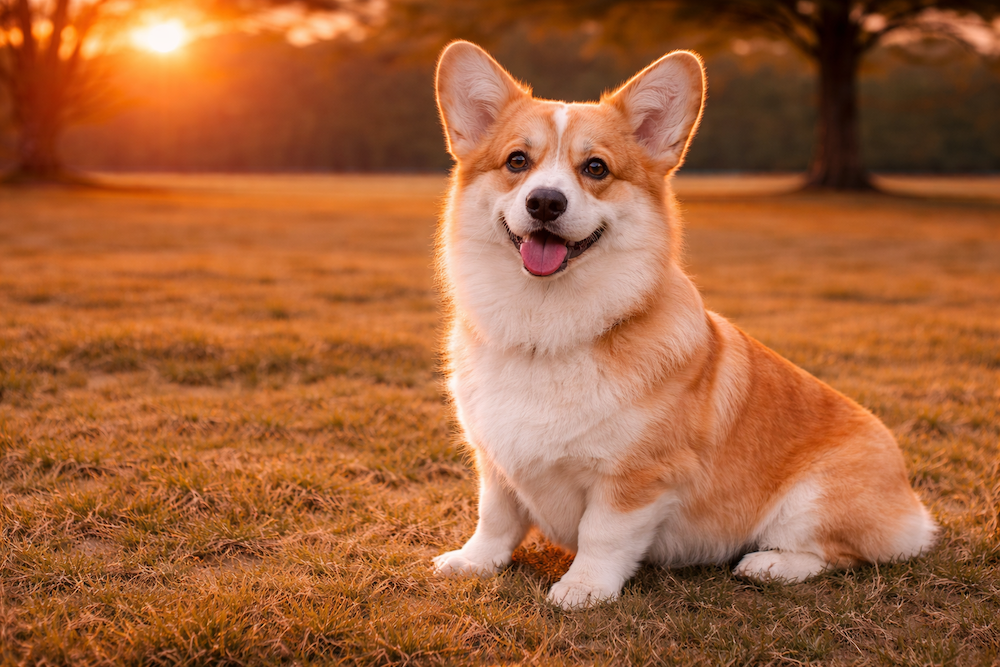







Short legs, big personality — a smart, playful companion with a loyal heart.
🧠 QUICK SNAPSHOT
- Temperament: Intelligent, Playful, Loyal
- Energy Level: Moderate to High
- Size: Small
- Good with Families: Excellent
- Training Difficulty: Easy
📚 OVERVIEW
Corgis are small herding dogs known for their short legs, long bodies, and expressive faces. Originally bred for working with livestock, they are intelligent, energetic, and highly trainable. They are also affectionate and enjoy being part of family life.
✅ PROS & CONS
Pros
- Very intelligent and easy to train
- Great with families and children
- Fun, playful personality
Cons
- Can be vocal and alert
- Needs regular exercise and stimulation
- Herding instincts can lead to nipping behaviour
Is a Corgi a Good Family Dog?
Yes. Corgis can be excellent family dogs for households prepared for an intelligent, active and surprisingly assertive little herding dog.
They’re affectionate, loyal and usually enthusiastic participants in family life.
Corgis can be good with children, although their herding instincts sometimes lead to chasing or nipping at heels.
Early training and socialisation are important. Despite their cute appearance, Corgis are genuine working dogs with considerably more drive and confidence than many people expect.
Are There Two Different Corgi Breeds?
Yes. There are two distinct Corgi breeds:
Pembroke Welsh Corgi
Cardigan Welsh Corgi
They share short legs, long bodies and Welsh herding heritage, but they’re separate breeds with different histories and physical characteristics.
The Pembroke is generally smaller and is famous for its association with Queen Elizabeth II.
The Cardigan is usually larger, has more rounded ears and naturally carries a long, fox-like tail.
How Much Exercise Does a Corgi Need?
Most adult Corgis need around 60 minutes of exercise each day, with energetic individuals enjoying considerably more.
Walking, training, scent games and controlled herding-style activities can all provide excellent stimulation.
Corgis shouldn’t be treated as sedentary dogs simply because their legs are short.
Their ancestors spent their working lives moving livestock across farms.
Mental exercise is particularly important because bored Corgis can become noisy, destructive or remarkably creative.
Is a Corgi Easy to Train?
Yes. Corgis are generally highly intelligent and trainable, although they can also be independent.
They were bred to make decisions while controlling livestock, so blind obedience was never the entire job.
Positive reinforcement and consistent rules work well.
Corgis can excel in obedience, agility, scent work, rally and herding activities.
Their intelligence has one downside: they can learn unwanted behaviours just as efficiently as useful ones.
Does a Corgi Shed?
Yes. Corgis can shed heavily.
Both Pembroke and Cardigan Welsh Corgis have dense double coats.
They usually shed throughout the year with particularly heavy seasonal coat changes when large quantities of undercoat are released.
Regular brushing helps considerably.
Anyone wanting a virtually hair-free house should probably reconsider the Corgi, regardless of how appealing those short legs may be.
Is a Corgi Hypoallergenic?
No. Corgis aren’t considered hypoallergenic.
Their dense double coats can shed extensively.
They also produce allergenic proteins in saliva, dander and skin secretions like other dogs.
Regular grooming can reduce loose hair but doesn’t make a Corgi hypoallergenic.
What Health Problems Are Common in Corgis?
Health risks vary somewhat between Pembroke and Cardigan Welsh Corgis, but potential concerns include hip dysplasia, eye disorders and degenerative myelopathy.
Their long-backed, short-legged structure can also make spinal health particularly important.
Pembrokes can be affected by conditions including von Willebrand disease, while Cardigans have their own population-specific genetic concerns.
Keeping a Corgi lean is one of the most important things an owner can do to reduce unnecessary stress on its joints and spine.
Are Corgis Prone to Back Problems?
Corgis can be at increased risk of spinal problems because of their long bodies and shortened limbs.
Intervertebral disc disease can occur.
Owners should maintain a healthy body weight and avoid encouraging excessive repetitive jumping from high furniture.
However, a healthy Corgi shouldn’t be treated like a fragile ornament.
Appropriate exercise and good muscle condition are also important for supporting the dog’s body.
How Long Do Corgis Live?
Corgis commonly live around 12–15 years.
Individual lifespan depends on genetics, weight, exercise, diet and veterinary care.
Obesity can significantly increase stress on the joints and spine and may contribute to other health problems.
Because Corgis are famously enthusiastic about food, portion control can become an important part of long-term health.
How Big Does a Corgi Get?
Corgis are small-to-medium dogs with surprisingly substantial bodies.
Pembroke Welsh Corgis generally weigh around 9–14 kg, while Cardigan Welsh Corgis are typically heavier at approximately 11–17 kg.
Both stand roughly around 25–32 cm at the shoulder, depending on breed and individual.
Their short legs make them look smaller than they actually are.
Picking one up often produces the immediate realisation that there’s considerably more Corgi than expected.
Can a Corgi Live in an Apartment?
Yes. Corgis can live successfully in apartments if they receive enough exercise and mental stimulation.
Their compact height helps, but they’re active working dogs rather than sedentary lap dogs.
Barking can be the bigger issue.
Corgis are alert and naturally vocal, so hallway noises, neighbours and delivery drivers may receive enthusiastic announcements.
Early training is particularly valuable in shared buildings.
Can a Corgi Be Left Alone?
Adult Corgis can learn to spend reasonable periods alone, but they shouldn’t regularly be isolated for very long periods.
They’re intelligent, active dogs that can become bored.
A bored Corgi may bark, chew or invent its own entertainment.
Exercise, enrichment and gradual independence training help considerably.
Do Corgis Bark a Lot?
Many Corgis are very vocal dogs.
Their working role required them to communicate while moving livestock and alerting farmers to unusual activity.
Modern Corgis may bark at visitors, unfamiliar noises, other dogs or simply excitement.
Training can reduce excessive barking, but expecting a completely silent Corgi may be unrealistic.
They are small dogs equipped with surprisingly serious public-address systems.
Are Corgis Good With Children?
Corgis can be excellent with children when properly socialised.
They’re sturdy, playful and often enjoy active family life.
However, their herding instincts can cause some Corgis to chase running children or nip at ankles.
This isn’t necessarily aggression — it’s an inappropriate application of behaviour originally used to control livestock.
Training should redirect the behaviour rather than allowing it to become a habit.
Why Do Corgis Nip at People’s Heels?
Heel nipping comes directly from the Corgi’s cattle-herding ancestry.
These dogs were developed to control livestock by working close to the animals’ legs.
A quick nip at a cow’s heel could encourage it to move.
Some modern Corgis instinctively apply similar behaviour to running children, joggers or other animals.
The instinct may be historical, but owners should still teach appropriate alternatives.
Are Corgis Good With Other Dogs?
Corgis are generally good with other dogs when properly socialised.
They’re confident animals and can sometimes behave assertively despite their small stature.
Some individuals may attempt to control other dogs through herding behaviour.
Early positive experiences and appropriate introductions help develop good canine social skills.
Are Corgis Good With Cats?
Corgis can live successfully with cats, especially when introduced while young.
Their herding instincts may initially cause them to chase or attempt to control a cat’s movement.
A confident household cat may quickly establish that this arrangement isn’t appreciated.
Supervision and training are useful until both animals understand the household rules.
Do Corgis Have a Strong Prey Drive?
Corgis generally have less specialised prey drive than terriers or sighthounds, but individuals can certainly chase small animals.
Their strongest inherited working tendency is usually herding rather than hunting.
Moving animals can still trigger pursuit.
Reliable recall and appropriate introductions to smaller pets remain important.
Why Are Corgis So Short?
Corgis have short legs because of a genetic form of disproportionate dwarfism known as chondrodysplasia.
A genetic change affecting the FGF4 pathway contributed to the shortened limbs seen in several dog breeds.
Humans then selectively bred dogs with this body shape because it was useful for particular working roles.
The Corgi’s short stature wasn’t originally just about looking cute — it had practical advantages around cattle.
Why Were Corgis Bred With Such Short Legs?
Short legs helped Corgis work beneath and around cattle while reducing their exposure to kicks.
Rather than controlling livestock from a distance, these compact dogs could work extremely close to the animals.
Their low centre of gravity, agility and confidence made them effective cattle dogs.
That adorable modern silhouette therefore has surprisingly serious agricultural origins.
What Were Corgis Originally Bred For?
Corgis were developed primarily as farm and livestock dogs in Wales.
They could herd cattle and other livestock, guard the farm and perform general working duties.
They belong to a type of herding dog sometimes called a heeler, because they could move livestock by working around and nipping at the heels.
The modern sofa-loving Corgi is descended from a dog expected to do a full day’s work.
How Can Such a Small Dog Herd Cattle?
Corgis relied on speed, agility, confidence and strategic positioning rather than physical size.
They could move close to cattle, nip at their heels and quickly avoid retaliatory kicks.
Their low stature may actually have been an advantage.
A Corgi confronting an animal weighing hundreds of kilograms sounds improbable until you remember that nobody informed the Corgi that this should be intimidating.
What Is the Difference Between a Pembroke and Cardigan Welsh Corgi?
The Cardigan Welsh Corgi is generally larger, heavier and has a long tail, while the Pembroke is typically smaller and historically often seen with a very short tail.
Cardigans tend to have larger, more rounded ears.
The breeds also differ in colour possibilities and ancestry.
Although they were once grouped together by kennel organisations, they’re now recognised as distinct breeds.
Which Corgi Has a Tail?
The Cardigan Welsh Corgi naturally has a long, fox-like tail.
Pembroke Welsh Corgis can also be born with tails, although some are naturally bobtailed.
Historically, Pembroke tails were also docked in countries where docking was permitted.
This created the popular misconception that Pembrokes simply don’t have tails.
In countries where cosmetic docking is prohibited, naturally long-tailed Pembrokes are much more commonly seen.
Are Corgis Born Without Tails?
Some Pembroke Welsh Corgis can be born with naturally shortened tails, but many are born with full-length tails.
The natural bobtail trait is genetic.
Historically, tail docking made naturally short tails appear far more universal than they actually are.
Cardigan Welsh Corgis characteristically have long tails.
Why Do Some Corgis Have Huge Ears?
Large upright ears are a characteristic feature of both Corgi breeds, particularly the Cardigan Welsh Corgi.
Cardigan ears are generally larger and more rounded, while Pembroke ears tend to be somewhat smaller and more pointed.
Their erect ears contribute greatly to the alert expression that makes Corgis so recognisable.
They also seem remarkably effective at detecting the opening of a food packet several rooms away.
What Is a Fluffy Corgi?
A Fluffy Corgi has a recessively inherited long-coat variation that produces noticeably longer, softer hair than the standard coat.
Fluffies can occur in Pembrokes and Cardigans.
They’re still Corgis rather than a separate breed.
The longer coat requires additional grooming and traditionally hasn’t been preferred for working dogs because it can collect mud, vegetation and moisture more easily.
What Colours Can Corgis Be?
Colour depends on which Corgi breed you’re discussing.
Pembroke Welsh Corgis commonly occur in red, sable, fawn and black-and-tan combinations, often with white markings.
Cardigans have a broader range that can include red, sable, brindle, black with tan or brindle points and blue merle, often combined with white.
Breed standards vary somewhat between kennel organisations.
Can Corgis Be Merle?
Cardigan Welsh Corgis can naturally occur in blue merle, but merle isn’t a standard colour in purebred Pembroke Welsh Corgis.
This distinction is important.
Dogs advertised as “merle Pembrokes” may have ancestry from another breed or from intentional crossbreeding.
Merle-to-merle breeding should also be avoided because double-merle puppies have a significantly increased risk of serious hearing and eye abnormalities.
Why Does a Corgi Have Such a Big Bottom?
The famous Corgi rear end is partly an illusion created by short legs, a broad muscular body and a thick double coat.
Powerful hindquarters were useful for a working cattle dog needing rapid acceleration and agility.
The coat adds additional visual volume.
The internet may have transformed the “Corgi butt” into a meme, but underneath the fluff is the muscular rear end of a surprisingly athletic herding dog.
Why Do Corgis “Sploot”?
A “sploot” is the position where a dog lies on its stomach with its hind legs stretched backwards.
Many Corgis seem particularly fond of it, possibly because their body shape makes the position comfortable.
Healthy dogs can sploot simply because they enjoy it.
It isn’t a reliable test of hip health, and a dog that suddenly changes posture, becomes stiff or shows pain should be assessed by a veterinarian.
Why Do Corgis Get the Zoomies?
Like many energetic dogs, Corgis sometimes experience sudden bursts of running commonly called zoomies or frenetic random activity periods.
Excitement, pent-up energy or simply feeling playful can trigger them.
Corgi zoomies are particularly entertaining because the dog’s long body, short legs and large ears create the impression that several different pieces of dog are attempting to travel at the same speed.
What Does the Word “Corgi” Mean?
The exact origin of the word Corgi is debated.
A popular explanation derives it from Welsh elements interpreted as something like “dwarf dog”, while another interpretation connects it with a term meaning working or cur-type dog.
Historical Welsh language development makes the etymology less straightforward than many breed histories suggest.
So the often-repeated “Corgi literally means dwarf dog” explanation should be treated as a plausible interpretation rather than unquestionable fact.
Is the Corgi an Ancient Dog Breed?
Corgis have deep historical roots in Wales, but stories claiming precise ancient dates should be treated cautiously.
Short-legged cattle and farm dogs existed in Wales for centuries.
The modern Pembroke and Cardigan were standardised much more recently through organised breeding.
Like many old working breeds, the Corgi’s practical ancestors existed long before anyone maintained modern pedigree records.
Are Pembroke and Cardigan Corgis Closely Related?
They share Welsh working history and were even interbred during parts of their development, but they’re considered distinct breeds with different underlying ancestry.
Cardigans are generally associated with older Central European or Teckel-like dog ancestry.
Pembrokes are traditionally linked more strongly with Spitz-type dogs introduced into Wales.
Modern genetic relationships are more complicated than the traditional stories suggest, particularly because historical crossing occurred.
Which Corgi Breed Is Older?
The Cardigan Welsh Corgi is generally considered the older of the two Welsh Corgi breeds.
Its ancestors are traditionally associated with dogs brought into Wales by early Celtic peoples.
The Pembroke is often linked with later Spitz-type dogs introduced by settlers and traders.
Exact timelines extending back thousands of years are difficult to prove, so these ancient-origin stories shouldn’t be interpreted as documented pedigrees.
Were Corgis Brought to Wales by Vikings?
This story is usually associated with the Pembroke Welsh Corgi.
Traditional breed histories suggest that Spitz-type dogs brought to Wales by Vikings or Scandinavian settlers contributed to Pembroke ancestry.
Swedish Vallhunds are frequently mentioned because of their striking similarity.
However, the exact historical genetic relationship isn’t completely documented.
It’s a plausible part of the breed’s history rather than a proven account of one specific founding event.
Is the Corgi Related to the Swedish Vallhund?
Pembroke Welsh Corgis and Swedish Vallhunds share obvious similarities, including short legs, erect ears and cattle-herding backgrounds.
Traditional theories propose that Scandinavian dogs brought to Britain may have contributed to Pembroke ancestry — or potentially that British dogs travelled in the opposite direction.
The precise historical relationship remains uncertain.
Their resemblance nevertheless provides a fascinating clue to the movement of working dogs around northern Europe.
What Is the Welsh Legend About Fairies and Corgis?
One of the most famous Welsh legends says that Corgis were the working dogs of fairies.
According to the story, fairies used Corgis to pull tiny carriages and rode them into battle.
Human children supposedly discovered the dogs and brought them home.
The markings across some Corgis’ shoulders are sometimes described as a “fairy saddle”, supposedly left behind by their magical riders.
It’s folklore rather than breed history — but few dogs have acquired a better origin story.
What Is a Corgi Fairy Saddle?
The fairy saddle refers to markings sometimes visible across a Corgi’s shoulders or back.
Welsh folklore says these marks remained where fairies once placed their saddles before riding the dogs.
There is obviously a genetic explanation for coat markings rather than a supernatural one.
Nevertheless, the story has become one of the most charming pieces of Corgi folklore and fits remarkably well with a dog that already looks as though it wandered out of a children’s storybook.
Why Is the Corgi Associated With Queen Elizabeth II?
Queen Elizabeth II had an extraordinary lifelong connection with Pembroke Welsh Corgis.
She encountered Corgis as a child and received her own Pembroke, Susan, for her 18th birthday in 1944.
Many of the Queen’s later Corgis descended from Susan.
Over several decades, photographs of Corgis accompanying the Queen at royal residences made the breed internationally famous.
Who Was Susan the Corgi?
Susan was the Pembroke Welsh Corgi given to Princess Elizabeth for her 18th birthday in 1944.
She became extraordinarily important in royal Corgi history.
Susan even accompanied Elizabeth and Prince Philip on part of their honeymoon.
The Queen subsequently bred Corgis from Susan’s line, and many of the royal dogs kept over the following decades were her descendants.
Susan effectively became the founding mother of one of the world’s most famous canine families.
How Many Corgis Did Queen Elizabeth II Own?
Queen Elizabeth II owned more than 30 Corgis and Dorgis during her lifetime, although she didn’t have that many simultaneously.
Many descended from Susan.
The Queen personally participated in breeding and naming her dogs and was closely involved with their care.
Her seven-decade association with the breed arguably made the Pembroke Welsh Corgi one of the most recognisable dogs in the world.
What Is a Dorgi?
A Dorgi is a Dachshund–Corgi cross.
The name became particularly well known because Queen Elizabeth II kept several Dorgis.
The royal Dorgi line reportedly began after one of the Queen’s Corgis was crossed with Pipkin, a Dachshund belonging to Princess Margaret.
The resulting dogs combined two of Britain’s most recognisable short-legged breeds.
Are Corgis Still Used as Herding Dogs?
Yes. Some Corgis still participate in livestock work and herding trials, although most modern Corgis are companions.
Their traditional herding abilities haven’t disappeared simply because the breed has become famous through royal ownership and social media.
Given appropriate training, many still demonstrate impressive instinct around livestock.
The transformation from cattle dog to internet celebrity is relatively recent compared with their working history.
Where Does the Corgi Come From?
Corgis come from Wales, where short-legged dogs were developed for livestock herding and general farm work.
Today there are two distinct breeds: the Pembroke Welsh Corgi, associated particularly with Pembrokeshire, and the Cardigan Welsh Corgi, associated with Cardiganshire, now Ceredigion.
Their history combines cattle farming, Scandinavian and Central European ancestry theories, Welsh folklore and one of the most famous royal dog stories in history.
The modern Corgi may be celebrated for big ears, short legs and an unusually photogenic backside, but those characteristics belong to a tough little working dog originally confident enough to tell cattle hundreds of times its own size where to go.