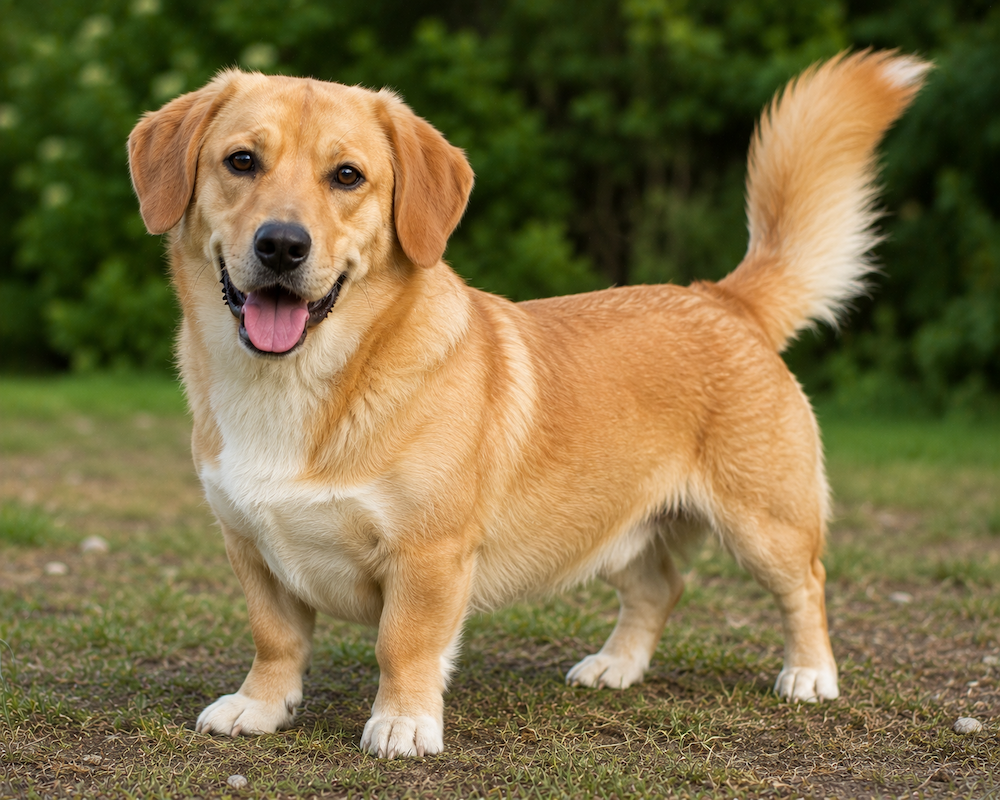







Friendly, intelligent, and full of personality — a lovable companion that combines the loyalty of the Labrador Retriever with the charm of the Corgi.
🧠 QUICK SNAPSHOT
- Temperament: Friendly, loyal, intelligent
- Energy Level: Moderate to high
- Size: Medium
- Good With Families: Yes
- Trainability: High
- Grooming: Moderate
- Best For: Families, active households, companionship
📚 OVERVIEW
The Corgidor is a cross between a Labrador Retriever and a Welsh Corgi, creating an affectionate and energetic companion with a unique appearance. Depending on which parent they take after, Corgidors may have the Labrador’s athletic build combined with the Corgi’s shorter legs and expressive face.
Known for their playful personality and eagerness to be involved in family life, Corgidors thrive in homes where they receive plenty of exercise, attention, and mental stimulation.
✅ PROS & CONS
Pros
- Loyal and affectionate with family
- Highly intelligent and trainable
- Great with children and other pets
- Adaptable to a variety of lifestyles
Cons
- Can inherit herding instincts
- Needs daily exercise and enrichment
- May gain weight if overfed
- Requires early socialisation and training
Is a Corgidor a Good Family Dog?
Yes. A Corgidor can be an excellent family dog, particularly for active households wanting a friendly, intelligent and medium-sized companion.
A Corgidor is a cross between a Corgi and Labrador Retriever. Most commonly, the Corgi parent is a Pembroke Welsh Corgi, although Cardigan crosses are also possible.
Both parent breeds are highly people-oriented working dogs, so Corgidors are often affectionate, playful and eager to participate in family life.
How Much Exercise Does a Corgidor Need?
Most Corgidors need around 60–90 minutes of daily exercise.
Labradors are energetic sporting dogs, while Corgis were developed to spend their days moving livestock.
Walking, retrieving, swimming, scent games and training can all provide excellent exercise.
Their body shape matters, however. Dogs inheriting very short legs and a long back should avoid excessive repetitive jumping and other unnecessarily high-impact activities.
Is a Corgidor Easy to Train?
Corgidors are generally intelligent and highly trainable.
Labradors are famous for their cooperative working temperament, while Corgis are clever herding dogs capable of learning very quickly.
The Corgi side can add an independent streak.
Positive reinforcement and consistent rules generally work extremely well.
Food rewards can be particularly effective — although with Labrador ancestry, owners may discover that “particularly effective” is something of an understatement.
Does a Corgidor Shed?
Yes. Corgidors can shed heavily.
Both Labradors and Corgis have dense double coats and experience seasonal coat changes.
A Corgidor may therefore shed throughout the year with considerably heavier periods when its undercoat is released.
Regular brushing can reduce the amount of loose hair around the home.
Crossing these two breeds definitely isn’t a recipe for a low-shedding dog.
Is a Corgidor Hypoallergenic?
No. Corgidors aren’t considered hypoallergenic.
Both parent breeds shed considerably and produce normal levels of canine allergens.
Allergenic proteins are found in saliva, dander and skin secretions as well as being distributed through shed hair.
Someone specifically wanting a low-shedding or allergy-friendly dog should consider other options.
What Health Problems Are Common in Corgidors?
Corgidors can potentially inherit health problems from both Labradors and Corgis.
Potential concerns include hip and elbow dysplasia, eye disorders, obesity and degenerative myelopathy.
Dogs inheriting a strongly Corgi-like long body and short legs may also face increased spinal concerns, including intervertebral disc disease.
Labrador ancestry introduces additional inherited conditions that responsible breeders can screen for.
Crossbreeding doesn’t eliminate the need for health testing.
Are Corgidors Prone to Back Problems?
Some Corgidors may have an increased risk of spinal problems, particularly if they inherit the Corgi’s long-backed, short-legged structure.
Corgis have chondrodysplastic characteristics associated with disproportionate limb shortening.
A Corgidor with a more Labrador-like body may have different structural risks from one built like an enlarged Corgi.
Keeping the dog lean and physically fit is especially important.
How Long Do Corgidors Live?
Corgidors commonly live around 10–14 years, although there is no established breed lifespan because the cross varies considerably.
Corgis often live longer than Labradors, so an individual Corgidor may fall somewhere between the typical ranges of its parents.
Genetics, weight, exercise, joint health and veterinary care all influence longevity.
Preventing obesity is particularly important.
How Big Does a Corgidor Get?
Corgidors are generally small-to-medium or medium-sized dogs, but size can vary substantially.
Many weigh approximately 16–27 kg, although individuals can fall outside this range.
Height is particularly unpredictable because the Labrador and Corgi have dramatically different leg lengths.
Some Corgidors look like slightly smaller Labradors.
Others look remarkably like someone placed a Labrador body onto Corgi legs.
Why Does My Corgidor Have Such Short Legs?
A Corgidor can inherit the Corgi’s genetic tendency towards disproportionately shortened limbs.
Corgis carry genetic changes associated with chondrodysplasia, which helped produce their characteristic short-legged structure.
Because a Corgidor receives a random combination of genes from both parents, leg length can vary significantly even within one litter.
Some puppies may be distinctly short-legged while their siblings have much more Labrador-like proportions.
Can a Corgidor Live in an Apartment?
A Corgidor can live in an apartment if provided with substantial daily exercise and mental stimulation.
Size isn’t necessarily the main challenge.
Energy and barking can be more important.
Corgis are famously alert and vocal, while Labradors are active dogs that need regular exercise.
A well-exercised Corgidor can settle nicely indoors, but an under-stimulated one may find its own entertainment.
Can a Corgidor Be Left Alone?
Adult Corgidors can learn to spend reasonable periods alone, but they generally prefer human companionship.
Labradors are famously social, and Corgis also form strong bonds with their families.
Gradual independence training is useful from puppyhood.
Long periods of boredom can result in barking, chewing or destructive behaviour.
Do Corgidors Bark a Lot?
Corgidors can be more vocal than Labradors, particularly if they inherit strong Corgi characteristics.
Corgis are alert herding dogs and often bark readily.
Labradors are generally less inclined towards persistent watchdog barking.
The resulting Corgidor can fall anywhere between these tendencies.
Early training can prevent alert barking from becoming excessive.
Are Corgidors Good With Children?
Corgidors are generally good with children when properly socialised.
Both parent breeds can make excellent family dogs.
Their playful temperament often suits active households.
However, Corgi herding instincts may cause some Corgidors to chase running children or nip at heels.
This behaviour should be redirected through training rather than dismissed as harmless because of the dog’s size.
Why Does My Corgidor Nip at People’s Heels?
Heel nipping can come from the Corgi’s cattle-herding ancestry.
Corgis were developed to control livestock by working around their feet and occasionally nipping at their heels.
A Corgidor may redirect this inherited behaviour towards running children, adults or other pets.
It isn’t necessarily aggression, but it should still be addressed through training.
Are Corgidors Good With Other Dogs?
Corgidors are generally sociable with other dogs, especially when properly socialised.
Labradors are typically very social, while Corgis can be confident and occasionally assertive.
Some Corgidors may attempt to herd other dogs during play.
Early positive experiences with dogs of different sizes can help develop appropriate social behaviour.
Are Corgidors Good With Cats?
Corgidors can live successfully with cats, particularly when introduced while young.
Their Corgi ancestry may contribute chasing or herding behaviour.
Labradors can also show interest in smaller animals because of their sporting background.
Training should discourage persistent chasing.
A household cat that confidently establishes boundaries may quickly teach an enthusiastic young Corgidor some additional rules.
Do Corgidors Have a Strong Prey Drive?
Corgidors can have a moderate interest in chasing animals, but their inherited working behaviours are more likely to involve retrieving or herding than specialised predation.
Labradors were developed to retrieve shot game, while Corgis controlled livestock.
Individual dogs vary considerably.
Recall training remains important, particularly around birds and small animals.
Do Corgidors Like Water?
Many Corgidors enjoy water, especially those strongly influenced by their Labrador ancestry.
Labrador Retrievers were developed as water-working dogs and are famously enthusiastic swimmers.
Corgis are less specialised for swimming.
A very short-legged Corgidor may not have the same swimming ability as a Labrador, so dogs should always be introduced to water safely and supervised.
Are Corgidors Good Swimmers?
Some Corgidors can be excellent swimmers, while others may find swimming more difficult.
Body structure is important.
A Corgidor with longer Labrador-like legs and proportions may swim naturally.
A heavily built dog with extremely short Corgi-like legs may have to work considerably harder.
A canine flotation vest can be useful during boating or extended water activities.
Do Corgidors Like to Play Fetch?
Many Corgidors love retrieving games.
The Labrador Retriever side brings centuries of selection for finding and carrying game back to hunters.
Corgis are also active, intelligent dogs that enjoy interactive activities.
Fetch can therefore provide an excellent combination of exercise, training and mental stimulation.
Some Corgidors may even inherit the Labrador’s famous desire to carry something around almost permanently.
Why Is My Corgidor Always Hungry?
Labradors are famous for their enthusiasm for food, and genetics can partly explain why.
A well-studied variant involving the POMC gene is associated with increased food motivation and obesity risk in some Labradors.
A Corgidor could potentially inherit Labrador traits influencing appetite.
Corgis are also notoriously enthusiastic eaters.
Because excess weight is particularly undesirable for a short-legged, long-backed dog, portion control is extremely important.
Are Corgidors Prone to Obesity?
Yes. Corgidors can be particularly prone to gaining excess weight.
Both parent breeds are famous for enjoying food, and Labradors have documented genetic factors affecting appetite in part of the population.
Extra weight increases stress on the hips, elbows and spine.
Owners should monitor body condition rather than relying entirely on the scales.
You should be able to feel the ribs without having to search for them beneath a thick layer of fat.
What Does a Corgidor Look Like?
There is no standard Corgidor appearance.
Some resemble compact Labradors with moderately shortened legs.
Others have distinctly Corgi-like bodies combined with Labrador heads, ears and colouring.
Ears may stand upright, fold down or sit somewhere between the two.
The tail can also vary considerably.
Even puppies from the same litter can develop surprisingly different proportions.
Does a Corgidor Have Floppy or Upright Ears?
Either is possible.
Labradors have drop ears, while Corgis have large upright ears.
A Corgidor may inherit either appearance or ears that are partially erect.
Ear carriage can even change as a puppy develops.
This unpredictability is one of the defining characteristics of first-generation crosses.
Does a Corgidor Have a Tail?
Yes. Corgidors naturally have tails, although length and appearance can vary.
Labradors have substantial “otter” tails, while Cardigan Welsh Corgis have long tails.
Pembroke Welsh Corgis can also be born with full tails, although natural bobtails occur and historical docking created the misconception that all Pembrokes are naturally tailless.
A Corgidor’s tail therefore depends heavily on its individual genetics.
What Colours Can Corgidors Be?
Corgidors can occur in colours influenced by both parent breeds.
Possible colours include black, yellow or cream, chocolate, red, sable, fawn and various combinations with white markings.
The exact possibilities depend partly on which Corgi breed and individual dogs are used.
Colour genetics can become surprisingly complicated when two breeds with different recognised patterns are crossed.
Can a Corgidor Be Merle?
A Corgidor could potentially be merle if a merle Cardigan Welsh Corgi is used as a parent.
Merle isn’t a standard colour in purebred Pembroke Welsh Corgis or Labrador Retrievers.
This makes knowing the actual ancestry important.
Merle-to-merle breeding should be avoided because double-merle puppies have an increased risk of serious hearing and eye abnormalities.
What Is an F1 Corgidor?
An F1 Corgidor is generally a first-generation cross between a Corgi and Labrador Retriever.
Because the parent breeds have dramatically different body structures, F1 puppies can vary considerably.
One puppy may inherit short legs and a long body while another develops more Labrador-like proportions.
The F1 label describes ancestry — it doesn’t guarantee a particular size, coat, temperament or appearance.
What Is an F1B Corgidor?
An F1B Corgidor is generally produced by breeding an F1 Corgidor back to either a Corgi or Labrador Retriever.
The resulting puppies may have a greater tendency towards characteristics of whichever parent breed is used for the backcross.
However, individual traits remain unpredictable.
An F1B label doesn’t guarantee size, leg length, shedding level or temperament.
Is a Corgidor a Recognised Dog Breed?
No. The Corgidor is generally considered a designer crossbreed rather than a formally recognised pedigree breed.
Major kennel clubs recognise Labrador Retrievers, Pembroke Welsh Corgis and Cardigan Welsh Corgis separately.
There is no universally accepted Corgidor breed standard.
Size, leg length, ear carriage, colour and temperament can therefore vary substantially.
Is a Corgidor Healthier Than a Labrador or Corgi?
A Corgidor may benefit from greater genetic diversity, but crossbreeding doesn’t automatically produce a healthier dog.
A puppy can inherit disease-associated genes from either parent.
Body structure creates another complication: combining a heavy Labrador-type body with very short Corgi-like legs isn’t automatically beneficial.
Responsible breeding should therefore include appropriate health screening of both parents and careful attention to structure.
Is a Corgidor the Same as a Lab Corgi Mix?
Yes. Corgidor, Corgi Lab mix and Labrador Corgi mix generally describe the same type of cross.
“Corgidor” is simply the designer name that has become attached to it.
However, the term doesn’t always specify whether the Corgi parent is a Pembroke or Cardigan Welsh Corgi.
Anyone considering a puppy should ask exactly which breeds and individual dogs are behind it.
Is a Corgidor Usually a Pembroke or Cardigan Corgi Cross?
Most dogs marketed as Corgidors appear to involve the Pembroke Welsh Corgi, largely because Pembrokes are much more widely recognised and commonly kept.
However, a Labrador crossed with a Cardigan Welsh Corgi could also reasonably be described as a Corgidor.
The distinction matters because Pembrokes and Cardigans are separate breeds with different ancestry, colours and physical characteristics.
How Can a Corgi and Labrador Produce Puppies When They Are Such Different Sizes?
A Corgi and Labrador can reproduce because they’re both domestic dogs of the same species, despite their considerable difference in size and shape.
However, responsible breeding must consider the physical size of the parents carefully.
Using a substantially larger male with a much smaller female can increase pregnancy and delivery risks.
Artificial insemination doesn’t remove the problem of a small female potentially carrying relatively large puppies.
Welfare should always take priority over creating an unusual cross.
What Were the Corgidor’s Parent Breeds Originally Bred For?
The Corgidor combines two very different working traditions.
Corgis were Welsh farm dogs used primarily for herding and controlling livestock.
Labradors developed from water-working dogs associated with Newfoundland before becoming specialised retrieving gundogs in Britain.
A Corgidor can therefore inherit characteristics from both worlds: herding livestock from below and retrieving birds from water.
Why Is It Called a Corgidor?
The name Corgidor combines Corgi and Labrador.
It’s one of many modern names created for intentional crossbreeds.
Unlike Labradoodle, the name doesn’t reveal the Labrador component quite as immediately, but “Corgidor” has become a commonly used label for the cross.
There is no kennel-club authority controlling the name, so alternatives such as Corgi Lab mix remain common.
Who Created the First Corgidor?
There is no reliably documented individual credited with creating the first Corgidor.
Corgis and Labradors could have crossed accidentally long before anyone began deliberately marketing the puppies under a designer name.
Purposeful breeding appears to be associated with the broader modern designer-dog trend.
Claims that the Corgidor was created by one particular breeder in a precise year should therefore be treated cautiously unless supported by historical documentation.
Where Does the Corgidor Come From?
The Corgidor is a modern cross between a Corgi and Labrador Retriever, rather than a traditional breed with a documented country of origin.
Its precise beginnings aren’t well recorded, although intentional breeding became associated with the modern designer-dog movement.
Its ancestry, however, combines two remarkable working histories: Welsh cattle-herding dogs and the water-retrieving ancestors of Canada’s Labrador Retriever.
That combination helps explain why a Corgidor can look slightly comical while taking life extremely seriously — the legs may say Corgi, the appetite may say Labrador, and the dog itself may be convinced it can herd your family before retrieving everyone’s lunch.