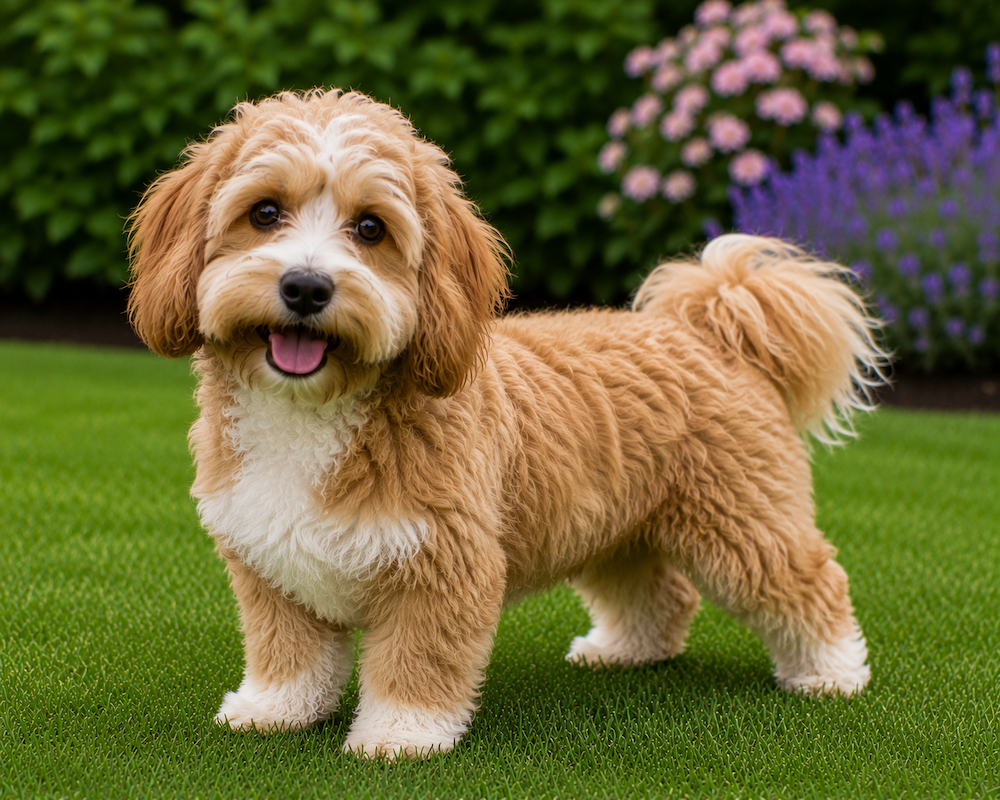






Clever, affectionate, and full of character — a delightful companion that combines the intelligence of the Poodle with the charm of the Corgi.
🧠 QUICK SNAPSHOT
- Temperament: Friendly, intelligent, playful
- Energy Level: Moderate
- Size: Small to medium
- Good With Families: Yes
- Trainability: High
- Grooming: Moderate
- Best For: Families, apartments, companionship
📚 OVERVIEW
The Corgipoo is a cross between a Welsh Corgi and a Poodle, creating an affectionate and intelligent companion with plenty of personality. Depending on which parent they take after, Corgipoos may have the Corgi’s long body and expressive face combined with the Poodle’s soft, wavy or curly coat.
They are social, playful dogs that love spending time with their family and adapt well to a variety of living environments.
✅ PROS & CONS
Pros
- Highly intelligent and easy to train
- Friendly and affectionate personality
- Great with families and children
- Often lower shedding depending on coat type
Cons
- Requires regular grooming
- Needs daily exercise and mental stimulation
- Can inherit herding instincts from the Corgi
- May become vocal or bored if left alone too long
Is a Corgipoo a Good Family Dog?
Yes. A Corgipoo can be an excellent family dog, particularly for households wanting an intelligent, affectionate and playful companion.
A Corgipoo is a cross between a Corgi and Poodle, most commonly a Pembroke Welsh Corgi crossed with a Miniature or Toy Poodle.
Both parent breeds are highly intelligent working dogs, so Corgipoos often learn quickly and enjoy being involved in family activities.
Early socialisation is important, particularly because some inherit strong Corgi herding instincts.
How Much Exercise Does a Corgipoo Need?
Most Corgipoos need around 45–75 minutes of exercise each day, depending on size, age and individual energy level.
Walks, retrieving, scent games, training and interactive play are excellent choices.
Both Corgis and Poodles were developed as active working dogs, so mental stimulation is equally important.
A short-legged Corgipoo should avoid excessive repetitive jumping, particularly if it inherits the Corgi’s long-backed body structure.
Is a Corgipoo Easy to Train?
Corgipoos are generally very intelligent and highly trainable.
Poodles are renowned for their trainability, while Corgis are clever herding dogs capable of making independent decisions.
This combination can produce a dog that learns commands extraordinarily quickly but may occasionally have its own ideas about whether they’re worth following.
Positive reinforcement, consistency and interesting training sessions usually work extremely well.
Does a Corgipoo Shed?
Corgipoos can be low, moderate or relatively heavy shedders, depending on which coat they inherit.
A curly Poodle-like coat may shed relatively little.
A straighter Corgi-like double coat can shed heavily, particularly during seasonal coat changes.
Some dogs fall somewhere between the two.
Crossing a Corgi with a Poodle doesn’t guarantee a non-shedding puppy.
Is a Corgipoo Hypoallergenic?
No Corgipoo can be guaranteed to be hypoallergenic.
Dogs inheriting a curly, low-shedding Poodle-type coat may release less hair into the environment and could be easier for some allergy sufferers to tolerate.
However, dog allergens primarily come from proteins in saliva, dander and skin secretions.
An F1 Corgipoo can inherit substantial shedding from its Corgi parent.
How Often Does a Corgipoo Need Grooming?
Grooming requirements depend heavily on the Corgipoo’s coat.
Curly or wavy coats generally need brushing several times each week and professional grooming approximately every 6–8 weeks.
Straighter Corgi-like coats may require less clipping but considerably more management of loose undercoat.
The worst-case combination can be a coat that both sheds and mats.
Owners shouldn’t assume that a Poodle cross automatically means easy grooming.
What Health Problems Are Common in Corgipoos?
Corgipoos can inherit health problems from both Corgis and Poodles.
Potential concerns include hip dysplasia, patellar luxation, progressive retinal atrophy and other eye diseases, degenerative myelopathy and some inherited Poodle disorders.
Dogs with strongly shortened legs and long backs may also have increased spinal concerns.
The specific risks depend partly on whether a Pembroke or Cardigan Corgi and Toy, Miniature or Standard Poodle were used.
Are Corgipoos Prone to Back Problems?
Some Corgipoos can be at increased risk of spinal problems, particularly those inheriting the Corgi’s long body and shortened legs.
Corgis have chondrodysplastic characteristics that contribute to their distinctive shape.
A Corgipoo with more moderate proportions may have different structural risks.
Maintaining a healthy weight, good muscle condition and avoiding excessive repetitive jumping are particularly important for long-backed individuals.
How Long Do Corgipoos Live?
Corgipoos commonly live around 12–15 years, although there isn’t an established breed lifespan.
Smaller dogs often have relatively long lifespans, and both Corgis and smaller Poodles can live well into their teens.
Genetics, weight, exercise, dental health and veterinary care all influence longevity.
Responsible breeding is far more important than simply assuming a crossbreed will automatically live longer.
How Big Does a Corgipoo Get?
Corgipoo size can vary considerably, but many adults weigh around 5–14 kg.
The Poodle parent makes a major difference.
A Toy Poodle cross may produce a very small Corgipoo, while a Miniature or Standard Poodle can produce a substantially larger dog.
Leg length is also unpredictable because of the dramatic structural difference between a Corgi and Poodle.
What Is a Mini Corgipoo?
A Mini Corgipoo generally refers to a Corgi crossed with a Miniature Poodle.
However, the terminology isn’t officially standardised.
Different breeders may use “Mini Corgipoo” for different size ranges.
The actual height and weight of the parents provide much more useful information than the word “Mini”.
Is There Such a Thing as a Teacup Corgipoo?
“Teacup Corgipoo” isn’t an officially recognised breed or size category.
It’s primarily a marketing term used for exceptionally small dogs.
Extreme miniaturisation can increase risks such as fragile bones, dental crowding, hypoglycaemia and other health problems.
Healthy structure and temperament should take priority over producing the smallest possible puppy.
Can a Corgipoo Live in an Apartment?
Yes. Corgipoos can be excellent apartment dogs when their exercise and mental-stimulation needs are met.
Their relatively compact size is useful.
However, Corgi ancestry can contribute considerable barking, while both parent breeds are intelligent enough to become troublesome when bored.
Regular walks, training and enrichment are more important than having a large backyard.
Can a Corgipoo Be Left Alone?
Adult Corgipoos can learn to spend reasonable periods alone, but many are strongly attached to their families.
Poodles tend to be people-oriented, while Corgis also form close bonds with their owners.
Some Corgipoos may develop separation-related distress.
Teaching independence from puppyhood is therefore important.
Do Corgipoos Bark a Lot?
Corgipoos can be quite vocal, particularly if they inherit the Corgi’s alert nature.
Corgis traditionally used barking while working livestock and guarding farms.
Poodles can also be alert watchdogs.
The combination can produce a dog that notices — and announces — virtually everything happening outside.
Early training can help prevent alert barking from becoming excessive.
Are Corgipoos Good With Children?
Corgipoos are generally good with children when properly socialised.
They’re playful, intelligent and often affectionate.
Very small Toy Poodle crosses may be more physically fragile around young children.
Corgi herding instincts can also produce chasing or heel-nipping behaviour.
Children and dogs should both be taught how to interact appropriately.
Why Does My Corgipoo Nip at People’s Heels?
Heel nipping usually comes from the Corgi’s herding ancestry.
Corgis were developed to move cattle by working close to their feet and occasionally nipping at their heels.
A Corgipoo may redirect this behaviour towards running children, adults or other pets.
It’s not necessarily aggression, but it should still be redirected through training.
Are Corgipoos Good With Other Dogs?
Corgipoos are generally sociable with other dogs when properly socialised.
Poodles often interact well with other dogs, while Corgis can be confident and occasionally bossy.
Some Corgipoos may attempt to herd other dogs during play.
Early exposure to different dogs can help them learn more appropriate social behaviour.
Are Corgipoos Good With Cats?
Corgipoos can live successfully with cats, especially when introduced while young.
However, both parent breeds have working instincts.
Corgis may chase and herd, while Poodles have sporting and retrieving ancestry.
A household cat may be completely accepted while unfamiliar animals outdoors still trigger pursuit.
Do Corgipoos Like Water?
Many Corgipoos enjoy water, particularly if they inherit strong Poodle characteristics.
Poodles were originally developed as water retrievers.
Corgis don’t have the same specialised aquatic history.
Body shape also matters: a long-bodied Corgipoo with very short legs may not be as efficient a swimmer as a more Poodle-shaped dog.
Water introductions should therefore be gradual and supervised.
Are Corgipoos Good at Fetch?
Many Corgipoos enjoy retrieving games.
Poodle ancestry contributes a genuine history of retrieving game from water, while Corgis are active working dogs that enjoy interactive activities.
Fetch can provide excellent physical and mental exercise.
The combination of Poodle intelligence and Corgi determination can also create a dog that quickly learns that returning the ball is an extremely efficient method of making the human throw it again.
Why Is My Corgipoo So Energetic?
Both parent breeds are working dogs with active minds.
Poodles were developed as retrievers, while Corgis spent their working lives controlling livestock.
A Corgipoo that seems restless may need more mental stimulation rather than simply another long walk.
Training, scent games, food puzzles and retrieving can help satisfy its need to think.
Why Does My Corgipoo Follow Me Everywhere?
Corgipoos are often strongly people-oriented.
Poodles were bred to work closely with handlers, and Corgis also developed close relationships with farmers and their families.
Following an owner from room to room can therefore be perfectly normal.
However, puppies should still learn to relax independently so that attachment doesn’t develop into separation distress.
Do Corgipoos Like to Cuddle?
Many Corgipoos are affectionate and enjoy cuddling, although individual personalities vary.
Poodles are often highly people-oriented.
Corgis can be affectionate but sometimes express it more independently.
A Corgipoo may therefore range from dedicated lap dog to companion who prefers simply lying nearby.
Why Does a Corgipoo Have Short Legs?
A Corgipoo can inherit the Corgi’s genetic tendency towards disproportionate limb shortening.
Corgis have genetic changes associated with chondrodysplasia, which produces their characteristic short legs.
Because crossbred puppies inherit different combinations of genes, leg length can vary dramatically.
One Corgipoo may resemble a curly-coated Corgi while another looks more like a slightly elongated Poodle.
What Does a Corgipoo Look Like?
There is no standard Corgipoo appearance.
Coats can be curly, wavy or relatively straight.
Ears may stand upright, flop down or end up somewhere in between.
Some dogs inherit very short Corgi legs and long bodies, while others have considerably more Poodle-like proportions.
This unpredictability is part of the nature of crossing two physically different breeds.
Does a Corgipoo Have Upright or Floppy Ears?
Either is possible.
Corgis have large upright ears, while Poodles have hanging ears.
Corgipoo puppies can therefore develop erect, semi-erect or completely floppy ears.
Even littermates may end up with very different ear carriage.
What Colours Can Corgipoos Be?
Corgipoos can occur in a wide range of colours and patterns.
Depending on the parents, possibilities can include red, sable, fawn, black, cream, apricot, brown and combinations with white.
Poodle colour genetics can also cause some coats to lighten as the dog matures.
Cardigan ancestry can introduce additional possibilities.
Why Do Some Corgipoos Fade in Colour?
Some Corgipoos inherit colour-fading genetics from their Poodle ancestry.
A puppy born deep red, apricot, brown or black may gradually become noticeably lighter.
The degree of fading varies considerably.
This is generally a normal genetic change rather than a problem with the coat.
Can a Corgipoo Be Merle?
A Corgipoo could potentially be merle if a merle Cardigan Welsh Corgi is involved.
Merle isn’t a standard colour in purebred Pembroke Welsh Corgis or Poodles.
Consequently, a supposedly merle Pembroke-Poodle Corgipoo raises questions about ancestry unless another merle-carrying breed has been introduced.
Merle-to-merle breeding should be avoided because double-merle puppies face increased risks of serious eye and hearing abnormalities.
What Is an F1 Corgipoo?
An F1 Corgipoo is a first-generation cross between a Corgi and Poodle.
This generation can be particularly variable because the two parent breeds differ dramatically in coat and body structure.
An F1 puppy isn’t automatically 50% of each parent’s visible characteristics.
Genetics don’t blend like paint.
One sibling can look remarkably Corgi-like while another strongly resembles a Poodle.
What Is an F1B Corgipoo?
An F1B Corgipoo is usually produced by breeding an F1 Corgipoo back to a Poodle.
This is often done in an attempt to increase the likelihood of a curly, lower-shedding coat.
However, shedding and coat type still aren’t guaranteed.
An F1B could theoretically also be backcrossed to a Corgi, so prospective owners should always ask exactly what the generation label means.
What Is an F2 Corgipoo?
An F2 Corgipoo is generally produced by breeding two F1 Corgipoos together.
Because numerous Corgi and Poodle gene combinations can recombine, F2 puppies may show considerable variation.
Some characteristics that weren’t obvious in either parent can appear among the puppies.
Generation labels describe ancestry, not guaranteed appearance or behaviour.
Is a Corgipoo a Recognised Dog Breed?
No. The Corgipoo is generally considered a designer crossbreed, not a formally recognised pedigree breed.
Major kennel clubs recognise Corgis and Poodles separately but don’t recognise the Corgipoo as an established breed.
There is therefore no universally accepted breed standard governing size, coat, proportions or temperament.
Is a Corgipoo Healthier Than a Corgi or Poodle?
A Corgipoo may benefit from greater genetic diversity, but it isn’t automatically healthier than either parent breed.
Inherited disease-associated genes can come from both sides.
Combining breeds also doesn’t necessarily eliminate structural concerns such as the Corgi’s shortened limbs and long back.
Health-tested parents and careful breeding decisions matter much more than simply describing puppies as hybrids.
Is a Corgipoo the Same as a Corgidoodle?
Yes. Corgipoo and Corgidoodle generally describe the same Corgi–Poodle cross.
Other names such as Corgi Poodle Mix may also be used.
There is no official naming authority because it isn’t a recognised breed.
Corgipoo is probably the shorter and more commonly recognised designer name.
Is a Corgipoo Usually a Pembroke or Cardigan Cross?
Most Corgipoos appear to use the Pembroke Welsh Corgi, which is substantially more familiar and widely kept.
However, a Cardigan Welsh Corgi can also be crossed with a Poodle.
The distinction matters because Pembrokes and Cardigans are separate breeds with different ancestry, colours and physical characteristics.
“Corgipoo” alone doesn’t tell you which Corgi is involved.
What Were the Corgipoo’s Parent Breeds Originally Bred For?
The Corgipoo combines two completely different working traditions.
Corgis were Welsh farm dogs used primarily for herding cattle and other livestock.
Poodles were developed as water retrievers, particularly for retrieving waterfowl.
This means the cute modern Corgipoo combines the genetics of a dog bred to chase cattle around a farm with another bred to jump into water and bring birds back to hunters.
That helps explain why many need considerably more activity than their teddy-bear appearance suggests.
Why Is It Called a Corgipoo?
The name Corgipoo combines Corgi and Poodle.
“Corgidoodle” follows the same modern naming convention used for Labradoodles and Goldendoodles.
Neither name represents an official breed designation.
They’re simply convenient labels for dogs with Corgi and Poodle ancestry.
Who Created the First Corgipoo?
There is no reliably documented creator of the Corgipoo.
Corgis and Poodles may have crossed accidentally long before puppies were deliberately marketed under the name.
Purposeful Corgipoo breeding appears to have emerged as part of the broader popularity of Poodle crosses.
Claims that one specific person invented the Corgipoo in a particular year should therefore be treated cautiously unless supported by credible historical records.
Where Does the Corgipoo Come From?
The Corgipoo is a modern Corgi–Poodle cross rather than a traditional breed with a securely documented country and date of origin.
Its precise beginnings aren’t well recorded.
Its parent breeds, however, have fascinating histories: the Corgi comes from the cattle-herding traditions of Wales, while the Poodle developed from European water-retrieving dogs and became particularly associated with Germany and France.
Put them together and you get one of the more unusual designer combinations: a dog that may inherit the legs of a cattle herder, the curls of a water retriever and enough intelligence from both sides to keep its owners permanently under supervision.