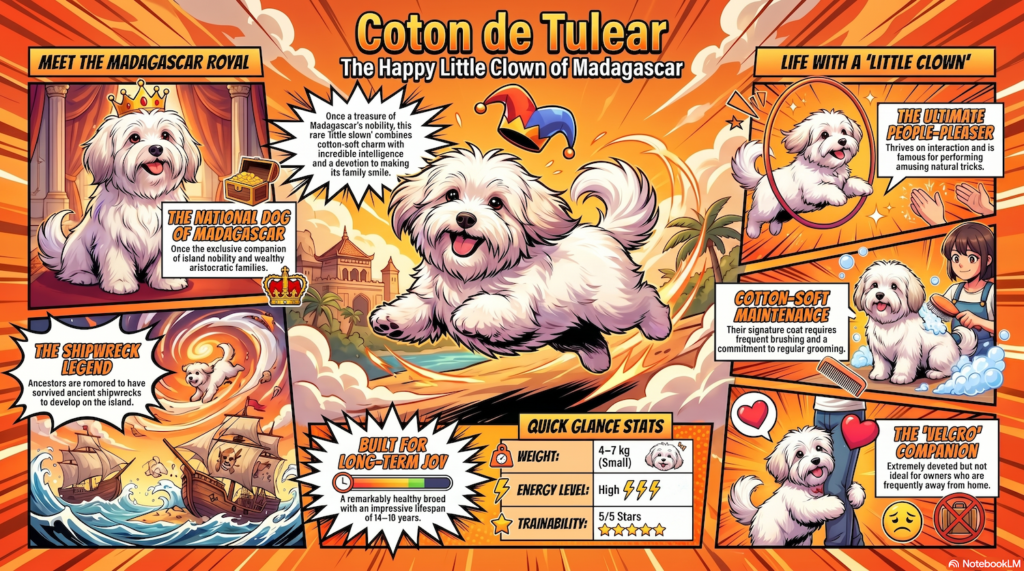
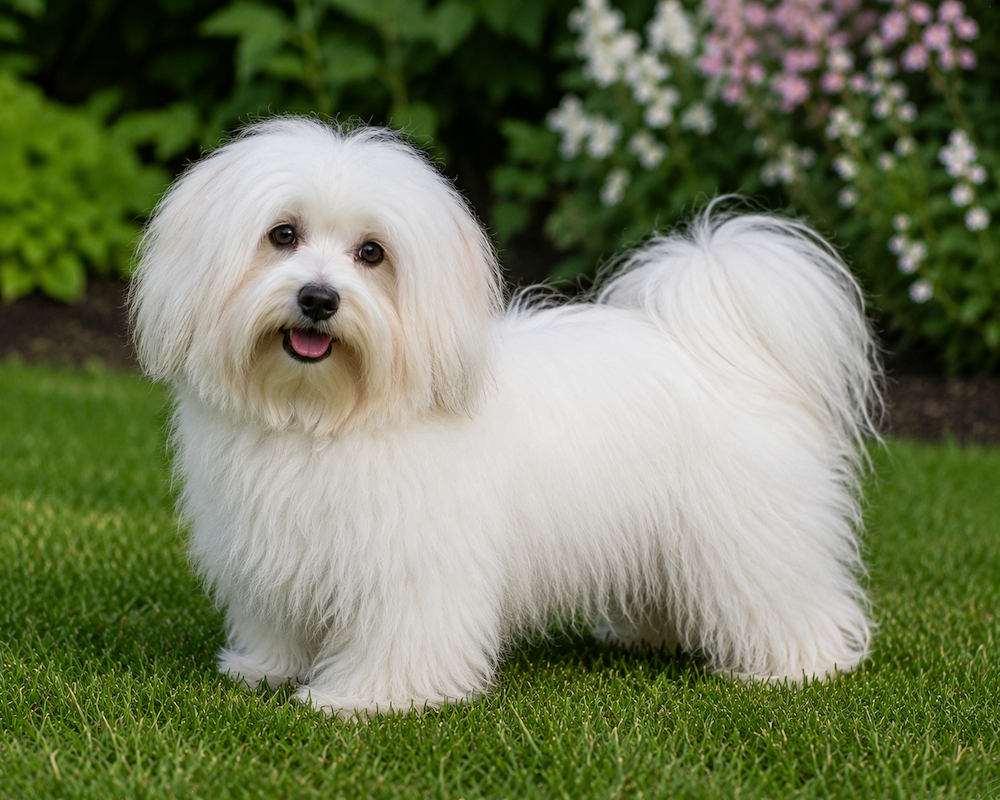







Cheerful, affectionate, and wonderfully fluffy — a charming companion that lives to make its family smile.
🧠 QUICK SNAPSHOT
- Temperament: Affectionate, friendly, playful
- Energy Level: Moderate
- Size: Small
- Good With Families: Yes
- Trainability: High
- Grooming: High
- Best For: Families, apartments, companionship
📚 OVERVIEW
The Coton de Tulear is Madagascar’s national dog and is famous for its soft, cotton-like coat and joyful personality. Originally bred as a companion dog for nobility, the breed is devoted to its family and thrives on human companionship.
Friendly, intelligent, and always eager to be involved, the Coton de Tulear adapts well to both apartments and larger homes, provided it receives plenty of love, attention, and regular grooming.
✅ PROS & CONS
Pros
- Exceptionally affectionate and family-oriented
- Intelligent and easy to train
- Friendly with children and other pets
- Adaptable to many living environments
Cons
- Requires frequent grooming
- Doesn’t enjoy being left alone for long periods
- Coat needs regular brushing to prevent mats
- Can develop separation anxiety
Is a Coton de Tulear a Good Family Dog?
Yes. The Coton de Tulear is generally an excellent family dog, known for being affectionate, cheerful and strongly attached to people.
Cotons were developed primarily as companions rather than working dogs, and most genuinely enjoy being part of everyday family life.
They’re typically playful without requiring enormous amounts of exercise and can do well with respectful children.
Their biggest requirement is companionship — this is a breed that usually wants to be wherever its family is.
How Much Exercise Does a Coton de Tulear Need?
Most adult Cotons need around 30–60 minutes of daily exercise, combined with play and mental stimulation.
They’re lively little dogs but don’t require the exercise regime of a high-energy working breed.
Walks, games, trick training and exploring new environments usually keep them happy.
Many Cotons retain a surprisingly playful personality well into adulthood.
Is a Coton de Tulear Easy to Train?
Yes. Cotons are generally intelligent, responsive and eager to interact with their owners.
Positive reinforcement works particularly well.
They can learn obedience, tricks and even dog sports surprisingly quickly.
House training may require patience with some individuals, as can happen with many small companion breeds.
Their natural desire to entertain people can make training particularly enjoyable.
Does a Coton de Tulear Shed?
The Coton de Tulear is generally considered a very low-shedding breed.
Instead of releasing large amounts of loose hair around the house, shed hairs tend to become trapped within the coat.
This reduces visible shedding but increases the risk of matting.
Low shedding therefore doesn’t mean low maintenance.
Regular brushing is essential.
Is a Coton de Tulear Hypoallergenic?
The Coton is often described as hypoallergenic, but no dog is completely allergen-free.
Its low-shedding coat may make it easier for some people with dog allergies to tolerate.
However, allergens are produced in saliva, dander and skin secretions rather than the hair alone.
Anyone with significant allergies should spend time around adult Cotons before bringing one home.
How Often Does a Coton de Tulear Need Grooming?
A full-coated Coton requires frequent grooming, often several times each week and sometimes daily.
The soft coat can mat quickly, particularly behind the ears, under the legs and around friction points.
Many pet owners keep their Cotons in shorter clips to simplify maintenance.
Bathing, nail care, dental care and regular ear checks should also form part of the grooming routine.
What Health Problems Are Common in Coton de Tulears?
Cotons are generally considered relatively healthy, but they can still develop inherited conditions.
Potential concerns include patellar luxation, hip problems and certain eye disorders.
Some inherited neurological or metabolic diseases have also been identified within Coton populations, making responsible DNA testing and health screening valuable.
Dental disease is another consideration in small dogs.
Responsible breeders should be able to explain exactly which conditions they screen for.
How Long Do Coton de Tulears Live?
Coton de Tulears commonly live around 14–16 years, with some living even longer.
Their relatively small size contributes to their potential longevity.
Healthy body weight, dental care, appropriate exercise and preventive veterinary treatment can help support a long life.
A Coton puppy can therefore represent a commitment extending well into the next decade and beyond.
How Big Does a Coton de Tulear Get?
The Coton de Tulear is a small companion dog, generally weighing around 4–7 kg.
Adults commonly stand approximately 23–28 cm at the shoulder, with some variation between males, females and kennel-club standards.
Their abundant coats make them appear larger than they actually are.
Underneath all that cotton-like hair is a surprisingly compact little dog.
Can a Coton de Tulear Live in an Apartment?
Yes. The Coton de Tulear is generally an excellent apartment dog.
Its small size and moderate exercise requirements make it highly adaptable to smaller homes.
The main considerations are barking and companionship.
A bored or lonely Coton may become vocal, so exercise, enrichment and gradual independence training remain important.
Can a Coton de Tulear Be Left Alone?
Cotons generally don’t enjoy being left alone for long periods.
They were developed specifically for companionship and often form extremely close relationships with their owners.
Some can develop separation-related distress.
Teaching a puppy to relax independently for short periods is therefore important, even if someone is usually home.
The goal is an affectionate companion rather than a dog that believes its owner must remain within three metres at all times.
Do Coton de Tulears Bark a Lot?
Cotons can be alert and moderately vocal, but they aren’t necessarily excessive barkers.
They may announce visitors or unfamiliar noises.
Excitement, boredom and separation distress can increase barking.
Early training can help teach when barking is appropriate and when it’s time to settle.
Are Coton de Tulears Good With Children?
Yes. Cotons are generally friendly and playful with respectful children.
However, they’re small dogs and can be accidentally injured through rough handling.
Families with very young children should supervise interactions carefully.
A well-socialised Coton can become an enthusiastic playmate while still being small enough to curl up beside the family afterwards.
Are Coton de Tulears Good With Other Dogs?
Yes. Cotons are generally sociable with other dogs.
They usually enjoy companionship and can adapt well to multi-dog households.
Early socialisation remains valuable.
Their small size means interactions with much larger dogs should be supervised, particularly when play becomes energetic.
Are Coton de Tulears Good With Cats?
Cotons can generally live very successfully with cats.
They weren’t developed as specialised hunters and usually have less intense prey drive than many terriers or sporting breeds.
Individual temperament still matters.
Early introductions and positive experiences offer the best chance of creating a peaceful multi-pet household.
Do Coton de Tulears Like to Cuddle?
Yes. Most Cotons are extremely affectionate companion dogs.
Many enjoy sitting on laps, sleeping beside their owners or simply remaining close to family members.
Their strong attachment to people is one of the breed’s defining characteristics.
The Coton was essentially developed for exactly this role — being an entertaining and affectionate companion.
Why Does My Coton de Tulear Follow Me Everywhere?
Following people is extremely common because Cotons are companion dogs by both history and temperament.
Unlike breeds developed to work independently away from people, the Coton’s primary role was human companionship.
This can produce an endearing little shadow.
Owners should still encourage independent relaxation so that closeness doesn’t develop into separation anxiety.
Are Coton de Tulears Really Funny Dogs?
Cotons have a reputation for being playful, expressive and naturally entertaining.
Owners frequently describe them performing amusing movements, unusual vocalisations or spontaneous antics seemingly designed to attract attention.
Breed descriptions have long emphasised their cheerful, clownish personality.
Some Cotons even become particularly animated when they realise people are laughing at them.
They may be small companion dogs, but many behave as though they’re responsible for the household entertainment programme.
Do Coton de Tulears Walk on Their Back Legs?
Some Cotons are famous for standing or walking briefly on their hind legs, particularly when excited or trying to attract attention.
Their intelligence and enthusiasm for performing also make the behaviour easy to reinforce.
Occasional natural standing is different from repeatedly forcing a dog to remain upright for entertainment.
Tricks should always be taught in ways that don’t place unnecessary strain on joints or the spine.
Can Coton de Tulears Learn Tricks?
Yes. Cotons can be excellent trick dogs.
They’re intelligent, playful and often highly motivated by interaction with people.
They can learn spins, retrieving, targeting, waving, dancing and many other behaviours.
Trick training provides valuable mental stimulation while taking advantage of the breed’s natural tendency to entertain.
Does a Coton de Tulear Have Hair or Fur?
The Coton has a distinctive hair-like coat, although biologically hair and fur are both composed primarily of keratin.
The practical difference is that the Coton’s coat tends to grow longer and shed relatively little compared with many conventional double-coated dogs.
Its unusual texture is central to the breed’s identity.
It should feel soft and cottony rather than harsh or woolly.
Why Is a Coton de Tulear’s Coat Like Cotton?
The breed is named partly for its soft, dry, cotton-like coat texture.
“Coton” is French for cotton.
Unlike the silky coat of breeds such as the Maltese, the Coton’s hair has a distinctive fluffy texture.
This unusual coat is sufficiently important that it became part of the breed’s actual name.
Is the Coton de Tulear Always White?
White is the breed’s characteristic adult colour, but puppies can have additional markings.
Young Cotons may display champagne, tan, grey or darker markings, particularly around the ears and head.
These markings often fade significantly as the dog matures.
Accepted colour details vary between kennel organisations, but the overall impression of an adult Coton should be predominantly white.
Why Do Coton de Tulear Puppies Change Colour?
Coton puppies can be born with coloured markings that gradually fade as the adult coat develops.
Areas of tan, champagne or grey can become much lighter over time.
A puppy that appears noticeably marked at a few weeks old may therefore become an almost completely white adult.
This is a normal feature of the breed rather than the puppy somehow “losing” its colour through grooming.
Why Does My Coton de Tulear Have Tear Stains?
Reddish-brown staining can become particularly noticeable because of the Coton’s white facial hair.
Tears contain pigments called porphyrins that can discolour pale coats.
Excessive tearing can also be associated with irritation, allergies, hair rubbing against the eye, tear-drainage problems or eye disease.
Persistent staining accompanied by excessive tearing should therefore be investigated rather than treated as purely cosmetic.
What Is the Difference Between a Coton de Tulear and a Maltese?
Both are small, white companion dogs, but they have distinctly different coat textures and histories.
The Maltese traditionally has a long, straight, silky coat.
The Coton’s coat is softer, fluffier and characteristically cotton-like.
The Coton also originated in Madagascar, while the Maltese has much older Mediterranean associations.
Both can be affectionate companions, but they’re separate breeds rather than different versions of the same dog.
What Is the Difference Between a Coton de Tulear and a Bichon Frise?
The Coton and Bichon Frise are both small, white companion breeds but have different coat types and appearances.
The Bichon has a dense, curly coat that creates its characteristic rounded appearance.
The Coton’s coat is longer, softer and more cotton-like, with a less tightly curled texture.
Both belong to the broader family of small bichon-type companion dogs and share historical connections with maritime trade around the Mediterranean and beyond.
Is the Coton de Tulear Related to the Bichon Frise?
Yes. The Coton is generally considered part of the broader Bichon family of small companion dogs.
This group includes breeds such as the Bichon Frise, Maltese, Bolognese and Havanese.
Their precise historical relationships are difficult to reconstruct because small companion dogs travelled extensively with sailors, merchants and aristocratic families long before modern pedigree records existed.
The family resemblance is nevertheless obvious.
Is the Coton de Tulear Related to the Havanese?
The Coton and Havanese are related through the broader bichon-type family of companion dogs.
Both developed on islands far from continental Europe — the Coton in Madagascar and the Havanese in Cuba.
Their ancestors likely arrived through maritime trade.
However, each breed subsequently developed independently into a distinct national dog with its own coat, history and breed standard.
What Does “Coton de Tulear” Mean?
The name translates approximately as “Cotton of Tulear.”
“Coton” refers to the breed’s characteristic cotton-like coat.
“Tuléar” was the former French spelling of Toliara, a port city in southwestern Madagascar.
The breed’s name therefore combines its most distinctive physical characteristic with the region strongly associated with its development.
How Do You Pronounce Coton de Tulear?
The name is French in origin and is commonly approximated in English as “ko-TON duh TOO-lee-ar.”
Pronunciation varies slightly between French and English speakers.
The final part comes from Tuléar, the former French name for the Malagasy city now known as Toliara.
Does the Coton de Tulear Come From Madagascar?
Yes. The Coton de Tulear is strongly associated with Madagascar, the large island nation off the southeastern coast of Africa.
The breed developed there from small companion dogs whose ancestors probably arrived aboard ships.
Madagascar became so closely identified with the Coton that the breed is frequently described as the country’s national dog.
Is the Coton de Tulear the National Dog of Madagascar?
The Coton de Tulear is widely regarded as Madagascar’s national dog.
Its history is closely connected with the island, particularly the region around the port of Tuléar, now Toliara.
The breed’s Malagasy association distinguishes it from other bichon-type dogs that developed around Europe, Cuba and the Mediterranean.
Did Coton de Tulears Survive a Shipwreck?
A popular legend claims that the Coton’s ancestors swam ashore from shipwrecked vessels near Madagascar.
Some versions become extremely elaborate, describing small white dogs surviving wrecks and establishing themselves on the island.
It’s a memorable story, but there is little solid historical evidence confirming a specific founding shipwreck.
The more plausible explanation is that bichon-type companion dogs arrived gradually aboard trading and sailing vessels.
The shipwreck story belongs more comfortably in Coton folklore than documented history.
Did Coton de Tulears Swim Ashore and Live Wild in Madagascar?
Stories sometimes claim that shipwrecked Cotons swam ashore and survived as wild dogs, even supposedly hunting in packs.
These tales should be treated very cautiously.
Small bichon-type dogs almost certainly reached Madagascar through maritime connections, but there isn’t strong evidence supporting the more dramatic stories of shipwreck survivors establishing feral hunting populations.
Like many rare breeds, the Coton acquired a colourful mythology around its origins.
Were Coton de Tulears Owned by Malagasy Royalty?
Cotons became associated with wealthy and influential families in Madagascar, and they’re frequently described as dogs of Malagasy royalty or nobility.
This aristocratic connection contributed to nicknames such as the “Royal Dog of Madagascar.”
However, some popular accounts embellish the historical record considerably.
The broader association with elite households is well established in breed tradition, while very specific royal stories can be harder to document.
Is the Coton de Tulear Called the Royal Dog of Madagascar?
Yes. The breed is frequently called the “Royal Dog of Madagascar.”
The nickname reflects its historical association with Madagascar’s elite and its later status as an important national breed.
It also helped create the Coton’s romantic international image.
For a dog weighing only a few kilograms, the Coton has accumulated an impressively grand collection of titles.
Were Ordinary People Once Forbidden From Owning Coton de Tulears?
A frequently repeated story claims that common people in Madagascar were prohibited from owning Cotons, reserving them for royalty or aristocrats.
This makes excellent breed folklore, but strong historical documentation supporting a blanket legal prohibition is difficult to establish.
It’s safer to say that Cotons became associated with privileged households rather than presenting the prohibition story as proven fact.
How Did the Coton de Tulear Reach Europe and America?
International interest in the Coton increased substantially during the 20th century, when visitors to Madagascar encountered the breed and dogs began being exported.
Breeding populations were subsequently established in Europe and North America.
Because Madagascar’s original population was relatively small, breed enthusiasts became concerned about preserving genetic diversity and maintaining the distinctive Malagasy type.
Why Is the Coton de Tulear Still Relatively Rare?
The Coton began with a comparatively limited international breeding population and never achieved the enormous numbers of breeds such as the Maltese or Poodle.
Responsible breeding is therefore particularly important.
Its intensive grooming requirements and limited availability also restrict widespread popularity.
The Coton remains well known among companion-dog enthusiasts while still being unusual enough that many people have never encountered one in person.
Is the Coton de Tulear a Rare Breed?
Yes. Compared with mainstream companion breeds, the Coton de Tulear remains relatively uncommon in many countries.
Numbers vary significantly by region.
Rarity shouldn’t be treated as a reason to pay excessive prices for fashionable colours or poorly bred puppies.
With a small breed population, responsible health testing and preservation of genetic diversity become even more important.
When Was the Coton de Tulear Recognised as a Breed?
The Coton became formally established internationally during the 20th century.
The Fédération Cynologique Internationale recognised the breed during the 1970s, helping establish an international standard.
Recognition by different national kennel organisations occurred at different times.
The American Kennel Club recognised the Coton de Tulear much later, in 2014.
Where Does the Coton de Tulear Come From?
The Coton de Tulear comes from Madagascar, particularly the region associated with the southwestern port of Tuléar, now called Toliara.
Its ancestors were probably small bichon-type companion dogs brought to the island aboard trading vessels, although colourful legends tell of dogs swimming ashore from shipwrecks.
Over generations, Madagascar developed its own distinctive little companion with a soft cotton-like coat and famously entertaining personality.
The Coton’s history therefore combines maritime trade, Madagascar, aristocratic households and more than a little folklore — which seems entirely appropriate for a dog that often behaves as though entertaining humans has been its official job for centuries.