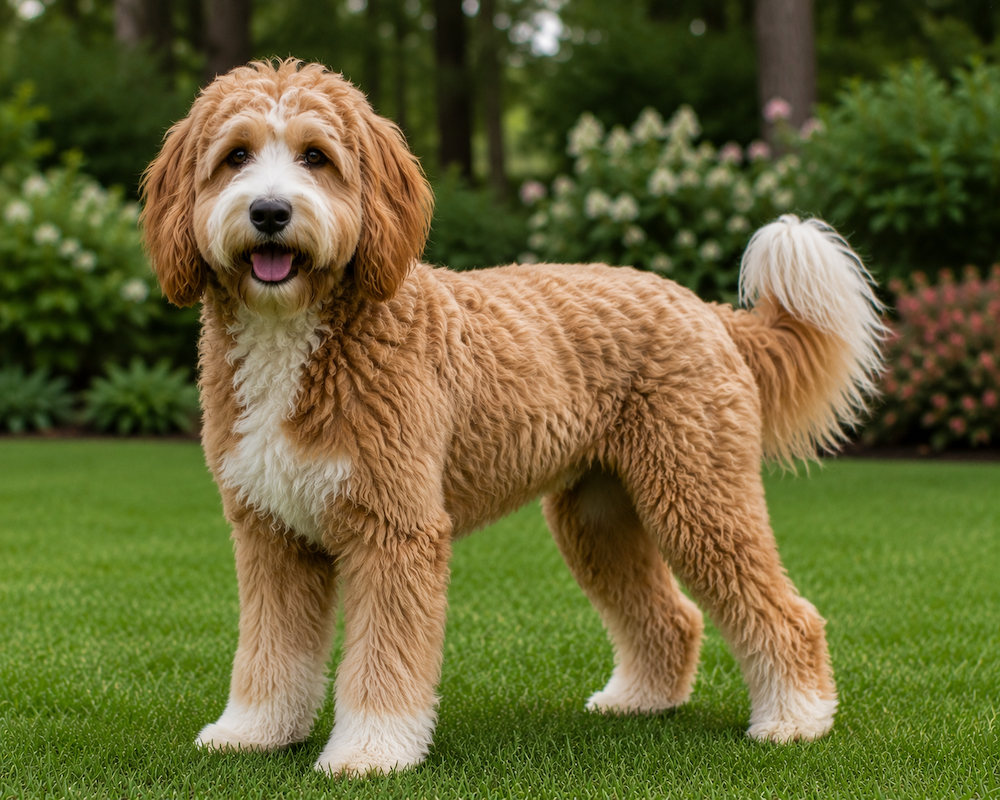







Friendly, intelligent, and full of energy — a loving companion that combines the best qualities of several popular family breeds.
🧠 QUICK SNAPSHOT
- Temperament: Affectionate, intelligent, playful
- Energy Level: High
- Size: Medium to large
- Good With Families: Yes
- Trainability: High
- Grooming: High
- Best For: Active families, companionship, outdoor lifestyles
📚 OVERVIEW
The Double Doodle is a hybrid breed typically created by combining a Goldendoodle and a Labradoodle, bringing together the traits of the Golden Retriever, Labrador Retriever, and Poodle. The result is an intelligent, social, and highly affectionate dog that thrives on human interaction.
Double Doodles are known for their friendly nature, eagerness to please, and adaptability, making them a popular choice for families looking for an active and loving companion.
✅ PROS & CONS
Pros
- Extremely friendly and family-oriented
- Highly intelligent and trainable
- Great with children and other pets
- Often lower shedding than many traditional breeds
Cons
- Requires regular grooming and coat maintenance
- Needs plenty of exercise and stimulation
- Can develop separation anxiety
- Energy levels may be too high for inactive households
Is a Double Doodle a Good Family Dog?
Yes. Double Doodles can be excellent family dogs, particularly for active households wanting an affectionate, social and intelligent companion.
The name usually refers to a dog combining Labrador Retriever, Golden Retriever and Poodle ancestry, commonly through a Labradoodle × Goldendoodle cross.
Temperament isn’t completely predictable, but all three foundation breeds are strongly associated with companionship, retrieving and working closely with people.
What Breeds Make a Double Doodle?
A Double Doodle is usually a combination of Labrador Retriever, Golden Retriever and Poodle.
One common pairing is:
Labradoodle × Goldendoodle
Because a Labradoodle is Labrador × Poodle and a Goldendoodle is Golden Retriever × Poodle, their offspring contain ancestry from all three breeds.
However, “Double Doodle” isn’t a regulated breed name, so prospective owners should always check the actual pedigree.
Is a Double Doodle Half Labradoodle and Half Goldendoodle?
Often, yes.
A Double Doodle can be produced by crossing a Labradoodle with a Goldendoodle.
However, multigenerational breeding can make the genetic proportions considerably more complicated.
The name describes a general type rather than one fixed genetic formula.
How Much Exercise Does a Double Doodle Need?
Most adult Double Doodles need around 60–90 minutes of daily exercise, with particularly energetic individuals requiring more.
Labradors, Golden Retrievers and Poodles all have sporting or retrieving backgrounds.
Walking, swimming, retrieving, hiking and dog sports can provide excellent exercise.
Mental work is equally important because Double Doodles can be exceptionally intelligent.
Is a Double Doodle Easy to Train?
Double Doodles are generally highly trainable.
Labradors, Golden Retrievers and Poodles are all breeds renowned for working closely with people.
Reward-based training can produce excellent results.
Their enthusiasm can sometimes create excitable adolescents, so calm behaviour, recall and loose-lead walking should be taught early.
Is a Double Doodle Intelligent?
Yes. Double Doodles potentially combine three highly intelligent working breeds.
They can excel at obedience, retrieving, scent games, puzzle solving and trick training.
However, intelligence doesn’t automatically create an easy dog.
A clever Double Doodle without enough stimulation may simply become better at opening doors, stealing food and finding weaknesses in household security.
Does a Double Doodle Shed?
Double Doodles can be low, moderate or relatively heavy shedders.
Dogs inheriting a strongly Poodle-like curly coat may shed considerably less than dogs with straighter Retriever-type coats.
Even littermates can have different coats.
The word “Doodle” shouldn’t be interpreted as a guarantee of a non-shedding dog.
Is a Double Doodle Hypoallergenic?
No Double Doodle can be guaranteed to be hypoallergenic.
Low-shedding individuals may distribute less hair around the home, which can help some allergy sufferers.
However, major dog allergens are also produced through saliva and skin.
Anyone with significant allergies should spend time around the individual dog rather than relying on its breed label.
What Type of Coat Does a Double Doodle Have?
A Double Doodle can have a straight, wavy, fleece-like or curly coat.
Some resemble shaggy Retrievers, while others look much more like Poodles.
Coat density and texture can also change as the puppy matures.
Because three breeds contribute to the ancestry, predicting the adult coat from a young puppy isn’t always straightforward.
Does a Double Doodle Need Professional Grooming?
Many do.
Double Doodles with dense wavy or curly coats generally require brushing several times each week and professional grooming approximately every 6–8 weeks.
Low-shedding coats can actually require more maintenance because loose hair becomes trapped rather than falling away.
Without regular brushing, severe matting can develop close to the skin.
Why Does a Double Doodle Get Matted So Easily?
Many Double Doodles inherit a combination of dense Retriever undercoat characteristics and curly or wavy Poodle-type hair.
Loose hairs can become trapped inside the coat and tangle together.
Friction areas such as behind the ears, under the collar, armpits, legs and tail are particularly vulnerable.
The fluffy teddy-bear appearance can hide substantial matting underneath.
What Health Problems Are Common in Double Doodles?
Double Doodles can potentially inherit conditions found in Labradors, Golden Retrievers and Poodles.
Important concerns can include hip and elbow dysplasia, eye disorders, certain cardiac conditions and inherited neurological or blood disorders.
Large, deep-chested individuals may also be vulnerable to gastric dilatation-volvulus.
Responsible breeders should health-test all breeding dogs for conditions relevant to their actual ancestry.
Is a Double Doodle Healthier Than a Purebred Dog?
Not automatically.
Greater genetic diversity can sometimes reduce the chance of particular recessive inherited diseases, but crossbreeding doesn’t erase genetic risk.
Labradors, Goldens and Poodles also share some health concerns, including orthopaedic and eye conditions.
A carefully bred cross from health-tested parents may have advantages, but “mixed breed” isn’t itself a health certificate.
Does Hybrid Vigour Make Double Doodles Healthier?
Hybrid vigour, or heterosis, is a genuine biological phenomenon, but it’s frequently oversimplified in designer-dog marketing.
Increasing genetic diversity can improve certain population-level traits and reduce the expression of some recessive conditions.
It doesn’t prevent a puppy from inheriting dominant, complex or shared diseases from its parents.
Health testing remains essential.
Are Double Doodles Prone to Hip Dysplasia?
Potentially, yes.
Labradors, Golden Retrievers and Standard Poodles can all develop hip dysplasia, meaning crossing them doesn’t eliminate the risk.
Breeding dogs should undergo appropriate hip assessment.
Maintaining a healthy weight and avoiding inappropriate exercise during rapid puppy growth can also help protect developing joints.
Are Double Doodles Prone to Ear Infections?
They can be.
Double Doodles usually have drop ears, and some also develop substantial hair around the ear canal.
Moisture after swimming can further encourage conditions in which yeast or bacteria thrive.
Regular ear checks are particularly important for dogs that swim frequently.
Persistent odour, redness, discharge or scratching requires veterinary attention.
Are Double Doodles Prone to Bloat?
Larger Double Doodles, particularly those with deep chests, may be vulnerable to gastric dilatation-volvulus (GDV).
The stomach fills with gas and may rotate, creating a life-threatening emergency.
Repeated unsuccessful attempts to vomit, abdominal swelling, drooling and severe restlessness require immediate veterinary treatment.
Owners of large Double Doodles should understand the warning signs.
How Long Do Double Doodles Live?
Double Doodles commonly have an estimated lifespan of around 10–15 years, although there isn’t a sufficiently standardised population to establish one precise figure.
Size can influence longevity.
Smaller individuals may tend to live longer than particularly large dogs.
Genetics, body weight, exercise, nutrition and preventive veterinary care all contribute.
How Big Does a Double Doodle Get?
Adult size varies substantially.
Standard Double Doodles commonly fall somewhere around 20–35 kg or more, depending on the sizes of the Labradoodle, Goldendoodle and Poodle ancestors.
Smaller versions can weigh considerably less.
Because there is no official breed standard, the parents and grandparents are much more useful predictors than the label “Double Doodle.”
Is There a Mini Double Doodle?
Yes, dogs are marketed as Mini Double Doodles, usually through ancestry involving Miniature Poodles and smaller Labradoodles or Goldendoodles.
However, “Mini” isn’t a universally standardised size.
Adult size can remain unpredictable, particularly in early generations.
Prospective owners should ask for the actual sizes of parents and previous related litters.
Is There a Teacup Double Doodle?
“Teacup Double Doodle” isn’t a recognised breed or size classification.
It’s primarily a marketing term for an unusually small dog.
Producing extremely tiny dogs from breeds originally ranging from medium to large requires substantial selective breeding and may create additional welfare concerns.
Health and sound structure should matter more than achieving an extreme miniature size.
Can a Double Doodle Live in an Apartment?
Yes, provided it receives enough exercise, training and mental stimulation.
Smaller Double Doodles may adapt particularly well.
Large energetic individuals can be more challenging in limited space.
A garden is useful but doesn’t replace walks and interaction.
A well-exercised Double Doodle can be considerably easier indoors than a bored one living on a large property.
Can a Double Doodle Be Left Alone?
Adult Double Doodles can learn to spend reasonable periods alone, but many are highly people-oriented dogs.
All three foundation breeds were developed to cooperate closely with humans.
Long periods of isolation can contribute to boredom or separation-related behaviour.
Gradual independence training is valuable from puppyhood.
Are Double Doodles Velcro Dogs?
Many can be.
Labradors, Golden Retrievers and Poodles all tend to form strong relationships with their people.
Some Double Doodles follow owners throughout the house and seek constant interaction.
Teaching them that being alone for short periods is safe and normal can help prevent excessive dependence.
Are Double Doodles Cuddly?
Many Double Doodles are extremely affectionate.
Golden Retriever and Labrador ancestry often contributes a friendly, people-focused temperament, while Poodles can also be highly attached to their families.
Individual personalities vary.
Some want constant physical contact; others prefer lying nearby rather than directly on top of someone.
Are Double Doodles Good With Children?
Double Doodles can be excellent family companions for children.
They’re often playful, affectionate and tolerant when responsibly bred and socialised.
Large adolescents can be extremely enthusiastic and may accidentally knock over small children.
Supervision and respectful handling remain essential regardless of how friendly the dog is.
Are Double Doodles Good With Other Dogs?
Generally, yes.
All three foundation breeds are commonly social with other dogs, although individual temperament always matters.
Early positive socialisation helps develop appropriate canine communication.
A highly energetic Double Doodle may need to learn that not every dog appreciates being invited to wrestle at maximum enthusiasm.
Are Double Doodles Good With Cats?
Many Double Doodles can live successfully with cats, particularly when introduced carefully while young.
Their Retriever ancestry can contribute chase instincts, but they’re not generally specialised vermin-hunting dogs.
Individual prey drive varies.
A familiar household cat may be treated very differently from an unfamiliar running animal outdoors.
Do Double Doodles Have a Strong Prey Drive?
Prey drive is usually moderate and variable.
Labradors, Golden Retrievers and Poodles all descend from hunting and retrieving dogs.
Their historical task was generally to retrieve shot game rather than independently kill it.
Nevertheless, birds, rabbits and fast-moving animals can trigger pursuit in some individuals.
Do Double Doodles Like Water?
Many Double Doodles love water.
All three foundation breeds have strong connections with aquatic retrieving.
Labradors and Golden Retrievers are famous water retrievers, while the Poodle was also developed for retrieving waterfowl.
An individual Double Doodle isn’t guaranteed to swim, but enthusiasm for water certainly wouldn’t be surprising.
Are Double Doodles Good Swimmers?
Many are excellent natural swimmers, particularly when they inherit the athletic build and water enthusiasm of their parent breeds.
Swimming can provide valuable low-impact exercise.
Dogs should still be introduced safely and supervised around deep or moving water.
Dense coats should be thoroughly dried afterwards to reduce matting and skin problems.
Are Double Doodles Good at Fetch?
Often exceptionally good.
The Labrador, Golden Retriever and Poodle all have retrieving ancestry.
Many Double Doodles therefore take naturally to carrying toys and retrieving balls.
Fetch can provide physical exercise, training and an outlet for inherited working behaviour.
Some may also decide that socks, shoes and television remotes deserve to participate.
Why Does My Double Doodle Carry Things Around?
Carrying objects can reflect the dog’s Retriever heritage.
Labradors, Goldens and Poodles were all selected historically for retrieving game.
A Double Doodle carrying toys around the house may therefore be expressing deeply inherited behaviour.
Teaching a reliable “give” or “drop” cue can make this charming trait considerably easier to live with.
Why Is My Double Doodle So Energetic?
A Double Doodle combines ancestry from three active sporting breeds.
Labradors, Golden Retrievers and Poodles weren’t originally developed simply to look attractive.
They worked alongside hunters, retrieving game over land and water.
A young Double Doodle can therefore have considerably more energy than its fluffy teddy-bear appearance suggests.
Do Double Doodles Calm Down With Age?
Usually, yes, but they don’t necessarily become inactive.
Many Double Doodles are particularly exuberant during puppyhood and adolescence and become more settled as they mature.
Training and appropriate exercise make an enormous difference.
Waiting for age alone to solve an under-stimulated dog’s behaviour can make the first few years feel considerably longer than necessary.
Are Double Doodles Good Running Dogs?
Healthy adult Double Doodles can make excellent running companions.
Their foundation breeds are athletic and capable of substantial endurance.
Structured running should generally wait until skeletal development is sufficiently mature.
Distance should then increase gradually according to the individual dog’s fitness and health.
Are Double Doodles Good Service Dogs?
Some Double Doodles have the temperament and trainability required for assistance or therapy work.
Labradors, Golden Retrievers and Poodles are all widely used in service roles.
However, ancestry doesn’t guarantee suitability.
Professional service work requires the correct individual temperament, health, stability and extensive specialised training.
Are Double Doodles Good Therapy Dogs?
They can be.
Friendly, calm and well-trained Double Doodles may make excellent therapy dogs because of their social nature.
However, an overly excitable dog isn’t automatically suitable simply because it’s friendly.
Successful therapy work requires a dog that genuinely enjoys calm interaction with unfamiliar people and can remain composed in unusual environments.
Do Double Doodles Bark a Lot?
Double Doodles aren’t generally known as extreme barkers, but individual behaviour varies.
Poodles can be alert and vocal, while Retrievers may bark from excitement or boredom.
Exercise, training and environmental stimulation can influence barking substantially.
A bored intelligent dog often discovers that barking produces interesting reactions.
Are Double Doodles Good Guard Dogs?
Usually they’re better watchdogs than serious guard dogs.
Their size and barking may deter an intruder, but Labrador and Golden Retriever ancestry often contributes considerable friendliness towards people.
Poodles can be more reserved and alert.
A Double Doodle may announce a stranger at the door and then immediately investigate whether the stranger has brought snacks.
What Does a Double Doodle Look Like?
There is no single Double Doodle appearance.
They can have curly, wavy or relatively straight coats and range considerably in size.
Many have the shaggy facial furnishings associated with Poodle crosses.
Others resemble unusually fluffy Retrievers.
Even puppies from the same litter can develop noticeably different adult appearances.
What Colours Can Double Doodles Be?
Double Doodles can appear in many colours, including cream, gold, apricot, red, black, brown and various combinations or patterns.
Poodle genetics introduce considerable colour diversity.
Some coats also lighten substantially with age.
Colour should be considered cosmetic rather than a reason to overlook health, temperament or responsible breeding.
Why Is My Double Doodle Changing Colour?
Poodles can carry genes associated with progressive greying or fading, and these can be passed to Double Doodles.
A puppy born dark red, brown or black may become noticeably lighter over time.
This doesn’t necessarily indicate a health problem.
Adult colour can sometimes be surprisingly different from the original puppy coat.
Can a Double Doodle Be Merle?
Merle isn’t a traditional naturally occurring pattern in Labradors, Golden Retrievers or recognised purebred Poodles.
A merle dog marketed as a Double Doodle therefore suggests additional ancestry somewhere in the pedigree.
Merle-to-merle breeding can also produce double-merle puppies at increased risk of serious hearing and eye abnormalities.
Unusual colour claims deserve careful investigation.
What Is an F1 Double Doodle?
Terminology isn’t completely standardised, but an F1 Double Doodle often refers to the first generation produced by crossing two established Doodle types, such as a Labradoodle with a Goldendoodle.
However, those parent dogs are already crosses themselves.
Consequently, “F1” in Double Doodle marketing doesn’t have quite the same straightforward meaning as an F1 Labradoodle.
Always ask for the actual pedigree.
What Is an F1B Double Doodle?
“F1B Double Doodle” is used inconsistently.
It may describe a Double Doodle backcrossed towards a Poodle or another Doodle line.
Because there is no recognised breed authority controlling the terminology, the label alone tells you surprisingly little.
A pedigree or genetic ancestry explanation is considerably more informative than the generation name.
Is a Double Doodle a Recognised Dog Breed?
No. The Double Doodle isn’t a recognised pedigree breed under major kennel organisations.
It’s a multibreed designer cross.
There is no universally accepted standard controlling size, coat, colour, temperament or genetic composition.
This makes careful evaluation of the actual breeder and parent dogs especially important.
Is a Double Doodle a Mixed Breed or Designer Dog?
It’s both.
A Double Doodle is genetically a mixed-breed dog and is generally described commercially as a designer dog because the crosses are intentionally planned.
Calling it a designer breed doesn’t give it the predictability created by many generations of breeding to a closed, established standard.
Variation is part of the package.
Is a Double Doodle the Same as a Labradoodle?
No.
A Labradoodle is primarily a Labrador Retriever × Poodle cross.
A Double Doodle generally adds Golden Retriever ancestry, commonly by crossing a Labradoodle with a Goldendoodle.
The names sound similar, but the Double Doodle usually involves three foundation breeds.
Is a Double Doodle the Same as a Goldendoodle?
No.
A Goldendoodle combines Golden Retriever and Poodle ancestry.
A Double Doodle generally combines Golden Retriever, Labrador Retriever and Poodle ancestry.
Some individual Double Doodles may genetically lean strongly towards one component, particularly after several generations of selective breeding.
Is a Double Doodle the Same as a Golden Labradoodle?
Terminology can become confusing because names such as Golden Labradoodle, North American Retriever and Double Doodle have sometimes been used for dogs combining Labrador, Golden Retriever and Poodle ancestry.
These labels aren’t universally standardised.
The safest approach is to ignore the marketing name temporarily and ask exactly which breeds appear in the dog’s pedigree.
Why Is It Called a Double Doodle?
The name comes from crossing two different Poodle-cross types.
A Labradoodle is one “Doodle” and a Goldendoodle is another.
Cross the two and you have a “Double Doodle.”
It’s one of those rare designer-dog names where the arithmetic is considerably easier to understand than the genetics.
What Were Labradors Originally Bred For?
Labrador Retrievers developed from water dogs associated with Newfoundland, Canada, before the breed was refined in Britain.
They became specialised sporting dogs used to retrieve shot game.
Their love of water, soft mouths, trainability and desire to work with people made them exceptional retrievers.
These characteristics continue to influence Double Doodles.
What Were Golden Retrievers Originally Bred For?
Golden Retrievers were developed in Scotland during the 19th century as sporting dogs capable of retrieving shot birds over varied terrain and through water.
Their trainability and cooperative nature later made them successful guide, assistance, detection and therapy dogs.
A Double Doodle therefore inherits Retriever ancestry from two different directions.
What Were Poodles Originally Bred For?
Poodles were originally developed as water retrievers, despite their later association with elaborate grooming and fashionable companionship.
Their intelligence, athleticism and swimming ability made them capable hunting dogs.
The name Poodle itself is connected with German words associated with splashing in water.
A Double Doodle is therefore effectively a combination of three breeds with retrieving heritage.
Is a Double Doodle Really a “Triple Retriever”?
In terms of historical function, it’s remarkably close.
Labradors, Golden Retrievers and Poodles all have strong retrieving ancestry, particularly involving birds and water.
A Double Doodle may therefore inherit retrieving behaviour from every major branch of its family tree.
That helps explain why so many love carrying objects, fetching and swimming.
Who Created the First Double Doodle?
There is no reliably documented single inventor of the Double Doodle.
Once Labradoodles and Goldendoodles became established, crossing the two was an obvious possibility.
Such crosses may have occurred before the name became commercially popular.
Claims that one person definitively invented the Double Doodle should therefore be treated cautiously unless supported by credible historical records.
When Did Double Doodles Become Popular?
Double Doodles became increasingly visible during the modern Doodle boom, particularly as Labradoodles and Goldendoodles grew enormously popular during the late 20th and early 21st centuries.
Breeders began combining established Doodle lines in an attempt to blend desirable characteristics from Labradors, Goldens and Poodles.
The result became another recognisable member of the rapidly expanding Doodle family.
Where Does the Double Doodle Come From?
The Double Doodle is a modern designer cross rather than a breed with one clearly documented birthplace.
It’s most commonly produced by combining Labradoodle and Goldendoodle lines, giving it Labrador Retriever, Golden Retriever and Poodle ancestry.
That means its deeper working history stretches from Newfoundland water dogs to Scottish sporting estates and European water retrievers.
The modern result may resemble a giant teddy bear, but underneath all that fluff is an impressive concentration of sporting genetics — three different retrieving traditions packed into one dog that may regard every ball, stick, sock and unattended shoe as something clearly requiring retrieval.