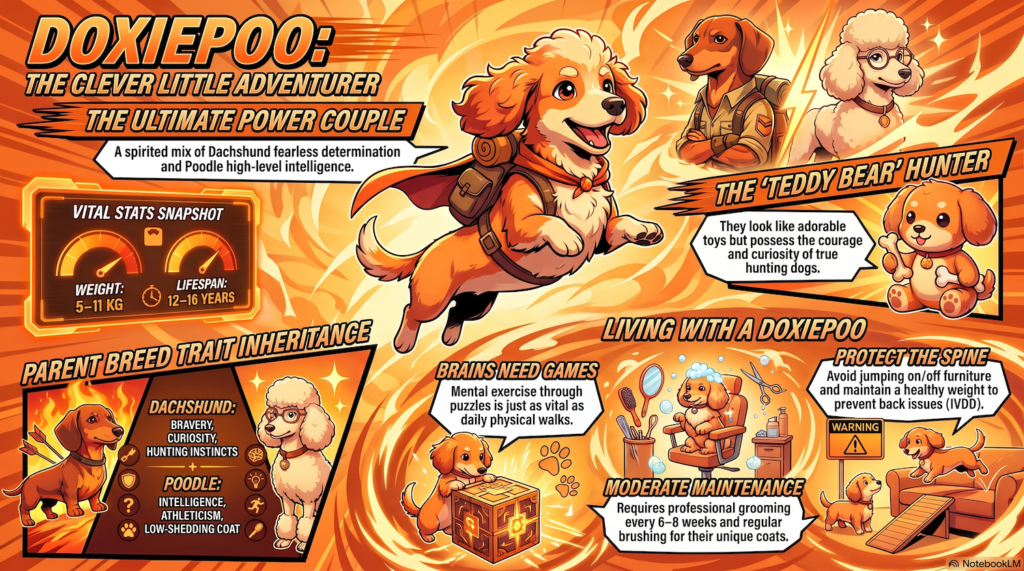
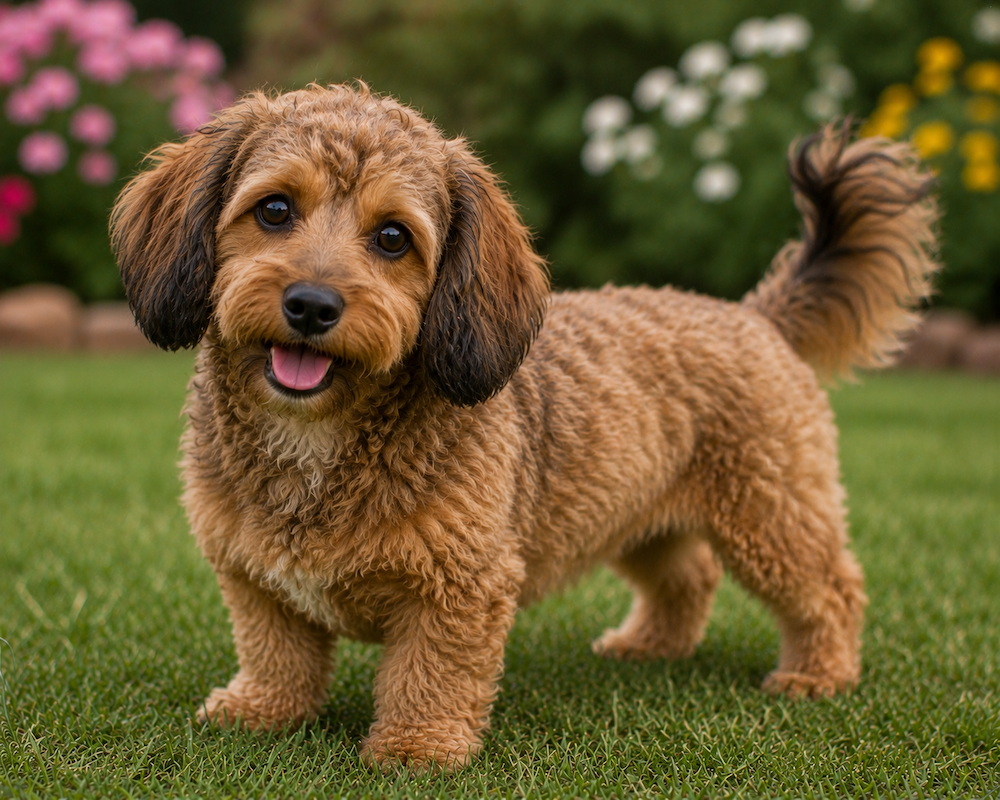







Clever, affectionate, and full of personality — a charming companion that combines the playful spirit of the Dachshund with the intelligence of the Poodle.
🧠 QUICK SNAPSHOT
- Temperament: Affectionate, intelligent, playful
- Energy Level: Moderate
- Size: Small
- Good With Families: Yes
- Trainability: High
- Grooming: Moderate to high
- Best For: Families, apartment living, companionship
📚 OVERVIEW
The Doxiepoo is a cross between a Dachshund and a Poodle, creating a lively, intelligent, and affectionate companion. Depending on which parent they take after, Doxiepoos can vary in appearance, but they are almost always full of character and love being around their family.
These adaptable little dogs enjoy both indoor relaxation and outdoor adventures. Their playful personality and eagerness to be involved in family activities make them a popular choice for a wide range of households.
✅ PROS & CONS
Pros
- Affectionate and loyal companion
- Highly intelligent and easy to train
- Often lower shedding depending on coat type
- Compact size suits apartment living
Cons
- Requires regular grooming
- May inherit back problems from the Dachshund
- Can develop separation anxiety
- Needs regular mental stimulation and exercise
Is a Doxiepoo a Good Family Dog?
Yes. A well-socialised Doxiepoo can be an affectionate, entertaining and devoted family companion.
The Doxiepoo is a cross between a Dachshund and a Poodle, usually a Toy or Miniature Poodle. Both parent breeds are intelligent and strongly bonded to their owners, although Dachshunds can add a substantial independent streak.
Because many Doxiepoos are small and may inherit a long-backed body, young children should be taught to handle them carefully.
How Much Exercise Does a Doxiepoo Need?
Most Doxiepoos need around 30–60 minutes of daily exercise, depending on size, age and which parent they resemble.
They’re generally lively dogs that enjoy walks, games, scent work and interactive toys.
Exercise is particularly important for maintaining a healthy body weight, as excess weight places additional stress on a long-backed dog’s spine.
Repeated high-impact jumping should be discouraged in dogs with pronounced Dachshund proportions.
Is a Doxiepoo Easy to Train?
Doxiepoos are usually intelligent but not always automatically obedient.
Poodles are famously trainable, while Dachshunds were bred to work independently underground without waiting for constant instructions.
The combination can produce a dog that understands exactly what you’re asking but occasionally wishes to renegotiate the arrangement.
Positive reinforcement, short training sessions and consistency work particularly well.
Does a Doxiepoo Shed?
A Doxiepoo can be low, moderate or relatively heavy shedding, depending on its inherited coat.
A curly Poodle-like coat may release relatively little hair, while a straighter Dachshund-type coat can shed considerably more.
Because Dachshunds themselves come in Smooth, Longhaired and Wirehaired varieties, Doxiepoo coat possibilities are unusually broad.
Is a Doxiepoo Hypoallergenic?
No Doxiepoo can be guaranteed to be hypoallergenic.
Dogs inheriting a curly, low-shedding Poodle coat may distribute less loose hair around the home.
However, allergens are also present in saliva and skin secretions.
Crossing a Dachshund with a Poodle doesn’t guarantee an allergy-friendly puppy.
How Often Does a Doxiepoo Need Grooming?
Grooming requirements depend heavily on coat type.
Curly or dense wavy Doxiepoos may need brushing several times each week and professional grooming every 6–8 weeks.
Straighter-coated dogs may require less clipping but can shed more.
Ears, nails and teeth also require routine attention.
What Health Problems Are Common in Doxiepoos?
Doxiepoos can potentially inherit conditions from both Dachshunds and Poodles.
Important concerns can include intervertebral disc disease (IVDD), patellar luxation, hip problems, eye disorders and dental disease.
Depending on the Poodle size and family lines, additional inherited conditions may also be relevant.
Responsible breeders should health-test both parents rather than assuming crossbreeding automatically prevents genetic disease.
Are Doxiepoos Prone to Back Problems?
Potentially, yes.
Doxiepoos that inherit the Dachshund’s long body and shortened legs may also inherit increased susceptibility to spinal problems, particularly IVDD.
Not every Doxiepoo has the same body proportions or risk.
Maintaining a lean body weight, encouraging appropriate exercise and reducing repeated high-impact jumping are sensible precautions.
What Is IVDD in a Doxiepoo?
Intervertebral disc disease (IVDD) occurs when one or more discs between the vertebrae degenerate and can rupture or protrude towards the spinal cord.
Symptoms may include back pain, reluctance to move, weakness, an abnormal gait or paralysis.
Dachshunds have a particularly high predisposition because of their chondrodystrophic genetics.
A Doxiepoo inheriting those genetic and structural characteristics may also be at increased risk.
Should Doxiepoos Be Allowed to Jump Off Furniture?
Repeated jumping from high furniture is best minimised, particularly in Doxiepoos with long backs and short legs.
Dog ramps or steps can provide easier access to favourite furniture.
However, protecting the spine doesn’t mean preventing all normal movement.
Regular controlled exercise helps maintain the muscles supporting the body and is important for overall health.
Can Doxiepoos Climb Stairs?
Many healthy adult Doxiepoos can manage stairs, but body shape and spinal health matter.
A particularly long-backed, short-legged dog may find steep staircases challenging.
Puppies, elderly dogs and dogs with known spinal disease may require greater restriction.
Slippery stairs should be made safer regardless of the dog’s proportions.
How Long Do Doxiepoos Live?
Doxiepoos commonly have an estimated lifespan of around 12–16 years, although there isn’t enough standardised population data to establish one precise figure.
Small dogs often enjoy relatively long lifespans.
Genetics, dental care, healthy body weight, exercise and preventive veterinary care all contribute to longevity.
How Big Does a Doxiepoo Get?
Doxiepoo size varies substantially depending on the Dachshund and Poodle used in the cross.
Many weigh roughly 4–12 kg, although smaller and larger individuals occur.
A Miniature Dachshund crossed with a Toy Poodle can produce a very different adult dog from a Standard Dachshund crossed with a Miniature Poodle.
There is no official size standard.
Is There a Mini Doxiepoo?
Many Doxiepoos are already relatively small because breeders frequently use Miniature Dachshunds and Toy or Miniature Poodles.
“Mini Doxiepoo” isn’t an officially standardised variety.
Anyone purchasing a puppy should ask about the actual size of the parents rather than relying on terms such as Mini, Micro or Tiny.
Is There Such a Thing as a Teacup Doxiepoo?
“Teacup Doxiepoo” isn’t a recognised breed or size classification.
It’s generally a marketing term for an unusually small dog.
Deliberately breeding for extreme miniaturisation can increase the risk of fragile bones, dental crowding, hypoglycaemia and other health problems.
Small enough isn’t automatically healthier when made even smaller.
Can a Doxiepoo Live in an Apartment?
Yes. Doxiepoos are generally well suited to apartment living provided their exercise and mental-stimulation needs are met.
Their small size makes them physically manageable in limited spaces.
Barking can be a bigger challenge than size because Dachshunds are naturally alert and vocal, while Poodles can also be enthusiastic watchdogs.
Early training can make apartment life considerably easier.
Can a Doxiepoo Be Left Alone?
Adult Doxiepoos can learn to spend reasonable periods alone, but many become strongly attached to their owners.
Both parent breeds can form close human bonds.
Some Doxiepoos may develop separation-related behaviours if they’re never taught to relax independently.
Gradual alone-time training from puppyhood can help.
Do Doxiepoos Bark a Lot?
They can.
Dachshunds are famously alert and surprisingly powerful barkers, while Poodles can also be vocal watchdogs.
A Doxiepoo may therefore readily announce visitors, passing dogs or suspicious activity outside.
Training, exercise and preventing habitual window barking can make a substantial difference.
Why Does Such a Small Doxiepoo Have Such a Loud Bark?
Dachshunds were bred to work around underground quarry and needed a strong voice that hunters could hear from a distance.
That surprisingly substantial bark can be inherited by the Doxiepoo.
The Poodle contribution doesn’t necessarily make things quieter.
A small Doxiepoo can therefore produce a bark that seems to belong to a dog several sizes larger.
Are Doxiepoos Good With Children?
Doxiepoos can be excellent companions for respectful children.
However, small individuals can be physically fragile, while long-backed dogs need careful handling.
Children should never pick up a Doxiepoo incorrectly, climb on it or encourage it to jump from heights.
Older children who understand appropriate handling are often an especially good match.
Are Doxiepoos Good With Other Dogs?
Many Doxiepoos live successfully with other dogs.
Early socialisation helps, and compatibility depends on individual temperament.
Dachshunds can be remarkably confident around much larger dogs, meaning a tiny Doxiepoo may occasionally possess a somewhat unrealistic assessment of its own physical size.
Supervision around unfamiliar large dogs is sensible.
Are Doxiepoos Good With Cats?
Doxiepoos can live successfully with cats, especially when raised together.
However, Dachshund ancestry can contribute a strong prey or chase instinct.
A Doxiepoo that sleeps peacefully beside the household cat may still chase an unfamiliar cat running across the garden.
Gradual introductions remain important.
Do Doxiepoos Have a Strong Prey Drive?
Some do.
Dachshunds were developed to hunt animals including badgers and rabbits, while Poodles have sporting hunting ancestry.
A Doxiepoo may therefore enthusiastically chase rodents, birds or other small animals.
Prey drive varies considerably between individuals.
Can a Doxiepoo Be Trusted Off Leash?
Some Doxiepoos develop excellent recall, but others can be challenging off leash.
Dachshunds were bred to follow scent trails and make independent decisions while hunting.
Once an interesting smell or animal appears, recall can suddenly become less compelling.
Secure areas and long training lines are useful while developing reliable recall.
Why Does My Doxiepoo Dig So Much?
Digging can come directly from the Dachshund side of the family.
Dachshunds were literally designed to dig and enter underground dens after quarry.
A Doxiepoo may therefore attack garden beds, blankets or cushions with impressive determination.
Providing a designated digging area can give this inherited behaviour a more acceptable outlet.
Why Does My Doxiepoo Burrow Under Blankets?
Burrowing is extremely common in Dachshunds and may be inherited by Doxiepoos.
Dachshunds were bred to enter underground tunnels and dens, while small dogs also appreciate warm enclosed sleeping places.
A blanket can therefore satisfy both warmth and den-like instincts.
Checking beneath cushions before sitting down becomes a useful Doxiepoo-owner survival skill.
Why Does My Doxiepoo Follow Me Everywhere?
Doxiepoos often form very strong bonds with their owners.
Poodles are highly people-oriented, while Dachshunds are famously devoted to their favourite humans.
Following someone from room to room can therefore be completely normal.
Teaching independent relaxation is still useful so attachment doesn’t develop into separation distress.
Are Doxiepoos Cuddly?
Many Doxiepoos are extremely affectionate and cuddly.
Dachshunds often enjoy burrowing against their owners, while Poodles can form intense human relationships.
Individual personalities vary, but lap-seeking behaviour is common.
A Doxiepoo may happily spend an hour behaving like a tiny hunting dog and the next hour buried beneath your jumper.
Are Doxiepoos Stubborn?
They can be.
Dachshunds were deliberately bred to think independently while hunting underground, so waiting for human instructions wasn’t always practical.
Poodles are highly trainable but intelligent enough to form their own opinions.
A Doxiepoo can therefore be clever, quick to learn and occasionally determined that its own plan is superior.
Are Doxiepoos Aggressive?
Doxiepoos aren’t inherently aggressive.
However, genetics, socialisation, fear, pain, training and previous experiences all influence behaviour.
Small dogs can also develop defensive behaviours when people repeatedly ignore their boundaries or handle them roughly.
Back pain should be considered if a normally friendly long-backed dog suddenly becomes reluctant to be touched.
Do Doxiepoos Like Water?
Some Doxiepoos enjoy water, particularly if they inherit the Poodle’s water-retrieving instincts.
Others may be much less enthusiastic.
Body proportions matter too: a very short-legged, long-bodied Doxiepoo may not be as efficient a swimmer as a more Poodle-shaped dog.
All small dogs should be supervised around deep water.
Are Doxiepoos Good at Fetch?
Many are.
Poodles have strong retrieving ancestry, while Dachshunds enjoy chasing moving objects.
Fetch can provide excellent exercise and mental stimulation.
Some Doxiepoos quickly understand the “chase the toy” part but develop their own interpretation of the “bring it back” section.
What Does a Doxiepoo Look Like?
There is no standard Doxiepoo appearance.
Some have long Dachshund-like bodies and short legs with curly coats.
Others inherit longer Poodle-like legs, a lighter build and only slightly wavy hair.
Ear shape, muzzle length, coat texture and overall proportions can vary dramatically even within the same litter.
Why Does My Doxiepoo Have Such Short Legs?
Some Doxiepoos inherit the Dachshund’s chondrodystrophic short-legged body type.
This results from genetic changes affecting bone growth.
The characteristic short legs helped Dachshunds work underground.
A Doxiepoo may inherit this trait strongly, moderately or barely at all depending on which genes it receives.
Can a Doxiepoo Have Long Legs?
Yes.
A Doxiepoo inheriting more of the Poodle’s skeletal proportions can have considerably longer legs than a Dachshund.
This is one reason Doxiepoos can look remarkably different from one another.
Crossbreeding doesn’t blend every physical feature into a perfect 50/50 average.
Can a Doxiepoo Have Curly Hair?
Yes. Many Doxiepoos inherit curly or wavy hair from their Poodle parent.
Others have relatively straight coats.
Curl alone doesn’t guarantee that the dog won’t shed.
Coat genetics are more complicated than simply inheriting “the Poodle coat” or “the Dachshund coat.”
Can a Doxiepoo Have Long Hair?
Yes.
Longhaired Dachshund ancestry combined with Poodle coat genetics can produce long, shaggy or wavy coats.
Even Smooth Dachshund crosses can produce coats that look quite different from either parent.
Adult coat length and texture may not become completely obvious during early puppyhood.
Can a Doxiepoo Have Wire Hair?
Potentially, yes, particularly when a Wirehaired Dachshund appears in the ancestry.
Wirehaired Dachshunds have different coat genetics from Smooth and Longhaired Dachshunds.
Combined with Poodle furnishings and curl, this can create unusual shaggy or coarse-textured coats.
Knowing exactly which Dachshund variety was used can help explain the result.
What Colours Can Doxiepoos Be?
Doxiepoos can occur in a very broad range of colours and patterns.
Possible colours include black, brown, cream, red, apricot and combinations involving tan or white markings.
Dachshund genetics can introduce additional patterns, while Poodle ancestry contributes its own extensive colour possibilities.
Appearance can therefore be highly variable.
Can a Doxiepoo Be Dapple?
Yes, if the Dachshund parent carries the dapple pattern, which is genetically a form of merle.
A Doxiepoo can inherit that gene.
The pattern can be striking, but merle should never be treated merely as a fashionable colour because breeding two merle dogs together can create serious health risks.
What Is a Double Dapple Doxiepoo?
A dog inheriting two copies of the merle gene can be described genetically as double merle, corresponding to the “double dapple” terminology commonly used in Dachshunds.
Double-merle dogs have an increased risk of serious hearing and eye abnormalities.
Responsible breeding avoids merle-to-merle pairings.
The attractive coat pattern isn’t worth creating preventable sensory disabilities.
Can a Doxiepoo Change Colour as It Gets Older?
Yes. Poodle ancestry can introduce progressive fading or greying, meaning a dark puppy may become considerably lighter with age.
Coat texture can also change as the adult coat replaces the puppy coat.
A Doxiepoo’s appearance at eight weeks isn’t necessarily an accurate preview of its appearance at three years.
Does a Doxiepoo Have Floppy Ears?
Usually, yes.
Both Dachshunds and Poodles naturally have drop ears, so Doxiepoos generally inherit floppy ears.
Hairy ear canals and reduced airflow can contribute to ear problems in some individuals.
Regular checking is particularly important for dogs that swim frequently.
What Is an F1 Doxiepoo?
An F1 Doxiepoo is a first-generation cross between a Dachshund and a Poodle.
It receives approximately half its ancestry from each parent breed.
That doesn’t mean every physical or behavioural characteristic will appear halfway between the two.
One F1 puppy can strongly resemble a Dachshund while its littermate looks much more Poodle-like.
What Is an F1B Doxiepoo?
An F1B Doxiepoo is usually produced by crossing an F1 Doxiepoo back to a Poodle.
This is often done in an attempt to increase the likelihood of a curly, lower-shedding coat.
However, F1B doesn’t guarantee non-shedding or hypoallergenic puppies.
It could technically also describe a backcross to a Dachshund, so the actual pedigree should be checked.
What Is an F2 Doxiepoo?
An F2 Doxiepoo is generally produced by breeding two F1 Doxiepoos together.
Second-generation litters can display considerable variation as Dachshund and Poodle traits recombine.
Some puppies may strongly resemble one foundation breed.
Generation terminology describes ancestry, not guaranteed appearance or temperament.
Is a Doxiepoo a Recognised Dog Breed?
No. The Doxiepoo is a designer crossbreed rather than a recognised pedigree breed under major kennel organisations.
There is no universally accepted standard governing size, coat, colour, temperament or proportions.
The Dachshund and Poodle are established breeds individually, but the Doxiepoo isn’t simply a new recognised breed created by combining them once.
Is a Doxiepoo Healthier Than a Dachshund?
Not necessarily.
Crossbreeding can increase genetic diversity, but it doesn’t automatically remove the Dachshund’s inherited health risks.
A Doxiepoo can still inherit chondrodystrophic genetics and susceptibility to IVDD, while also acquiring health risks from its Poodle ancestry.
The health of the actual parents is far more informative than the “designer dog” label.
Does Hybrid Vigour Protect a Doxiepoo From IVDD?
No. Hybrid vigour doesn’t guarantee protection from a specific inherited disorder.
If a Doxiepoo inherits the genetic variants associated with the Dachshund’s characteristic body structure and disc degeneration, it may still be vulnerable to IVDD.
Genetic diversity can have population-level benefits, but it doesn’t magically neutralise every harmful gene.
Is a Doxiepoo the Same as a Doxiedoodle?
Usually, yes.
Doxiepoo, Doxiedoodle, Dachshundpoo and Dachshund Poodle Mix are names used for the Dachshund-Poodle cross.
Because the cross isn’t governed by an official breed registry, terminology varies between breeders.
The actual parentage matters more than the name.
Why Is It Called a Doxiepoo?
“Doxie” is a popular nickname for the Dachshund, while “poo” comes from Poodle.
Combining them produces Doxiepoo.
It’s part of the wider naming tradition that produced Cockapoo, Cavapoo and Maltipoo.
The name is considerably easier to say than “Dachshund-Poodle cross” every time.
What Were Dachshunds Originally Bred For?
Dachshunds were developed in Germany as hunting dogs, particularly for pursuing badgers underground.
Their long bodies, short powerful legs, strong forefeet and determined personalities suited subterranean work.
Different sizes were also used for other quarry.
That history explains many modern Doxiepoo behaviours, including digging, scent following, barking and extraordinary confidence.
What Were Poodles Originally Bred For?
Poodles were developed as water retrievers, particularly for retrieving birds for hunters.
Despite their modern association with elegant show grooming, they’re athletic sporting dogs with strong working instincts.
The Poodle contributes intelligence, trainability, retrieving behaviour and potentially a curly low-shedding coat to the Doxiepoo.
Does the Doxiepoo Combine Two Hunting Breeds?
Yes.
Although their jobs were very different, both parent breeds have hunting ancestry.
The Dachshund pursued quarry on and below ground, while the Poodle retrieved waterfowl.
A Doxiepoo therefore combines an underground scent hunter with a water retriever — which may help explain why some seem determined to investigate absolutely everything.
Who Created the First Doxiepoo?
There is no reliably documented inventor of the Doxiepoo.
Dachshunds and Poodles could have been crossed accidentally long before the name became commercially popular.
Deliberate Doxiepoo breeding appears to belong largely to the modern designer-dog movement.
Claims assigning the cross to one specific founder or year should therefore be treated cautiously.
Where Does the Doxiepoo Come From?
The Doxiepoo is a modern designer cross, most strongly associated with the broader popularity of Poodle mixes rather than one clearly documented place of origin.
Its two parent breeds have much older European histories: the Dachshund was developed in Germany as a determined underground hunting dog, while the Poodle emerged from European water-retrieving traditions.
Put them together and the result can be wonderfully unpredictable — part scent hound, part water retriever, potentially curly, possibly short-legged and often completely convinced that whatever is beneath the blanket, behind the fence or inside the cupboard urgently requires investigation.