







Friendly, entertaining and full of personality, Ducks are among the most charming birds you can keep.
🧠 QUICK SNAPSHOT
Trait | Duck |
|---|---|
Scientific Name | Anas platyrhynchos domesticus (most domestic breeds) |
Pet Type | Domestic waterfowl |
Natural Origin | Primarily descended from the Mallard |
Typical Lifespan | Around 8–12 years |
Adult Size | Approximately 40–70 cm, depending on breed |
Adult Weight | Around 1–4.5 kg, depending on breed |
Diet | Omnivore |
Activity | Diurnal |
Temperament | Social, curious and active |
Noise Level | Moderate to loud |
Social Needs | Very high |
Housing | Secure outdoor enclosure with shelter and bathing water |
Handling | Usually prefers limited handling |
Beginner Friendly? | Yes, with suitable facilities |
Famous Feature | Webbed feet, waterproof feathers and enthusiastic swimming |
📚 OVERVIEW
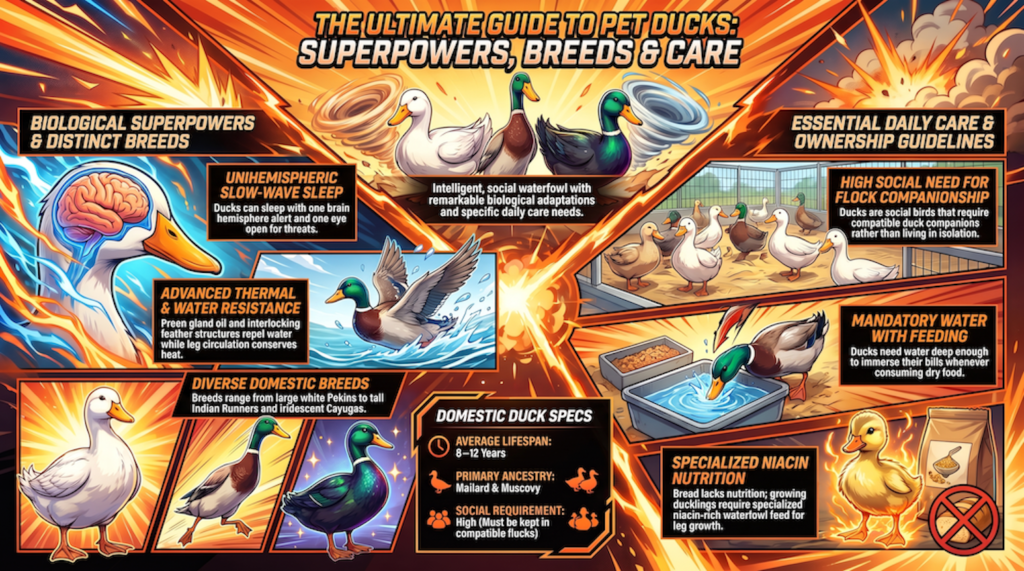
Domestic Ducks are popular backyard birds kept for companionship, eggs, ornamental purposes and their entertaining personalities. Most domestic breeds descend from the wild Mallard (Anas platyrhynchos), although Muscovy Ducks have a different ancestry.
Popular breeds include the Pekin, Indian Runner, Khaki Campbell, Cayuga and Call Duck, each with distinctive appearances, temperaments and characteristics.
Ducks are highly social animals that naturally spend much of their time exploring, foraging, bathing and interacting with other Ducks. They need secure outdoor accommodation, clean drinking water, access to bathing water and a balanced diet.
Although generally straightforward to care for once properly housed, Ducks can be surprisingly messy. Their love of water means good drainage, regular cleaning and predator-proof housing are essential.
✅ PROS & CONS
👍 Pros
Friendly and entertaining personalities
Fascinating social behaviour
Many beautiful breeds and colours
Enjoy foraging and exploring
Some breeds produce plenty of eggs
Generally hardy with appropriate care
Can become comfortable around people
Wonderful additions to suitable outdoor spaces
👎 Cons
Need outdoor space
Extremely messy around water
Require regular cleaning
Vulnerable to predators
Need companionship from other Ducks
Some breeds can be noisy
Can damage gardens and lawns
Require ongoing water and housing maintenance
Are Ducks Good Pets?
Yes. Ducks can make excellent pets for people with suitable outdoor space and the time to provide daily care.
They’re social, curious and entertaining birds that can become comfortable around familiar people.
However, they’re not suitable for households wanting a quiet, clean indoor pet.
Are Ducks Good for Beginners?
Yes, provided the owner understands their housing, water and social requirements.
Ducks are generally manageable backyard birds, but they need more than a simple enclosure and food bowl.
A secure shelter, suitable outdoor area, appropriate diet and access to clean water are essential.
How Long Do Pet Ducks Live?
Domestic Ducks commonly live around 8–12 years, although some can live longer with excellent care.
Lifespan varies depending on breed, genetics, health and environmental conditions.
Large, fast-growing breeds and intensive egg-laying strains may experience particular health challenges.
How Big Do Ducks Get?
Domestic Ducks vary considerably in size.
Small breeds such as Call Ducks are relatively compact, while large breeds such as Pekins can weigh several kilograms.
Most domestic Ducks measure approximately 40–70 cm in length, depending on breed.
What Are the Best Duck Breeds for Pets?
Several domestic breeds are popular with backyard keepers:
Pekin Duck — large, white and generally friendly
Indian Runner Duck — upright posture and energetic personality
Khaki Campbell — active and well known for egg production
Cayuga Duck — beautiful dark plumage with a green sheen
Call Duck — small, ornamental and often very vocal
Welsh Harlequin — attractive colouring and generally calm temperament
The best choice depends on available space, experience and whether companionship or egg production is the main goal.
Are Ducks Friendly?
Many domestic Ducks are naturally curious and can become comfortable around familiar caregivers.
Hand-reared or patiently socialised Ducks may approach people enthusiastically, particularly when food is involved.
However, individual personalities vary, and not every Duck enjoys physical contact.
Do Ducks Recognise Their Owners?
Ducks can learn to recognise familiar people, routines and feeding cues.
Some will follow their caregivers or approach when they expect food.
Their ability to learn routines makes them surprisingly interactive backyard companions.
Do Ducks Like Being Petted?
Some Ducks tolerate or enjoy gentle interaction with familiar people.
However, many prefer not to be picked up or restrained.
Respecting their body language and allowing them to approach voluntarily helps maintain trust.
Do Ducks Need Other Ducks?
Yes. Ducks are highly social birds and should generally be kept with compatible Duck companions.
Keeping a single Duck without appropriate companionship can cause stress and behavioural problems.
A small, well-matched group is usually preferable to keeping one Duck alone.
Can Ducks Live With Chickens?
Ducks and Chickens can sometimes share outdoor areas successfully.
However, they have different nutritional, water and housing requirements.
Ducks create wetter conditions, while Chickens generally need dry accommodation. Separate sleeping arrangements and carefully managed feeding areas are often beneficial.
Can Ducks Live Indoors?
Ducks are generally unsuitable as permanent indoor pets.
They produce frequent droppings, need opportunities for natural foraging and bathing, and benefit from outdoor space.
A properly designed outdoor environment is much better suited to their physical and behavioural needs.
Do Ducks Need a Pond?
Ducks don’t necessarily require a large natural pond, but they do need regular access to clean water for bathing and natural behaviours.
A suitably sized, easily cleaned pool can provide an alternative.
They must always have drinking water deep enough to immerse their bills and clean their nostrils and eyes.
Why Do Ducks Love Water?
Ducks are naturally adapted to aquatic environments.
Their webbed feet help propel them through water, while their feathers provide insulation and water resistance.
Bathing also allows Ducks to clean and maintain their plumage.
Are Duck Feathers Waterproof?
Duck feathers are highly water-resistant thanks to their structure and regular preening.
Ducks spread secretions from the preen gland through their feathers, helping maintain their protective condition.
However, feather waterproofing can deteriorate if Ducks cannot bathe or maintain their plumage properly.
Can All Domestic Ducks Fly?
No. Flight ability varies considerably between breeds.
Heavy domestic breeds such as Pekins generally cannot fly effectively, while lighter breeds and some ornamental varieties may be capable of flight.
Housing should account for the abilities of the particular breed.
What Do Ducks Eat?
Ducks are omnivores.
A balanced commercial Duck or suitable waterfowl feed should form the foundation of their diet.
They may also eat appropriate leafy vegetables, insects and other suitable supplementary foods.
Ducklings and laying females have specific nutritional requirements that must be considered.
Can Ducks Eat Bread?
Bread is not recommended as a regular food for Ducks.
Although Ducks may readily eat it, bread provides poor nutritional balance and can displace more suitable foods.
Balanced feed and appropriate vegetables are much better choices.
Do Ducks Eat Insects and Slugs?
Yes. Ducks naturally forage for insects, worms, slugs and other small invertebrates.
Some breeds, particularly Indian Runners, are popular with gardeners because of their enthusiastic foraging.
However, Ducks may also eat desirable plants and damage delicate garden areas.
Do Ducks Lay Eggs Without a Male?
Yes.
Female Ducks can lay eggs without a male present, just as Chickens do.
However, eggs laid without fertilisation cannot develop into ducklings.
Egg production varies significantly between breeds and individuals.
How Many Eggs Do Ducks Lay?
Egg production depends on breed, age, nutrition and seasonal conditions.
Some productive laying breeds can produce 200–300 or more eggs annually under favourable conditions.
Ornamental and less productive breeds may lay considerably fewer.
Are Duck Eggs Safe to Eat?
Yes. Duck eggs are eaten in many parts of the world.
They’re often larger than Chicken eggs and have a relatively rich yolk.
Good hygiene, appropriate storage and thorough cooking are important for food safety.
Are Male or Female Ducks Better Pets?
Both can make enjoyable companions.
Female Ducks are often more vocal, while males, called drakes, may have quieter, raspier calls.
However, drakes can become sexually aggressive, and inappropriate male-to-female ratios may cause injury or stress.
Why Do Ducks Quack?
Ducks use vocalisations to communicate with one another.
Calls may signal excitement, social contact, alarm or other information.
The familiar loud quack is particularly associated with female Mallard-derived Ducks, while males often produce softer, raspier sounds.
Are Ducks Noisy?
Some breeds can be quite vocal.
Call Ducks, for example, are known for their loud voices, while other breeds may be relatively quiet.
Noise levels should be considered carefully, particularly in residential areas.
How Much Space Do Ducks Need?
Ducks need enough room to walk, forage, exercise and interact naturally.
Space requirements depend on breed, flock size and housing design.
A spacious outdoor run with secure shelter, appropriate drainage and access to bathing water is preferable to a small enclosed pen.
Do Ducks Need a House at Night?
Yes. Domestic Ducks need secure nighttime accommodation to protect them from predators and adverse weather.
A suitable Duck house should provide good ventilation, dry bedding, sufficient floor space and protection from predators.
Most domestic Ducks prefer sleeping at ground level rather than roosting on high perches.
Do Ducks Get Cold in Winter?
Healthy adult Ducks are generally well adapted to cool weather.
Their insulating feathers and natural behaviours help them regulate body temperature.
However, they still need dry, sheltered accommodation, unfrozen drinking water and protection from extreme conditions.
What Health Problems Are Common in Ducks?
Potential concerns include respiratory infections, parasites, foot problems, nutritional deficiencies and reproductive disorders.
Ducks can also be affected by infectious diseases, including avian influenza.
Clean housing, appropriate nutrition, good biosecurity and veterinary care are essential.
Why Is My Duck Limping?
Limping may result from injury, foot infections such as bumblefoot, joint problems or other medical conditions.
Wet, dirty or abrasive surfaces can contribute to foot problems.
Persistent limping should be assessed by a veterinarian experienced with birds.
How Long Do Duck Eggs Take to Hatch?
Most Mallard-derived domestic Duck eggs hatch after approximately 28 days of incubation.
Muscovy Duck eggs generally require around 35 days.
Successful incubation depends on suitable temperature, humidity and egg management.
Can Ducks Be Trained?
Yes.
Ducks can learn feeding routines, respond to familiar cues and become accustomed to being guided into their enclosure.
Positive reinforcement and consistent routines can make daily management much easier.
Are Ducks Good Pets for Children?
Ducks can be wonderful animals for children to observe and help care for under adult supervision.
However, they’re not ideal for frequent cuddling or rough handling.
Children should be taught to respect the birds’ space and practise good hygiene after contact.
Are Ducks Legal to Keep as Pets?
Domestic Duck ownership is permitted in many locations, but local rules may restrict flock numbers, housing, noise or particular species.
Some areas also have biosecurity requirements.
Always check local regulations before bringing Ducks home.
Are Ducks Better Pets Than Chickens?
Neither is universally better.
Ducks are particularly entertaining around water and often enjoy group foraging, while Chickens may be easier to accommodate in smaller, drier backyard environments.
The best choice depends on space, facilities, climate and personal preferences.
What Makes the Duck Unique?
Imagine an animal that can walk, swim, dive, forage and communicate with an entire flock.
Now imagine that same animal waddling towards you with the enthusiasm of a small, feathered comedian.
That’s the Duck.
But behind the amusing appearance is an extraordinary collection of natural adaptations.
Their webbed feet act like paddles, helping propel them through water.
Their specialised bills allow them to investigate mud and water while searching for food.
And their remarkable feathers help keep them insulated and buoyant.
Even their swimming technique is fascinating.
While their feet push backwards through the water, the flexible webbing helps maximise propulsion. As the feet move forwards again, they offer less resistance.
It’s an elegant natural swimming system hidden beneath an entertaining waddle.
Then there’s their social intelligence.
Ducks recognise familiar companions, communicate using different calls and can learn routines remarkably quickly.
Some even become enthusiastic followers of their favourite human caregivers.
And with breeds ranging from upright Indian Runners to tiny Call Ducks, the domestic Duck comes in an astonishing variety of shapes, colours and personalities.
The Duck might look like one of nature’s comedians, but beneath those feathers is a beautifully adapted, intelligent and surprisingly sophisticated bird.
Discover why Ducks have webbed feet, how their feathers resist water, what their different quacks mean, why some Ducks stand almost upright and how these intelligent birds recognise familiar people and routines.
Watch our Duck video and discover the fascinating secrets behind one of the world’s most entertaining domestic birds.