






Friendly, intelligent, and wonderfully fluffy — a loyal companion bred for life in the Arctic and devoted to its family.
🧠 QUICK SNAPSHOT
- Temperament: Friendly, intelligent, gentle
- Energy Level: Moderate to high
- Size: Medium
- Good With Families: Yes
- Trainability: High
- Grooming: Moderate to high
- Best For: Families, active owners, outdoor lifestyle
📚 OVERVIEW
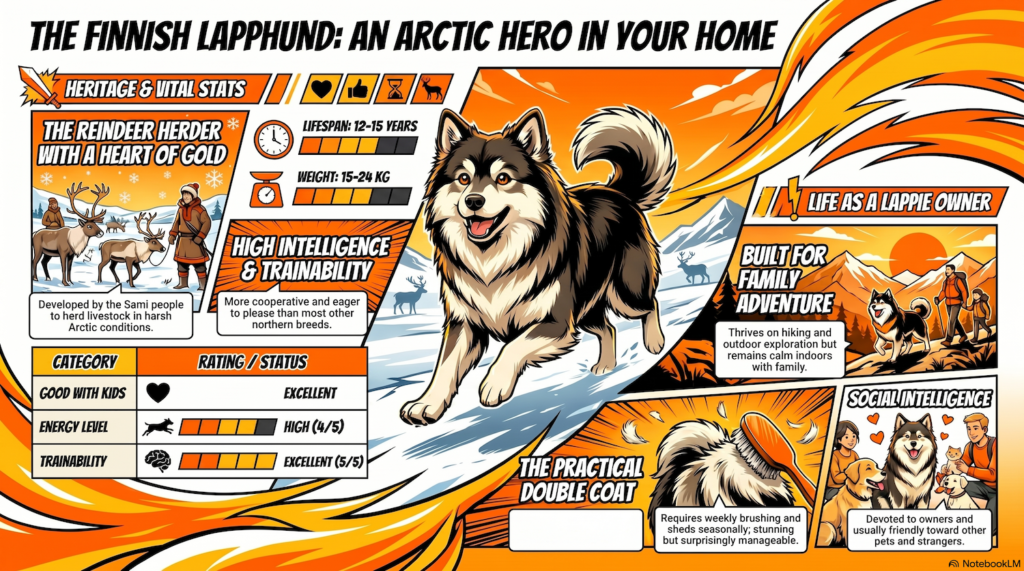
The Finnish Lapphund is a beautiful Spitz-type breed that originated in the Arctic regions of Finland, where it was traditionally used by the Sámi people to herd reindeer. Built to withstand harsh climates, the breed is known for its thick double coat, expressive face, and calm, friendly nature.
Despite its working heritage, the Finnish Lapphund is a gentle and affectionate companion that forms strong bonds with its family. They are intelligent, adaptable, and equally happy joining outdoor adventures or relaxing at home after a day of activity.
✅ PROS & CONS
Pros
- Friendly and affectionate with family
- Highly intelligent and eager to learn
- Great with children and other pets
- Adaptable and easy-going temperament
Cons
- Heavy seasonal shedding
- Needs regular brushing
- Requires daily exercise and mental stimulation
- Can be vocal when excited or alerting owners
Is a Finnish Lapphund a Good Family Dog?
Yes. The Finnish Lapphund is generally an excellent family dog for an active household.
Lapphunds are typically affectionate, gentle, intelligent and strongly attached to their families. Their historical work required them to cooperate closely with people while remaining confident around large reindeer herds.
They can be particularly appealing to families wanting a northern-looking dog that’s generally more cooperative and handler-focused than many traditional sled breeds.
How Much Exercise Does a Finnish Lapphund Need?
Most adult Finnish Lapphunds need around 60–90 minutes of daily exercise, combined with mental stimulation.
Walking, hiking, scent work, obedience, agility and interactive games can all suit the breed.
They’re energetic working dogs but usually aren’t as relentlessly demanding as breeds such as the Border Collie or Belgian Malinois.
Is a Finnish Lapphund Easy to Train?
Yes. Finnish Lapphunds are intelligent and generally highly trainable.
They were bred to work cooperatively with reindeer herders, which encouraged responsiveness to people.
They can still display independent Spitz thinking, particularly when something more interesting captures their attention.
Positive reinforcement and varied training usually produce excellent results.
Does a Finnish Lapphund Shed?
Yes — a lot.
Finnish Lapphunds have a dense double coat and typically shed throughout the year, with extremely heavy seasonal coat blows.
During major shedding periods, loose undercoat can seem almost endless.
Anyone considering the breed should be comfortable with dog hair becoming a regular household feature.
Is a Finnish Lapphund Hypoallergenic?
No. Finnish Lapphunds aren’t considered hypoallergenic.
Their abundant double coats shed heavily and distribute dander throughout the environment.
People with significant dog allergies should spend time around adult Lapphunds before considering ownership.
How Often Does a Finnish Lapphund Need Grooming?
A Finnish Lapphund generally needs thorough brushing once or twice each week, increasing substantially during seasonal shedding.
The coat is relatively functional and doesn’t normally require extensive clipping.
Areas behind the ears, around the legs and beneath the tail deserve additional attention.
Routine nail, ear and dental care is also important.
Should You Shave a Finnish Lapphund?
Generally, no.
The Finnish Lapphund’s double coat provides insulation and environmental protection.
Regularly shaving it can interfere with normal coat function and regrowth.
Loose undercoat should instead be removed through appropriate brushing, unless clipping is medically necessary.
What Health Problems Are Common in Finnish Lapphunds?
Potential health concerns include hip dysplasia, progressive retinal atrophy and other eye disorders, along with certain inherited metabolic conditions found in some lines.
Responsible breeders should perform relevant health and DNA testing.
The breed is generally regarded as reasonably robust, but no pedigree population is free from inherited disease.
What Is Progressive Retinal Atrophy in Finnish Lapphunds?
Progressive retinal atrophy (PRA) is a group of inherited eye diseases in which retinal cells gradually deteriorate.
Affected dogs progressively lose vision and may eventually become blind.
DNA testing is available for relevant inherited forms, allowing responsible breeders to avoid producing affected puppies.
Dogs can adapt remarkably well to gradual vision loss, but prevention through responsible breeding remains preferable.
What Is Pompes Disease in Finnish Lapphunds?
Pompe disease, also known as glycogen storage disease type II, is a serious inherited metabolic disorder that has been identified in Finnish Lapphunds.
It affects the body’s ability to process stored glycogen properly.
Fortunately, DNA testing allows carriers to be identified.
Careful breeding can prevent affected puppies while retaining healthy carriers within appropriately managed breeding programmes.
How Long Do Finnish Lapphunds Live?
Finnish Lapphunds commonly live around 12–15 years.
Some individuals live longer.
Responsible breeding, maintaining a healthy body weight, regular exercise and preventive veterinary care all influence longevity.
For a medium-sized northern working breed, they generally have a good lifespan.
How Big Does a Finnish Lapphund Get?
Finnish Lapphunds are medium-sized dogs, although their enormous coats can make them look considerably larger.
Males are ideally around 49 cm at the shoulder, while females are around 44 cm, with some variation permitted.
Adults commonly weigh approximately 15–24 kg, depending on sex and build.
Under all that fur is a surprisingly moderate-sized dog.
Can a Finnish Lapphund Live in an Apartment?
Yes. A Finnish Lapphund can adapt to apartment living if given enough exercise and mental stimulation.
Their moderate size is helpful.
Barking may be the greater challenge because Lapphunds have historically used their voices extensively while working reindeer.
Training becomes especially important when neighbours share walls.
Do Finnish Lapphunds Bark a Lot?
They can be very vocal.
Barking had genuine value during reindeer herding, helping dogs move animals and allowing herders to locate dogs within large herds and difficult terrain.
Modern Lapphunds may bark when excited, alerting or playing.
Early training can teach when barking is appropriate without expecting a naturally vocal breed to become completely silent.
Why Are Finnish Lapphunds So Vocal?
Their voice was historically part of their working toolkit.
A reindeer-herding dog needed to influence fast-moving animals while communicating its location to human handlers.
Barking therefore wasn’t merely tolerated — it could be useful.
The modern Lapphund’s enthusiasm for commentary has very practical historical roots.
Can a Finnish Lapphund Be Left Alone?
Adult Finnish Lapphunds can learn to spend reasonable periods alone, but they’re generally social and strongly attached to their families.
They aren’t ideal for routinely spending entire days isolated.
Bored or lonely Lapphunds may become destructive or particularly vocal.
Gradual independence training is useful from puppyhood.
Are Finnish Lapphunds Good With Children?
Yes. Finnish Lapphunds are generally excellent family dogs and often very good with children.
They’re typically affectionate, playful and relatively gentle.
Their herding ancestry may occasionally produce chasing or attempts to control movement, particularly in young dogs.
Supervision and early training help establish appropriate behaviour.
Are Finnish Lapphunds Good With Other Dogs?
Usually, yes.
Finnish Lapphunds tend to be social with other dogs, especially when properly socialised.
Their historical work could involve dogs operating around other working dogs and large groups of animals.
Individual personalities still vary, but severe dog aggression isn’t considered typical breed behaviour.
Are Finnish Lapphunds Good With Cats?
Many Finnish Lapphunds can live successfully with cats, particularly when raised alongside them.
Their prey drive is generally more manageable than that of many hunting-focused northern breeds.
However, chasing instinct can still occur.
Gradual introductions and appropriate supervision remain important.
Do Finnish Lapphunds Have a Strong Prey Drive?
Prey drive is generally moderate and variable.
The Finnish Lapphund’s primary historical role became reindeer herding rather than independently hunting large game.
Some individuals will still chase wildlife.
Recall should therefore be trained carefully before allowing unrestricted off-leash freedom.
Do Finnish Lapphunds Have a Strong Herding Instinct?
Many retain clear herding behaviours, although intensity varies between breeding lines.
They may circle, chase movement, bark or attempt to influence the direction of people and animals.
These instincts reflect generations of working with reindeer.
Herding activities and dog sports can provide constructive outlets.
Do Finnish Lapphunds Nip at Heels?
Some may, particularly as puppies.
Heel nipping can emerge from herding instincts and excitement, although it shouldn’t simply be accepted as unavoidable breed behaviour.
Consistent training can redirect the behaviour towards appropriate activities.
Modern family members don’t need to be managed like an escaping reindeer herd.
Can a Finnish Lapphund Be Trusted Off Leash?
Many Finnish Lapphunds can develop good recall and off-leash reliability.
They’re generally cooperative with their owners and often less prone to long-distance roaming than some northern breeds.
However, wildlife and interesting scents can still become distracting.
Recall should be thoroughly trained and proofed before trusting the dog in unfenced areas.
Are Finnish Lapphunds Good Hiking Dogs?
Yes. Finnish Lapphunds can make excellent hiking companions.
They’re agile, sturdy and historically accustomed to travelling over demanding northern terrain.
Cool-weather hiking particularly suits them.
Their heavy coat means owners need to be much more cautious during warm conditions.
Are Finnish Lapphunds Good Running Dogs?
Healthy adult Finnish Lapphunds can enjoy moderate running, although they’re generally better suited to varied outdoor activity than relentless high-speed distance work.
Structured running should wait until skeletal maturity.
Hot-weather running is particularly inappropriate because of their dense northern coat.
Do Finnish Lapphunds Like Snow?
Most are exceptionally well equipped for snow and cold weather.
Their dense double coats, northern ancestry and historical work in Arctic and sub-Arctic environments make low temperatures relatively comfortable.
Many become noticeably more energetic when winter arrives.
For a Lapphund, weather that makes its owner reconsider leaving the house may be absolutely perfect.
Do Finnish Lapphunds Handle Cold Weather Well?
Extremely well.
The Finnish Lapphund developed in northern Scandinavia, where working dogs had to function through severe winters.
Its thick undercoat provides substantial insulation.
Cold tolerance doesn’t mean the dog should be isolated outdoors; Lapphunds remain strongly people-oriented family dogs.
Do Finnish Lapphunds Handle Hot Weather Well?
Heat requires considerably more caution.
The breed’s thick double coat evolved for cold northern climates, not extreme heat.
Exercise should occur during cooler parts of the day, with constant access to shade, water and cool indoor areas.
This is particularly important for Finnish Lapphunds living in Australia.
Do Finnish Lapphunds Like Water?
Some do, although the breed isn’t a specialised water dog.
Individual Finnish Lapphunds may enjoy swimming, paddling or playing in water, while others are indifferent.
Their enormous coats become heavy when soaked and should be allowed to dry thoroughly.
What Does a Finnish Lapphund Look Like?
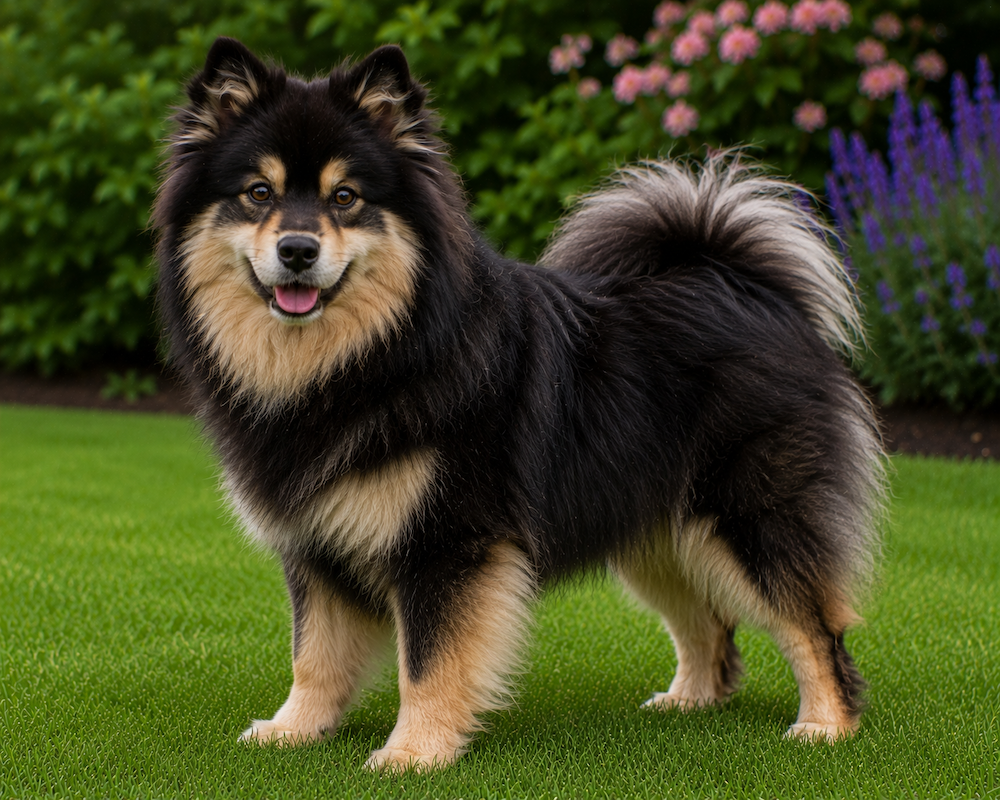
The Finnish Lapphund is a medium-sized Spitz dog with a thick double coat, erect or semi-erect ears, expressive eyes and a heavily coated tail often carried over the back.
Its abundant neck and chest coat can create a particularly impressive mane.
Despite its fluffy appearance, the breed should remain agile and functional underneath.
Why Does a Finnish Lapphund Have Such a Thick Coat?
The coat developed to protect working dogs in the harsh northern climate of Finland and Lapland.
A dense soft undercoat provides insulation, while longer guard hairs help protect against snow and weather.
The coat is therefore functional equipment rather than simply decorative fluff.
Why Does a Finnish Lapphund Have a Curled Tail?
The tail carried over or along the back is a classic Spitz characteristic.
A heavily coated tail also provides useful insulation.
Northern dogs can curl themselves tightly when resting and use their tails around the body and face for additional protection from cold conditions.
Why Does My Finnish Lapphund Have Semi-Floppy Ears?
Finnish Lapphund ears may be erect or semi-erect, depending on the individual and breed standard.
This can give some dogs an especially expressive appearance.
Unlike breeds where perfectly upright ears are mandatory, a degree of variation is normal within the Finnish Lapphund.
What Colours Can Finnish Lapphunds Be?
Finnish Lapphunds occur in a wide variety of colours.
These can include black, brown, cream, sable, wolf-sable and combinations with lighter markings.
One colour should generally dominate the overall appearance.
The breed’s extensive colour variation means two Finnish Lapphunds can look surprisingly different.
Can Finnish Lapphunds Be Black and Tan?
Yes. Black with tan or cream markings is one of the breed’s most familiar appearances.
Light markings can occur around the face, chest, legs and underside.
The expressive lighter “spectacles” around the eyes can give some Lapphunds an especially distinctive face.
Can Finnish Lapphunds Be Brown?
Yes. Brown Finnish Lapphunds occur and can range from rich chocolate-like shades to lighter brown combinations.
Pigmentation of the nose and eye rims generally corresponds with coat genetics.
Brown dogs can look dramatically different from the more familiar black-and-tan examples.
Can Finnish Lapphunds Be Cream?
Yes. Very light cream or pale-coloured Finnish Lapphunds occur.
Their heavy coats can create an appearance superficially reminiscent of other northern Spitz breeds.
However, structure, temperament and breed history distinguish them clearly.
Is a Finnish Lapphund the Same as a Lapponian Herder?
No. The Finnish Lapphund and Lapponian Herder are separate breeds.
Both share northern Finnish and Sámi reindeer-working heritage.
The Finnish Lapphund is more heavily coated and Spitz-like, while the Lapponian Herder is generally longer-bodied with a shorter coat and a distinctly different silhouette.
What Is the Difference Between a Finnish Lapphund and a Lapponian Herder?
The Finnish Lapphund is compact, heavily coated and distinctly Spitz-like.
The Lapponian Herder is generally more rectangular, lighter-coated and visually closer to a conventional herding dog.
Both developed from northern reindeer-working populations.
Their formal separation into distinct breeds reflects different working and physical types within those populations.
Is a Finnish Lapphund the Same as a Swedish Lapphund?
No. The Finnish Lapphund and Swedish Lapphund are distinct breeds.
Both belong to the northern Lapphund/Spitz family and share connections with traditional Sámi culture and reindeer work.
The Swedish Lapphund is generally rarer and usually much more restricted in colour.
Is a Finnish Lapphund Related to the Swedish Lapphund?
Yes. The breeds share deep regional and functional connections within northern Scandinavia.
Traditional northern herding dogs existed long before modern national kennel clubs separated them into formal breeds.
Today’s Finnish and Swedish Lapphunds represent different standardised populations emerging from this broader working-dog tradition.
Is a Finnish Lapphund Related to the Samoyed?
Both are northern Spitz breeds, but the Finnish Lapphund isn’t simply a smaller or multicoloured Samoyed.
They developed from different regional working populations and cultural traditions.
The Samoyed is associated with Siberian Samoyedic peoples, while the Finnish Lapphund is closely associated with Sámi reindeer-herding traditions in northern Fennoscandia.
Is a Finnish Lapphund Related to the Siberian Husky?
They’re both northern Spitz-type dogs but are distinct breeds with very different working histories.
Siberian Huskies became specialised endurance sled dogs.
Finnish Lapphunds became strongly associated with reindeer herding.
That difference helps explain why Lapphunds are often more naturally handler-focused and easier to train for close cooperative work.
Is a Finnish Lapphund a Sled Dog?
No. The Finnish Lapphund is primarily a reindeer-herding breed rather than a specialised sled dog.
Individual dogs can certainly learn pulling sports.
However, comparing them with Siberian Huskies based purely on their northern appearance overlooks the very different jobs for which the breeds were developed.
Is a Finnish Lapphund a Reindeer Dog?
Yes. Reindeer herding is central to the breed’s history.
Finnish Lapphund ancestors worked with Sámi reindeer herders across northern Fennoscandia.
The dogs helped gather, move and control reindeer over vast and difficult landscapes.
This working relationship shaped the breed’s agility, intelligence, voice and cooperative temperament.
How Can a Dog Herd Reindeer?
Reindeer are fast, agile animals, so a herding dog needs speed, confidence, intelligence and excellent responsiveness.
Lapphund-type dogs used movement and barking to influence the herd.
They also needed enough judgement to avoid being injured.
The work could involve covering substantial distances through snow, forests and open northern terrain.
Why Did Finnish Lapphunds Bark While Herding Reindeer?
Barking helped the dog move and influence reindeer while remaining audible to the human herder.
In large herds or difficult terrain, knowing where the dog was working could be extremely useful.
This helps explain why vocal behaviour remains so deeply embedded in the modern breed.
A barking Lapphund isn’t necessarily malfunctioning — historically, its ancestors were being useful.
Were Finnish Lapphunds Originally Hunting Dogs?
The ancestors of modern Lapphunds were associated with northern communities whose dogs likely performed multiple functions, including hunting before reindeer pastoralism became increasingly important.
As large-scale reindeer herding developed, specialised herding behaviour became central.
Trying to assign one unchanging job across thousands of years oversimplifies the history of northern dogs.
Who Are the Sámi?
The Sámi are Indigenous peoples of northern Europe, traditionally inhabiting regions across what are now northern Norway, Sweden, Finland and Russia’s Kola Peninsula.
Different Sámi communities historically practised combinations of fishing, hunting and reindeer husbandry.
Dogs played important practical roles in these northern lifestyles.
The Finnish Lapphund’s history can’t be properly understood without this cultural connection.
Is “Lapland” a Country?
No. Lapland is a geographical and cultural region, not an independent country.
It extends across northern parts of Finland, Sweden, Norway and Russia.
The Finnish region called Lapland is only part of this wider northern area.
This is why Lapphund-type dogs have histories extending beyond modern Finnish borders.
What Does “Lapphund” Mean?
“Lapphund” essentially refers historically to a dog associated with Lapland, particularly the northern Spitz dogs used by Sámi communities.
Modern terminology increasingly favours “Sámi” when referring to the Indigenous people themselves because older terms related to “Lapp” can be considered outdated or inappropriate in some contexts.
The established dog breed name, however, remains Finnish Lapphund.
What Is the Finnish Name for the Finnish Lapphund?
In Finland, the breed is called Suomenlapinkoira.
“Suomen” relates to Finland, “lapin” to Lapland and “koira” means dog.
The name therefore closely reflects the English “Finnish Lapphund.”
How Do You Pronounce Suomenlapinkoira?
A reasonable English approximation is “SWOH-men lah-pin-KOY-rah.”
The exact Finnish pronunciation contains sounds and rhythm that don’t map perfectly onto English.
It’s the native Finnish breed name and literally identifies the dog with Finland and Lapland.
Is the Finnish Lapphund an Ancient Breed?
Its working ancestors are very old, but the modern standardised Finnish Lapphund is much more recent.
Northern Spitz dogs have accompanied people in Fennoscandia for centuries and probably far longer.
However, today’s pedigree breed was formally defined through organised breeding during the 20th century.
Ancient working ancestry and modern kennel-club recognition shouldn’t be treated as the same thing.
Are Finnish Lapphunds Closely Related to Ancient Northern Dogs?
Finnish Lapphunds belong to the broader northern Spitz tradition, with deep roots in northern Eurasian dog populations.
However, dramatic claims that today’s breed is unchanged for thousands of years should be treated cautiously.
Modern breeds are shaped by relatively recent selection, breed standards and closed registries even when their ancestral populations are much older.
When Did the Finnish Lapphund Become an Official Breed?
Organised efforts to document and standardise Finnish Lapland dogs accelerated during the 20th century, particularly around the 1940s.
Early standards encompassed northern working dogs that would later be separated more clearly into different breeds and types.
The modern Finnish Lapphund identity developed gradually through subsequent decades.
Was the Finnish Lapphund Once Called the Lapponian Shepherd Dog?
Historical breed classification and naming changed as Finnish kennel organisations worked to separate different Lapland reindeer-herding dog types.
The heavily coated Lapphund and the shorter-coated herding type were eventually recognised separately.
This history helps explain occasional confusion between Finnish Lapphunds and Lapponian Herders.
Why Did Finnish Lapphunds Almost Lose Their Traditional Job?
The arrival of snowmobiles and other motorised transport transformed reindeer husbandry during the 20th century.
Machines could cover enormous distances quickly and reduced reliance on dogs for some herding tasks.
Fortunately, reindeer dogs weren’t rendered completely obsolete, and interest in preserving their cultural and working heritage continued.
Are Finnish Lapphunds Still Used to Herd Reindeer?
Yes. Dogs continue to have a role in reindeer management, although modern methods also use snowmobiles, helicopters and other technology.
Not every modern Finnish Lapphund comes from active working lines.
Nevertheless, reindeer herding remains an important part of the breed’s identity and history.
Why Is the Finnish Lapphund So Good at Dog Sports?
Reindeer work required agility, intelligence, responsiveness, stamina and rapid decision-making.
Those same characteristics translate extremely well into modern activities such as agility, obedience, rally, tracking and scent work.
Dog sports can therefore provide a suburban Lapphund with an outlet for abilities originally developed hundreds of kilometres north of anything resembling suburbia.
Is the Finnish Lapphund a Rare Breed?
Globally, the Finnish Lapphund is still relatively uncommon, although it’s well established and appreciated in Finland and has growing populations in countries including Australia.
Its striking appearance has increased international interest.
Responsible breeding remains important because rapid popularity can reduce attention to health and temperament.
Is the Finnish Lapphund Popular in Finland?
Yes. The Finnish Lapphund is a well-known and much-loved Finnish breed and has ranked among the country’s popular registered dogs.
Its appeal extends beyond reindeer work.
The combination of family-friendly temperament, manageable size and unmistakably northern appearance has made it a successful modern companion.
Is the Finnish Lapphund Finland’s National Dog?
No. That distinction belongs to the Finnish Spitz.
The Finnish Lapphund is nevertheless one of Finland’s most culturally significant native breeds.
Its connection to northern reindeer husbandry and Sámi working traditions gives it an especially distinctive place in Finnish canine history.
What Is the Difference Between a Finnish Lapphund and a Finnish Spitz?
They’re very different breeds despite sharing Finland and Spitz characteristics.
The Finnish Lapphund was primarily developed as a reindeer-herding dog, while the Finnish Spitz became a specialised hunting dog famous for locating game birds and barking to indicate their position.
The Lapphund is generally heavier-coated, more varied in colour and more obviously herding-oriented.
Why Is the Finnish Lapphund Sometimes Called a “Reindeer Herder With a Smile”?
The description captures the breed’s combination of northern Spitz appearance, friendly expression and genuine reindeer-working history.
The smiling appearance comes partly from facial structure and expression rather than constant happiness.
Still, it suits a breed generally known for being cheerful, affectionate and highly engaged with its family.
Where Does the Finnish Lapphund Come From?
The Finnish Lapphund comes from the far north of Finland and the wider Fennoscandian region, where its ancestors worked alongside Sámi communities and became particularly important in reindeer herding.
These dogs needed to be agile enough to dodge reindeer, tough enough to work in Arctic conditions, intelligent enough to make decisions and cooperative enough to remain connected with their human handlers.
Modern technology eventually replaced some of their traditional work, but the characteristics survived. That’s why today’s Finnish Lapphund can look like a fluffy family teddy bear while still possessing the instincts of a northern working dog — including a spectacular winter coat, an impressive brain and a firm ancestral belief that important events should probably be announced by barking.