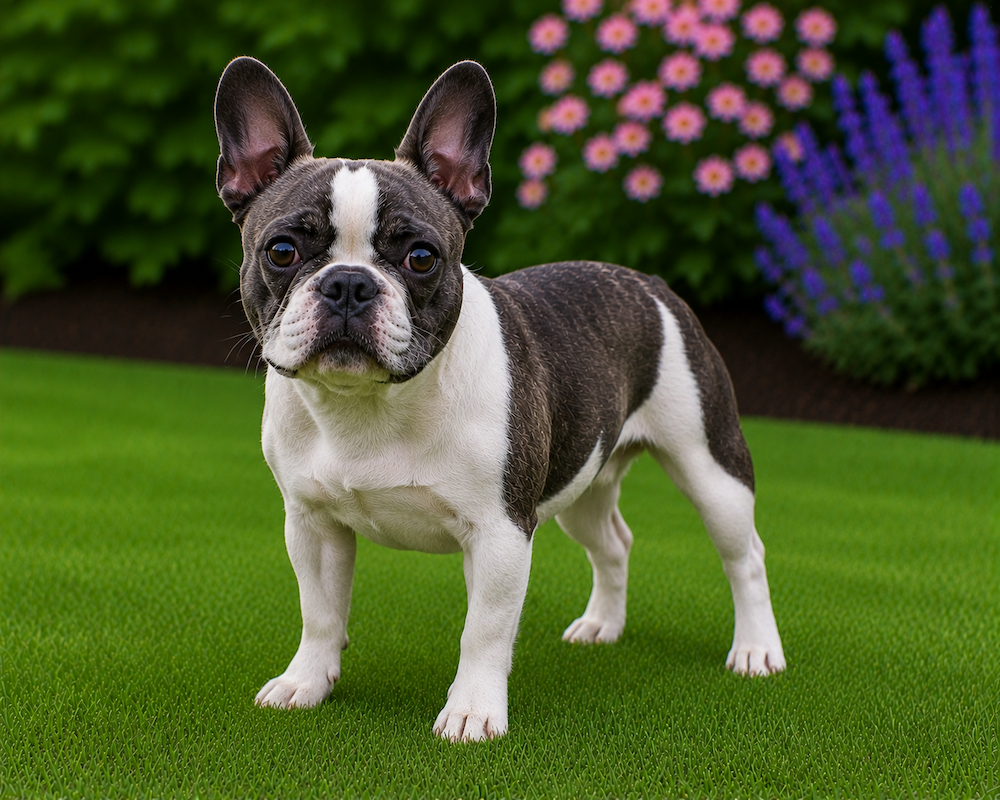



Playful, affectionate, and full of charm — a lovable companion that blends the best of the French Bulldog and Boston Terrier.e.
🧠 QUICK SNAPSHOT
- Temperament: Friendly, affectionate, playful
- Energy Level: Moderate
- Size: Small
- Good With Families: Yes
- Trainability: Moderate to high
- Grooming: Low
- Best For: Families, apartment living, companionship
📚 OVERVIEW
The Frenchton is a cross between a French Bulldog and a Boston Terrier, combining the playful personality of both breeds into a compact, muscular companion. Known for their expressive faces and affectionate nature, Frenchtons are social dogs that love being around people and quickly become part of the family.
They are adaptable, entertaining, and generally easier to train than many people expect, making them a popular choice for first-time and experienced dog owners alike.
✅ PROS & CONS
Pros
- Extremely affectionate and family-oriented
- Excellent apartment companion
- Low grooming requirements
- Friendly with children and other pets
Cons
- May inherit breathing issues from its brachycephalic parents
- Sensitive to hot weather
- Can develop separation anxiety
- Needs weight management and moderate daily exercise
Is a Frenchton a Good Family Dog?
Yes. Frenchtons are generally affectionate, playful and people-oriented family dogs.
A Frenchton is a cross between a French Bulldog and a Boston Terrier, two breeds developed primarily as companions. Many inherit a sociable, entertaining personality and enjoy being closely involved in family life.
As with any crossbreed, temperament can vary depending on the parents and early socialisation.
What Breeds Make a Frenchton?
A Frenchton is a cross between a French Bulldog and a Boston Terrier.
Other names sometimes used include Frenchbo, Faux Frenchbo and Boston Frenchie, although Frenchton is by far the most familiar.
Because it’s a cross rather than a standardised pedigree breed, individual Frenchtons can inherit very different combinations of characteristics from the two parents.
How Much Exercise Does a Frenchton Need?
Most adult Frenchtons need around 30–60 minutes of moderate exercise each day, often divided into shorter walks and play sessions.
Boston Terrier influence can make some noticeably more energetic than the average French Bulldog.
However, both parent breeds are brachycephalic, so strenuous exercise and hot-weather activity require particular caution.
Is a Frenchton Easy to Train?
Generally, yes.
Frenchtons are typically intelligent, food-motivated and interested in their owners, although they can also inherit a stubborn streak.
Positive reinforcement and short, entertaining training sessions usually work best.
Their Boston Terrier ancestry may contribute additional enthusiasm and responsiveness.
Does a Frenchton Shed?
Yes. Frenchtons usually have short coats that shed moderately.
Weekly brushing is generally enough to remove loose hair and maintain the coat.
Despite the short fur, the small stiff hairs can become surprisingly noticeable on clothing, furniture and car seats.
Is a Frenchton Hypoallergenic?
No. Frenchtons aren’t considered hypoallergenic.
Both French Bulldogs and Boston Terriers shed and produce normal canine allergens through saliva and skin secretions.
People with significant allergies should spend time around adult dogs before considering ownership.
How Often Does a Frenchton Need Grooming?
Frenchtons are generally low-maintenance in terms of coat grooming.
Weekly brushing, occasional bathing, nail trimming, dental care and ear checks usually cover the basics.
Dogs inheriting deeper French Bulldog-style facial folds may also require regular fold cleaning and careful drying.
What Health Problems Are Common in Frenchtons?
Potential concerns include brachycephalic airway problems, heat intolerance, eye disorders, patellar luxation, allergies and spinal disease.
Because both parent breeds are brachycephalic, crossing them doesn’t automatically eliminate breathing problems.
Health depends greatly on the anatomy and genetics of the individual parents.
Can Frenchtons Have BOAS?
Yes. Frenchtons can develop Brachycephalic Obstructive Airway Syndrome (BOAS).
Both French Bulldogs and Boston Terriers have shortened skulls and can experience airway obstruction.
A Frenchton with a somewhat longer muzzle may breathe better than an extremely flat-faced parent, but muzzle length alone doesn’t guarantee healthy internal airway anatomy.
Do Frenchtons Breathe Better Than French Bulldogs?
Some do, but it isn’t guaranteed.
A Frenchton that inherits a longer muzzle, wider nostrils and less extreme facial anatomy may have better respiratory function than a severely brachycephalic French Bulldog.
However, Boston Terriers are themselves brachycephalic.
The cross should therefore never be marketed as automatically free from French Bulldog breathing problems.
Is a Longer-Nosed Frenchton Healthier?
Potentially, particularly when the longer muzzle accompanies open nostrils and more functional airway anatomy.
However, facial appearance alone can’t reveal everything happening inside the airway.
Parent health, respiratory testing, body condition and overall structure matter.
Selecting specifically for healthier anatomy is more meaningful than simply choosing the puppy with the longest visible nose.
Do Frenchtons Snore?
Many do.
Their shortened facial anatomy can produce snoring, snorting and other respiratory noises.
Mild sleep noise may occur, but persistent noisy breathing while awake, exercise intolerance or obvious respiratory effort shouldn’t simply be considered normal.
A dog should be able to breathe comfortably.
Do Frenchtons Overheat Easily?
Yes. Frenchtons can be particularly susceptible to heat stress because both parent breeds are brachycephalic.
Panting becomes less effective when airflow is restricted.
Exercise should be limited during hot or humid conditions, with walks scheduled during cooler periods.
This is particularly important in hot climates.
Can Frenchtons Swim?
Frenchtons should be treated as potentially poor swimmers.
The French Bulldog’s heavy front end and brachycephalic structure can make swimming difficult, while Boston Terrier ancestry doesn’t guarantee strong swimming ability.
Individual capability varies.
Close supervision and a properly fitted canine life jacket are sensible around pools, boats and deep water.
Are Frenchtons Prone to Back Problems?
They can be.
French Bulldogs have significant predispositions to vertebral abnormalities and intervertebral disc disease, and some Frenchtons may inherit related structural risks.
Boston Terriers can also experience vertebral abnormalities associated with screw tails.
Back pain, weakness or sudden difficulty walking requires prompt veterinary attention.
What Is IVDD in Frenchtons?
Intervertebral disc disease (IVDD) occurs when discs between spinal vertebrae degenerate, bulge or rupture.
Pressure on the spinal cord can cause pain, weakness or paralysis.
A Frenchton inheriting chondrodystrophic or abnormal spinal characteristics may be at increased risk.
Sudden inability to walk is a veterinary emergency.
Are Frenchtons Prone to Eye Problems?
Yes. Both parent breeds have large, prominent eyes, which can increase susceptibility to injury and disease.
Potential problems include corneal ulcers, dry eye and cherry eye.
Squinting, redness, cloudiness or suddenly keeping an eye closed should receive prompt veterinary attention.
Are Frenchtons Prone to Skin Allergies?
They can be.
French Bulldogs in particular have a substantial predisposition to allergic skin disease, and Frenchtons may inherit this tendency.
Signs can include paw licking, recurrent ear infections, itching, redness and hair loss.
Persistent skin problems should be investigated rather than treated solely with repeated shampoos.
Are Frenchtons Prone to Patellar Luxation?
Patellar luxation can occur in Frenchtons.
It happens when the kneecap moves out of its normal position, sometimes producing intermittent skipping or lifting of a hind leg.
Severity varies considerably.
Responsible breeders should consider orthopaedic health in both parent dogs.
How Long Do Frenchtons Live?
Frenchtons commonly live around 11–14 years, although there’s substantial individual variation.
Longevity depends on genetics, breathing function, spinal health, body condition and general veterinary care.
Being a crossbreed doesn’t automatically guarantee a longer lifespan than either parent breed.
How Big Does a Frenchton Get?
Most Frenchtons are small, compact dogs, commonly weighing around 7–13 kg.
Height often falls roughly between 28 and 40 cm at the shoulder.
Because the cross isn’t standardised, some individuals may fall outside these ranges.
Are There Mini Frenchtons?
“Mini Frenchton” isn’t an officially recognised size.
The term is generally used as a marketing description for particularly small Frenchtons.
Extreme miniaturisation can increase health risks and shouldn’t be considered automatically desirable.
Parent size and health are more meaningful than labels such as Mini or Micro.
Are There Teacup Frenchtons?
“Teacup Frenchton” is a marketing term rather than a recognised variety.
There is no official Teacup Frenchton breed standard.
Deliberately breeding for extreme smallness can increase the risk of skeletal, metabolic and developmental problems.
Very small size shouldn’t command a premium simply because it’s unusual.
Can a Frenchton Live in an Apartment?
Yes. Frenchtons are generally very well suited to apartment living.
They’re compact, have moderate exercise requirements and usually enjoy spending time indoors with their families.
Barking and separation behaviour still require training, but space itself usually isn’t the main challenge.
Do Frenchtons Bark a Lot?
Usually not excessively.
Both parent breeds can alert to unusual sounds, but Frenchtons are generally moderate barkers.
Some individuals inherit more of the Boston Terrier’s alertness and enthusiasm.
Boredom and separation distress can also increase vocal behaviour.
Can a Frenchton Be Left Alone?
Frenchtons are typically strongly people-oriented, so long periods of isolation may be difficult.
Some can develop separation-related behaviour.
Gradual independence training from puppyhood is valuable.
They’re generally best suited to households where they’ll receive regular companionship and interaction.
Are Frenchtons Cuddly?
Very often.
Both French Bulldogs and Boston Terriers tend to be affectionate companion dogs, and Frenchtons frequently inherit this characteristic.
Many enjoy laps, sofas and sleeping against their owners.
Personal space may become more of a theoretical concept once a Frenchton moves in.
Why Does My Frenchton Follow Me Everywhere?
Close attachment to people comes from both sides of the family tree.
French Bulldogs and Boston Terriers were developed primarily as companion dogs rather than independent working breeds.
Many Frenchtons therefore prefer remaining near their owners and following household activity.
Are Frenchtons Good With Children?
Generally, yes.
Well-socialised Frenchtons tend to be playful, affectionate and sturdy enough for sensible family life.
Children should still learn appropriate handling.
Particular care is necessary if the dog has back, breathing or other physical problems that could make rough play uncomfortable.
Are Frenchtons Good With Other Dogs?
Usually, yes.
Frenchtons are often social and playful with other dogs when properly socialised.
Individual temperament still varies.
Early positive experiences help prevent fearfulness and improve canine social skills.
Are Frenchtons Good With Cats?
Many Frenchtons can live successfully with cats, especially when introduced appropriately or raised together.
Neither parent breed was primarily developed for high-intensity hunting.
Some individuals will still chase moving animals, so compatibility shouldn’t simply be assumed.
Are Frenchtons Aggressive?
Frenchtons aren’t generally expected to be aggressive.
Both parent breeds are primarily companion dogs, and a friendly, confident temperament is desirable.
Poor socialisation, fear, pain or irresponsible breeding can still produce behavioural problems.
Sudden aggression in a normally friendly dog should also raise the possibility of pain.
Are Frenchtons Good Watchdogs?
They can be useful alert watchdogs.
Many notice visitors and unusual sounds quickly.
Their small size means they’re not conventional protection dogs.
Most are much better suited to announcing that someone has arrived than doing anything particularly intimidating about it.
Are Frenchtons Energetic?
Frenchtons usually have moderate energy, although individuals leaning towards their Boston Terrier ancestry can be surprisingly lively.
They often enjoy energetic play followed by equally enthusiastic sofa time.
Their breathing ability should always determine how much strenuous exercise is appropriate.
Do Frenchtons Get the Zoomies?
Absolutely.
Many Frenchtons display spectacular bursts of high-speed playful running, commonly called zoomies.
These are generally normal.
Because of brachycephalic breathing limitations, owners should prevent prolonged overexertion, particularly during hot weather.
Are Frenchtons Good Running Dogs?
Generally, they’re not ideal distance-running companions.
Even athletic individuals can inherit brachycephalic airway limitations.
Short runs and energetic play may suit healthy adults, but prolonged endurance exercise can place excessive demands on breathing and temperature regulation.
Why Does My Frenchton Fart So Much?
Flatulence can occur because brachycephalic dogs may swallow extra air while eating, drinking and breathing.
Dietary sensitivity can contribute as well.
Slow feeding may help some dogs.
Persistent gas combined with diarrhoea, vomiting or abdominal discomfort deserves veterinary investigation.
Why Does My Frenchton Snort?
The shortened muzzle inherited from both parents can create snorting and nasal noises.
Occasional sounds may occur during excitement.
Frequent noisy breathing or respiratory effort while resting isn’t something that should simply be dismissed as a cute Frenchton characteristic.
Why Does My Frenchton Have Upright Ears?
Both French Bulldogs and Boston Terriers normally have erect ears, so upright ears are extremely common in Frenchtons.
Puppies may temporarily have floppy or uneven ears while developing.
The eventual shape can range from broad Frenchie-style “bat ears” to somewhat narrower Boston-type ears.
Do All Frenchtons Look the Same?
No. Frenchtons can vary substantially because they’re a cross between two breeds rather than a fully standardised breed.
Some look almost like French Bulldogs with slightly longer legs.
Others strongly resemble Boston Terriers with heavier bodies.
Muzzle length, ears, build, tail and colouring can all vary.
How Can You Tell a Frenchton From a French Bulldog?
Frenchtons often have a slightly longer muzzle, lighter build and longer legs than French Bulldogs, although this isn’t guaranteed.
Some display strong Boston Terrier-style markings.
DNA testing or documented parentage is much more reliable than appearance alone because some Frenchtons can look remarkably Frenchie-like.
How Can You Tell a Frenchton From a Boston Terrier?
Frenchtons may have a broader head, heavier body and more muscular French Bulldog-like structure.
However, individuals leaning strongly towards the Boston Terrier can be difficult to identify visually.
Colour isn’t definitive either.
Knowing the dog’s pedigree or using DNA testing provides much better evidence.
What Is the Difference Between a Frenchton and a French Bulldog?
A French Bulldog is an established pedigree breed, while a Frenchton is specifically a French Bulldog × Boston Terrier cross.
Frenchtons may be lighter, leggier and somewhat longer-muzzled.
However, there’s no guarantee because first-generation puppies can inherit very different combinations from their parents.
What Is the Difference Between a Frenchton and a Boston Terrier?
The Boston Terrier is an established breed with a defined standard.
The Frenchton contains French Bulldog ancestry, which can produce a heavier body, broader head and more substantial bone.
Temperament can also fall anywhere between the characteristics of the two parent breeds.
What Colours Can Frenchtons Be?
Frenchtons can inherit a broad range of colours and patterns from their parents.
Common appearances include black and white, brindle and white, brindle, fawn and combinations with white markings.
Non-standard colours can also occur depending on the genetics present in the breeding population.
Why Does My Frenchton Have Tuxedo Markings?
The classic black-and-white or brindle-and-white “tuxedo” pattern is strongly associated with the Boston Terrier.
Frenchtons inheriting these markings can look particularly Boston-like.
The Boston Terrier’s famously neat markings contributed to its nickname, the “American Gentleman.”
Can Frenchtons Be Brindle?
Yes. Brindle occurs in both parent breeds, so it’s very common and completely unsurprising in Frenchtons.
The pattern consists of darker striping over a lighter base colour.
The amount of visible brindling can range from subtle to extremely pronounced.
Can Frenchtons Be Blue?
Dilute pigmentation can occur in Frenchtons if the appropriate recessive dilution genes are present.
These dogs may be marketed as blue.
Rare colouring doesn’t make a dog healthier or higher quality, and dilute coats can sometimes be associated with colour dilution alopecia.
Can Frenchtons Be Merle?
Merle can appear in dogs marketed as Frenchtons, but it isn’t a traditional colour of either the Boston Terrier or French Bulldog foundation populations.
Its presence generally indicates that merle was introduced through other ancestry somewhere in the breeding history.
Merle-to-merle breeding carries a significant risk of producing puppies with serious hearing and eye abnormalities.
Can Frenchtons Have Long Hair?
A Frenchton could theoretically inherit recessive long-coat genetics if those variants are present in the French Bulldog side.
However, the typical Frenchton has a short, smooth coat.
Dogs marketed as unusually fluffy Frenchtons deserve careful investigation of pedigree and parentage.
What Is an F1 Frenchton?
An F1 Frenchton is the first-generation offspring of a purebred French Bulldog and a purebred Boston Terrier.
Genetically, the puppy averages approximately 50% ancestry from each breed.
That doesn’t mean every physical characteristic will appear as an exact 50/50 blend.
What Is an F1B Frenchton?
An F1B Frenchton is generally produced by breeding an F1 Frenchton back to one of the parent breeds.
For example, a Frenchton bred back to a French Bulldog would average more French Bulldog ancestry.
Because breeders don’t always use generation labels consistently, actual parentage should be confirmed.
What Is an F2 Frenchton?
An F2 Frenchton is generally the offspring of two F1 Frenchtons.
Second-generation puppies can display considerable variation because different combinations of genes are inherited.
Moving to another generation doesn’t automatically make appearance or health predictable.
Are Frenchtons Healthier Than French Bulldogs?
They can be, but aren’t automatically.
Crossing genetically different populations can increase diversity, but the Boston Terrier and French Bulldog share several important structural health risks — especially brachycephaly.
If both parents have poor breathing or problematic anatomy, crossbreeding doesn’t magically correct those problems.
Parent selection remains crucial.
Does Hybrid Vigour Make Frenchtons Healthier?
Hybrid vigour, or heterosis, is a genuine genetic phenomenon, but it’s often oversimplified in designer-dog marketing.
Crossing unrelated populations can reduce the chance of some recessive disorders.
However, if both breeds share the same health vulnerability, the offspring can still inherit it.
Hybrid vigour isn’t a substitute for health testing.
Is a Frenchton a Designer Dog?
Yes. The Frenchton is generally described as a designer crossbreed.
The term refers to intentionally crossing two established breeds with the aim of combining particular characteristics.
Unlike the French Bulldog and Boston Terrier, the Frenchton isn’t currently a universally recognised pedigree breed with a single established international standard.
Is the Frenchton Recognised by Major Kennel Clubs?
Frenchtons aren’t recognised as a distinct pedigree breed by major traditional kennel organisations such as the Australian National Kennel Council, American Kennel Club or Fédération Cynologique Internationale.
That doesn’t prevent them from being popular companion dogs.
It does mean there’s no universally enforced breed standard controlling size, structure or appearance.
Is a Frenchton the Same as a Faux Frenchbo?
Usually, yes.
Faux Frenchbo is one of several names that have been used for French Bulldog × Boston Terrier crosses.
Frenchton has become the most widely recognised name.
Whenever buying a designer cross, documented parentage matters more than the creative name attached to it.
Is a Frenchton the Same as a Frenchbo?
Names such as Frenchbo, Faux Frenchbo and Boston Frenchie are sometimes used for French Bulldog-Boston Terrier crosses.
Naming isn’t standardised.
A breeder using one of these terms should still clearly explain exactly which breeds and generations are behind the puppies.
Why Is It Called a Frenchton?
The name combines parts of French Bulldog and Boston Terrier.
“French” comes from the French Bulldog, while “ton” comes from Boston.
Designer cross names frequently use this portmanteau approach.
It’s considerably easier to say than “French Bulldog-Boston Terrier cross” every time.
When Was the Frenchton Created?
Frenchtons became increasingly visible during the late 20th and early 21st-century designer-dog movement.
Claims that the cross was deliberately created at a specific date should be treated cautiously.
French Bulldogs and Boston Terriers could have been crossed long before the name Frenchton became commercially established.
Who Created the First Frenchton?
There is no reliably documented single creator of the Frenchton.
Some designer breeds have reasonably traceable beginnings, but the Frenchton doesn’t have a universally accepted founder.
Claims that one breeder definitively invented the cross should therefore be treated cautiously unless supported by historical records.
Where Was the Frenchton First Created?
The modern Frenchton is strongly associated with North American designer-dog breeding, particularly the United States, but a precise birthplace isn’t well documented.
The parent breeds themselves have an interesting international combination: French Bulldog development centred in France, while the Boston Terrier was created in the United States.
Why Were French Bulldogs Crossed With Boston Terriers?
The idea was likely to combine two small, affectionate, short-coated companion breeds while potentially producing a somewhat lighter and less exaggerated dog.
Their similarities make the cross relatively intuitive.
However, because both breeds are brachycephalic, the cross doesn’t automatically solve the most important structural health issue affecting them.
Is a Frenchton Half French and Half American?
In a rather entertaining historical sense, yes.
The French Bulldog was principally developed in France from dogs with English roots, while the Boston Terrier was developed in the United States.
An F1 Frenchton therefore combines two breeds whose histories already span several countries.
It’s one small dog with a surprisingly international family tree.
Is the Frenchton a Good First Dog?
A Frenchton can suit a first-time owner because it’s generally affectionate, manageable in size and moderately active.
The biggest complication is health rather than behaviour.
Owners should understand brachycephalic breathing, heat sensitivity, eye and spinal risks and the potential cost of veterinary treatment.
Why Are Frenchtons Becoming Popular?
Frenchtons offer many characteristics people find appealing: compact size, expressive upright ears, playful personalities and strong attachment to their owners.
Some also have longer muzzles and lighter bodies than extremely exaggerated French Bulldogs.
However, popularity should encourage better health-focused breeding rather than simply creating new colours, miniature versions or increasingly extreme appearances.
Where Does the Frenchton Come From?
The Frenchton is a modern French Bulldog × Boston Terrier designer cross, most strongly associated with North American breeding during the rise of deliberately named crossbreeds.
Its parent breeds make the combination particularly interesting. The French Bulldog traces back to small English bulldogs that became fashionable companions in France, while the Boston Terrier emerged in the United States and became known as the “American Gentleman.”
The result can look like someone put a Frenchie and a Boston into a genetic cocktail shaker — bat ears, tuxedo markings, Frenchie muscle, Boston enthusiasm and enough personality to ensure nobody forgets which small dog currently owns the house.