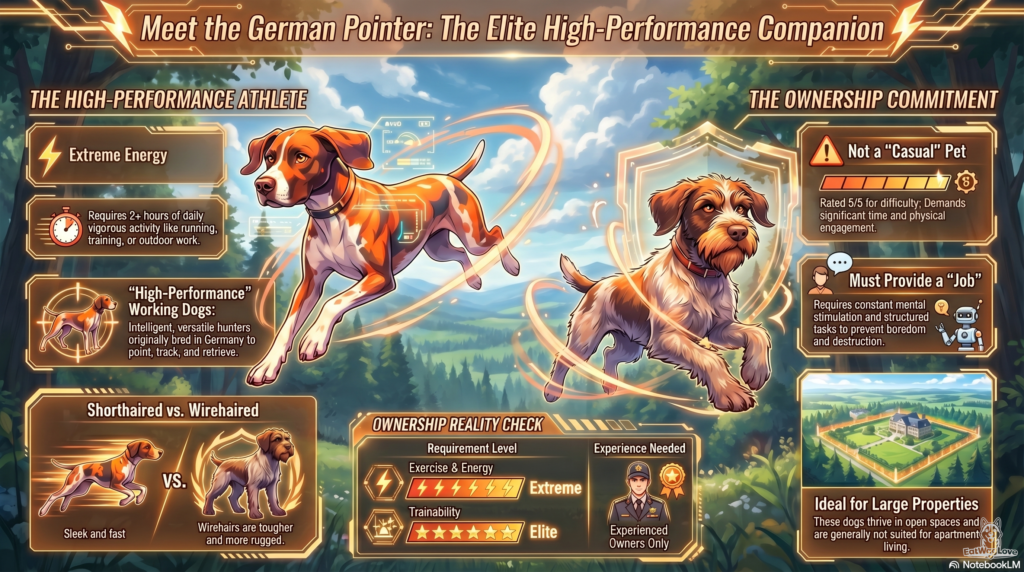







Athletic, intelligent, and built for action — the ultimate companion for active lifestyles.
🧠 QUICK SNAPSHOT
- Temperament: Energetic, Intelligent, Friendly
- Energy Level: Very High
- Size: Large
- Good with Families: Yes (active homes)
- Training Difficulty: Moderate
📚 OVERVIEW
German Shorthaired Pointers (GSPs) are versatile hunting dogs known for their athleticism, intelligence, and endurance. Originally bred for tracking and retrieving game, they are highly adaptable and excel in active environments. They form strong bonds with their owners and love being part of daily activities.
✅ PROS & CONS
Pros
- Extremely intelligent and trainable
- Loyal and people-oriented
- Great for active lifestyles
Cons
- Requires a lot of exercise and stimulation
- Can become destructive if bored
- Not suited to sedentary homes
Is a German Pointer a Good Family Dog?
Yes. A German Pointer can be an excellent family dog for an active household, although the name usually refers to the German Shorthaired Pointer (GSP).
German Shorthaired Pointers are affectionate, energetic and strongly people-oriented. They often form close bonds with the entire household.
Their enormous exercise requirements make them better suited to active families than people wanting a relaxed companion.
Is a German Pointer the Same as a German Shorthaired Pointer?
Usually, yes. When people say “German Pointer,” they most commonly mean the German Shorthaired Pointer.
However, Germany developed several related pointing breeds, including the German Wirehaired Pointer and German Longhaired Pointer.
“German Pointer” therefore isn’t as precise as German Shorthaired Pointer.
How Much Exercise Does a German Pointer Need?
Most healthy adult German Shorthaired Pointers need around 90 minutes to two hours of substantial daily exercise, with some working dogs happily doing considerably more.
Running, hiking, swimming, retrieving, scent work and field activities are excellent outlets.
A leisurely walk around the block usually isn’t enough for a young GSP.
Is a German Pointer Easy to Train?
Yes. German Shorthaired Pointers are highly intelligent and trainable.
They were developed to cooperate closely with hunters while also working independently in the field.
Positive reinforcement, consistency and meaningful activities generally produce excellent results.
Their enthusiasm can make young dogs distractible, so impulse-control training is particularly valuable.
Does a German Pointer Shed?
Yes. German Shorthaired Pointers shed moderately throughout the year.
Their coat is short, dense and relatively easy to maintain.
The small hairs can nevertheless become embedded in clothing, carpets and furniture.
Weekly brushing helps remove loose hair.
Is a German Pointer Hypoallergenic?
No. German Shorthaired Pointers aren’t considered hypoallergenic.
They shed and produce normal canine allergens through saliva and skin secretions.
Their short coat may make grooming easier, but short hair doesn’t mean allergy-friendly.
How Often Does a German Pointer Need Grooming?
German Shorthaired Pointers are low-maintenance dogs in terms of coat care.
Weekly brushing is generally sufficient.
Their floppy ears should be checked regularly, particularly after swimming.
Nails, teeth and paws also need routine attention, especially in dogs spending substantial time running outdoors.
What Health Problems Are Common in German Pointers?
Potential health concerns include hip dysplasia, certain eye disorders, cardiac disease and gastric dilatation-volvulus (GDV or bloat).
Some inherited neurological or blood disorders can occur in particular lines.
Responsible breeders should use appropriate health screening and carefully document their breeding dogs’ health histories.
Are German Pointers Prone to Bloat?
Yes. As relatively deep-chested dogs, German Shorthaired Pointers can be at risk of gastric dilatation-volvulus (GDV).
The stomach expands with gas and may twist, compromising blood supply.
Symptoms can include repeated unsuccessful attempts to vomit, abdominal enlargement, restlessness and collapse.
GDV is a life-threatening veterinary emergency.
How Long Do German Pointers Live?
German Shorthaired Pointers commonly live around 10–14 years.
Some individuals live longer.
Healthy body condition, appropriate exercise, good genetics and preventive veterinary care all influence longevity.
How Big Does a German Pointer Get?
German Shorthaired Pointers are medium-to-large athletic dogs.
Males are generally around 58–64 cm at the shoulder, with females around 53–59 cm.
Adults commonly weigh approximately 20–32 kg, depending on sex and build.
They’re designed for athleticism rather than bulk.
Can a German Pointer Live in an Apartment?
It’s possible, but generally challenging.
The dog’s physical size isn’t the main issue — its energy level is.
A GSP receiving substantial daily outdoor exercise may settle indoors surprisingly well, but an under-exercised dog in a small apartment can quickly become difficult to live with.
Can a German Pointer Be Left Alone?
German Shorthaired Pointers are typically strongly attached to their people and don’t always cope well with long periods of isolation.
Some develop separation-related behaviour.
An under-stimulated GSP may also chew, dig, bark or invent its own entertainment.
Gradual independence training is important.
Are German Pointers Velcro Dogs?
Very often.
German Shorthaired Pointers have a reputation for being “Velcro dogs” because many want to remain extremely close to their owners.
A dog capable of ranging through enormous areas while hunting may return home and decide that sitting directly on top of its owner is perfectly reasonable.
Are German Pointers Cuddly?
Many are exceptionally affectionate.
Despite their athletic hunting background, German Shorthaired Pointers often become enthusiastic sofa companions when their exercise needs have been met.
Some seem completely unaware that a 25-kilogram hunting dog isn’t technically a lap dog.
Are German Pointers Good With Children?
Generally, yes.
Well-socialised German Shorthaired Pointers are usually affectionate and playful with children.
Their exuberance can accidentally knock over small children, particularly during adolescence.
Training and supervision are therefore important.
Are German Pointers Good With Other Dogs?
Usually, yes.
German Shorthaired Pointers are generally social with other dogs, particularly when properly socialised.
Historically, hunting dogs often needed to work around other dogs and people.
Individual compatibility still varies.
Are German Pointers Good With Cats?
Some can live successfully with cats, particularly when raised with them from puppyhood.
However, the breed has substantial hunting and prey drive.
A familiar household cat may be accepted while an unfamiliar cat running outdoors triggers pursuit.
Careful introductions and management are essential.
Do German Pointers Have a Strong Prey Drive?
Yes. German Shorthaired Pointers have strong hunting instincts.
Birds and small animals can be particularly stimulating.
These instincts aren’t behavioural defects — they’re central to what generations of breeders deliberately selected the dog to do.
Owners need secure containment and reliable training.
Can a German Pointer Be Trusted Off Leash?
Many can become excellent off-leash dogs with extensive training.
Hunting dogs needed to range across terrain while remaining responsive to their handlers.
However, strong prey drive can create significant distractions.
Recall should be trained systematically before allowing unrestricted freedom.
Do German Pointers Run Away?
They’re not necessarily trying to “run away,” but they can range enormous distances when following scent or game.
A young GSP can disappear remarkably quickly if something triggers its hunting instincts.
Secure fencing, recall training and appropriate outlets for exploration are important.
How Fast Can a German Pointer Run?
German Shorthaired Pointers are fast, athletic dogs capable of impressive bursts of speed, often estimated around 50–55 km/h under suitable conditions.
Exact speed varies between individuals.
Their greater strength is the combination of speed and endurance needed to cover large areas while hunting.
Are German Pointers Good Running Dogs?
Yes. Healthy adult GSPs can be exceptional running companions.
They possess substantial endurance and usually enjoy sustained physical activity.
Structured distance running should wait until skeletal maturity.
Weather conditions also matter, particularly during extreme heat.
Are German Pointers Good Hiking Dogs?
Excellent.
Their combination of stamina, athleticism and enthusiasm for exploring makes German Shorthaired Pointers superb hiking companions.
Recall and wildlife management remain important.
Owners should also check paws, ears and skin after outings through rough vegetation.
Do German Pointers Like Water?
Many absolutely love it.
German Shorthaired Pointers were developed as versatile hunting dogs capable of retrieving from water as well as land.
Their webbed-looking feet, athletic build and retrieving instincts can make them strong swimmers.
Individual enthusiasm still varies.
Are German Pointers Good Swimmers?
Usually, yes.
The breed’s athletic structure and historical retrieving work make many GSPs powerful and enthusiastic swimmers.
Water exercise can be an excellent outlet for energetic dogs.
Cold-water conditions, currents and exhaustion still require sensible supervision.
Do German Pointers Have Webbed Feet?
Like all dogs, German Shorthaired Pointers have skin connecting their toes, but the breed’s compact, well-arched feet are particularly useful for varied terrain and swimming.
Calling them “webbed feet” is a convenient description rather than suggesting anything remotely duck-like.
Their feet were designed for serious outdoor work.
Why Does My German Pointer Point?
Pointing is a deeply inherited hunting behaviour.
When a GSP detects game, it may freeze with its head and body directed towards the scent, sometimes raising one front paw.
The posture indicates the location of quarry without immediately flushing it.
Some puppies display recognisable pointing behaviour with remarkably little instruction.
Do German Pointer Puppies Point Naturally?
Many do.
Pointing has been strongly selected genetically over generations, so young puppies may freeze and point at birds, insects or other interesting objects before receiving formal hunting training.
Training refines and controls the behaviour rather than creating the underlying instinct from nothing.
Why Does a Pointer Lift One Paw?
The famous raised paw often accompanies the pointing posture, although not every point includes it.
The dog becomes intensely focused on scent and temporarily freezes movement.
The raised leg has become visually synonymous with pointing breeds, but the critical feature is the dog’s stationary indication of game.
What Is the Difference Between Pointing and Flushing?
A pointing dog locates game and remains stationary, allowing the hunter to approach before the bird is flushed.
A flushing breed such as an English Springer Spaniel is typically expected to actively push birds into flight within gun range.
Both are gundogs, but their hunting strategies differ.
Does a German Pointer Retrieve?
Yes. Retrieving was deliberately built into the German Shorthaired Pointer’s versatile hunting role.
The dog could locate and point game before the shot and retrieve it afterwards.
This distinguishes versatile continental gundogs from breeds developed for much narrower specialised tasks.
Can a German Pointer Track Animals?
Yes. German Shorthaired Pointers have excellent scenting ability.
They can track wounded game and follow ground scent in addition to locating birds through airborne scent.
Modern GSPs can excel in tracking, scent work and search-oriented activities.
Can German Pointers Hunt Deer?
German versatile hunting dogs were expected to work with multiple types of game, including tracking wounded larger animals.
The GSP’s job wasn’t limited to birds.
Modern hunting use varies according to country, local game laws and hunting traditions.
Can German Pointers Hunt Ducks?
Yes. German Shorthaired Pointers can locate and retrieve waterfowl, and many willingly work in water.
Their versatility was one of the breed’s central design goals.
However, they lack the extremely heavy insulating coats of specialised cold-water retrievers, so environmental conditions matter.
What Animals Were German Pointers Bred to Hunt?
The breed was developed as an all-purpose hunting dog, capable of working birds and small game while also tracking larger wounded animals and retrieving from land or water.
German hunters wanted one dog capable of performing numerous tasks.
That versatility explains the GSP’s combination of pointing, retrieving, tracking and prey drive.
What Does a German Shorthaired Pointer Look Like?
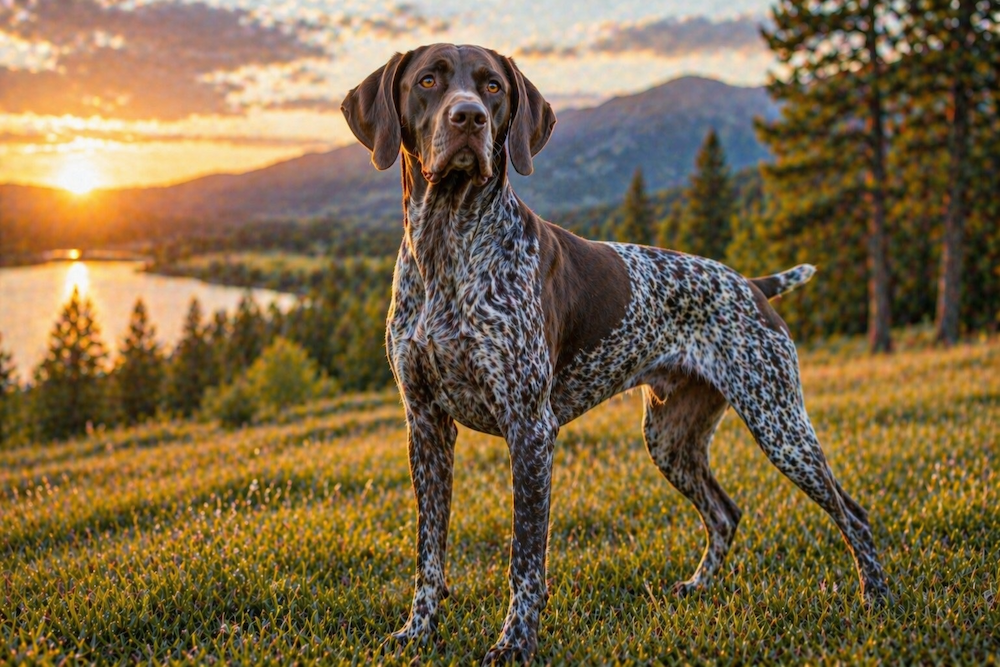
The GSP is a lean, muscular, athletic dog with a streamlined head, floppy ears, deep chest and short dense coat.
Its appearance should suggest endurance and efficient movement rather than heaviness.
The breed’s distinctive liver, liver-and-white, patched, ticked and roan coats make it particularly recognisable.
What Colours Can German Shorthaired Pointers Be?
Traditional colours centre around liver and white, including solid liver, liver-and-white patches, ticking and roan patterns.
Black and black-and-white GSPs are accepted by some major kennel organisations, although historical standards have differed.
Colour shouldn’t take priority over health, temperament and working structure.
What Does “Liver” Mean in a German Pointer?
“Liver” describes a rich brown pigmentation produced by specific coat-colour genetics.
A liver GSP typically has a brown nose rather than a black one.
The colour ranges visually from lighter chocolate-like shades to deep dark brown.
What Is a Roan German Pointer?
Roan describes a coat in which coloured and white hairs are finely intermixed, creating an overall blended appearance.
GSPs can display striking liver roan patterns.
The head may remain largely solid while the body appears densely speckled.
Roan colouring also helps break up the dog’s outline in natural hunting environments.
What Is a Ticked German Pointer?
Ticking consists of small coloured spots appearing through otherwise white areas of coat.
GSP puppies can be born with relatively plain white areas that develop increasingly visible ticking as they grow.
Dense ticking can contribute to an almost roan appearance.
Are German Pointer Puppies Born With Their Spots?
Large patches are generally visible at birth, but fine ticking develops progressively after birth.
A puppy with substantial white areas can become dramatically more speckled over the following weeks and months.
This can make puppy-to-adult coat transformations particularly striking.
Can German Shorthaired Pointers Be Black?
Yes. Black GSPs exist and are recognised under some major international standards.
Historically, liver was more strongly associated with the breed, and acceptance of black has varied between kennel organisations.
Black can occur as solid colour or combined with white, ticking or roan.
Can German Pointers Have Blue Eyes?
Adult breed-standard GSPs normally have brown eyes, preferably harmonising with the coat.
Very light or blue eyes aren’t characteristic of the mature breed.
Puppy eye colour can change as pigmentation develops.
Why Does a German Pointer Have Floppy Ears?
The hanging ears are typical of many continental scenting and gundog breeds.
They contribute to the GSP’s characteristic appearance.
Because floppy ears reduce ventilation within the ear canal, regular checking becomes particularly important for dogs that swim frequently.
Why Are German Pointer Tails Docked?
Historically, GSP tails were commonly docked because working dogs moved rapidly through dense vegetation, where tail injuries were considered a concern.
Docking subsequently became incorporated into traditional breed appearance.
Routine cosmetic tail docking is now prohibited or restricted in many countries, including Australia.
A natural GSP tail is long.
Is a German Pointer the Same as an English Pointer?
No. The German Shorthaired Pointer and Pointer — often informally called the English Pointer — are separate breeds.
The Pointer became highly specialised for locating and pointing birds.
The GSP was developed as a more versatile hunting dog capable of pointing, tracking and retrieving on land and water.
What Is the Difference Between a German Pointer and an English Pointer?
English Pointers are generally more specialised pointing dogs, particularly associated with wide-ranging bird work.
German Shorthaired Pointers were developed as versatile hunters capable of tracking, pointing and retrieving different game.
Both are extremely athletic, but their historical breeding goals weren’t identical.
Is a German Shorthaired Pointer the Same as a German Wirehaired Pointer?
No. They’re separate breeds.
The German Wirehaired Pointer has a harsh protective coat, beard and eyebrows, while the German Shorthaired Pointer has a smooth short coat.
Both emerged from Germany’s tradition of versatile hunting dogs, but their breeding histories and modern standards differ.
Is a German Shorthaired Pointer the Same as a German Longhaired Pointer?
No. The German Longhaired Pointer is a distinct German hunting breed with a much longer coat and separate development.
All three share Germany’s emphasis on versatile gundogs.
The Shorthaired variety became particularly internationally successful.
Is a German Pointer Related to the Weimaraner?
They share the broader history of German versatile hunting dogs, but the Weimaraner and German Shorthaired Pointer are distinct breeds.
Both were developed to locate and work various game.
The Weimaraner’s characteristic grey coat and somewhat different development distinguish it clearly from the GSP.
Is a German Pointer Related to the Vizsla?
The German Shorthaired Pointer and Hungarian Vizsla are separate national breeds, although both belong to the versatile pointing-dog family.
Their similar athletic bodies and close-working hunting styles can create superficial resemblance.
The Vizsla is traditionally golden-rust, while GSPs are particularly associated with liver, white and roan.
Where Did the German Shorthaired Pointer Come From?
The German Shorthaired Pointer was developed in Germany, with its recognisable modern form emerging during the 19th century.
German hunters wanted versatile dogs capable of performing many hunting tasks rather than maintaining a different specialised breed for each job.
This philosophy drove the GSP’s development.
Why Was the German Shorthaired Pointer Created?
German hunters wanted an all-purpose hunting companion.
The ideal dog needed to search for game, point birds, track wounded animals, retrieve shot game and work both land and water.
It also needed to cooperate closely with its owner and function as a useful household dog.
The GSP became one of the great successes of that versatile-gundog philosophy.
What Breeds Created the German Shorthaired Pointer?
The exact recipe isn’t completely documented.
The developing breed drew from older German pointing dogs and continental hunting-dog populations, with other pointing influences introduced as breeders refined speed, scenting ability and structure.
The English Pointer is commonly cited as an important later influence.
Exact percentage claims should be treated cautiously.
What Was the German Bird Dog?
Before the modern GSP became established, Germany had various regional pointing and hunting dogs often broadly described as German bird dogs or German pointers.
These weren’t necessarily identical to today’s breed.
Selective breeding during the 19th century increasingly consolidated desired characteristics into the German Shorthaired Pointer.
Is the German Shorthaired Pointer Related to the Spanish Pointer?
Heavy old Spanish-type pointing dogs are often mentioned among the historical influences behind continental European pointers.
Their precise contribution to the modern GSP is difficult to quantify because early breeding records are incomplete.
The GSP emerged from a complex network of European hunting-dog populations rather than one simple cross.
Was the English Pointer Used to Create the German Shorthaired Pointer?
English Pointer influence is widely associated with later GSP development.
Breeders sought additional speed, elegance and wide-ranging pointing ability while retaining German versatility.
The result was a more athletic dog without abandoning tracking and retrieving abilities.
Who Was Prince Albrecht zu Solms-Braunfels?
Prince Albrecht zu Solms-Braunfels became an important figure in the organised development of the German Shorthaired Pointer.
He promoted breeding dogs according to practical hunting performance rather than appearance alone.
The philosophy commonly associated with the breed’s development was essentially that function should determine form.
What Does “Noble by Utility” Mean in German Pointer History?
The phrase reflects the German breeding philosophy that a hunting dog’s beauty should emerge from functional usefulness rather than decorative appearance.
The GSP’s athletic body, powerful nose and efficient movement were developed because they helped it work.
Its elegant appearance was effectively a consequence of designing an extremely functional dog.
When Was the German Shorthaired Pointer Developed?
The recognisable modern breed was primarily established during the 19th century, although its foundation hunting dogs were considerably older.
Organised breeding and record keeping increasingly formalised the breed during the latter part of that century.
When Was the German Shorthaired Pointer Studbook Established?
Germany’s organised breed development became formalised during the late 19th century, with the first studbook for the German Shorthaired Pointer published in 1879.
This period marks an important transition from regional hunting-dog populations to a documented modern pedigree breed.
Who Was Nero in German Shorthaired Pointer History?
A dog named Nero is frequently associated with early German Shorthaired Pointer history and the breed’s developing studbook era.
Early dogs such as Nero helped establish the physical and working type breeders wanted to preserve.
The breed’s formal documentation during the late 1800s made selective breeding increasingly systematic.
What Does “Deutsch Kurzhaar” Mean?
The German name for the breed is Deutsch Kurzhaar.
“Deutsch” means German, while “Kurzhaar” means short hair.
The name therefore essentially means German Shorthair.
German enthusiasts commonly abbreviate the breed as DK, while English-speaking countries usually use GSP.
What Does GSP Mean?
GSP stands for German Shorthaired Pointer.
It’s one of the most widely used breed abbreviations in the dog world.
Owners, breeders and dog-sport competitors frequently use GSP rather than repeating the full breed name.
What Is a Versatile Hunting Dog?
A versatile hunting dog is bred to perform multiple tasks before and after the shot.
Rather than specialising only in pointing or retrieving, the dog may search, point, track wounded game, retrieve from land and water and work different types of quarry.
The GSP is one of the world’s best-known examples.
Are German Pointers Used as Working Dogs Outside Hunting?
Yes. Their exceptional noses, athleticism and trainability have allowed GSPs to work in detection, tracking, search activities and various dog sports.
They excel in scent-based tasks.
A dog designed to search huge areas for tiny traces of game already possesses many abilities useful in modern scent work.
Are German Pointers Good at Dog Sports?
Excellent.
German Shorthaired Pointers can excel in field trials, tracking, scent work, obedience, agility, canicross and other athletic activities.
Their combination of speed, intelligence and enthusiasm makes them highly versatile.
The main challenge is finding enough activities to satisfy them.
Why Does My German Pointer Never Seem Tired?
The breed was developed to work for hours across large hunting territories.
That endurance hasn’t disappeared because modern dogs live in suburban homes.
Physical exercise alone may also create an increasingly fit dog rather than a calmer one.
Mental work, scenting and training are therefore just as valuable as simply adding more kilometres.
When Do German Pointers Calm Down?
GSPs generally begin becoming more settled as they mature, often around two to three years, although many remain energetic and playful throughout life.
Training an “off switch” is important.
Owners waiting for an adolescent GSP to simply wake up one morning and decide it prefers quiet contemplation may be waiting for quite some time.
Is a German Pointer a Good First Dog?
Possibly, but only for a committed and very active first-time owner.
GSPs are intelligent and trainable but require substantial exercise, training and companionship.
Their prey drive and adolescent exuberance can be challenging.
They’re usually a poor choice for someone primarily attracted by their beautiful spotted coat.
Are German Pointers Rare?
No. The German Shorthaired Pointer is a well-established international breed and has become particularly popular in countries with strong hunting and outdoor cultures.
Its success reflects its versatility.
The same characteristics that make it an outstanding hunting dog have also made it popular with runners, hikers and active families.
Where Does the German Pointer Come From?
The German Shorthaired Pointer was developed in Germany from older continental hunting dogs, with organised breeding taking shape during the 19th century.
German hunters weren’t trying to create a dog that did one job brilliantly. They wanted one capable of doing almost everything: searching, pointing, tracking, retrieving, working water and land, and remaining closely connected to the hunter.
The result was one of the world’s great all-purpose gundogs. That versatility still defines the modern GSP — although it also explains why living with one can feel as though you’ve invited a professional athlete, detective, swimmer and bird-spotting enthusiast to share your sofa.