






Powerful, intelligent, and highly driven — a commanding companion that thrives on purpose and structure.
🧠 QUICK SNAPSHOT
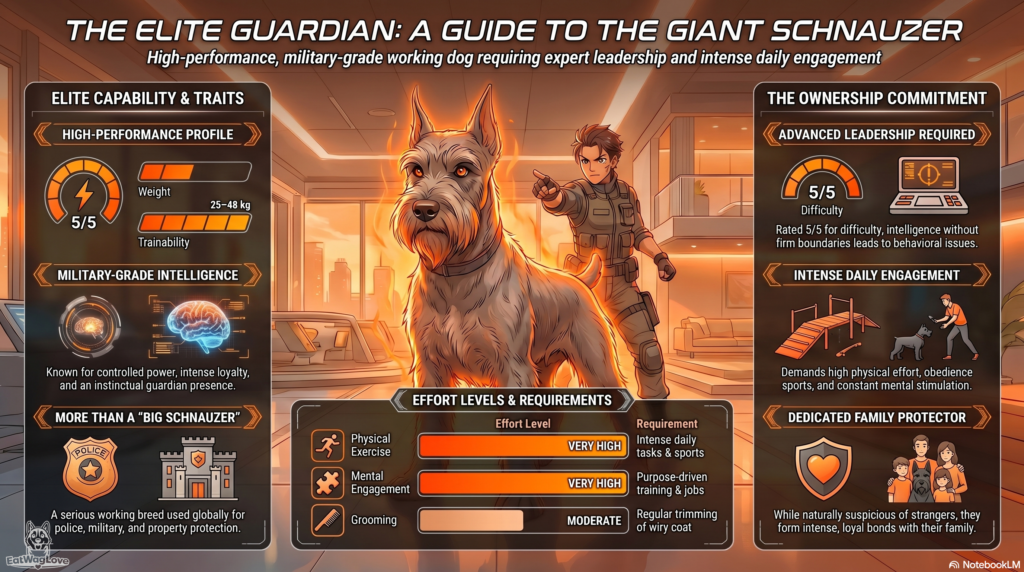
- Temperament: Loyal, protective, intelligent
- Energy Level: Very high
- Size: Large
- Good With Families: Yes (experienced homes)
- Trainability: High
- Grooming: Moderate
- Best For: Active, experienced owners
📚 OVERVIEW
The Giant Schnauzer is a large, powerful working breed originally developed for driving cattle and guarding property. Known for its intelligence and strong work ethic, it requires both mental and physical challenges to stay balanced.
They are deeply loyal and protective, forming strong bonds with their family but needing firm leadership.
✅ PROS & CONS
Pros
- Highly intelligent and trainable
- Loyal and protective
- Strong working ability
- Impressive presence
Cons
- Very high exercise requirements
- Needs experienced handling
- Can be dominant or strong-willed
- Requires mental stimulation
Is a Giant Schnauzer a Good Family Dog?
Yes. A Giant Schnauzer can be an excellent family dog for an experienced, active household.
They’re typically deeply loyal, intelligent and strongly attached to their families. However, this is a powerful working breed with substantial exercise, training and mental-stimulation requirements.
Their natural guarding instincts also make early socialisation particularly important.
How Much Exercise Does a Giant Schnauzer Need?
Most adult Giant Schnauzers need around 90 minutes to two hours of substantial exercise every day, combined with mental work.
Running, hiking, obedience, tracking, scent work and dog sports are excellent outlets.
Simply providing a large garden isn’t enough. An under-stimulated Giant Schnauzer can create its own activities, and those activities may involve substantial home renovation.
Is a Giant Schnauzer Easy to Train?
Giant Schnauzers are extremely intelligent and highly trainable, but they aren’t necessarily easy.
They learn rapidly and can be independent, assertive and quick to notice inconsistencies.
Positive reinforcement combined with clear boundaries and structured training works well.
They generally thrive when given challenging tasks rather than repetitive drills.
Does a Giant Schnauzer Shed?
Giant Schnauzers are relatively low-shedding compared with many large breeds.
Their harsh outer coat tends to retain dead hair rather than releasing enormous amounts around the house.
However, low shedding doesn’t mean low maintenance.
Regular brushing and professional grooming are required to prevent matting and maintain coat condition.
Is a Giant Schnauzer Hypoallergenic?
Giant Schnauzers are often described as more allergy-friendly than heavily shedding breeds, but no dog is truly hypoallergenic.
Dog allergens are found in saliva and skin secretions as well as hair.
Some people with allergies tolerate Schnauzers better than high-shedding breeds, while others still react strongly.
How Often Does a Giant Schnauzer Need Grooming?
Giant Schnauzers generally need brushing several times each week and professional grooming approximately every six to eight weeks.
Their beard requires particular attention because food, water and debris can become trapped in it.
Show coats usually require hand stripping, while many pet dogs are clipped.
What Is Hand Stripping a Giant Schnauzer?
Hand stripping involves removing mature dead outer hairs from the coat rather than cutting them.
When performed correctly on a coat that’s ready to shed, it preserves the characteristic harsh texture and strong colour.
It’s commonly used for show dogs.
Many companion Giant Schnauzers are clipped instead because clipping is considerably easier to maintain.
Can You Clip a Giant Schnauzer?
Yes. Most pet Giant Schnauzers can be professionally clipped.
Clipping is convenient but can gradually soften the coat and sometimes lighten its colour.
Owners wanting the traditional harsh working coat generally choose hand stripping.
For most family dogs, practical maintenance is more important than maintaining a perfect show coat.
Why Does a Giant Schnauzer Have a Beard?
The dramatic beard and eyebrows are characteristic features of Schnauzer-type dogs.
The harsh facial furnishings may have offered some protection during traditional farm and vermin-control work.
Selective breeding subsequently emphasised the distinctive appearance.
The beard also functions extremely efficiently as a portable water-storage device after every drink.
What Health Problems Are Common in Giant Schnauzers?
Potential health concerns include hip dysplasia, certain eye disorders, thyroid disease and some cancers, with other inherited conditions occurring in particular lines.
As a large, deep-chested breed, they can also be at risk of gastric dilatation-volvulus.
Responsible breeders should use appropriate health screening.
Are Giant Schnauzers Prone to Hip Dysplasia?
Yes. Hip dysplasia can occur in Giant Schnauzers.
It develops when the hip joint doesn’t form normally, potentially causing instability, arthritis and pain.
Formal hip assessment of breeding dogs helps reduce risk.
Keeping growing puppies lean and avoiding excessive repetitive impact is also sensible.
Are Giant Schnauzers Prone to Bloat?
Yes. Their deep chest places Giant Schnauzers at risk of gastric dilatation-volvulus (GDV).
The stomach can rapidly expand with gas and potentially twist.
Repeated unsuccessful attempts to vomit, abdominal swelling, severe restlessness or collapse require immediate emergency veterinary treatment.
How Long Do Giant Schnauzers Live?
Giant Schnauzers commonly live around 10–12 years, although some live longer.
Genetics, body condition, cancer risk, joint health and preventive veterinary care all influence longevity.
Maintaining a lean, physically fit dog is particularly important.
How Big Does a Giant Schnauzer Get?
Giant Schnauzers are large, powerful dogs.
Adults generally stand around 60–70 cm at the shoulder.
Weight commonly falls around 25–48 kg, depending on sex, build and breeding line.
Despite the word “Giant,” they’re athletic working dogs rather than giant breeds in the Great Dane or Mastiff sense.
Why Is It Called a Giant Schnauzer?
The name distinguishes it from the Standard and Miniature Schnauzers.
The Giant is substantially larger than the original Standard Schnauzer.
However, “Giant” is relative within the Schnauzer family.
Compared with true giant breeds, it’s better described as a large, powerful working dog.
Are There Three Types of Schnauzer?
Yes. There are three recognised Schnauzer breeds:
Miniature Schnauzer, Standard Schnauzer and Giant Schnauzer.
They’re separate breeds rather than simply three sizes of exactly the same dog.
They share characteristic appearance and ancestry, but their development and traditional jobs differ.
Is a Giant Schnauzer Just a Large Standard Schnauzer?
No. The Giant Schnauzer was developed partly from larger Schnauzer-type farm dogs and other working breeds, rather than simply selecting progressively larger Standard Schnauzers.
Standard Schnauzer ancestry was important, but additional dogs were used to increase size and working capability.
The result became a distinct breed.
What Is the Difference Between a Giant Schnauzer and a Standard Schnauzer?
The Giant Schnauzer is considerably larger, more powerful and generally more demanding.
Both are intelligent working dogs with harsh coats and distinctive facial furnishings.
The Standard historically functioned as an all-purpose farm dog and ratter, while the Giant became particularly associated with cattle driving, guarding and later police work.
What Is the Difference Between a Giant Schnauzer and a Miniature Schnauzer?
The difference is enormous.
Miniature Schnauzers are small companion and vermin-control dogs, while Giant Schnauzers are large, powerful working and guarding dogs.
They share the famous beard and eyebrows, but their physical capabilities and management requirements are very different.
Can a Giant Schnauzer Live in an Apartment?
It’s possible but challenging.
A well-exercised Giant Schnauzer can settle indoors, but the breed needs substantial daily physical and mental activity.
Its size, alert barking and guarding instincts can complicate apartment living.
Lifestyle matters more than garden size, but this isn’t an easy small-space breed.
Can a Giant Schnauzer Be Left Alone?
Adult Giant Schnauzers can learn to spend reasonable periods alone, but they’re typically strongly attached to their families.
Long periods without interaction or activity can lead to boredom and destructive behaviour.
They’re generally happiest when actively involved in their owner’s life.
Are Giant Schnauzers Velcro Dogs?
Many are.
Despite their formidable working appearance, Giant Schnauzers often form intense relationships with their people.
They may follow family members throughout the house and want to participate in virtually everything.
The same handler focus that benefits working dogs can produce an extremely devoted companion.
Are Giant Schnauzers Cuddly?
Many are surprisingly affectionate with their families.
They can be physically demonstrative, playful and cuddly with trusted people.
Their behaviour towards family can contrast sharply with their more reserved attitude towards unfamiliar people.
A 40-kilogram Giant Schnauzer may also have an optimistic interpretation of the phrase “lap dog.”
Are Giant Schnauzers Good With Children?
They can be excellent with children when properly socialised and trained.
However, they’re large, powerful and energetic.
Young dogs can accidentally knock over small children.
Supervision and respectful interaction are essential, particularly because some individuals possess strong guarding instincts.
Are Giant Schnauzers Good With Other Dogs?
It varies.
Giant Schnauzers can be assertive or selective around other dogs, particularly dogs of the same sex.
Early socialisation is important.
Many live successfully in multi-dog households, but they shouldn’t automatically be expected to enjoy every unfamiliar dog they encounter.
Are Giant Schnauzers Good With Cats?
Some can live successfully with cats, especially when raised together.
However, Giant Schnauzers can possess significant prey drive, partly reflecting their farm-dog and vermin-control ancestry.
A household cat may be accepted while unfamiliar running animals trigger pursuit.
Do Giant Schnauzers Have a Strong Prey Drive?
Many do.
Their ancestors performed farm work and vermin control, and modern working lines can retain substantial chase and prey instincts.
Small fast-moving animals can therefore be extremely stimulating.
Early training and secure containment are important.
Are Giant Schnauzers Protective?
Yes. Strong protective instincts are one of the breed’s defining characteristics.
Giant Schnauzers tend to be watchful, territorial and naturally suspicious of unusual activity.
Responsible breeding should produce confidence and judgement rather than uncontrolled aggression.
Early socialisation helps dogs distinguish ordinary life from genuine threats.
Are Giant Schnauzers Good Guard Dogs?
Yes. Giant Schnauzers can be exceptional guard dogs.
Their imposing appearance, deep bark, intelligence and natural territorial instincts provide substantial deterrence.
Historically, guarding livestock, farms, businesses and property became important parts of their work.
Most family dogs don’t need specialised protection training.
Are Giant Schnauzers Aggressive?
A well-bred Giant Schnauzer shouldn’t be indiscriminately aggressive.
However, the breed can be assertive, territorial and highly protective, making responsible training particularly important.
Poor socialisation or unstable breeding can create serious problems in such a powerful dog.
Confidence and control are far more desirable than unnecessary aggression.
Do Giant Schnauzers Bark a Lot?
They can be vocal, particularly when alerting to unfamiliar people or activity.
They’re natural watchdogs and tend to notice changes in their environment.
Training can establish appropriate boundaries.
Persistent barking can also result from boredom in an under-stimulated dog.
Are Giant Schnauzers Good Watchdogs?
Excellent.
Very little escapes the attention of a Giant Schnauzer.
They tend to be highly observant and quick to alert their family.
Their imposing appearance means they usually don’t need to do much beyond standing behind the gate to make visitors reconsider whether they really need to enter.
Are Giant Schnauzers Good Running Dogs?
Yes. Healthy adult Giant Schnauzers can make excellent running companions.
They’re athletic working dogs rather than lumbering giants.
Structured running should wait until skeletal maturity.
They can possess substantial endurance once properly conditioned.
Are Giant Schnauzers Good Hiking Dogs?
Excellent.
Their stamina, strength and enthusiasm for working with their owners make them strong hiking companions.
Training and recall are important around wildlife.
Their harsh coat also provides useful protection in rough outdoor conditions.
Can Giant Schnauzers Swim?
Many can swim well, although enthusiasm varies.
They weren’t developed specifically as water retrievers.
Their athletic structure generally allows them to become capable swimmers when introduced positively to water.
That magnificent beard will carry approximately half the lake back into the house.
Are Giant Schnauzers High-Energy Dogs?
Yes. Giant Schnauzers are high-energy working dogs.
Their energy is combined with considerable intelligence, which makes mental stimulation particularly important.
An hour of mindless exercise may not satisfy them as effectively as a combination of physical activity, obedience and problem-solving.
When Do Giant Schnauzers Calm Down?
Many begin becoming noticeably more mature around two to three years of age, although they often remain energetic throughout adulthood.
Mental maturity can take time in such a large working breed.
Teaching calm behaviour from puppyhood is much more effective than simply waiting for age to solve everything.
Are Giant Schnauzers Good at Dog Sports?
Yes. They can excel in obedience, tracking, scent work, agility, protection sports and other working disciplines.
Their combination of intelligence, athleticism and drive makes them highly versatile.
They generally thrive when training has a clear purpose.
Are Giant Schnauzers Used as Police Dogs?
Yes. Giant Schnauzers have historically been used for police and security work, particularly in Europe.
Their strength, trainability, courage and guarding instincts made them suitable.
They never became as globally dominant in police work as German Shepherds or Belgian Malinois, but they have a genuine service history.
Are Giant Schnauzers Used by the Military?
Giant Schnauzers have been used in military and security roles, particularly in Europe.
Their abilities include guarding, patrol work and trainable scent-based tasks.
Their working temperament made the transition from cattle dog to service dog relatively natural.
Can Giant Schnauzers Do Protection Sports?
Yes. Appropriate Giant Schnauzers can perform very well in IGP and other protection-oriented working sports.
These disciplines combine tracking, obedience and controlled protection work.
Success requires stable temperament and expert training rather than simply encouraging aggression.
Are Giant Schnauzers Intelligent?
Extremely.
The breed is known for rapid learning, problem-solving and independent thinking.
That intelligence can be an advantage or a challenge.
A Giant Schnauzer that understands the rules but sees no reason to follow them provides a very different training experience from a dog that simply hasn’t learned them yet.
Are Giant Schnauzers Stubborn?
They can appear stubborn.
They’re confident working dogs developed to make decisions rather than wait passively for instructions.
If training becomes repetitive or inconsistent, they may lose interest.
Clear expectations, rewards and meaningful work generally produce much better results.
Is a Giant Schnauzer Good for a First-Time Owner?
Usually, it isn’t the easiest choice.
Their size, intelligence, exercise needs, guarding instincts and assertive personality can overwhelm inexperienced owners.
A dedicated first-time owner with strong professional support can succeed, but many easier breeds provide a gentler introduction to dog ownership.
What Does a Giant Schnauzer Look Like?
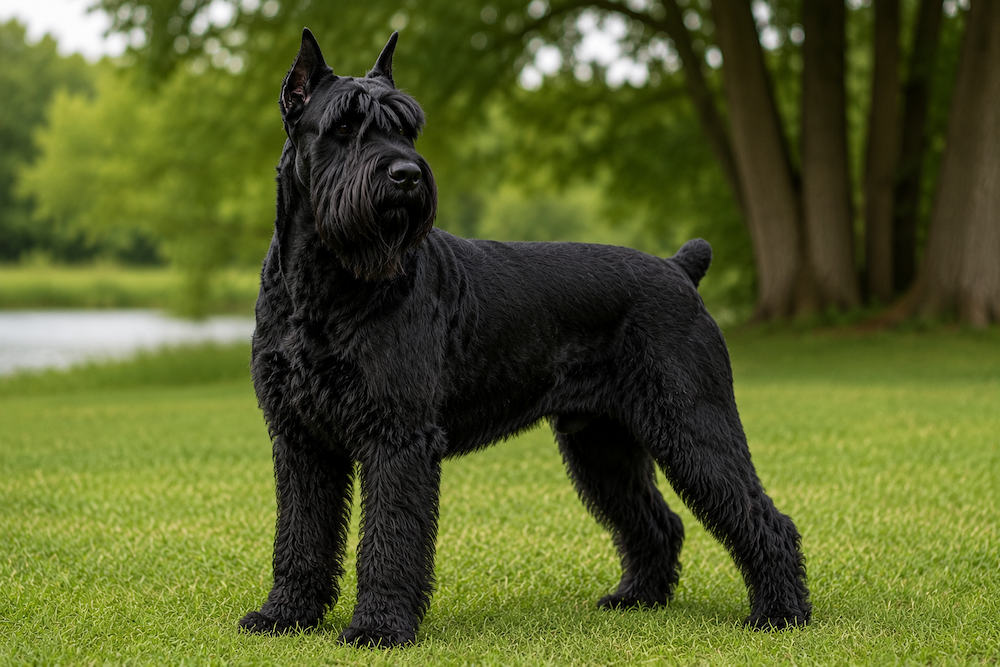
The Giant Schnauzer is a large, powerful, square-built dog with a harsh coat, rectangular head and dramatic beard and eyebrows.
Its appearance should combine strength with athleticism.
Despite the elaborate facial furnishings, the dog underneath should look capable of serious physical work.
What Colours Can Giant Schnauzers Be?
The best-known colour is solid black.
Pepper and salt is also historically important and recognised under various standards.
Some kennel organisations now recognise additional colour variations differently, so accepted colours can depend on the registry.
What Is a Pepper and Salt Giant Schnauzer?
Pepper and salt describes a coat made up of banded hairs creating an overall grey or silver appearance, often with darker and lighter shading.
It isn’t simply grey hair.
The pattern results from individual hairs containing alternating pigment.
It’s one of the traditional Schnauzer colour patterns.
Why Are Black Giant Schnauzers So Common?
Solid black became strongly established through selective breeding during the breed’s development.
The dramatic black coat also suited the imposing appearance desired in guarding and working dogs.
Today black is probably the colour most people immediately associate with the Giant Schnauzer.
Do Giant Schnauzers Turn Grey?
Black Giant Schnauzers can develop grey hairs with age, particularly around the muzzle.
Clipping can also make black coats appear progressively softer or duller because it changes how the outer coat grows.
Hand stripping tends to preserve stronger coat texture and pigmentation.
Why Does a Giant Schnauzer Have Such Large Eyebrows?
The eyebrows are part of the breed’s harsh facial furnishings.
Selective grooming exaggerates their characteristic shape.
Together with the beard, they give the Giant Schnauzer one of the most recognisable faces in the dog world — and the permanent expression of a dog carefully evaluating your recent decisions.
Where Did the Giant Schnauzer Come From?
The Giant Schnauzer was developed in southern Germany, particularly Bavaria and neighbouring regions.
Farmers and livestock dealers needed powerful dogs capable of driving cattle, guarding property and performing general farm work.
These practical working dogs eventually developed into the breed recognised today.
What Was the Giant Schnauzer Originally Bred For?
Its original jobs included driving cattle, guarding farms and protecting livestock and property.
The breed needed enough strength to manage cattle while remaining agile and intelligent.
This explains why the modern Giant combines considerable physical power with strong working drive.
Was the Giant Schnauzer Originally a Cattle Dog?
Yes. Cattle driving was an important part of the breed’s early work.
Giant Schnauzer ancestors helped move livestock between farms, markets and other locations.
The job required endurance, confidence and enough authority to influence animals many times the dog’s size.
Why Was the Giant Schnauzer Called the Munich Schnauzer?
The breed was historically associated with Munich and Bavaria, leading to names such as the Munich Schnauzer or Münchener Schnauzer.
Its modern German name is Riesenschnauzer.
“Riesen” means giant, making the German name essentially “Giant Schnauzer.”
What Does Riesenschnauzer Mean?
Riesenschnauzer is the German name for the Giant Schnauzer.
“Riesen” means giant, while “Schnauzer” refers to the Schnauzer type and its characteristic muzzle.
The name distinguishes it from the smaller Standard and Miniature Schnauzers.
What Does the Word Schnauzer Mean?
“Schnauzer” is connected to the German word Schnauze, meaning muzzle or snout.
The name is particularly appropriate given the breed family’s unmistakable bearded faces.
Interestingly, the Standard Schnauzer was historically known as a Wirehaired Pinscher before Schnauzer became the established breed name.
Was There a Dog Actually Named Schnauzer?
Yes. A Wirehaired Pinscher named Schnauzer exhibited in Germany during the 19th century is often associated with the name becoming attached to the breed type.
Eventually “Schnauzer” replaced the older Wirehaired Pinscher terminology.
The dog’s most famous physical feature effectively became the name of an entire breed family.
What Breeds Created the Giant Schnauzer?
The precise historical recipe isn’t completely documented.
Standard Schnauzer-type dogs were important foundations, while larger regional cattle and farm dogs were incorporated to increase size and capability.
Great Dane and Bouvier-type influences are frequently discussed in historical accounts, although exact ancestry percentages can’t be established.
Was the Great Dane Used to Create the Giant Schnauzer?
Great Dane influence is frequently mentioned in histories of Giant Schnauzer development, particularly in relation to increasing size and power.
However, the breed wasn’t created through a simple, documented modern two-breed cross.
It emerged from practical southern German working-dog populations and deliberate selection over generations.
Is the Giant Schnauzer Related to the Bouvier des Flandres?
The breeds share similarities as large European cattle and farm dogs, and Bouvier-type dogs are sometimes discussed in Giant Schnauzer ancestry.
Precise historical relationships are difficult to establish.
Both ultimately developed into powerful, rough-coated working breeds capable of livestock and guarding work.
Is the Giant Schnauzer Related to the German Pinscher?
Yes, through the broader historical Pinscher-Schnauzer family of German working dogs.
Smooth-coated Pinschers and wire-coated Schnauzer-type dogs were once much more closely associated than modern breed divisions suggest.
Formal breed standardisation eventually separated these working-dog populations.
When Was the Giant Schnauzer Developed?
The breed’s recognisable development occurred primarily during the late 19th and early 20th centuries in southern Germany.
It was initially valued for practical farm and cattle work.
Organised showing and breed registration gradually transformed regional working dogs into a standardised pedigree breed.
When Was the Giant Schnauzer First Shown?
Giant Schnauzers appeared at organised German dog shows in the early 20th century, including an important exhibition in Munich around 1909.
Early examples weren’t yet completely uniform.
Further selective breeding refined the distinctive Giant Schnauzer appearance.
Why Did Giant Schnauzers Stop Driving Cattle?
Industrialisation and motorised transport reduced the need for traditional livestock-driving dogs.
Fortunately, the Giant Schnauzer’s abilities translated extremely well into guarding and service work.
The breed found new employment protecting businesses and later working with police and military organisations.
Were Giant Schnauzers Used to Guard Breweries?
Yes. Giant Schnauzers became particularly associated with guarding breweries, stockyards, factories and other businesses in southern Germany.
Their intimidating appearance, alertness and territorial instincts made them highly effective property guardians.
This brewery connection is one of the breed’s most memorable historical jobs.
Why Were Giant Schnauzers Good Brewery Guard Dogs?
Breweries and related businesses needed dogs capable of guarding valuable premises, wagons and goods.
The Giant Schnauzer combined physical size with vigilance and strong territorial instincts.
A large black bearded dog confronting an intruder in a dark brewery probably required very little additional explanation.
How Did the Giant Schnauzer Become a Police Dog?
Once cattle-driving work declined, breeders recognised that the same intelligence, courage, trainability and guarding instincts could serve police work.
During the early 20th century, the breed increasingly entered security and service roles.
This transition helped preserve its working identity.
When Was the Giant Schnauzer Recognised as a Working Dog in Germany?
By the early 20th century, the Giant Schnauzer had gained recognition for police and service work, and its reputation expanded beyond Bavaria.
Working ability became an important part of organised breeding.
The transition from farm dog to formal service dog was crucial to the breed’s modern development.
Why Didn’t Giant Schnauzers Become as Common as German Shepherds in Police Work?
German Shepherds became extraordinarily dominant because of their huge breeding population, versatility and established international service infrastructure.
Giant Schnauzers remained capable police dogs but never reached comparable numbers.
Today Belgian Malinois and German Shepherds dominate many professional programmes, while Giant Schnauzers remain a more specialised working choice.
Are Giant Schnauzers Still Working Dogs Today?
Yes. Giant Schnauzers continue participating in protection sports, obedience, tracking, scent work, police-style activities and other demanding disciplines.
Most modern dogs are companions rather than cattle drivers.
However, strong working instincts remain very much alive in many bloodlines.
Why Are Giant Schnauzers Sometimes Called “Dogs With a Human Brain”?
Owners sometimes use expressions like this because of the breed’s problem-solving ability, memory and tendency to analyse situations independently.
It isn’t a scientific description of canine intelligence.
It does capture something important about living with the breed: Giant Schnauzers tend to notice patterns and learn household routines extremely quickly.
Are Giant Schnauzers Rare?
They’re relatively uncommon compared with breeds such as German Shepherds, Labradors or Golden Retrievers.
Their demanding temperament, grooming requirements and substantial exercise needs naturally limit their mass-market appeal.
For experienced working-dog enthusiasts, however, that intensity is often exactly what makes the breed attractive.
Is the Giant Schnauzer a Natural Breed?
No. The Giant Schnauzer is a deliberately developed working breed created from southern German farm and cattle dogs.
Its ancestors were practical regional working populations.
Formal breeding during the late 19th and early 20th centuries gradually established the consistent modern breed.
Why Does the Giant Schnauzer Look Like a Giant Miniature Schnauzer?
All three Schnauzer breeds share the characteristic rectangular muzzle, beard, eyebrows and harsh coat, making them look like scaled versions of one another.
But appearances are deceptive.
The Giant wasn’t created simply by enlarging the Miniature Schnauzer. In fact, the Standard is the older foundation type, while the Giant and Miniature developed in different directions for different jobs.
Where Does the Giant Schnauzer Come From?
The Giant Schnauzer comes from southern Germany, particularly Bavaria, where large Schnauzer-type working dogs helped farmers drive cattle and protect property.
As traditional cattle driving declined, these powerful dogs found new employment guarding breweries, stockyards and businesses, and eventually became police and service dogs.
That history explains the modern Giant remarkably well. Underneath the spectacular beard is still a serious working dog: part cattle driver, part security guard, part athlete and part extremely intelligent family shadow — with eyebrows that make it look as though it’s permanently conducting your performance review.