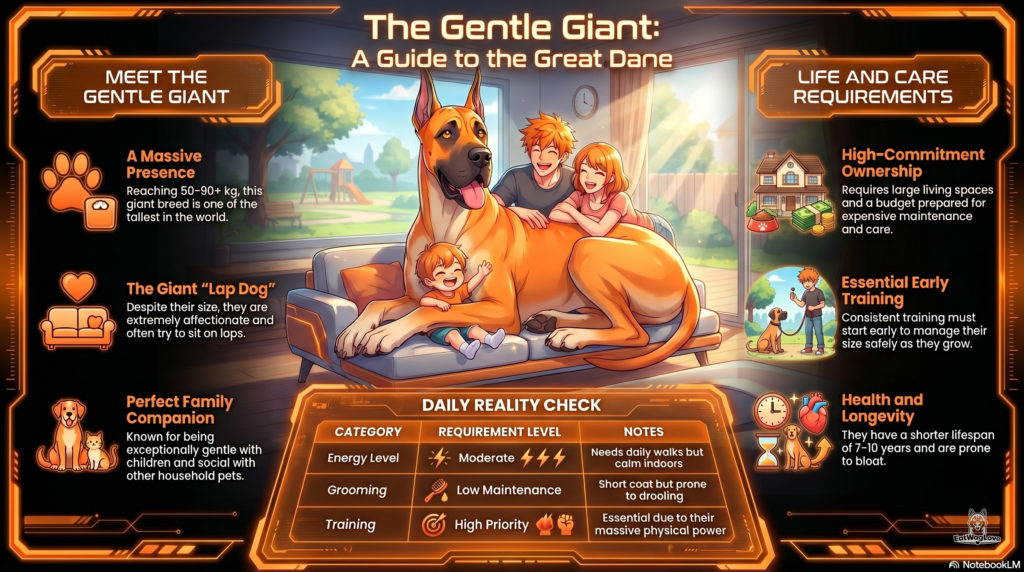
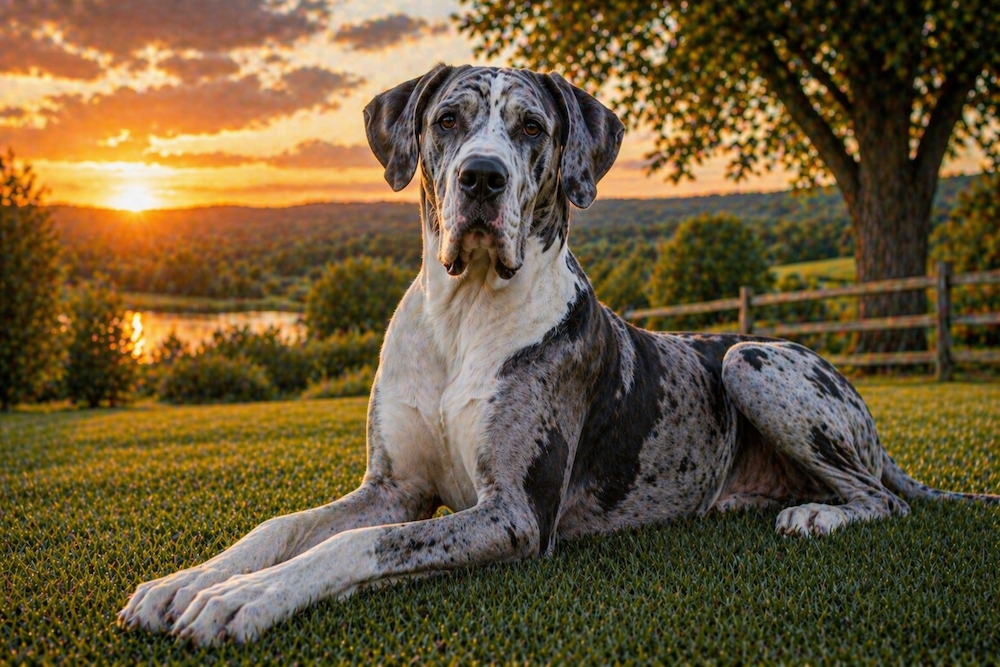







Massive, gentle, and incredibly loyal — a true gentle giant of the dog world.
🧠 QUICK SNAPSHOT
- Temperament: Gentle, Friendly, Loyal
- Energy Level: Moderate
- Size: Giant
- Good with Families: Excellent
- Training Difficulty: Moderate
📚 OVERVIEW
Great Danes are one of the largest dog breeds in the world, known for their towering height and gentle nature. Despite their size, they are affectionate, friendly, and often think they are lap dogs. They thrive on companionship and are known for forming strong bonds with their families.
✅ PROS & CONS
Pros
- Extremely gentle and affectionate
- Great with families and children
- Impressive, eye-catching presence
Cons
- Very large size requires space and planning
- Higher food and care costs
- Shorter lifespan compared to smaller breeds
Is a Great Dane a Good Family Dog?
Yes. Great Danes are often gentle, affectionate and devoted family dogs despite their enormous size.
Well-socialised Danes are typically friendly and people-oriented, and many are remarkably patient around children.
Their sheer size still requires supervision. A happy tail, enthusiastic lean or badly judged turn can send small children and household objects flying.
How Much Exercise Does a Great Dane Need?
Most adult Great Danes need around 45–60 minutes of moderate daily exercise.
They’re generally less relentlessly energetic than many working or sporting breeds.
Growing puppies require particular care because their skeletons develop rapidly. Forced long-distance running and excessive repetitive impact should be avoided while they’re immature.
Is a Great Dane Easy to Train?
Great Danes are intelligent and generally trainable, particularly with positive reinforcement and early consistency.
Training is especially important because an untrained 70 kg dog can be extremely difficult to manage.
Loose-leash walking, recall, polite greetings and remaining calm around people should begin while the puppy is still physically manageable.
Does a Great Dane Shed?
Yes. Great Danes shed moderately throughout the year.
Their short coat is easy to maintain, but the individual hairs can still appear throughout the house.
Weekly brushing generally removes loose hair effectively.
Is a Great Dane Hypoallergenic?
No. Great Danes aren’t considered hypoallergenic.
They shed hair and dander and produce normal canine allergens through saliva and skin secretions.
Their short coat requires relatively little grooming, but that doesn’t make them allergy-friendly.
How Much Grooming Does a Great Dane Need?
Great Danes are relatively low-maintenance to groom.
Weekly brushing, regular nail trimming, dental care and ear checks generally cover the basics.
Bathing is needed occasionally — although convincing an unwilling Great Dane to enter a bathtub can turn “low-maintenance grooming” into a major logistical exercise.
What Health Problems Are Common in Great Danes?
Important health concerns include gastric dilatation-volvulus (GDV), dilated cardiomyopathy, hip dysplasia, cervical vertebral instability, thyroid disease and certain cancers.
Their giant size also contributes to orthopaedic and developmental challenges.
Responsible breeding and appropriate nutrition during growth are particularly important.
Why Are Great Danes So Prone to Bloat?
Great Danes have a large, deep chest, a body type strongly associated with increased risk of gastric dilatation-volvulus.
During GDV, the stomach fills with gas and may rotate, compromising blood supply and causing shock.
Great Danes are considered one of the breeds at particularly high risk.
What Are the Signs of Bloat in a Great Dane?
Warning signs can include repeated unsuccessful attempts to vomit, excessive drooling, restlessness, abdominal enlargement, pain, weakness and collapse.
GDV is an immediate veterinary emergency.
Minutes matter — owners should never wait to see whether a suspected case improves on its own.
What Is Preventive Gastropexy in a Great Dane?
A gastropexy is a surgical procedure that attaches the stomach to the abdominal wall, greatly reducing the risk that it can twist during GDV.
It doesn’t prevent the stomach from filling with gas, but it can help prevent the catastrophic twisting component.
Owners of high-risk breeds such as Great Danes commonly discuss preventive gastropexy with their veterinarian.
Are Great Danes Prone to Heart Disease?
Yes. Dilated cardiomyopathy (DCM) is an important concern in Great Danes.
The heart muscle becomes weakened and enlarged, reducing its ability to pump blood effectively.
Signs may include exercise intolerance, coughing, weakness, abnormal heart rhythms or collapse, although disease can initially be silent.
Are Great Danes Prone to Hip Dysplasia?
Yes.
Great Danes can develop hip dysplasia, where the hip joint forms abnormally and may eventually develop painful arthritis.
Genetics, growth rate, body condition and environmental factors all influence joint development.
Formal hip screening of breeding animals is important.
What Is Wobbler Syndrome in Great Danes?
Wobbler syndrome refers to conditions causing compression of the spinal cord in the neck, resulting in an abnormal or unsteady gait.
Great Danes are among the breeds predisposed to cervical vertebral problems.
Affected dogs may appear weak or poorly coordinated, particularly in the hind limbs.
Are Great Danes Prone to Bone Cancer?
Great Danes have an increased risk of osteosarcoma, an aggressive bone cancer seen more frequently in large and giant breeds.
Persistent lameness, pain or swelling deserves veterinary investigation.
Early signs can sometimes initially resemble a simple orthopaedic injury.
Why Do Great Danes Have Such Short Lifespans?
Giant breeds generally have shorter average lifespans than smaller dogs, despite reaching enormous physical size remarkably quickly.
Great Danes are vulnerable to several serious conditions, including GDV, heart disease and cancer.
Their rapid growth and giant body size also place considerable demands on the cardiovascular and musculoskeletal systems.
How Long Does a Great Dane Live?
Great Danes commonly live around 7–10 years, although individual dogs can live longer.
Their relatively short lifespan is one of the most difficult realities of owning the breed.
Good breeding, appropriate body condition and preventive veterinary care can help maximise healthy years.
How Big Does a Great Dane Get?
Great Danes are among the world’s tallest dog breeds.
Adult males commonly stand at least around 76 cm at the shoulder, while females are generally at least around 71 cm, depending on the breed standard.
Many weigh approximately 45–80 kg, with exceptionally large males exceeding this.
Is the Great Dane the Tallest Dog Breed?
Great Danes are among the tallest dogs and have repeatedly produced individual world-record holders for height.
However, the Irish Wolfhound is also exceptionally tall and breed standards differ in how size is described.
Great Danes have become particularly famous because individual males can reach extraordinary heights.
What Is the World’s Tallest Dog Ever?
One of the most famous record holders was Zeus, a Great Dane from Michigan.
Guinness World Records measured Zeus at approximately 111.8 cm at the shoulder.
Standing on his hind legs, he towered over most adult humans.
Have Other Great Danes Held the World’s Tallest Dog Record?
Yes. Great Danes have dominated modern records for exceptionally tall dogs.
Dogs such as Giant George, Zeus and Freddy became internationally famous because of their extraordinary height.
The breed’s combination of long legs and giant skeletal structure makes it particularly suited to breaking height records.
Is a Great Dane Bigger Than an Irish Wolfhound?
It depends on the individual.
Both breeds can be extraordinarily tall.
Great Danes often have greater body mass and a more substantial appearance, while Irish Wolfhounds may be similarly tall or taller in some cases.
They’re both genuine giant breeds.
Is a Great Dane Bigger Than an English Mastiff?
Great Danes are generally taller and more athletic, while English Mastiffs are usually heavier and more massively built.
English Mastiffs have produced some of the heaviest dogs ever recorded.
Great Danes specialise more in vertical real estate.
Can a Great Dane Live in an Apartment?
Surprisingly, yes.
Adult Great Danes are often fairly calm indoors provided they receive adequate exercise.
Their enormous physical dimensions create practical issues, however. Beds, lifts, staircases, cars and available floor space all matter.
A Great Dane doesn’t need a mansion — but it can make a normal sofa look suspiciously small.
Are Great Danes Couch Potatoes?
Many adult Great Danes become impressively relaxed indoors.
They enjoy daily exercise but are often happy to sleep for substantial periods between activities.
Young Danes can be much more energetic.
Calling them couch potatoes is therefore partly accurate — assuming the Dane hasn’t already occupied the entire couch.
Can a Great Dane Be Left Alone?
Adult Great Danes can learn to spend reasonable periods alone, but they’re generally strongly people-oriented dogs.
Some develop separation-related behaviour.
Because destructive behaviour from a giant dog can be particularly impressive, gradual independence training should begin early.
Are Great Danes Velcro Dogs?
Many are.
Great Danes frequently form intense attachments to their families and enjoy staying physically close to people.
They may follow owners from room to room and attempt to occupy the same furniture.
Their understanding of personal space doesn’t always increase in proportion to their body size.
Are Great Danes Cuddly?
Extremely, in many cases.
Great Danes often behave as though they’re considerably smaller than they actually are.
Leaning, climbing partly onto laps and pressing against people are common displays of affection.
The phrase “lap dog” becomes somewhat theoretical when the lap dog weighs 70 kg.
Why Do Great Danes Lean on People?
Leaning is generally a form of affection, attention-seeking or comfortable physical contact.
Great Danes are particularly famous for it.
The behaviour isn’t evidence of dominance.
Unfortunately, what feels like a gentle lean to the Dane can feel like being slowly pushed over by a wardrobe to the human.
Do Great Danes Think They’re Lap Dogs?
They don’t literally misunderstand their size, but many Great Danes display close-contact behaviours associated with much smaller companion dogs.
They may attempt to sit partially on people, curl into undersized spaces or climb onto furniture.
Their affectionate personality makes the “world’s biggest lap dog” reputation understandable.
Are Great Danes Good With Children?
Usually, yes.
Well-socialised Great Danes are often gentle and patient with children.
Their size remains the major concern.
Even a friendly Dane can accidentally knock over a toddler, so interactions with young children should always be supervised.
Are Great Danes Good With Other Dogs?
Generally, yes.
Great Danes can be sociable with other dogs when properly socialised.
Their size can intimidate smaller dogs, and rough play requires supervision.
Individual temperament and early experiences remain important.
Are Great Danes Good With Cats?
Many can live successfully with cats, especially when raised with them.
However, Great Danes have historical hunting ancestry, and some retain significant prey drive.
Careful introductions are important, particularly around unfamiliar small animals.
Are Great Danes Aggressive?
Aggression isn’t typical of a well-bred Great Dane.
The modern breed is generally expected to be friendly, confident and dependable.
Poor breeding, fear, pain or inadequate socialisation can produce behavioural problems in any dog.
Because of the Great Dane’s enormous power, temperament quality is especially important.
Are Great Danes Protective?
Many are naturally watchful and devoted to their families.
Their appearance alone provides considerable deterrence.
Some individuals are more protective than others, but modern Great Danes aren’t generally expected to display uncontrolled aggression.
Are Great Danes Good Guard Dogs?
They can be effective deterrents and watchdogs simply because of their size, deep bark and imposing appearance.
Historically, Great Dane ancestors performed guarding work as well as hunting.
Modern Danes vary considerably in protective instinct.
Do Great Danes Bark a Lot?
Most aren’t considered excessive barkers.
When they do bark, however, the sound can be deep, powerful and extremely difficult to ignore.
They may bark at visitors, unfamiliar activity or when seeking attention.
Are Great Danes High-Energy Dogs?
Not usually compared with breeds such as Border Collies or Belgian Malinois.
Adult Great Danes generally have moderate exercise requirements.
Puppies and adolescents can be energetic, clumsy and playful.
Managing that adolescent phase can feel rather different when the puppy is already larger than many adult dogs.
When Does a Great Dane Stop Growing?
Great Danes gain enormous amounts of height during their first year, but physical development can continue until around 18–24 months or beyond.
They may continue filling out after reaching much of their adult height.
Growth should be steady rather than artificially accelerated through excessive feeding.
How Fast Do Great Dane Puppies Grow?
Extremely fast.
A Great Dane can progress from a small newborn puppy to a 50 kg or larger adolescent within little more than a year.
This extraordinary growth rate is one reason appropriate giant-breed puppy nutrition is so important.
More food and faster growth aren’t better.
What Should a Great Dane Puppy Eat?
Great Dane puppies should receive a complete diet formulated appropriately for large or giant-breed growth.
The goal is controlled, steady development with appropriate mineral balance.
Excess calories or inappropriate calcium supplementation can contribute to skeletal problems.
Dietary decisions should be discussed with a veterinarian.
Should Great Dane Puppies Take Calcium Supplements?
Not routinely when they’re eating an appropriately formulated complete puppy food.
Excessive calcium can interfere with normal skeletal development in giant-breed puppies.
Supplements should only be used when specifically recommended by a veterinarian.
Are Great Danes Good Running Dogs?
Adult Great Danes can enjoy short-to-moderate running, but they’re not ideal endurance-running dogs.
Their giant joints and skeletal structure experience substantial impact.
Long-distance running should be approached cautiously, and forced running should be avoided in growing puppies.
Are Great Danes Good Hiking Dogs?
Healthy adult Great Danes can enjoy hiking, particularly at moderate distances and temperatures.
Their size means owners should consider terrain, heat and emergency logistics.
Carrying an injured Great Dane off a remote mountain is not a realistic backup plan for most people.
Can Great Danes Swim?
Some can, but swimming ability and enthusiasm vary.
Their enormous bodies and deep chests can make swimming more demanding than it is for specialised water breeds.
Supervision and a well-fitted canine flotation device can be sensible around deep water.
Are Great Danes Fast?
Yes. Despite their giant size, Great Danes can run surprisingly quickly.
Their long legs and historical hunting background give them considerable athletic ability.
They’re not lumbering Mastiffs — a fit Great Dane can be powerful, agile and impressively fast over shorter distances.
What Were Great Danes Originally Bred For?
Great Dane ancestors were developed primarily as large hunting dogs capable of pursuing and holding dangerous game, particularly wild boar.
This required enormous strength, courage and athleticism.
Later, these impressive dogs also became estate guardians and prestigious companions.
Did Great Danes Really Hunt Wild Boar?
Yes. Dogs ancestral to the modern Great Dane were used in boar hunting, one of Europe’s most dangerous forms of hunting.
Boars are powerful animals capable of seriously injuring dogs and people.
The dogs therefore needed speed, strength and extraordinary courage.
Were Great Danes Called Boarhounds?
Dogs of this general type were historically associated with names such as boarhound because of their hunting function.
However, the modern Great Dane emerged gradually from several European Mastiff- and hunting-dog populations rather than from one perfectly documented ancient breed.
Why Did Great Danes Have Cropped Ears?
Ear cropping historically had a claimed practical rationale for boar-hunting dogs, because long ears could potentially be injured during encounters with dangerous game.
It later became primarily a breed tradition and cosmetic practice.
Cropping is now prohibited or heavily restricted in many countries, including Australia.
What Do Natural Great Dane Ears Look Like?
Natural Great Dane ears are medium-sized, folded and hanging close to the cheeks.
Upright pointed ears seen on some Danes result from surgical cropping.
A Great Dane doesn’t naturally develop erect ears.
Why Are Great Dane Tails So Powerful?
Their long tail is attached to an enormous, athletic body and can move with considerable force.
Repeated impact against walls or furniture can occasionally cause “happy tail” injuries, where the tip becomes damaged.
Owners also quickly learn to relocate drinks from Great Dane tail height.
Do Great Danes Drool?
Yes, although the amount varies.
Dogs with looser lips and jowls tend to drool more heavily, particularly after drinking or eating.
Some relatively tight-lipped Danes drool less.
Prospective owners should still expect occasional contributions to walls, clothes and ceilings.
Why Do Great Danes Sit on People?
Many Great Danes enjoy close physical contact and sometimes back onto people before sitting partially on them.
It’s generally affectionate or attention-seeking behaviour.
Their enormous hindquarters simply make the gesture considerably more memorable than when performed by a Chihuahua.
What Does a Great Dane Look Like?
The Great Dane is an enormous but elegant and athletic dog, combining tremendous height with a relatively refined build.
It has a long head, deep chest, powerful body, long legs and naturally folded ears.
The overall impression should be strength combined with dignity rather than extreme heaviness.
What Colours Can Great Danes Be?
Recognised colours and patterns commonly include fawn, brindle, black, blue, harlequin and mantle, with some standards also recognising merle.
Acceptable colours vary somewhat between kennel organisations.
Great Dane colour genetics are particularly fascinating because of the breed’s dramatic harlequin pattern.
What Is a Fawn Great Dane?
Fawn Great Danes have a golden-yellow coat with a black mask.
It’s one of the breed’s classic colours.
The famous cartoon Great Dane Scooby-Doo is brown rather than standard fawn, but his appearance was loosely inspired by the breed.
What Is a Brindle Great Dane?
Brindle Danes have a fawn background crossed by dark stripes.
The pattern is sometimes compared with tiger striping.
The black mask characteristic of fawn Danes may also be present.
What Is a Blue Great Dane?
Blue Great Danes have a steel-blue or slate-grey coat caused by dilution of black pigmentation.
The colour is genetically based and recognised under several major breed standards.
“Blue” doesn’t mean bright blue; it describes the characteristic diluted grey appearance.
What Is a Harlequin Great Dane?
A harlequin Great Dane has a white background with irregular black patches distributed across the body.
It’s one of the most visually distinctive patterns in the dog world.
Harlequin colouring results from a complicated interaction involving merle genetics and an additional modifier.
Is a Harlequin Great Dane the Same as a Merle Great Dane?
No.
Merle Great Danes typically have dark irregular patches on a grey background.
Harlequins have a predominantly white background with black torn-looking patches.
The patterns are genetically related, but they’re visually and genetically distinct.
Why Is Great Dane Harlequin Genetics So Complicated?
The classic pattern requires merle plus a separate harlequin modifier that removes much of the grey background pigmentation.
This creates the striking white-and-black appearance.
Because merle genetics can create serious health problems when inherited in duplicate, colour breeding requires careful genetic understanding.
What Is a Double-Merle Great Dane?
A dog inheriting two copies of the merle variant can have large amounts of white and significantly increased risk of hearing and eye abnormalities.
Responsible breeders carefully plan matings to avoid producing high-risk combinations.
Colour should never be prioritised over health.
Can Great Danes Be Completely White?
Predominantly white Great Danes can occur through certain colour combinations, particularly involving merle genetics.
However, extensive white can be associated with congenital deafness and eye abnormalities.
A white coat should therefore never automatically be treated as a desirable “rare colour.”
Can Great Danes Be Black?
Yes. Solid or predominantly black Great Danes are recognised.
Black also forms part of several other patterns, including mantle and harlequin.
A glossy black Great Dane can have an especially imposing appearance.
What Is a Mantle Great Dane?
Mantle Great Danes have a black body with contrasting white markings, typically around the chest, neck, muzzle, legs and tail tip.
The pattern resembles a black blanket or mantle draped over the dog.
It was historically sometimes called Boston colouring because of its resemblance to the Boston Terrier pattern.
Can Great Danes Be Chocolate?
Chocolate or brown pigmentation can occur genetically but isn’t generally a standard recognised Great Dane colour.
Dogs marketed primarily for unusual “rare colours” should be evaluated carefully.
Responsible breeding should prioritise health, structure and temperament rather than novelty pigmentation.
What Is a European Great Dane?
“European Great Dane” usually refers to dogs bred from European lines or towards certain European conformation preferences.
They may appear heavier, broader-headed and more substantial.
It isn’t a separate breed.
All remain Great Danes, although breeding styles can produce noticeable differences.
What Is an American Great Dane?
“American Great Dane” generally describes dogs bred according to American lines and conformation preferences.
They’re sometimes perceived as lighter and more refined than some European lines.
Again, these aren’t separate breeds — they’re variations within the same breed population.
Are There Miniature Great Danes?
No recognised Miniature Great Dane exists.
A genuinely tiny adult dog cannot simply be a miniature version of a normal Great Dane without unusual genetics, health issues or other breed ancestry.
“Mini Great Dane” should therefore be treated as a marketing term requiring investigation.
Is a Great Dane a Mastiff?
Great Danes have substantial Mastiff-type ancestry and historical connections with Mastiff hunting dogs, but the modern Great Dane is recognised as its own breed.
It combines Mastiff-like power with a more athletic, long-legged hunting-dog structure.
Is a Great Dane a Sighthound?
Not formally, although historical development included fast hunting dogs and Mastiff-type dogs.
Great Danes possess some Greyhound-like athletic influence in their historical development.
Their function required both speed and strength for pursuing large game.
What Breeds Created the Great Dane?
The exact recipe isn’t perfectly documented.
Historical development involved large Mastiff-type hunting dogs, with Greyhound-type influence helping produce greater speed and athleticism.
Various European hunting-dog populations contributed as the modern German breed gradually emerged.
Is the Great Dane Actually Danish?
No. Despite its English name, the modern Great Dane is fundamentally a German-developed breed.
Germany played the central role in standardising the dogs that became today’s Great Dane.
The name is one of dog history’s more persistent geographical misdirections.
Why Is a German Dog Called a Great Dane?
The English name traces largely to the French term Grand Danois, meaning “Great Dane.”
The name became established internationally despite Denmark not being the principal country responsible for developing the modern breed.
German breeders understandably preferred a different name.
What Is a Great Dane Called in Germany?
In Germany, the breed is called the Deutsche Dogge, meaning essentially “German Mastiff” or German Dogue.
The name much more accurately reflects the breed’s modern development.
Germany formally consolidated various regional names into Deutsche Dogge during the 19th century.
Was the Great Dane Ever Called an English Dog?
Large Mastiff-type hunting dogs imported into continental Europe were historically known by terms including Englische Dogge or Englischer Hund, reflecting English Mastiff-type ancestry.
Over time, German breeders developed these dogs into a distinctive type.
Breed terminology changed repeatedly before modern standardisation.
What Is an Ulmer Dogge?
The Ulmer Dogge was a regional German name associated with large hunting dogs from the area around Ulm.
Other regional names existed as well.
During the 19th century, German breeders worked to unite these related types under a single national breed identity.
When Did the Great Dane Become the Deutsche Dogge?
In 1880, German breeders meeting in Berlin established a breed standard and consolidated the various types under the name Deutsche Dogge.
This was an important moment in creating the modern Great Dane as a formally standardised breed.
Where Does the Great Dane Come From?
The modern Great Dane comes primarily from Germany, despite its misleading English name.
Its ancestors were powerful European hunting dogs developed from Mastiff-type stock and other athletic hunting dogs. They were used particularly for hunting wild boar, requiring an extraordinary combination of speed, courage and strength.
During the 19th century, German breeders transformed these working boarhounds into the more refined dog we recognise today. In 1880, breeders meeting in Berlin established the Deutsche Dogge as a standardised German breed.
Were Great Danes Kept by European Nobility?
Yes. Powerful hunting dogs of this type became prestigious animals among European aristocratic households.
Exceptional dogs could serve both as hunting companions and symbols of status.
Some were kept especially close to noble owners rather than simply housed with hunting packs.
What Was a Kammerhund?
A Kammerhund, or “chamber dog,” was a particularly valued large hunting dog allowed to remain within its noble owner’s private chambers.
These elite dogs could wear ornate collars and effectively served as personal companions and guardians.
The role reveals that Great Dane ancestors were becoming companion dogs long before the modern breed abandoned boar hunting.
Did Great Danes Wear Armour?
Historical boar-hunting dogs could be fitted with protective equipment or padded armour to reduce injuries from a boar’s tusks.
Boar hunting was extraordinarily dangerous.
The elegant modern Great Dane therefore descends from dogs whose working environment was considerably more hazardous than today’s sofa.
Why Did Great Danes Stop Hunting Boar?
Changes in hunting practices reduced the need for specialised packs of enormous boarhounds.
Breeders increasingly selected Great Danes for appearance, companionship and guarding.
The breed gradually changed from a dangerous-game hunting specialist into the comparatively gentle companion known today.
How Did the Great Dane Become a “Gentle Giant”?
As its original hunting role declined, breeders increasingly emphasised stable temperament and companionship.
Modern Great Danes retain enormous size and impressive presence but are generally expected to be friendly and dependable.
This contrast produced the famous “gentle giant” description.
Is the Great Dane Germany’s National Dog?
The Great Dane has enormous historical importance in Germany, but claims that it’s formally the country’s official national dog should be treated cautiously.
It’s certainly one of Germany’s most internationally recognisable breeds.
Its German name, Deutsche Dogge, makes its national heritage much clearer than “Great Dane” does.
Was Scooby-Doo a Great Dane?
Yes. Scooby-Doo is a fictional Great Dane, although his appearance deliberately breaks several breed-standard conventions.
Animator Iwao Takamoto reportedly discussed desirable Great Dane characteristics and then exaggerated or reversed some of them to create Scooby’s distinctive awkward appearance.
Why Was Scooby-Doo Made a Great Dane?
The contrast was part of the joke.
Great Danes have a reputation for imposing size and dignity, while Scooby is famously nervous, clumsy and food-obsessed.
Turning a huge, intimidating-looking breed into a frightened comedy character created much of Scooby’s charm.
Is Marmaduke a Great Dane?
Yes. Marmaduke is a Great Dane.
The newspaper comic strip created by Brad Anderson began in 1954 and revolves around the chaos produced by an enormous Great Dane living with a suburban family.
Anyone who has watched a real Dane attempt to turn around in a small room may consider the premise surprisingly documentary-like.
Why Are Great Danes So Popular in Cartoons and Movies?
Their extraordinary height, long legs, expressive faces and enormous physical presence make them instantly recognisable.
They can appear intimidating, elegant or comically oversized depending on the story.
Their generally affectionate real-world temperament also makes the contrast particularly effective.
Are Great Danes Good First Dogs?
They can be, but they’re not an easy first dog.
Temperament is often manageable, but giant size magnifies almost every aspect of ownership — food, veterinary costs, transport, training, medication doses and physical control.
A committed first-time owner can succeed, but preparation matters.
Are Great Danes Expensive to Own?
Usually, yes.
Large quantities of food, giant beds, heavy-duty equipment and veterinary treatments can all cost more.
Even medications are frequently priced according to body weight.
A Great Dane may have moderate grooming needs, but very little else about giant-dog ownership comes in a small size.
Where Did the Great Dane Really Originate?
Despite the word “Dane,” the modern Great Dane is a German breed descended from powerful European hunting dogs used particularly against wild boar.
Its ancestors combined Mastiff-like strength with the speed and athleticism required to pursue dangerous game. German breeders gradually refined these dogs, and in 1880 the Deutsche Dogge was formally standardised.
The breed then underwent one of the more remarkable career changes in canine history: from armoured aristocratic boar hunter to affectionate household companion.
The modern Great Dane may spend considerably less time confronting wild boar, but it still has one unmistakable connection with its giant ancestors — everything it does happens on a scale that makes ordinary dogs look slightly under-engineered.