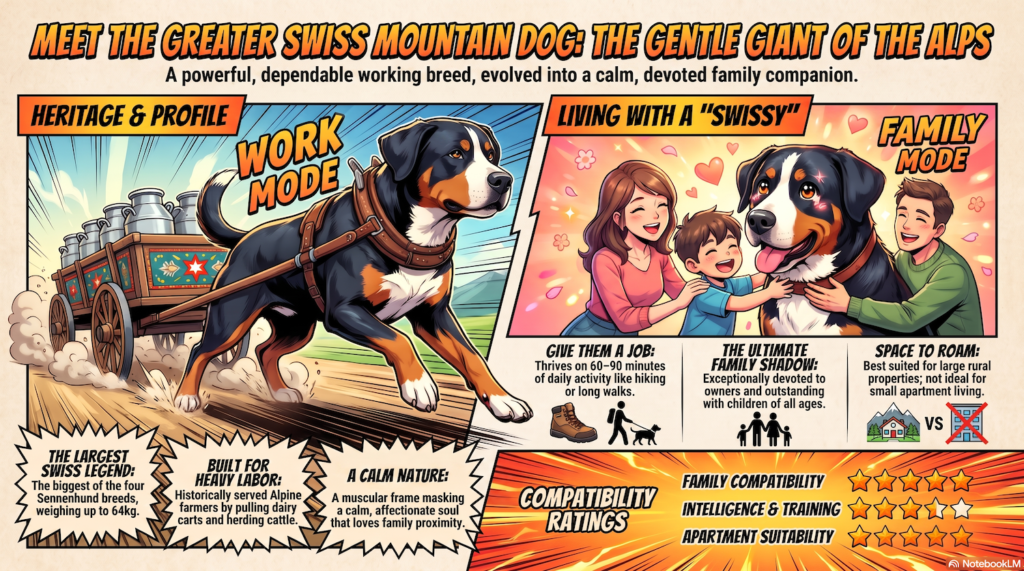







Powerful, gentle, and incredibly loyal — a giant working dog with a calm temperament and a heart devoted to its family.
🧠 QUICK SNAPSHOT
- Temperament: Loyal, gentle, confident
- Energy Level: Moderate
- Size: Giant
- Good With Families: Yes
- Trainability: High
- Grooming: Low
- Best For: Families, spacious homes, active lifestyles
📚 OVERVIEW
The Greater Swiss Mountain Dog is the largest of Switzerland’s four Sennenhund breeds and was originally developed as an all-purpose farm dog. These powerful dogs herded livestock, guarded property, and pulled heavy carts through the Swiss Alps, earning a reputation for strength, reliability, and calm determination.
Despite their imposing size, Greater Swiss Mountain Dogs are affectionate, patient, and deeply devoted to their families. They thrive on companionship and are happiest when included in everyday family life.
✅ PROS & CONS
Pros
- Gentle and affectionate with family
- Calm, confident temperament
- Excellent watchdog without being overly aggressive
- Low-maintenance coat
Cons
- Large size requires plenty of space
- Heavy shedding, especially seasonally
- Shorter lifespan than many smaller breeds
- Needs early training due to its strength and size
Is a Greater Swiss Mountain Dog a Good Family Dog?
Yes. The Greater Swiss Mountain Dog can be a devoted, affectionate and confident family companion, particularly for households comfortable with very large dogs.
They’re usually strongly attached to their people and can be patient with children. Their enormous size and strength require early training and supervision around small children.
They’re generally calmer than many working breeds but still need regular exercise, companionship and something useful to do.
How Much Exercise Does a Greater Swiss Mountain Dog Need?
Most adults need around 60–90 minutes of moderate daily exercise.
Walking, hiking, training and controlled pulling activities can suit them well.
They’re powerful working dogs rather than endurance athletes. Excessive repetitive exercise should be avoided while puppies are growing because of their large frame and developing joints.
Is a Greater Swiss Mountain Dog Easy to Train?
They’re intelligent and capable of learning quickly, although they can be independent and somewhat stubborn.
Positive reinforcement and consistent boundaries generally work best.
Training should begin early. A behaviour that’s amusing in a 12 kg puppy becomes considerably less entertaining when performed by a 55 kg adult.
Does a Greater Swiss Mountain Dog Shed?
Yes. Greater Swiss Mountain Dogs shed moderately throughout the year, often with heavier seasonal shedding.
They have a short, dense double coat.
Regular brushing helps remove loose undercoat, but this isn’t a low-shedding breed.
Is a Greater Swiss Mountain Dog Hypoallergenic?
No.
Greater Swiss Mountain Dogs shed hair and dander and produce normal canine allergens.
Their short coat is relatively easy to maintain, but short-haired doesn’t mean hypoallergenic.
How Much Grooming Does a Greater Swiss Mountain Dog Need?
Grooming requirements are relatively modest.
A thorough brushing once or twice a week is usually sufficient, with more frequent brushing during seasonal shedding.
Regular nail trimming is especially important because this is a very heavy dog placing substantial force through its feet.
What Health Problems Are Common in Greater Swiss Mountain Dogs?
Important concerns include hip and elbow dysplasia, gastric dilatation-volvulus (GDV), eye disorders and certain orthopaedic problems.
Epilepsy and urinary incontinence have also been reported within the breed.
Responsible breeders should use appropriate health screening and maintain detailed knowledge of their bloodlines.
Are Greater Swiss Mountain Dogs Prone to Bloat?
Yes. Their large, deep-chested structure places them at risk of gastric dilatation-volvulus (GDV).
The stomach expands with gas and may rotate, creating a life-threatening emergency.
Repeated unsuccessful attempts to vomit, abdominal swelling, severe restlessness, drooling or collapse require immediate veterinary treatment.
Are Greater Swiss Mountain Dogs Prone to Hip Dysplasia?
Yes.
Hip dysplasia is an important consideration in such a large, heavy breed.
Formal hip assessment of breeding dogs is valuable, while maintaining healthy body weight throughout life reduces unnecessary stress on the joints.
What Is Splenic Torsion in Greater Swiss Mountain Dogs?
Splenic torsion occurs when the spleen twists around its supporting structures and blood vessels.
It can occur alone or alongside other abdominal problems and requires urgent veterinary attention.
Large, deep-chested breeds can be vulnerable to abdominal torsion disorders, making sudden abdominal pain, weakness or collapse particularly concerning.
How Long Does a Greater Swiss Mountain Dog Live?
Greater Swiss Mountain Dogs commonly live around 8–11 years.
As with many large and giant breeds, average lifespan is shorter than in smaller dogs.
Genetics, cancer risk, joint health, body condition and preventive veterinary care all influence longevity.
How Big Does a Greater Swiss Mountain Dog Get?
They’re very large dogs.
Males typically stand around 65–72 cm at the shoulder, with females approximately 60–68 cm.
Adults commonly weigh roughly 39–64 kg, with males generally considerably heavier than females.
Despite their size, they should remain powerful and athletic rather than excessively fat.
Is the Greater Swiss Mountain Dog a Giant Breed?
It’s generally regarded as a large to giant working breed.
Mature males can exceed 60 kg while retaining considerable strength and mobility.
The breed’s substantial bone, broad chest and powerful musculature reflect its historical work as a farm and draught dog.
Can a Greater Swiss Mountain Dog Live in an Apartment?
It’s possible, but not ideal for many owners.
Swissies are often reasonably calm indoors, but they’re very large dogs requiring regular exercise and considerable physical space.
Stairs can also become problematic for puppies, elderly dogs or animals with joint problems.
Can a Greater Swiss Mountain Dog Be Left Alone?
Adults can learn to spend reasonable periods alone, but Swissies are generally strongly attached to their families.
They were historically farm dogs living and working around people and animals.
Long periods of isolation can contribute to boredom, frustration or destructive behaviour.
Are Greater Swiss Mountain Dogs Velcro Dogs?
Many are.
Despite their rugged working-dog history, Greater Swiss Mountain Dogs often enjoy remaining close to their family.
They may follow people around the house and position themselves where they can observe household activity.
Their interpretation of “close” occasionally involves occupying the exact piece of floor you intended to walk across.
Are Greater Swiss Mountain Dogs Cuddly?
Many are extremely affectionate.
They’re often physically demonstrative dogs that enjoy leaning against people or lying nearby.
Not every Swissy wants to be a lap dog, but some appear entirely unconcerned by the mathematical impossibility of fitting 50-plus kilograms onto one.
Are Greater Swiss Mountain Dogs Good With Children?
Generally, yes.
Well-socialised Swissies can be patient, affectionate and protective family dogs.
Their size is the primary concern around small children. An excited young Swissy can accidentally knock a child over without any aggressive intent.
Are Greater Swiss Mountain Dogs Good With Other Dogs?
Many are sociable with other dogs when properly socialised.
However, some mature Swissies can become selective or assertive with unfamiliar dogs, and same-sex conflict can occur.
Early socialisation and responsible management remain important.
Are Greater Swiss Mountain Dogs Good With Cats?
They can live successfully with cats, particularly when raised together.
As general-purpose farm dogs, their ancestors lived around a variety of animals.
Individual prey drive varies, so introductions should still be managed carefully.
Are Greater Swiss Mountain Dogs Protective?
Yes. Many have natural watchdog and protective instincts.
Historically, they guarded farms, families and livestock as part of their general working role.
They should ideally be confident and discerning rather than indiscriminately suspicious or aggressive.
Are Greater Swiss Mountain Dogs Good Guard Dogs?
They can be effective property guardians.
Their enormous size, deep bark and confident presence provide considerable deterrence.
The breed’s traditional role included watching farms and protecting property, although they’re not specialised personal-protection dogs.
Are Greater Swiss Mountain Dogs Aggressive?
Aggression isn’t a desirable breed characteristic.
A well-bred Swissy should generally be confident, stable and dependable.
Poor socialisation, fear, pain or irresponsible breeding can produce behavioural problems in any dog.
With a breed this powerful, stable temperament is particularly important.
Are Greater Swiss Mountain Dogs Good With Strangers?
Many are initially reserved or watchful, then become friendly once they recognise that the visitor is welcome.
Temperaments range from socially enthusiastic to more dignified and aloof.
Early positive socialisation helps prevent normal watchfulness from developing into inappropriate suspicion.
Do Greater Swiss Mountain Dogs Bark a Lot?
They’re generally moderate barkers, but many possess an impressively deep alarm bark.
Their traditional farm work included alerting people to unfamiliar activity.
Boredom and insufficient stimulation can increase nuisance barking.
Are Greater Swiss Mountain Dogs High-Energy?
They’re moderately energetic rather than hyperactive.
A Swissy usually enjoys exercise and outdoor activities but isn’t typically as relentless as a Border Collie or Belgian Malinois.
Their historical work required strength, stamina and versatility rather than constant high-speed movement.
When Do Greater Swiss Mountain Dogs Calm Down?
Swissies can mature relatively slowly.
Many retain adolescent enthusiasm until around two to three years of age, sometimes longer.
The challenge is that their bodies become enormous considerably before their brains have completely finished the puppy phase.
Are Greater Swiss Mountain Dogs Good Hiking Dogs?
Yes. Healthy adult Swissies can make excellent hiking companions in cool to moderate conditions.
Their strength and endurance suit steady walking over varied terrain.
Hot-weather hiking requires caution because their large body and dense double coat make heat management important.
Are Greater Swiss Mountain Dogs Good Running Dogs?
They’re better suited to walking, hiking and moderate activity than sustained long-distance running.
Their heavy skeletal structure places substantial force through the joints.
Forced running should particularly be avoided during growth.
Can Greater Swiss Mountain Dogs Swim?
Some swim well, while others are less enthusiastic.
They’re heavy, deep-bodied dogs rather than specialised water retrievers.
Individual confidence varies considerably, so dogs should be introduced gradually and supervised around deep water.
Can Greater Swiss Mountain Dogs Handle Cold Weather?
Very well.
Their dense double coat and Alpine heritage provide substantial protection in cold conditions.
They’re generally far more comfortable in cool weather than extreme heat.
Can Greater Swiss Mountain Dogs Handle Hot Weather?
They can live in warm climates with appropriate management, but heat requires considerable caution.
Their large body mass and dense undercoat make cooling difficult.
Exercise should be shifted to cooler parts of the day during hot Australian weather, with shade, water and cool indoor access always available.
What Does a Greater Swiss Mountain Dog Look Like?
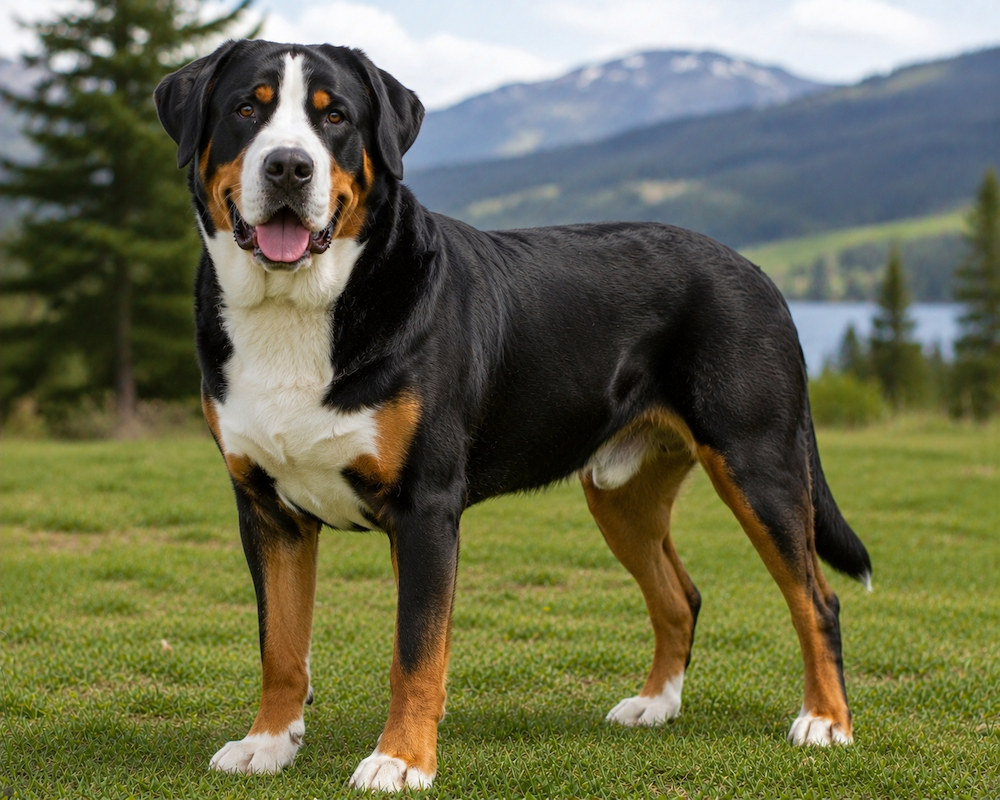
The Greater Swiss Mountain Dog is a large, powerful, short-coated dog with distinctive black, rust and white markings.
It has a broad head, muscular body, deep chest and substantial bone.
Despite its imposing build, it should appear athletic enough to perform genuine farm work.
Why Are Greater Swiss Mountain Dogs Black, White and Rust?
The breed has a characteristic tricolour pattern consisting of a predominantly black coat with rich rust markings and clearly defined white areas.
This colour scheme occurs in several Swiss mountain breeds.
Selective breeding eventually made it one of the Swissy’s defining features.
What Is the White “Swiss Cross” on a Greater Swiss Mountain Dog?
The white chest markings can sometimes form a cross-like shape, informally associated with the Swiss cross.
It’s a striking visual feature rather than a functional adaptation.
Exact markings vary from dog to dog.
Can Greater Swiss Mountain Dogs Have Blue Eyes?
Blue eyes aren’t characteristic of the breed standard.
The expected eye colour is generally brown, contributing to the Swissy’s warm expression.
Unusual eye colours should be considered in the context of genetics and breed standards rather than promoted automatically as desirable “rare” features.
What Is the Difference Between a Greater Swiss Mountain Dog and a Bernese Mountain Dog?
The easiest difference is the coat.
The Greater Swiss Mountain Dog has a short coat, while the Bernese Mountain Dog has a long, heavily feathered coat.
Swissies are also generally larger, heavier and more robustly built.
Both belong to the family of traditional Swiss mountain and farm dogs.
Is a Greater Swiss Mountain Dog Just a Short-Haired Bernese Mountain Dog?
No.
Although they’re closely related in historical type and share similar tricolour markings, they’re separate established breeds.
The Swissy isn’t simply a Bernese with short hair.
Each developed its own structure, working characteristics and breed standard.
Is the Greater Swiss Mountain Dog Bigger Than a Bernese Mountain Dog?
Generally, yes.
Greater Swiss Mountain Dogs are typically heavier and more powerfully built than Bernese Mountain Dogs.
The Bernese’s long coat can make it look enormous, but beneath the coat the Swissy is usually the more substantial dog.
What Is the Difference Between a Greater Swiss Mountain Dog and a Rottweiler?
Both are powerful European working dogs with black-and-tan colouring and historical associations with cattle and draught work.
However, the Swissy has characteristic white markings, a different head and body structure and a distinct Swiss development history.
The Rottweiler became particularly associated with German cattle-driving and guarding traditions.
Is the Greater Swiss Mountain Dog Related to the Rottweiler?
They belong to a broader historical world of European cattle dogs, butcher’s dogs and Mastiff-type working dogs, and similarities are obvious.
However, describing one simply as the ancestor of the other would oversimplify their development.
Both emerged from regional working-dog populations shaped for related tasks.
What Is the Difference Between a Greater Swiss Mountain Dog and a Saint Bernard?
Both are large Swiss breeds, but their histories and appearance differ.
Saint Bernards became famous for Alpine hospice and rescue work, while Greater Swiss Mountain Dogs were primarily multipurpose farm, cattle and draught dogs.
Swissies are usually shorter-coated, more athletic and distinctly tricoloured.
Is the Greater Swiss Mountain Dog Related to the Saint Bernard?
They share broad geographic and historical connections with large Swiss working dogs, but they’re separate breeds.
Older Swiss farm and Mastiff-type populations likely shared ancestry across regions.
Modern pedigree boundaries were established much later.
What Is a Sennenhund?
“Sennenhund” refers to the traditional Swiss mountain or Alpine farm dogs associated with Sennen, the herders and dairymen of the Swiss Alps.
Four modern breeds belong to this group:
Greater Swiss Mountain Dog
Bernese Mountain Dog
Appenzeller Sennenhund
Entlebucher Mountain Dog
They share a distinctive working heritage and often similar tricolour markings.
What Are the Four Swiss Mountain Dog Breeds?
The four recognised Swiss Sennenhund breeds are the Greater Swiss Mountain Dog, Bernese Mountain Dog, Appenzeller Sennenhund and Entlebucher Mountain Dog.
The Greater Swiss is the largest.
The Entlebucher is the smallest, while the Bernese is the only one with the characteristic long coat.
Is the Greater Swiss Mountain Dog the Largest Sennenhund?
Yes.
The Greater Swiss Mountain Dog is the largest of the four traditional Swiss Sennenhund breeds.
Its German name, Grosser Schweizer Sennenhund, literally identifies it as the large or greater Swiss mountain/farm dog.
What Is a Greater Swiss Mountain Dog Called in Switzerland?
The German name is Grosser Schweizer Sennenhund.
“Sennenhund” refers to dogs associated with Alpine herders and dairymen.
The English name Greater Swiss Mountain Dog is essentially a translation reflecting the same origin.
What Were Greater Swiss Mountain Dogs Originally Bred For?
They were multipurpose Swiss farm dogs.
Their jobs included moving cattle, guarding farms and livestock, pulling carts and serving as general working companions.
This versatility explains their combination of strength, confidence, trainability and moderate endurance.
Did Greater Swiss Mountain Dogs Herd Cattle?
Yes. Cattle driving was an important part of their traditional work.
Swiss farm dogs helped move and manage cattle, particularly as livestock travelled between farms, markets and seasonal grazing areas.
They weren’t specialised precision herders like Border Collies, but cattle work formed part of their job description.
Did Greater Swiss Mountain Dogs Pull Carts?
Yes. Cart pulling is one of the breed’s most fascinating traditional roles.
Their enormous strength allowed them to haul milk, cheese, farm goods and other loads.
For families unable to afford horses, a strong dog could provide extremely useful pulling power.
Why Were Greater Swiss Mountain Dogs Called the Poor Man’s Horse?
Large draught dogs could perform transportation jobs that might otherwise require a horse.
For farmers, dairymen and tradespeople of limited means, a strong dog was cheaper to keep and required far less space than a horse.
This gave Swiss draught dogs the memorable description “the poor man’s horse.”
How Much Can a Greater Swiss Mountain Dog Pull?
A properly conditioned Swissy can pull impressive loads in organised drafting and weight-pulling activities.
However, there isn’t one safe universal maximum because ability depends on the dog’s size, conditioning, equipment, surface and health.
Heavy pulling should never be attempted with immature dogs whose joints are still developing.
Do Greater Swiss Mountain Dogs Still Pull Carts Today?
Yes, primarily recreationally and competitively.
Drafting events allow modern Swissies to demonstrate a skill closely connected with their historical work.
Many breed enthusiasts regard carting as an excellent way to preserve the dog’s working heritage.
What Is Drafting With a Greater Swiss Mountain Dog?
Drafting involves a dog wearing a specialised harness and pulling a cart or wagon through controlled exercises.
Competitions can test obedience, manoeuvring, control and practical hauling ability.
It’s far more sophisticated than simply attaching a wagon to a large dog.
Did Greater Swiss Mountain Dogs Pull Milk Carts?
Yes. Swiss draught dogs became particularly associated with transporting dairy products and farm goods.
A dog could haul milk or cheese from farms and dairies to local destinations.
Their role developed within Switzerland’s strong agricultural and dairy traditions.
Were Greater Swiss Mountain Dogs Butcher’s Dogs?
Large Swiss farm dogs were historically associated with butchers, cattle dealers and livestock workers.
They could help move cattle, guard property and haul goods.
This places the Swissy within the broader European tradition of powerful “butcher’s dogs” that also contributed to the history of breeds such as the Rottweiler.
Did Greater Swiss Mountain Dogs Guard Farms?
Yes.
Farm guarding was part of their multipurpose role.
Their size, deep bark and natural watchfulness made them effective deterrents against unwanted visitors while they simultaneously performed livestock and draught work.
Where Does the Greater Swiss Mountain Dog Come From?
The Greater Swiss Mountain Dog originated in Switzerland, developing from large multipurpose farm dogs used by herders, dairymen, farmers and tradespeople.
These dogs drove cattle, guarded property and pulled carts.
They were valued for practical usefulness rather than appearance, and regional populations existed before organised pedigree breeding.
Is the Greater Swiss Mountain Dog an Ancient Breed?
Its working ancestors have a long history, but claims that the modern Swissy has existed unchanged since ancient times should be treated cautiously.
The modern pedigree breed was established in the early 20th century from surviving Swiss farm dogs.
Its working type is old; its formal breed identity is comparatively recent.
Is the Greater Swiss Mountain Dog Descended From Roman Mastiffs?
A popular historical theory claims Roman armies brought large Mastiff-type dogs across the Alps and that these contributed to Swiss mountain breeds.
Some ancient dog movement certainly occurred, but a simple direct Roman Mastiff-to-Swissy pedigree can’t be demonstrated.
The breed’s ancestry is better understood as part of a long history of European farm and Mastiff-type working dogs.
Is the Greater Swiss Mountain Dog a Mastiff?
It has clear Mastiff-type characteristics and historical connections, but it’s recognised as a distinct Swiss working breed.
Its heavy bone, broad head and tremendous strength reflect that background.
However, it’s generally more athletic and versatile than specialised heavy Mastiff breeds.
Was the Greater Swiss Mountain Dog Nearly Extinct?
Yes. By the beginning of the 20th century, dogs recognised as the old large Swiss farm type had become uncommon and were at risk of disappearing as a distinct population.
Industrialisation and changing transport methods reduced demand for draught dogs.
The modern breed owes its survival to a small number of enthusiasts who recognised remaining examples.
Why Did Greater Swiss Mountain Dogs Nearly Disappear?
Mechanisation was a major factor.
As motor vehicles and other forms of transport replaced dog-drawn carts, one of the Swissy’s most useful jobs disappeared.
Agricultural practices also changed.
Working breeds maintained primarily because they were useful could decline quickly once technology replaced their traditional occupation.
Who Rediscovered the Greater Swiss Mountain Dog?
Swiss geologist and dog expert Professor Albert Heim played an enormously important role in recognising and preserving the breed.
At a Swiss dog show in 1908, he encountered large short-haired dogs entered as Bernese Mountain Dogs and recognised them as representatives of an older large Sennenhund type.
Who Was Albert Heim?
Albert Heim was a distinguished Swiss geologist as well as an influential authority on Swiss mountain dogs.
His interest extended far beyond simply judging dogs.
He helped identify, describe and promote the traditional Sennenhund breeds at a time when some were in danger of disappearing.
What Happened at the 1908 Dog Show That Saved the Breed?
At a show in Langenthal, Switzerland, in 1908, Franz Schertenleib presented a large short-haired dog called Bello as a Bernese Mountain Dog.
Albert Heim recognised that Bello represented a different, older large Swiss mountain-dog type.
That recognition became a crucial moment in the revival of the Greater Swiss Mountain Dog.
Who Was Bello?
Bello was a large short-haired Swiss farm dog whose appearance at the 1908 Langenthal dog show helped trigger recognition of the Greater Swiss Mountain Dog as a distinct breed.
He wasn’t literally the sole ancestor of every modern Swissy.
His importance was that he helped experts recognise that surviving examples of the old type still existed.
Who Was Franz Schertenleib?
Franz Schertenleib was a Swiss breeder associated with the rediscovery of the Greater Swiss Mountain Dog.
He presented Bello at the 1908 show where Albert Heim recognised the dog’s significance.
Schertenleib subsequently helped locate other examples of the traditional large short-haired Sennenhund type.
When Was the Greater Swiss Mountain Dog Officially Recognised?
Following the breed’s rediscovery in the early 20th century, Swiss cynological authorities began recognising and registering it as a distinct breed.
A breed standard was developed during the following years as enthusiasts searched for suitable foundation dogs and established a sustainable population.
Did Greater Swiss Mountain Dogs Serve in the Military?
Yes. Swissies were used by the Swiss military as draught and transport dogs, particularly during the era when animal power remained important for moving supplies.
Their strength and ability to work in difficult terrain made them useful where larger transport animals or vehicles weren’t always practical.
Were Greater Swiss Mountain Dogs Used During World War II?
Dogs of the breed were used by the Swiss Army for hauling loads and transport duties during the 20th century, including the World War II era.
Switzerland remained neutral, but its military was mobilised and maintained substantial defensive preparations.
The Swissy’s traditional draught abilities remained practically useful.
Why Is the Greater Swiss Mountain Dog Less Famous Than the Bernese Mountain Dog?
The Bernese became much more internationally popular as a companion dog, helped by its dramatic long coat and teddy-bear appearance.
The Greater Swiss remained less numerous and retained a more specialised following.
Ironically, the Swissy is the larger of the two despite being considerably less famous.
Is the Greater Swiss Mountain Dog Rare?
Yes, relatively.
The breed survives securely today but remains far less common than Bernese Mountain Dogs, Saint Bernards or mainstream family breeds.
Its large size, relatively small breeding population and specialised history have limited widespread popularity.
Is a Greater Swiss Mountain Dog a Good First Dog?
It can be, but it’s not among the easiest beginner breeds.
Owners need to manage giant size, considerable strength, slow maturation, training, joint health and potential guarding behaviour.
A committed first-time owner can succeed, particularly with good breeder support and early training.
Why Is the Greater Swiss Mountain Dog Sometimes Called a Swissy?
“Swissy” is the breed’s popular affectionate nickname.
It’s considerably easier to say repeatedly than Greater Swiss Mountain Dog and has become common among owners and breed enthusiasts.
The nickname shouldn’t be confused with Swiss Mountain Dogs collectively, since there are four separate Sennenhund breeds.
What Makes the Greater Swiss Mountain Dog Unusual?
Few modern companion dogs have such a varied historical résumé.
The Swissy could move cattle in the morning, guard the farm, haul dairy products to market and then watch over the family.
Rather than being developed for one narrow speciality, it was essentially a four-legged piece of agricultural infrastructure.
Where Does the Greater Swiss Mountain Dog Come From?
The Greater Swiss Mountain Dog comes from Switzerland, where its ancestors served as powerful all-purpose farm dogs. They moved cattle, guarded farms and livestock and, most famously, pulled carts loaded with milk, cheese and other goods.
The breed almost disappeared as mechanised transport replaced working dogs. Its survival took a remarkable turn at a dog show in Langenthal in 1908, when a large short-haired dog named Bello caught the attention of Swiss geologist and dog authority Albert Heim. Heim recognised him as representative of the old large Sennenhund type, helping launch efforts to preserve the breed.
That history explains the modern Swissy remarkably well. It’s huge but athletic, watchful but affectionate, and enormously strong without being a high-speed working dog.
For generations, these dogs were effectively cattle drover, security guard, farmhand and delivery vehicle rolled into one — which makes fetching a tennis ball seem like a fairly undemanding retirement job.