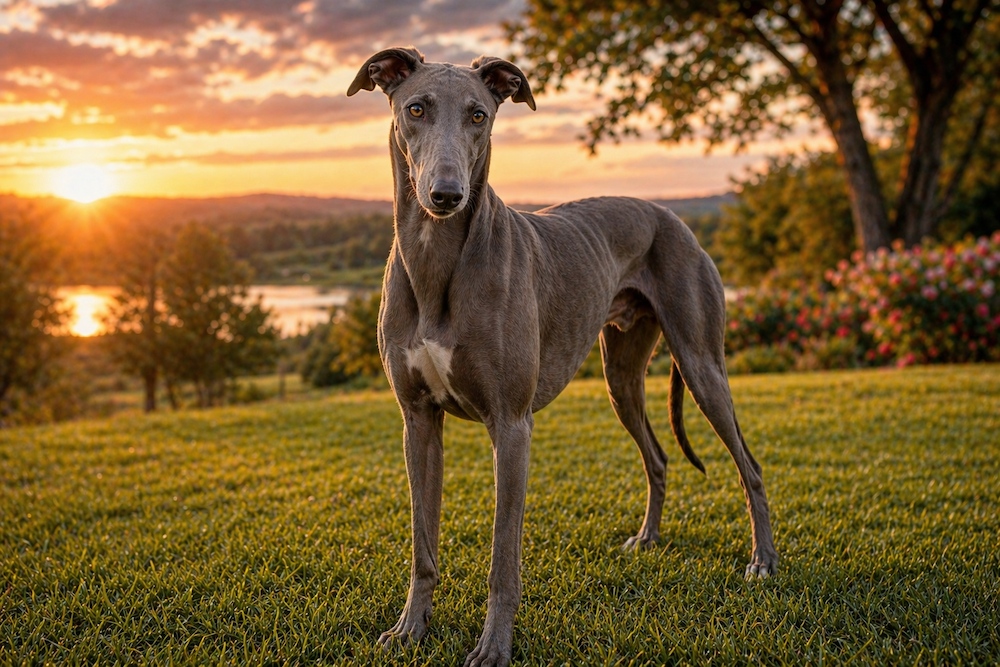







Lightning fast on the track, calm and gentle at home — the ultimate relaxed athlete.
🧠 QUICK SNAPSHOT
- Temperament: Gentle, Calm, Affectionate
- Energy Level: Low to Moderate (with bursts of speed)
- Size: Large
- Good with Families: Yes
- Training Difficulty: Easy
📚 OVERVIEW
Greyhounds are one of the fastest dog breeds in the world, built for speed and agility. Despite their racing background, they are known for being calm, quiet, and affectionate companions. Often referred to as “couch potatoes,” they enjoy relaxing just as much as running.
✅ PROS & CONS
Pros
- Very calm and quiet indoors
- Gentle and affectionate nature
- Low grooming requirements
Cons
- Needs secure areas due to strong prey drive
- Sensitive to cold weather
- Can be shy or reserved initially
Is a Greyhound a Good Family Dog?
Yes. Greyhounds are often gentle, affectionate and surprisingly calm family dogs.
Despite their racing reputation, most adult Greyhounds are relaxed indoors and spend substantial amounts of time sleeping.
Their sensitive temperament generally responds best to calm, positive handling. Individual prey drive and experience with children or other animals should always be considered.
How Much Exercise Does a Greyhound Need?
Most adult Greyhounds need around 45–60 minutes of daily exercise, usually divided between walks and opportunities for safe activity.
They’re sprinters rather than endurance athletes.
A Greyhound can run extraordinarily fast and then spend much of the remaining day demonstrating an equally impressive commitment to the sofa.
Is a Greyhound Easy to Train?
Greyhounds can learn well, but they’re independent rather than intensely obedience-focused.
They were bred to pursue prey using their own vision and judgement rather than constantly waiting for human instructions.
Positive reinforcement and short, enjoyable training sessions generally work best.
Does a Greyhound Shed?
Yes, but generally not heavily.
Greyhounds have short, fine coats and typically shed a relatively modest amount compared with heavily coated breeds.
Regular gentle brushing can remove loose hair.
Is a Greyhound Hypoallergenic?
No.
Greyhounds produce normal canine allergens through their skin, saliva and dander.
Their short coat and relatively low shedding may make household hair easier to manage, but they aren’t truly hypoallergenic.
How Much Grooming Does a Greyhound Need?
Very little.
Their short coat generally requires only occasional brushing and bathing.
Dental care is particularly important because Greyhounds can experience significant dental disease.
Nails should also be kept appropriately short.
Why Do Greyhounds Have Such Thin Skin?
Greyhounds have very little body fat, a fine coat and relatively delicate skin.
Their athletic body has been selected for speed rather than physical protection.
Minor collisions that wouldn’t trouble a heavily coated dog can sometimes cause significant skin injuries in a Greyhound.
What Health Problems Are Common in Greyhounds?
Important concerns include dental disease, osteosarcoma, certain eye conditions, musculoskeletal injuries and gastric dilatation-volvulus.
Greyhounds also have unusual physiological characteristics that can affect blood-test interpretation and anaesthetic management.
Veterinarians familiar with sighthounds are particularly valuable.
Are Greyhounds Prone to Dental Problems?
Yes. Dental and periodontal disease can be significant in Greyhounds, particularly in some retired racing dogs.
Regular tooth brushing, veterinary dental examinations and appropriate professional cleaning can be important.
Persistent bad breath shouldn’t simply be accepted as normal Greyhound behaviour.
Are Greyhounds Prone to Osteosarcoma?
Yes. Greyhounds have an increased risk of osteosarcoma, an aggressive bone cancer also seen in several other large breeds.
Persistent or unexplained lameness deserves veterinary investigation.
Early osteosarcoma can initially resemble an ordinary orthopaedic injury.
Are Greyhounds Sensitive to Anaesthesia?
Greyhounds have physiological differences from many other dogs, including low body fat and distinctive drug metabolism.
Historically, some older anaesthetic drugs presented particular problems for sighthounds.
Modern anaesthetic protocols are much safer, but veterinarians should still account for Greyhound-specific physiology.
Do Greyhounds Have Unusual Blood Test Results?
Yes.
Healthy Greyhounds commonly have higher red blood cell counts, haemoglobin and packed cell volume than many other breeds.
Some blood chemistry values can also differ from general canine reference expectations.
These differences are important because a perfectly healthy Greyhound can otherwise appear abnormal on paper.
Why Do Greyhounds Have So Many Red Blood Cells?
Their unusually high red-cell mass supports the rapid delivery of oxygen to working muscles during intense sprinting.
It’s part of the extraordinary physiology that makes the Greyhound such an efficient high-speed athlete.
This characteristic also historically made some Greyhounds valuable canine blood donors.
Can Greyhounds Be Blood Donors?
Some can make excellent blood donors because of their large size, calm temperament and high red-cell mass.
Blood type compatibility still matters, and donor suitability must be assessed individually.
Retired racing Greyhounds have historically participated in canine blood-donor programmes in several countries.
How Long Do Greyhounds Live?
Greyhounds commonly live around 10–14 years.
Many retired racers therefore have substantial lives ahead of them after leaving the racing industry.
Health, dental care, cancer risk, previous injuries and body condition all influence longevity.
How Big Does a Greyhound Get?
Greyhounds are large but exceptionally lean dogs.
Adults generally stand around 68–76 cm at the shoulder and often weigh roughly 25–40 kg, with males typically larger.
Their deep chest and extremely narrow waist make them appear lighter than many dogs of similar height.
Can a Greyhound Live in an Apartment?
Yes. Greyhounds can be excellent apartment dogs despite their size.
Most adults are calm indoors and don’t require constant high-intensity exercise.
Reliable outdoor walking and safe opportunities to stretch their legs remain important.
Are Greyhounds Couch Potatoes?
Famously so.
Adult Greyhounds often spend large portions of the day sleeping or resting.
Their athletic specialisation is explosive speed rather than constant activity.
The contrast between a Greyhound running at full speed and the same dog several minutes later occupying a sofa is one of the breed’s defining characteristics.
How Many Hours a Day Do Greyhounds Sleep?
Many adult Greyhounds happily sleep or rest for much of the day, sometimes around 16–18 hours depending on age and lifestyle.
This doesn’t mean they don’t need exercise.
They’re simply remarkably good at switching between explosive athleticism and complete inactivity.
Can a Greyhound Be Left Alone?
Many adult Greyhounds can learn to spend reasonable periods alone.
However, some retired racers initially struggle because they’ve spent much of their lives surrounded by other dogs and structured routines.
Gradual independence training can be particularly important during the transition into a home.
Are Greyhounds Cuddly?
Many are extremely affectionate.
Some enjoy leaning against people, resting their heads on laps or curling up nearby.
Others are more quietly affectionate.
Their reputation for aloofness often disappears quickly once a retired Greyhound discovers soft beds and human attention.
Are Greyhounds Velcro Dogs?
Some become surprisingly attached to their owners.
Retired racers may follow people around the house as they adjust to companion life.
Others retain a more independent personality.
The breed tends to be gentle and affectionate without necessarily demanding constant entertainment.
Are Greyhounds Good With Children?
Many are excellent with calm, respectful children.
Greyhounds are generally gentle and non-boisterous indoors.
Children should understand not to disturb sleeping dogs, and interactions with young children should always be supervised.
Individual temperament and previous experience matter.
Are Greyhounds Good With Other Dogs?
Usually.
Racing Greyhounds spend considerable time around other Greyhounds, so many are comfortable with canine company.
Small dogs can require additional assessment because prey drive varies between individuals.
Good socialisation and careful introductions remain important.
Are Greyhounds Good With Cats?
Some are, while others aren’t.
Greyhounds have been selectively bred for generations to chase rapidly moving animals, so prey drive can be substantial.
Many adoption organisations specifically assess retired Greyhounds for cat compatibility.
A cat-safe Greyhound can often live peacefully with cats, but this shouldn’t simply be assumed.
Do Greyhounds Have a Strong Prey Drive?
Many do.
Greyhounds are sighthounds developed to detect, pursue and catch moving prey visually.
A rabbit, hare or small animal suddenly running can trigger powerful chase behaviour.
Prey drive varies significantly between individuals.
Can Greyhounds Be Trusted Off Leash?
Generally, they should only run off leash in securely fenced areas unless local laws and exceptionally reliable individual circumstances allow otherwise.
A Greyhound can accelerate rapidly and travel a considerable distance before an owner can react.
Once chase instinct engages, recall may be ineffective.
Why Do Greyhounds Need Secure Fencing?
Their combination of extraordinary speed and prey drive makes escape particularly dangerous.
A loose Greyhound can cover hundreds of metres very quickly.
Secure fencing provides somewhere the dog can run without the risks posed by traffic or wildlife.
Why Do Greyhounds Wear Wide Collars?
Greyhounds have long, narrow heads that aren’t dramatically wider than their necks, making ordinary collars easier to slip.
Wide sighthound collars spread pressure over a larger area.
Martingale-style collars are also commonly used because they tighten sufficiently to prevent escape without functioning like a traditional choke collar when properly fitted.
Why Do Greyhounds Wear Martingale Collars?
A martingale collar helps prevent a Greyhound from backing out of its collar.
Because the head is narrow, a standard flat collar may slide over the ears.
Properly fitted martingales provide additional security without continuous tightness.
Why Do Greyhounds Wear Muzzles?
Muzzles have historically been associated with racing regulations, kennel management and safety around other animals.
A muzzled Greyhound isn’t automatically aggressive.
In some jurisdictions or circumstances, retired racing Greyhounds have also been subject to breed-specific public-muzzling requirements, although laws vary and have changed over time.
Does a Muzzle Mean a Greyhound Is Dangerous?
No.
Greyhounds are generally gentle dogs.
A muzzle may be used because of racing history, prey drive, local regulations, introduction protocols or responsible safety management.
It shouldn’t automatically be interpreted as evidence of aggression towards people.
Why Do Greyhounds Chatter Their Teeth?
Many Greyhounds produce a distinctive teeth-chattering behaviour when excited, relaxed or anticipating something enjoyable.
It can look alarming to new owners but isn’t necessarily a sign of coldness or fear.
Context matters, particularly if chattering occurs alongside signs of pain or distress.
Why Do Greyhounds Lean on People?
Leaning is a common affectionate behaviour.
Rather than enthusiastically climbing onto people, many Greyhounds simply press their long body against someone they trust.
It’s a characteristically understated way of requesting attention.
What Is Greyhound Roaching?
“Roaching” describes a Greyhound lying on its back with its legs sticking into the air, resembling a dead cockroach.
It’s generally a sign that the dog feels extremely relaxed and secure.
For an animal built with such elegant aerodynamic precision, the sleeping position can be spectacularly undignified.
Why Do Greyhounds Sleep With Their Legs in the Air?
The position usually indicates relaxation and comfort.
It exposes the vulnerable belly, suggesting the dog feels safe.
Greyhound owners commonly call this roaching, and it’s one of the most recognisable quirks of retired racers living as pets.
Why Do Greyhounds Sleep With Their Eyes Open?
Some Greyhounds sleep with their eyes partially open, which can confuse new owners.
Dogs can enter sleep while the eyelids remain incompletely closed.
If the eye appears irritated, dry or abnormal when the dog is awake, veterinary examination is appropriate.
Why Do Greyhounds Freeze on Walks?
Some Greyhounds, particularly newly retired racers, may suddenly stop and refuse to move.
Possible causes include uncertainty, sensory overload, fear or simply unfamiliarity with the environment.
Patience and positive reinforcement are preferable to dragging the dog.
Why Are Retired Greyhounds Sometimes Afraid of Stairs?
Racing kennels and training environments may provide limited exposure to household stairs.
A newly adopted Greyhound may therefore encounter them as an entirely unfamiliar obstacle.
Their long legs and body shape can also make steep or slippery stairs awkward.
Why Are Retired Greyhounds Sometimes Afraid of Glass Doors?
Some have limited experience with ordinary household environments.
Glass doors, televisions, mirrors, vacuum cleaners and polished floors can all be completely new experiences.
Many retired racers need a period of gradual adjustment to life inside a home.
Do Greyhounds Know How to Sit?
Yes, but sitting can be physically awkward for some Greyhounds because of their long thighs, deep chest and body proportions.
Many prefer standing or lying down.
A Greyhound reluctant to sit isn’t necessarily being stubborn.
Why Do Greyhounds Sometimes Sit Sideways?
Their long limbs and highly specialised body shape can make a conventional square sit uncomfortable.
Some naturally adopt an off-centre or sideways position.
Persistent difficulty sitting accompanied by pain or stiffness should still be investigated.
Do Greyhounds Get Cold Easily?
Yes.
Greyhounds have very little insulating body fat and extremely short coats.
They can become uncomfortable in cold or wet weather much sooner than heavily coated breeds.
Coats or jackets can be useful in cool conditions.
Do Greyhounds Need Pyjamas?
Not literally, but indoor dog coats or pyjamas can be useful for Greyhounds in cold homes or climates.
Their minimal coat and low body fat provide relatively little insulation.
This is one breed where canine clothing can serve a genuine practical purpose rather than purely fashion.
Can Greyhounds Handle Hot Weather?
Greyhounds generally cope better with moderate warmth than heavily coated breeds, but they’re still vulnerable to heat stress, particularly during exercise.
High-speed running produces substantial metabolic heat.
Exercise should be limited during extreme temperatures.
Are Greyhounds Good Running Partners?
Surprisingly, they’re usually better sprinters than long-distance running companions.
Greyhounds are specialised for short bursts of extreme speed.
Some conditioned individuals can build endurance, but someone seeking a serious distance-running dog may be better suited to a breed developed for sustained work.
Are Greyhounds Good Hiking Dogs?
Many enjoy moderate hikes, but they’re not naturally designed for long-distance endurance over rough terrain.
Their thin skin, relatively delicate feet and lack of protective coat can make difficult trails challenging.
Individual fitness and previous lifestyle matter.
Can Greyhounds Swim?
Some can swim, but many aren’t naturally confident in water.
Their deep chest, low body fat and unusual body proportions can make swimming more difficult than for breeds such as Labradors.
A canine flotation vest and close supervision are sensible.
How Fast Can a Greyhound Run?
Greyhounds can reach approximately 70–72 km/h (43–45 mph) over short distances.
That makes them among the fastest land animals relative to the familiar animals people encounter.
Their acceleration is equally remarkable.
Is the Greyhound the Fastest Dog in the World?
Yes. The Greyhound is generally regarded as the fastest dog breed over short distances.
Its entire body is specialised for sprinting: long legs, flexible spine, enormous heart and lungs, powerful hindquarters and exceptionally lean musculature.
How Quickly Can a Greyhound Reach Top Speed?
Greyhounds accelerate extraordinarily quickly, reaching high racing speeds within only a few strides.
Their explosive acceleration comes from powerful hindquarters, a flexible spine and a double-suspension gallop.
Few domestic animals can match the speed at which a Greyhound transforms from stationary to disappearing into the distance.
What Is a Double-Suspension Gallop?
During a double-suspension gallop, there are two moments during each stride when all four feet are off the ground.
One occurs when the body is fully extended and another when the legs gather beneath it.
This running style helps Greyhounds achieve extraordinary stride length and speed.
Why Is a Greyhound’s Spine So Flexible?
Spinal flexibility allows the body to contract and extend dramatically during galloping.
This increases stride length.
The same basic high-speed adaptation occurs in other fast-running animals, most famously the cheetah.
Why Do Greyhounds Have Such Deep Chests?
The deep chest accommodates an exceptionally large heart and lungs needed to deliver oxygen during intense sprinting.
Their narrow waist contrasts dramatically with this enormous thoracic capacity.
The result is one of the most specialised athletic body shapes among domestic dogs.
Do Greyhounds Have Large Hearts?
Yes. Athletic Greyhounds have relatively large hearts adapted to high cardiovascular output.
This helps deliver oxygenated blood rapidly during sprinting.
Their athletic physiology differs enough from ordinary dogs that veterinarians sometimes use breed-specific expectations when assessing them.
Why Are Greyhounds So Skinny?
A healthy Greyhound is naturally extremely lean.
Excess body mass would reduce speed and increase the energy required for acceleration.
Their body shape includes a narrow waist and visible muscular definition.
However, excessive thinness and poor condition shouldn’t automatically be dismissed as normal.
Should You Be Able to See a Greyhound’s Ribs?
Some rib definition can be normal in a healthy Greyhound because the breed carries very little body fat.
The exact healthy body condition depends on the individual.
A veterinarian familiar with Greyhounds can help distinguish normal athletic leanness from being underweight.
Why Do Greyhounds Have Long Tails?
The long tail helps with balance and rapid directional changes at speed.
During high-speed pursuit, small shifts in body position can have significant effects.
The tail effectively contributes to the dog’s extraordinary athletic control.
Why Do Greyhounds Have Such Long Legs?
Long limbs increase stride length, helping Greyhounds cover substantial ground with each galloping cycle.
Their leg proportions work together with the flexible spine and powerful hindquarters.
The entire body is essentially built around one objective: moving very quickly.
Do Greyhounds Hunt by Sight?
Yes. Greyhounds are sighthounds, meaning they were developed primarily to locate and pursue prey visually.
Unlike scent hounds that may follow a trail for kilometres, a Greyhound responds particularly strongly to visible movement.
This explains the breed’s famous chase instinct.
How Far Can a Greyhound See?
There isn’t a single useful breed-specific maximum distance, but Greyhounds possess excellent ability to detect movement at substantial distances.
Their visual system and head shape support the wide field of view valuable to a coursing dog.
Movement matters particularly strongly to sighthounds.
Do Greyhounds Have Better Vision Than Other Dogs?
Their vision is particularly well suited to detecting movement and monitoring a broad visual field.
This doesn’t mean every aspect of Greyhound eyesight is superior to every other dog.
Their sensory specialisation simply reflects generations of hunting primarily by sight.
What Were Greyhounds Originally Bred For?
Greyhounds were developed for coursing — pursuing fast-moving game by sight across open ground.
Hares became particularly associated with Greyhound coursing.
Speed, acceleration, visual awareness and the ability to capture prey were central to the breed.
What Is Coursing?
Coursing is a hunting method in which sighthounds pursue live game using sight rather than following a scent trail.
Historically, hares were commonly pursued by Greyhounds.
Modern lure coursing recreates aspects of the chase using an artificial lure rather than live prey.
What Is Lure Coursing?
Lure coursing is a dog sport where sighthounds chase a mechanically operated artificial lure around a course.
Turns and changes of direction imitate aspects of prey movement.
It allows Greyhounds and other sighthounds to use their natural chase instincts without hunting live animals.
Is Greyhound Racing the Same as Coursing?
No.
Track racing involves Greyhounds chasing an artificial lure around a defined racing track, usually over a relatively short distance.
Coursing historically involved pursuing prey across open terrain.
Both draw on the same fundamental chase instinct but are different activities.
Were Greyhounds Hunting Dogs Before They Were Racing Dogs?
Yes — by thousands of years.
Greyhounds were coursing and hunting dogs long before organised track racing existed.
Modern racing developed from older sporting traditions that already valued Greyhounds for exceptional speed.
Is the Greyhound an Ancient Breed?
Greyhound-type sighthounds have an extremely long history, and the modern Greyhound belongs to one of the oldest recognised families of specialised hunting dogs.
However, claims that today’s pedigree Greyhound is genetically identical to specific dogs depicted thousands of years ago go beyond the evidence.
Ancient sighthound traditions are real; perfectly continuous modern pedigrees are not.
Did Greyhounds Come From Ancient Egypt?
This is one of the most repeated Greyhound stories, but it needs qualification.
Ancient Egyptian art depicts elegant sighthound-like dogs, but these shouldn’t automatically be identified as modern Greyhounds.
The modern Greyhound’s documented development is much more strongly connected with European, particularly British, coursing traditions.
Are the Dogs in Egyptian Tombs Greyhounds?
They resemble sighthounds, but identifying them specifically as modern Greyhounds is too simplistic.
Ancient Egypt had slender hunting dogs adapted to visual pursuit.
Modern breeds such as Greyhounds, Salukis and other sighthounds were standardised much later from their respective populations.
Is the Greyhound Related to the Saluki?
Greyhounds and Salukis belong to the broader sighthound tradition, sharing similar functional adaptations such as long legs, deep chests and visual hunting.
They’re distinct modern breeds with separate histories.
Their similarity demonstrates how strongly high-speed pursuit shapes canine anatomy.
Is a Greyhound the Same as an Italian Greyhound?
No.
The Italian Greyhound is a separate much smaller breed, historically developed primarily as a companion and small sighthound.
It resembles a miniature Greyhound but isn’t simply a size variety of the Greyhound.
Is a Greyhound the Same as a Whippet?
No.
Whippets are a separate sighthound breed developed in Britain.
They’re considerably smaller than Greyhounds but share the deep chest, narrow waist, flexible spine and explosive running style.
Whippets became particularly associated with racing and working-class communities in industrial Britain.
What Is the Difference Between a Greyhound and a Whippet?
Greyhounds are significantly larger and generally faster at maximum speed.
Whippets are smaller, easier to accommodate and extraordinarily fast for their size.
Both tend to be gentle, calm indoors and explosive athletes when given an opportunity to run.
Is a Lurcher a Greyhound?
Not necessarily.
A Lurcher is traditionally a sighthound crossed with another breed or type, often involving Greyhound ancestry.
Historically, Greyhounds were crossed with Collies, Terriers and other working dogs to create versatile hunting dogs.
A Lurcher is therefore a type rather than simply another name for a Greyhound.
Where Does the Name Greyhound Come From?
Surprisingly, the name probably doesn’t simply mean a grey-coloured hound.
Greyhounds occur in many colours, and historical forms of the word predate modern English spelling.
Its precise linguistic origin is debated, with Old English forms such as grighund appearing in discussions of the name.
Are Greyhounds Always Grey?
No.
Greyhounds occur in black, white, fawn, red, blue-grey, brindle and numerous combinations and markings.
Grey is only one possible colour.
The breed’s name isn’t a reference to a requirement for grey fur.
What Colours Can Greyhounds Be?
Greyhounds occur in an exceptionally wide variety of colours and patterns, including black, white, fawn, red, blue, brindle and parti-coloured combinations.
Colour has little connection with racing ability or temperament.
What Is a Blue Greyhound?
“Blue” describes a diluted black coat producing a slate-grey appearance.
It doesn’t mean the dog is literally blue.
Blue is one of several recognised Greyhound colours.
Why Are Some Greyhounds Brindle?
Brindle is a genetically determined pattern producing dark stripes over a lighter background.
It occurs naturally within Greyhound populations.
The pattern has no special relationship with speed, temperament or racing performance.
Where Did the Modern Greyhound Develop?
The modern pedigree Greyhound is particularly associated with Britain, where coursing became highly organised and breeding records increasingly formalised.
Greyhound-like hunting dogs existed much earlier and across multiple regions, but British breeding played a major role in shaping the modern breed.
Were Greyhounds Owned by Nobility?
Yes.
For centuries, Greyhounds were strongly associated with aristocracy, hunting and social status.
Their speed and elegance made them prestigious animals.
Historical laws and hunting rights also restricted who could pursue certain game, reinforcing the Greyhound’s association with wealth and privilege.
What Were the Forest Laws and How Did They Affect Greyhounds?
Medieval English forest laws controlled hunting rights and access to game.
Greyhounds were valuable coursing dogs capable of taking protected animals.
Various historical restrictions therefore affected ownership or use of hunting dogs, although popular claims that ordinary people were universally forbidden to own Greyhounds can oversimplify a complex legal history.
Why Are Greyhounds Associated With Royalty?
Greyhounds combined practical hunting ability with an elegant, distinctive appearance, making them popular among rulers and aristocrats.
They appear repeatedly in European art, heraldry and courtly imagery.
Few working dogs managed to look quite so regal while pursuing dinner at 70 km/h.
Do Greyhounds Appear in the Bible?
Some English Bible translations historically used the word “greyhound” in Proverbs 30:31.
However, translation of the underlying Hebrew term has been debated, and modern translations often render it differently.
It’s therefore interesting historically but shouldn’t be treated as definitive proof that the biblical animal was a modern Greyhound.
Do Greyhounds Appear in Shakespeare?
Greyhounds appear in Shakespeare’s works.
One famous reference occurs in Henry V, comparing eager soldiers to Greyhounds straining at the start of a hunt.
The imagery shows how strongly speed and pursuit were already associated with the breed in English culture.
What Is the Waterloo Cup?
The Waterloo Cup was one of Britain’s most famous hare coursing competitions, first held in the 19th century.
Greyhounds competed on their ability to pursue and turn hares.
The event became enormously prestigious before live hare coursing was eventually prohibited in Britain.
When Did Modern Greyhound Racing Begin?
Modern mechanical-lure track racing developed during the early 20th century.
The invention and commercial development of mechanical lure systems allowed Greyhounds to race around tracks without live prey.
The sport subsequently spread internationally.
Who Invented the Mechanical Lure for Greyhound Racing?
American inventor Owen Patrick Smith is strongly associated with developing the modern mechanical lure and oval-track Greyhound racing during the early 20th century.
His system helped transform traditional coursing into a spectator racing industry.
Why Did Greyhound Racing Become So Popular?
Greyhound racing combined high-speed competition, relatively compact tracks, spectator entertainment and gambling.
It expanded rapidly in several countries during the 20th century.
The industry’s treatment and rehoming of racing dogs subsequently became the subject of substantial animal-welfare concern and regulatory change.
What Happens to Greyhounds After Racing?
Many retired racing Greyhounds are rehomed as companion animals through adoption programmes, although outcomes have historically varied between jurisdictions and periods.
Transitioning into a household can involve learning unfamiliar experiences such as stairs, glass doors, household appliances and spending time alone.
Many adapt remarkably well.
Do Retired Racing Greyhounds Make Good Pets?
Yes. Many make exceptionally gentle, calm and affectionate companion dogs.
Retirement reveals something racing doesn’t make obvious: Greyhounds can be surprisingly low-key household dogs.
Individual prey drive, health, confidence and previous experiences still need to be assessed.
Why Do Retired Greyhounds Need Time to Adjust to Home Life?
A racing dog’s previous environment may have been highly structured and very different from an ordinary household.
Stairs, televisions, slippery floors, mirrors, children and household noises may all be unfamiliar.
The dog isn’t necessarily traumatised — it may simply be encountering an entirely new way of living.
Are Greyhounds Good First Dogs?
Often, yes.
Their calm indoor behaviour, low grooming requirements and gentle temperament can make them excellent first dogs.
Owners still need to understand prey drive, secure handling, dental care and the transition needs of retired racers.
Why Are Greyhounds Called the “45 mph Couch Potato”?
Because the description captures their two most famous characteristics remarkably well.
A Greyhound can sprint at around 70 km/h, making it the fastest dog breed, yet many adults spend the majority of their day sleeping.
Few breeds transition quite so efficiently from elite athlete to decorative sofa cushion.
Where Does the Greyhound Come From?
The Greyhound belongs to an ancient tradition of sighthounds developed to detect and pursue fast-moving prey by sight. Slender hunting dogs appear in very old art across several civilisations, although identifying those animals directly as today’s Greyhound goes beyond what the evidence can prove.
The modern Greyhound became particularly shaped by British coursing traditions, where dogs were selectively bred for extraordinary speed, eyesight and pursuit of game such as hare. Organised coursing eventually gave rise to modern track racing after mechanical lures appeared during the early 20th century.
The result is one of the most physically specialised dogs humans have ever created: huge cardiovascular capacity, long legs, a flexible spine, powerful hindquarters and the ability to reach roughly 70 km/h.
And perhaps the Greyhound’s greatest surprise is what happens when all that engineering comes indoors. The fastest dog on Earth often uses its extraordinary athletic body primarily to walk from one soft bed to another and then require several hours to recover from the journey.