






Energetic, intelligent, and adventure-loving — a striking companion that combines loyalty with endless enthusiasm.
🧠 QUICK SNAPSHOT
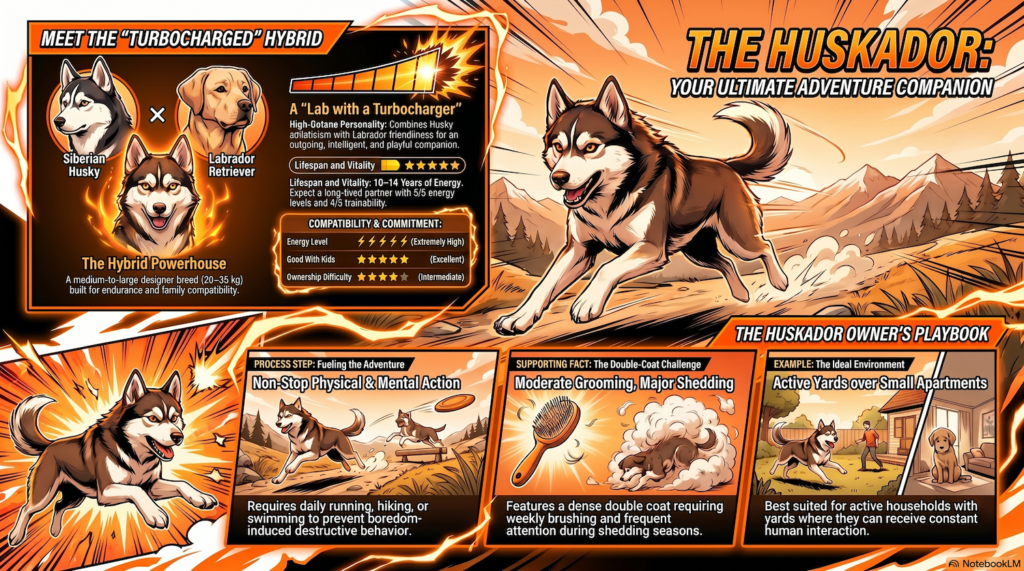
- Temperament: Friendly, intelligent, energetic
- Energy Level: Very high
- Size: Medium to large
- Good With Families: Yes
- Trainability: High
- Grooming: Moderate to high
- Best For: Active families, outdoor lifestyles, experienced owners
📚 OVERVIEW
The Huskador is a cross between a Siberian Husky and a Labrador Retriever, combining the intelligence, friendliness, and athleticism of two of the world’s most popular breeds. They are highly energetic dogs that love activity, adventure, and spending time with their family.
With their striking appearance and playful nature, Huskadors make excellent companions for active households that can provide plenty of exercise and engagement.
✅ PROS & CONS
Pros
- Friendly and affectionate personality
- Highly intelligent and trainable
- Great companion for active families
- Athletic and adventurous nature
Cons
- Very high exercise requirements
- Can become destructive if bored
- Sheds heavily, especially seasonally
- Needs consistent training and stimulation
Is a Huskador a Good Family Dog?
Yes, for active families. A Huskador — a Siberian Husky × Labrador Retriever cross — can be affectionate, playful, outgoing and strongly attached to its family.
Both parent breeds are energetic working dogs, so this isn’t usually a low-maintenance family pet.
A well-socialised Huskador can be wonderful with children, but owners should expect substantial exercise, training and shedding.
What Breeds Make a Huskador?
A Huskador combines a Siberian Husky and Labrador Retriever.
The cross may inherit the Labrador’s retrieving instincts and people-focused temperament alongside the Husky’s endurance, independence and northern working-dog characteristics.
The result can vary considerably from one dog to another.
What Other Names Does a Huskador Have?
The cross is also commonly called a Labsky.
Less commonly, names such as Siberian Retriever may appear.
Huskador and Labsky generally describe the same Husky-Labrador combination rather than separate breeds.
Is a Huskador the Same as a Labsky?
Yes.
Huskador and Labsky both generally mean Siberian Husky × Labrador Retriever.
Because designer-cross terminology isn’t formally regulated, owners should still confirm the dog’s actual parentage rather than relying entirely on the name.
How Much Exercise Does a Huskador Need?
Most adult Huskadors need around 90 minutes to two hours of exercise each day, with particularly energetic individuals requiring more.
Walking alone may not be sufficient.
Running, hiking, retrieving, swimming, scent games and training can help satisfy both physical and mental needs.
Is a Huskador a High-Energy Dog?
Usually, yes — potentially extremely high-energy.
Labradors were developed as working retrievers, while Siberian Huskies were bred to pull sleds over substantial distances.
Combining them doesn’t normally produce a dog whose greatest ambition is a five-minute stroll around the block.
Is a Huskador Easy to Train?
Huskadors are usually intelligent, but trainability can vary.
Labradors are famously cooperative and food-motivated, while Huskies can be much more independent and selective about following instructions.
Positive reinforcement, consistency and interesting training sessions generally produce the best results.
Are Huskadors Intelligent?
Yes.
Both parent breeds are intelligent, but they demonstrate intelligence differently.
The Labrador was selected to work cooperatively with people, while the Husky needed enough independence to function effectively within a sled team.
A Huskador can therefore be both highly trainable and remarkably good at developing its own plans.
Are Huskadors Stubborn?
Some certainly can be.
A Huskador inheriting substantial Husky temperament may understand a command perfectly while deciding that something else is more interesting.
This isn’t necessarily a lack of intelligence.
Independent decision-making has been useful in northern working dogs for generations.
Does a Huskador Shed?
Yes — usually a lot.
Both Siberian Huskies and Labrador Retrievers have shedding double coats.
A Huskador should therefore be expected to leave hair around the home throughout the year, with potentially dramatic seasonal shedding.
Is a Huskador Hypoallergenic?
No.
Both parent breeds shed and produce normal canine allergens.
A Huskador is therefore a poor choice for someone specifically seeking a low-shedding or hypoallergenic dog.
Does a Huskador Have a Double Coat?
Usually, yes.
Both parent breeds possess weather-resistant double coats, making a double coat highly likely in their offspring.
Length and density vary, with some Huskadors appearing Labrador-like and others developing noticeably thicker Husky-style coats.
How Often Should You Groom a Huskador?
Most should be brushed several times each week, increasing to daily grooming during major seasonal coat blows.
An undercoat rake or appropriate deshedding tool can help remove loose undercoat.
Bathing should generally be performed when necessary rather than excessively.
Should You Shave a Huskador?
Generally, no.
The double coat provides insulation and environmental protection.
Routine shaving doesn’t stop shedding and may interfere with normal coat regrowth.
Regular brushing and undercoat removal are usually preferable unless clipping is medically necessary.
What Health Problems Are Common in Huskadors?
Potential concerns include hip and elbow dysplasia, eye disorders, exercise-related orthopaedic problems and inherited conditions occurring in either parent breed.
Labrador-related obesity tendencies and Husky-associated eye disease are particularly relevant.
Responsible breeding should include appropriate health testing of both parents.
Are Huskadors Prone to Hip Dysplasia?
They can be.
Hip dysplasia occurs in both Siberian Huskies and Labrador Retrievers.
Formal hip assessment of breeding dogs helps reduce risk.
Maintaining a lean body condition is also particularly important in an athletic cross.
Are Huskadors Prone to Eye Problems?
They can be.
Siberian Huskies have recognised inherited eye concerns, while Labrador Retrievers can also develop hereditary eye disease.
Responsible breeders should use appropriate ophthalmic examinations and relevant DNA testing.
Are Huskadors Prone to Obesity?
Some are.
Labradors have a well-known tendency towards strong food motivation, and certain genetic factors can contribute to increased appetite in some Labrador lines.
A Huskador that inherits Labrador appetite without Husky energy expenditure can gain weight surprisingly efficiently.
How Long Does a Huskador Live?
Huskadors commonly live around 10–14 years.
Individual longevity depends on genetics, size, joint health, body condition and preventive veterinary care.
There is no large standardised population providing one definitive lifespan figure for the cross.
How Big Does a Huskador Get?
Most are medium-to-large dogs, commonly weighing around 20–36 kg, although individuals can fall outside this range.
Height and build vary depending on which parent they resemble.
Some are lean and Husky-like, while others inherit the Labrador’s heavier structure.
Is There a Mini Huskador?
There is no officially recognised Mini Huskador.
Because both parent breeds are medium-to-large dogs, a genuinely small “Mini Huskador” would generally require additional breed ancestry or deliberate multigenerational downsizing.
The term should therefore be treated as a marketing description rather than a defined variety.
Can a Huskador Live in an Apartment?
It’s possible, but challenging.
Their size isn’t necessarily the biggest problem — energy, vocalisation and exercise requirements are.
An exceptionally committed owner could manage a Huskador in an apartment, but regular outdoor activity and mental stimulation would be essential.
Can a Huskador Be Left Alone?
Some adults can learn to spend reasonable periods alone, but Huskadors generally need substantial exercise, companionship and mental stimulation.
An under-exercised Huskador left alone can become destructive.
A combination of Husky ingenuity and Labrador enthusiasm can produce impressive home renovations.
Are Huskadors Prone to Separation Anxiety?
They can be.
Labradors tend to form strong relationships with people, while Huskies are highly social dogs accustomed historically to living within groups.
Gradual independence training from puppyhood can help prevent separation-related problems.
Are Huskadors Cuddly?
Many are extremely affectionate.
Labradors commonly enjoy close human contact, while Huskies can range from cuddly to more independent.
A Huskador may inherit either style — or alternate between demanding affection and pretending it has never met you.
Are Huskadors Velcro Dogs?
Some are, particularly if they inherit the Labrador’s strongly people-focused temperament.
Others show more Husky independence.
Because the cross isn’t standardised, attachment style can vary considerably between individuals.
Are Huskadors Good With Children?
Generally, yes, when well socialised.
Both parent breeds can be friendly family dogs.
Huskadors are often energetic and physically enthusiastic, so young dogs can accidentally knock over small children.
Supervision remains important.
Are Huskadors Good With Other Dogs?
Usually.
Siberian Huskies historically worked in teams, while Labradors are generally socially tolerant.
Good early socialisation can produce dogs that enjoy canine company.
Individual temperament still matters.
Are Huskadors Good With Cats?
Some are, but caution is warranted.
Siberian Huskies can have strong prey drive, while Labradors generally have less intense predatory behaviour.
A Huskador raised with cats may coexist successfully, but cat safety shouldn’t simply be assumed.
Do Huskadors Have a Strong Prey Drive?
They can.
Husky ancestry can contribute a substantial instinct to chase small animals.
Labrador ancestry may soften this in some individuals, but genetics aren’t blended in perfectly predictable proportions.
Secure management around wildlife and small pets is sensible.
Are Huskadors Good Off Leash?
Some can develop reliable recall, but others are challenging.
A Huskador may combine the Labrador’s desire to return with the Husky’s desire to find out what’s happening several kilometres away.
Securely fenced off-leash areas are generally the safest option for dogs with unreliable recall.
Do Huskadors Run Away?
Some can be prone to roaming.
Huskies are famous for their ability to travel substantial distances and exploit inadequate fencing.
A Huskador inheriting this trait requires secure boundaries and careful management.
Are Huskadors Escape Artists?
They can be.
Husky ancestry may contribute digging, climbing and impressive problem-solving ability.
Strong, secure fencing is particularly important.
An ordinary backyard gate may occasionally be interpreted less as a boundary and more as a puzzle.
Do Huskadors Dig?
Some do.
Digging can come strongly through Husky ancestry and may be used for entertainment, exploration or creating cool resting areas.
Providing a designated digging area can sometimes redirect the behaviour.
Do Huskadors Bark a Lot?
It varies.
Labradors can bark, particularly when excited or alerting, while Huskies are famous for a much broader vocal repertoire.
A Huskador may bark moderately or become a remarkably enthusiastic conversationalist.
Do Huskadors Howl?
Many do, especially those inheriting strong Husky characteristics.
Howling is a normal form of canine communication.
Some Huskadors will respond to sirens, music, other dogs or apparently compelling arguments known only to themselves.
Do Huskadors “Talk” Like Huskies?
Some absolutely do.
Husky-style vocalisations can include howls, whines, groans and dramatic conversational noises.
Not every Huskador inherits this behaviour, but owners shouldn’t be surprised if their Labrador-looking dog suddenly begins arguing like a Husky.
Are Huskadors Good Guard Dogs?
Usually not as specialist guardians.
Their size and barking may provide some deterrence, but both parent breeds are generally more associated with working cooperation than serious property protection.
Many Huskadors are socially enthusiastic with strangers.
Are Huskadors Protective?
They may alert their family or show protective behaviour, but this isn’t a consistently predictable trait.
Huskadors shouldn’t be selected primarily as protection dogs.
Temperament varies substantially because they’re a cross between two breeds not principally developed for guarding people.
Are Huskadors Friendly With Strangers?
Many are.
Labradors are famously outgoing, and Siberian Huskies generally aren’t traditional guard dogs.
A well-socialised Huskador may therefore greet unfamiliar people enthusiastically.
Some individuals are naturally more reserved.
Do Huskadors Like Water?
Many do.
Labradors were specifically developed for water retrieving, so swimming and retrieving instincts can be strong.
Huskies aren’t water specialists, meaning individual enthusiasm can vary.
Are Huskadors Good Swimmers?
Many are excellent swimmers, particularly those inheriting Labrador characteristics.
Their dense coats can become heavy when wet, and cold-water conditions still require appropriate caution.
Dogs should always be introduced to water safely rather than simply assuming they can swim.
Do Huskadors Like Playing Fetch?
Many love it.
Labrador Retrievers were selectively bred to retrieve game and carry objects back to their handlers.
Some Huskadors inherit this strongly.
Others may enthusiastically chase the ball and then allow their Husky ancestry to determine whether returning it is contractually required.
Why Does My Huskador Carry Things Around?
Labrador ancestry can produce a powerful desire to carry objects in the mouth.
Toys, socks, shoes and household objects may all become interesting.
Providing appropriate retrieving toys can give this behaviour a useful outlet.
Are Huskadors Good Running Dogs?
Yes. Healthy adult Huskadors can be excellent running companions.
Both parent breeds are athletic, although their original work differed.
Structured distance running should wait until skeletal maturity, and exercise needs to be moderated carefully in hot conditions.
Are Huskadors Good Hiking Dogs?
Usually excellent.
Their combination of endurance, athleticism and enthusiasm for outdoor activity makes hiking a natural fit.
Reliable leash control is important around wildlife because of potential prey drive.
Can Huskadors Pull Sleds?
Potentially.
A Huskador with appropriate size, health, temperament and conditioning can participate in recreational pulling sports.
Husky ancestry obviously provides a strong genetic connection with sled work.
Correct harnesses and gradual conditioning are essential.
Are Huskadors Good at Canicross?
They can be excellent canicross dogs.
Running in harness combines the Husky’s pulling heritage with the Labrador’s athleticism and enthusiasm.
Dogs should be mature and physically sound before undertaking demanding pulling exercise.
Can Huskadors Handle Cold Weather?
Usually very well.
Both parent breeds have weather-resistant double coats, with the Siberian Husky particularly adapted to extreme northern cold.
Many Huskadors become noticeably more energetic as temperatures drop.
Can Huskadors Handle Hot Weather?
They require careful management in hot climates.
Their dense double coats and high activity levels can increase the risk of overheating.
During Australian summers, exercise should generally occur during cooler mornings and evenings, with constant access to water and shade.
Why Does My Huskador Love Cold Weather?
Siberian Husky ancestry can strongly influence temperature preference.
Huskies were developed in northeastern Siberia for working in extremely cold conditions.
A Huskador may therefore regard weather that sends its owner searching for another jumper as finally becoming comfortable.
What Does a Huskador Look Like?
Appearance varies dramatically.
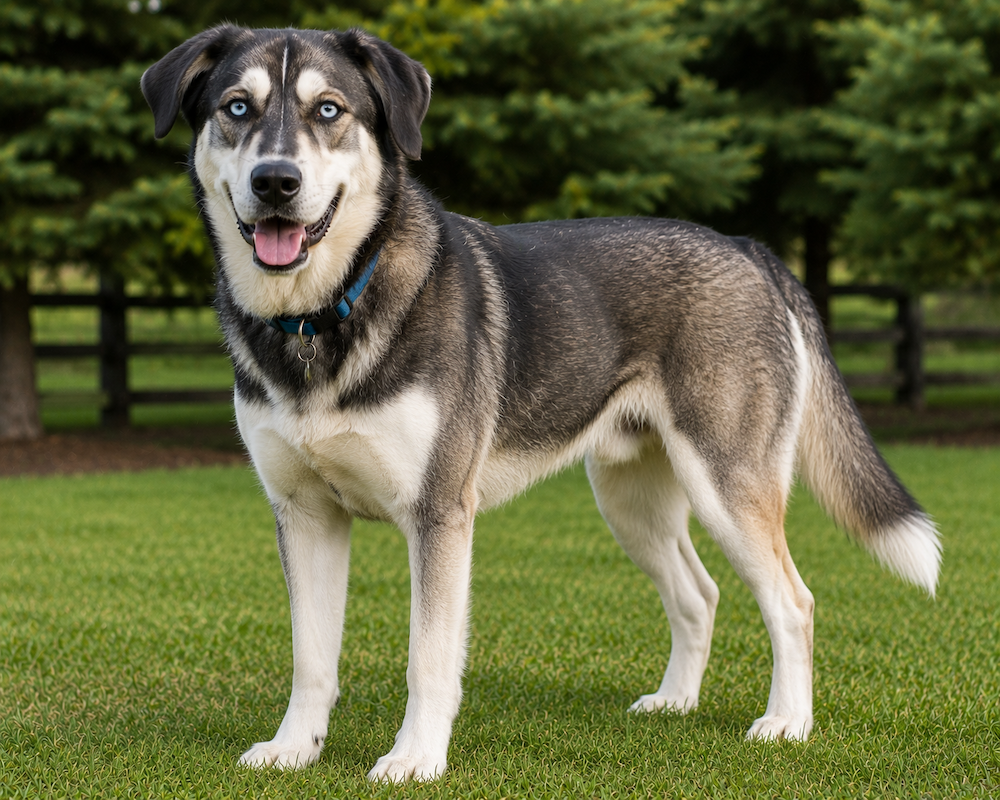
A Huskador may have the broader head and heavier build of a Labrador, the more refined head and erect ears of a Husky, or something between the two.
Coat colour, eye colour, ear position and markings can all vary.
Can Huskadors Have Blue Eyes?
Yes.
The Siberian Husky is famous for blue eyes, and this trait can appear in Huskadors.
Others have brown eyes or occasionally different-coloured eyes.
Blue eyes don’t mean the dog has impaired vision.
Can Huskadors Have One Blue Eye and One Brown Eye?
Yes.
This is called heterochromia and occurs commonly enough in Siberian Huskies that it can also appear in their crosses.
It usually affects appearance rather than vision.
Can Huskadors Have Partly Blue Eyes?
Yes.
Some dogs can have parti-coloured eyes, where more than one colour occurs within the same iris.
Husky ancestry makes unusual eye pigmentation considerably more likely than in purebred Labradors.
Can a Huskador Have Floppy Ears?
Yes.
Labradors have drop ears, while Huskies have erect triangular ears.
Huskadors can inherit floppy, erect or semi-erect ears.
Even littermates can end up with noticeably different ear shapes.
What Colours Can Huskadors Be?
Huskadors can appear in black, yellow/cream, chocolate/brown, grey, white, red-toned and numerous mixed patterns.
Husky facial markings may appear in some dogs.
Others can look remarkably similar to Labradors.
Can a Huskador Look Like a Labrador With Blue Eyes?
Yes — and it’s one of the cross’s most striking possible appearances.
A dog may inherit much of the Labrador’s body and coat while receiving blue-eye genetics or facial markings from the Husky side.
Other Huskadors look much more obviously Husky-like.
Can Huskadors Have Husky Masks?
Yes.
Some inherit the characteristic contrasting facial markings associated with Siberian Huskies.
Others have almost solid-coloured Labrador-style faces.
Because this is a crossbreed, appearance isn’t reliably standardised.
Can Huskadors Be Chocolate?
Yes.
Labrador ancestry can contribute chocolate colouring.
How this interacts with Husky colour genetics can produce a wide variety of brown and patterned appearances.
Can Huskadors Be All Black?
Yes.
Black is common in Labradors and also occurs in Siberian Husky coat genetics.
An all-black or predominantly black Huskador is therefore entirely possible.
Is a Huskador a Recognised Breed?
No.
The Huskador isn’t recognised as an established pedigree breed by major traditional kennel organisations.
The Siberian Husky and Labrador Retriever are recognised breeds, while the Huskador remains a crossbreed.
Is a Huskador a Designer Dog?
Yes.
Purposefully bred Husky-Labrador crosses are generally considered part of the modern designer-dog category.
However, accidental crosses between the two breeds almost certainly occurred long before the term “designer dog” became popular.
What Is an F1 Huskador?
An F1 Huskador is a first-generation Siberian Husky × Labrador Retriever cross.
Its average ancestry is approximately half from each parent breed.
That doesn’t mean every physical or behavioural trait will be exactly halfway between them.
What Is an F1B Huskador?
An F1B Huskador generally results from breeding an F1 Huskador back to either a Labrador Retriever or Siberian Husky.
Unlike many Poodle crosses, there isn’t one universally assumed direction for the backcross.
The actual pedigree should therefore be specified.
What Is an F2 Huskador?
An F2 Huskador generally results from breeding two F1 Huskadors together.
Second-generation puppies can still vary substantially because numerous Labrador and Husky traits can recombine in different ways.
Are Huskadors Healthier Than Purebred Dogs?
Not automatically.
Crossbreeding can increase genetic diversity, but Huskadors can still inherit disorders occurring in either parent breed.
Responsible health screening remains important.
“Crossbreed” shouldn’t be interpreted as “can’t inherit genetic disease.”
What Health Tests Should Huskador Parents Have?
Testing should address inherited risks in both Siberian Huskies and Labrador Retrievers.
Depending on breeding lines, this can include hip and elbow assessment, eye examinations and relevant DNA tests.
Both parents should be properly health tested before breeding.
Is a Huskador a Wolf Hybrid?
No.
A Huskador is a domestic dog cross between a Siberian Husky and Labrador Retriever.
The Husky’s wolf-like appearance doesn’t make it a recent wolf hybrid.
A genuine wolfdog has recent wolf ancestry, which is entirely different.
Are Huskadors Part Wolf?
Not in the way the phrase is normally used.
Like all domestic dogs, Huskadors ultimately share ancient ancestry with wolves.
However, ordinary Siberian Huskies aren’t modern wolf-dog hybrids, so crossing one with a Labrador doesn’t create a wolf hybrid.
Is a Huskador the Same as a Shepsky?
No.
A Huskador/Labsky combines Siberian Husky and Labrador Retriever.
A Shepsky generally combines Siberian Husky and German Shepherd.
The two crosses can occasionally look similar but have different ancestry.
Is a Huskador the Same as an Alusky?
No.
An Alusky generally combines an Alaskan Malamute and Siberian Husky.
A Huskador combines a Siberian Husky with a Labrador Retriever.
Aluskies tend to have stronger northern sled-dog characteristics on both sides.
What Is the Difference Between a Huskador and a Labrador?
A purebred Labrador has a considerably more predictable appearance and temperament.
A Huskador may inherit blue eyes, erect ears, Husky markings, stronger prey drive, howling, roaming behaviour and greater independence.
Both can remain friendly, energetic and highly athletic.
What Is the Difference Between a Huskador and a Siberian Husky?
A Huskador introduces Labrador ancestry, which can contribute greater handler focus, retrieving instinct, food motivation and water enthusiasm.
Appearance may also become heavier and more Labrador-like.
The Husky remains a standardised northern sled breed.
Why Cross a Siberian Husky With a Labrador?
The attraction is easy to understand.
Both are athletic, intelligent, outgoing working breeds, but their historical specialties differ dramatically.
The Labrador contributes retrieving ability and strong cooperation with humans, while the Husky contributes endurance, pulling ability and northern resilience.
What Were Labrador Retrievers Originally Bred For?
Labrador ancestors worked with fishermen in Newfoundland before the breed was further developed in Britain as a sporting retriever.
They became exceptional at retrieving shot game, particularly waterfowl.
Their soft mouths, swimming ability and cooperative temperament remain defining characteristics.
What Were Siberian Huskies Originally Bred For?
Siberian Huskies were developed by the Chukchi people of northeastern Siberia as endurance sled dogs.
They pulled relatively light loads over long distances in severe cold.
They also lived closely with human communities, helping shape their social temperament.
Does the Huskador Combine Two Working Breeds?
Absolutely.
The cross combines a northern endurance sled dog with one of the world’s most successful retrieving breeds.
Both parent breeds were developed for demanding physical work, just in very different environments.
This is why expecting a Huskador to be naturally sedentary is generally unrealistic.
Where Does the Name Huskador Come From?
“Huskador” combines Husky and Labrador.
“Labsky” reverses the same basic naming idea.
Neither term has an official kennel-club definition, but both are now widely used for the cross.
Where Did the Huskador Originate?
There is no reliably documented single breeder, location or founding date for the Huskador.
Huskies and Labradors undoubtedly crossed accidentally before anyone created a fashionable name for the result.
Purposeful breeding became more visible alongside the growth of designer crosses during the late 20th and early 21st centuries.
Who Created the First Huskador?
No individual is reliably credited with creating the Huskador.
Unlike breeds with documented founders, the Husky-Labrador combination appears to have emerged independently in multiple places.
Claims that one breeder “invented” the Huskador should therefore be treated cautiously.
Could the Huskador Become a Recognised Breed?
Potentially, but that would require many generations of coordinated breeding.
A genuine new breed needs a consistent standard, predictable traits, pedigree records, health programmes and a genetically sustainable breeding population.
At present, Huskadors remain variable Husky-Labrador crosses.
Why Are Huskadors So Different From One Another?
Crossbreeding doesn’t produce a perfectly averaged dog.
One puppy might inherit the Labrador’s floppy ears, retrieving drive and people focus while another receives Husky eyes, erect ears, vocalisation and independence.
Even littermates can therefore look and behave surprisingly differently.
Is a Huskador a Good First Dog?
It can be, but it’s usually better suited to an active and committed owner.
The combination of high exercise requirements, heavy shedding, potential prey drive, roaming tendencies and occasional Husky independence can challenge inexperienced owners.
Training should begin early.
Where Does the Huskador Come From?
The Huskador — also known as the Labsky — is a modern cross between the Siberian Husky and Labrador Retriever. There is no reliably documented single creator or moment when the cross first appeared, and informal Husky-Labrador crosses almost certainly existed before the modern designer-dog name.
What makes the Huskador particularly interesting is that its parents represent two very different forms of working-dog excellence. The Siberian Husky was developed by the Chukchi people of northeastern Siberia to pull sleds efficiently over long distances in brutal cold. Labrador ancestors worked alongside fishermen before becoming highly specialised sporting retrievers renowned for swimming, retrieving and cooperating with people.
Combine those histories and you can potentially get the Labrador’s love of retrieving and water together with the Husky’s endurance, independence, cold tolerance and talent for finding weaknesses in fences.
In other words, the Huskador can inherit the Labrador’s enthusiasm for bringing things back — and the Husky’s enthusiasm for disappearing in the opposite direction.