







Intelligent, colourful and remarkably talented at talking, the Indian Ringneck is a captivating parrot with a playful personality and an unmistakable elegant appearance.
🧠 QUICK SNAPSHOT
Trait | Indian Ringneck |
|---|---|
Scientific Name | Psittacula krameri |
Other Names | Indian Ringneck Parakeet, Rose-Ringed Parakeet |
Pet Type | Parrot / Companion Bird |
Natural Origin | Indian Subcontinent; rose-ringed parakeets also occur naturally in parts of Africa |
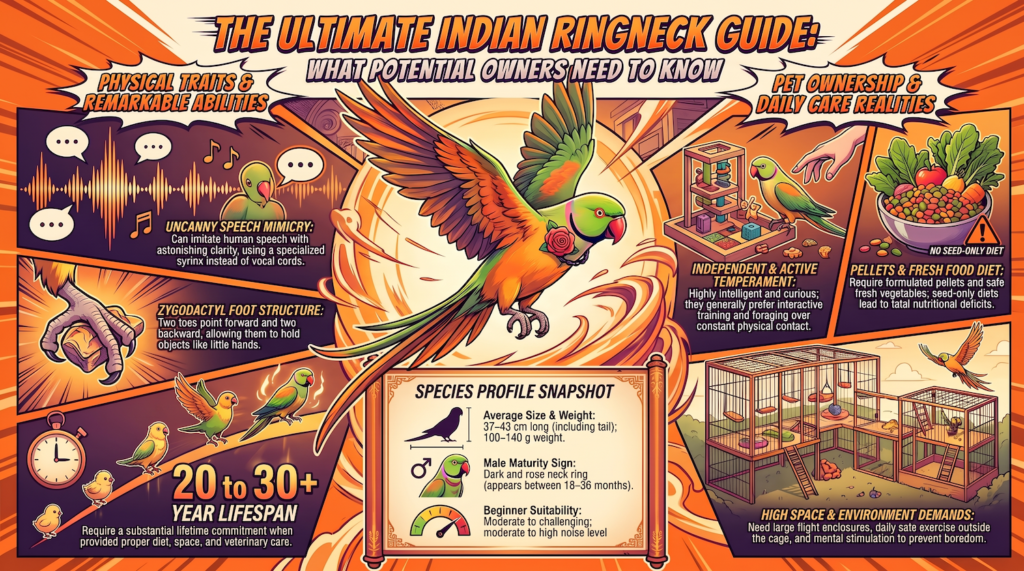
Typical Lifespan | Around 20–30 years |
Adult Size | Approximately 37–43 cm, including tail |
Adult Weight | Approximately 100–140 g |
Colours | Green, blue, yellow, white, grey, violet and other mutations |
Diet | Omnivorous, predominantly plant-based |
Activity | Diurnal |
Temperament | Intelligent, curious, independent and energetic |
Noise Level | Moderate to loud |
Social Needs | High; daily interaction and enrichment |
Talking Ability | Excellent in some individuals |
Grooming | Regular bathing opportunities and nail care when needed |
Housing | Spacious flight cage or aviary |
Beginner Friendly? | Best for prepared, committed owners |
Famous Feature | Exceptional speech mimicry and distinctive neck ring in mature males |
📚 OVERVIEW
The Indian Ringneck is a striking, medium-sized parrot belonging to the rose-ringed parakeet species. Native to the Indian Subcontinent, these elegant birds are recognised by their long, tapered tails, slender bodies and vibrant plumage.
Indian Ringnecks are particularly famous for their intelligence and ability to imitate human speech. Some develop impressive vocabularies and can reproduce words, phrases, whistles and household sounds with remarkable clarity.
Unlike some companion parrots that actively seek cuddling, Indian Ringnecks are often more independent. They enjoy exploring, solving problems, manipulating toys and interacting with their surroundings.
Their care requires spacious housing, daily enrichment, a balanced diet, regular social interaction and opportunities for supervised exercise. Their strong personalities and vocal abilities make them rewarding companions for owners who understand parrot behaviour.
✅ PROS & CONS
👍 Pros
Exceptional talking potential
Beautiful colours and long tails
Highly intelligent and curious
Playful and entertaining personalities
Can learn tricks and commands
Relatively long lifespan
Enjoy interactive enrichment
Often develop strong relationships with caregivers
👎 Cons
Can be loud and demanding
Require daily attention and stimulation
May bite when frightened or frustrated
Can become territorial
Not always affectionate or cuddly
Need spacious housing and exercise
May damage household objects
Long-term ownership commitment
Are Indian Ringnecks Good Pets?
Yes. Indian Ringnecks can make wonderful companions for people who enjoy intelligent, active parrots.
They’re entertaining, curious and capable of developing strong relationships with their caregivers.
However, they require consistent interaction, appropriate training and considerable mental stimulation.
Are Indian Ringnecks Good for Beginners?
Indian Ringnecks can be suitable for dedicated beginners who thoroughly research their needs.
However, their independence, strong beaks, vocalisations and occasional defensive behaviour can challenge inexperienced owners.
They generally suit people prepared to invest time in training and enrichment.
How Long Do Indian Ringnecks Live?
Indian Ringnecks commonly live around 20–30 years in captivity.
Some may live longer with excellent nutrition, veterinary care and suitable housing.
Their lifespan makes ownership a significant long-term commitment.
How Big Do Indian Ringnecks Get?
Adult Indian Ringnecks generally measure approximately 37–43 cm from beak to tail.
Much of this length comes from their distinctive long tail feathers.
Despite their impressive overall length, they’re relatively slender parrots.
Can Indian Ringnecks Talk?
Yes.
Indian Ringnecks are among the most talented talking parrots.
Some learn extensive vocabularies and reproduce words with remarkable clarity, although individual talking ability varies.
At What Age Do Indian Ringnecks Start Talking?
Some Indian Ringnecks begin imitating words around 8–12 months of age.
Others develop speech earlier or later, and some never become reliable talkers.
Consistent interaction and positive reinforcement can encourage vocal learning.
Can Female Indian Ringnecks Talk?
Yes.
Both male and female Indian Ringnecks can learn to imitate human speech.
Talking ability depends more on the individual bird, its experiences and opportunities for learning than its sex.
Are Indian Ringnecks Friendly?
Indian Ringnecks can be friendly and interactive when properly socialised.
However, many retain an independent personality and prefer choosing when to interact.
Respecting their body language helps build trust.
Do Indian Ringnecks Bond With Their Owners?
Yes.
Indian Ringnecks can develop strong social relationships with familiar caregivers.
They may seek attention, vocalise when someone enters the room or enjoy training sessions.
Regular positive interaction helps maintain these relationships.
Do Indian Ringnecks Like Being Cuddled?
Not always.
Many Indian Ringnecks prefer sitting nearby, playing or interacting without extensive physical contact.
Some enjoy gentle head scratches, while others dislike being touched.
Their individual preferences should always be respected.
Are Indian Ringnecks Aggressive?
Indian Ringnecks aren’t inherently aggressive, but they can display defensive or territorial behaviour.
Biting may occur when a bird feels threatened, overstimulated or uncomfortable.
Appropriate socialisation, enrichment and positive-reinforcement training can help reduce problems.
What Is the Indian Ringneck Bluffing Stage?
The term bluffing stage is sometimes used to describe increased lunging, biting or defensive behaviour in young Indian Ringnecks.
However, this isn’t a scientifically established developmental stage, and not every bird experiences it.
Behaviour should be assessed individually rather than dismissed as something the bird will automatically outgrow.
Are Indian Ringnecks Noisy?
Yes.
Indian Ringnecks can produce loud, sharp calls that travel considerable distances.
They may vocalise during morning and evening activity periods or when seeking interaction.
They’re generally unsuitable for households requiring a consistently quiet pet.
Do Indian Ringnecks Scream?
They can.
Loud calling is part of normal parrot communication, but excessive screaming may be associated with boredom, stress or attention-seeking.
Adequate enrichment, predictable routines and appropriate behavioural training can help.
What Do Indian Ringnecks Eat?
Indian Ringnecks need a balanced diet based on quality formulated parrot pellets and a variety of suitable vegetables.
Smaller amounts of fruit, healthy grains and appropriate seeds can provide variety.
Avoid avocado, chocolate, caffeine, alcohol and other foods toxic to birds.
Can Indian Ringnecks Eat Fruit?
Yes.
Suitable fruits include apple without seeds, berries, mango, papaya and melon.
Fruit should form a moderate part of their diet because of its sugar content.
Vegetables and nutritionally balanced pellets should remain dietary priorities.
What Size Cage Does an Indian Ringneck Need?
Indian Ringnecks require spacious accommodation that allows climbing, wing stretching and movement.
A cage approximately 90 × 60 × 90 cm is a practical minimum starting point for one bird, but larger flight cages or aviaries are strongly preferred.
Daily supervised exercise outside the cage is also important.
Do Indian Ringnecks Need Toys?
Absolutely.
These intelligent parrots need toys that encourage chewing, climbing, problem-solving and foraging.
Rotating safe toys regularly helps maintain interest and reduce boredom.
How Much Attention Do Indian Ringnecks Need?
Indian Ringnecks require daily social interaction and mental stimulation.
Training, supervised exercise and enrichment activities should form part of their routine.
Birds left isolated or understimulated may develop behavioural problems.
Can Two Indian Ringnecks Live Together?
Yes, compatible Indian Ringnecks may live together successfully.
However, introductions must be gradual, and individual birds may become territorial.
A spacious enclosure, multiple feeding stations and careful monitoring are important.
Can Indian Ringnecks Live With Other Birds?
Sometimes, but mixed-species housing requires caution.
Indian Ringnecks can be territorial and may injure smaller birds.
Separate enclosures are generally safest unless compatibility has been carefully established.
How Can You Tell Male and Female Indian Ringnecks Apart?
Mature males usually develop a distinctive coloured neck ring.
Females generally lack the complete male-style ring, although they may show subtle neck markings.
Young birds can be difficult to sex visually, so DNA testing is often used.
When Do Male Indian Ringnecks Get Their Neck Ring?
Male Indian Ringnecks generally begin developing their characteristic neck ring between approximately 18 months and three years of age.
Some individuals take longer to develop full adult markings.
Colour mutations can also affect the ring’s appearance.
Do Indian Ringnecks Need Baths?
Yes.
Regular bathing helps maintain feather condition and provides natural enrichment.
Many enjoy gentle misting or bathing in a shallow dish of clean water.
Birds should be allowed to dry in a warm, draught-free environment.
Can Indian Ringnecks Learn Tricks?
Yes.
Their intelligence makes them excellent candidates for positive-reinforcement training.
They can learn to step up, target objects, turn around, retrieve items and perform other behaviours.
Short, enjoyable training sessions are generally most effective.
What Health Problems Are Common in Indian Ringnecks?
Potential concerns include nutritional deficiencies, obesity, respiratory infections, feather damage and reproductive problems.
An unbalanced seed-heavy diet can contribute to long-term health issues.
Annual examinations by an avian veterinarian are recommended.
Are Indian Ringnecks Legal to Keep as Pets?
Ownership regulations vary by country and region.
Indian Ringnecks are established companion birds in many places, but restrictions may apply because escaped populations can become invasive.
Always check local wildlife, importation and ownership laws before acquiring one.
What Makes the Indian Ringneck Unique?
Imagine a parrot that can speak with remarkable clarity, solve puzzles and recognise familiar daily routines.
That’s the extraordinary Indian Ringneck.
These elegant birds have fascinated people for centuries.
Indian Ringnecks belong to the rose-ringed parakeet species, which has an exceptionally long history of living alongside humans.
They’re also among the most recognisable talking parrots.
Some individuals reproduce human speech so clearly that their voices can sound surprisingly human.
But their remarkable abilities extend beyond talking.
Indian Ringnecks are intelligent problem-solvers capable of learning complex routines, manipulating objects and responding to positive-reinforcement training.
Their appearance is equally extraordinary.
Mature males develop a beautiful neck ring that typically includes dark and pinkish markings, while their long, pointed tails give them an elegant silhouette.
Selective breeding has produced spectacular colour varieties, including brilliant blue, yellow, white and violet birds.
Perhaps most surprisingly, rose-ringed parakeets have established wild populations far beyond their original native range.
Free-living populations can now be found in cities such as London, where these colourful tropical-looking birds have adapted to an environment very different from their ancestral habitats.
And despite their beautiful appearance, Indian Ringnecks have strong, independent personalities.
They can be playful, demanding, mischievous and extraordinarily entertaining.
The Indian Ringneck is far more than a beautiful talking parrot — it’s an intelligent, adaptable and charismatic bird with a remarkable ability to surprise its owners.