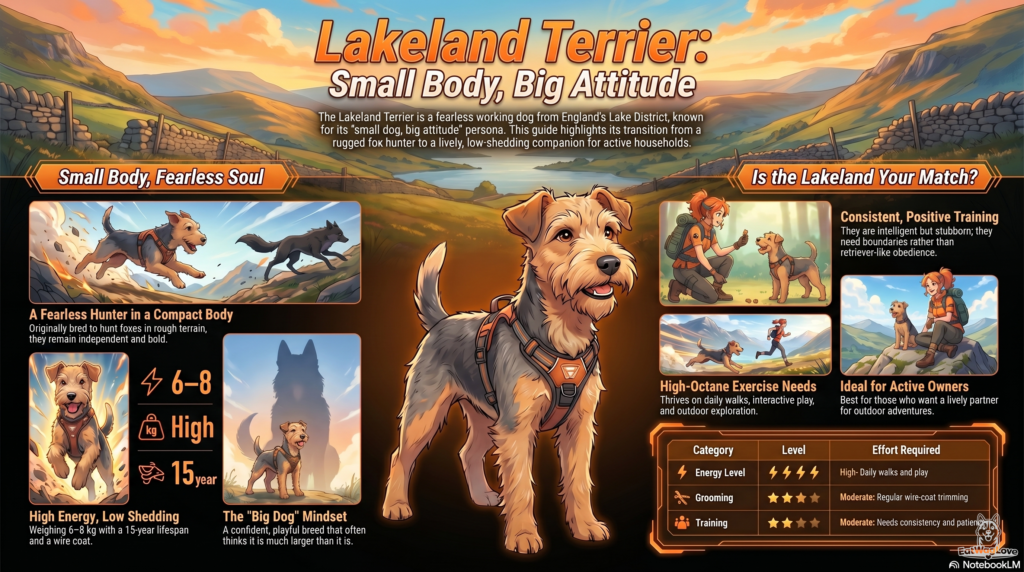







Fearless, energetic, and full of attitude — a small dog with a big, bold personality.
🧠 QUICK SNAPSHOT
- Temperament: Bold, energetic, confident
- Energy Level: High
- Size: Small
- Good With Families: Yes
- Trainability: Moderate
- Grooming: Moderate
- Best For: Active owners, terrier lovers
📚 OVERVIEW
The Lakeland Terrier is a true working terrier, originally bred to hunt foxes in rugged terrain. Despite its small size, it is fearless, determined, and full of energy.
They are lively, confident dogs that thrive in homes where they can stay active and engaged.
✅ PROS & CONS
Pros
- Brave and confident personality
- Energetic and playful
- Compact size with strong presence
- Low shedding coat
Cons
- Can be stubborn
- High energy levels
- Strong prey drive
- Needs consistent training
Is a Lakeland Terrier a Good Family Dog?
Yes. The Lakeland Terrier can be an affectionate, confident, playful and entertaining family dog, particularly for households that enjoy an active terrier personality.
They’re typically devoted to their people without being excessively dependent.
Their independence, prey drive and determination mean they benefit from consistent training from puppyhood.
How Much Exercise Does a Lakeland Terrier Need?
Most adults need around 60–90 minutes of exercise each day, combined with play and mental stimulation.
They enjoy brisk walks, hiking, scent games, digging activities and dog sports.
Despite their relatively small size, Lakelands are genuine working terriers rather than low-energy lapdogs.
Is a Lakeland Terrier a High-Energy Dog?
Yes.
They were developed to work across the rugged landscape of England’s Lake District, pursuing predators over difficult terrain.
That history produced a dog with considerable stamina, agility and determination.
Is a Lakeland Terrier Easy to Train?
They’re intelligent and capable learners, but not always easy.
Lakeland Terriers have the independent decision-making typical of working terriers.
Short, interesting, reward-based training usually works better than repetitive exercises.
Are Lakeland Terriers Intelligent?
Yes.
Their traditional work required them to search independently, navigate difficult terrain and pursue quarry underground.
They tend to be quick problem-solvers — including when the problem they’re solving is how to reach something the owner specifically placed out of reach.
Are Lakeland Terriers Stubborn?
They certainly can be.
Persistence was deliberately selected because a terrier that abandoned difficult quarry wouldn’t be very useful.
Modern owners experience that same characteristic as determination, independence or occasionally spectacular selective hearing.
Does a Lakeland Terrier Shed?
Very little.
Their harsh wiry outer coat tends to release relatively little loose hair around the home.
Low shedding doesn’t mean maintenance-free, however.
Is a Lakeland Terrier Hypoallergenic?
They’re often considered a better choice for some allergy sufferers because they shed relatively little.
However, no dog is truly hypoallergenic, since allergens also occur in saliva and skin secretions.
Anyone with significant allergies should spend time around the breed first.
What Type of Coat Does a Lakeland Terrier Have?
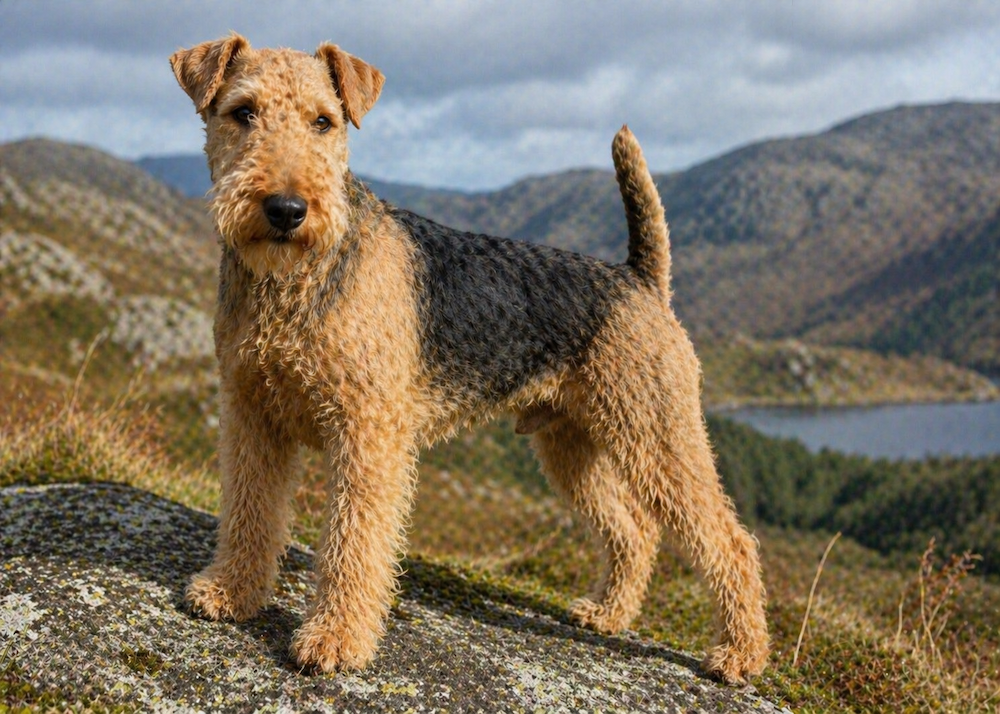
The Lakeland has a harsh, wiry outer coat with a softer insulating undercoat.
This practical coat protected working dogs from cold, wet weather and rough vegetation.
Longer furnishings create the characteristic beard and leg hair.
How Often Should You Groom a Lakeland Terrier?
The coat should generally be brushed and combed several times each week.
Professional grooming is usually needed every six to eight weeks, depending on coat length and whether the dog is maintained as a pet or for showing.
Does a Lakeland Terrier Need Hand Stripping?
Hand stripping is the traditional method for maintaining the correct harsh coat texture.
It removes dead hairs from the follicle rather than simply cutting them.
Pet dogs are frequently clipped instead, but clipping can gradually soften the coat and alter its colour.
What Is Hand Stripping a Lakeland Terrier?
Hand stripping involves carefully removing mature dead outer hairs so new wiry hairs can grow.
When done properly on a ready coat, it shouldn’t simply mean painfully pulling healthy hair.
Show coats are often maintained through regular rolling or stripping rather than occasional complete removal.
Can You Clip a Lakeland Terrier?
Yes.
Many companion Lakelands are professionally clipped because it’s quicker and easier than maintaining a hand-stripped coat.
The trade-off is that repeated clipping can make the coat softer, paler and less weather-resistant.
Why Does a Clipped Lakeland Terrier Change Colour?
The strongest pigmentation is often concentrated toward the tips of the wiry outer hairs.
Clipping repeatedly removes those coloured ends while leaving softer hair behind.
Over time, a clipped coat can appear noticeably lighter or duller.
What Health Problems Are Common in Lakeland Terriers?
The Lakeland Terrier is generally considered a relatively robust breed.
Potential concerns include eye disorders, patellar luxation and some inherited neurological or orthopaedic problems.
Responsible breeders should still use recommended health screening rather than assuming a traditionally hardy working breed is automatically free of inherited disease.
Are Lakeland Terriers Prone to Eye Problems?
Some inherited eye conditions occur within the breed.
Appropriate ophthalmic screening of breeding dogs helps reduce risk.
Any persistent redness, cloudiness, discomfort or change in vision warrants veterinary attention.
Are Lakeland Terriers Prone to Patellar Luxation?
It can occur.
Patellar luxation happens when the kneecap moves out of its normal groove.
Affected dogs may intermittently skip or carry a hind leg.
How Long Does a Lakeland Terrier Live?
Lakeland Terriers commonly live around 12–15 years, with some reaching their mid-to-late teens.
Their moderate size and functional working structure contribute to generally good longevity.
How Big Does a Lakeland Terrier Get?
The Lakeland is a small but sturdy terrier, standing around 34–37 cm at the shoulder.
Adults commonly weigh approximately 7–8 kg, although individual dogs vary.
They’re deliberately compact enough to follow quarry into confined spaces.
Is There a Miniature Lakeland Terrier?
No.
There is no recognised Miniature Lakeland Terrier.
The standard breed is already relatively small.
Is There a Teacup Lakeland Terrier?
No recognised Teacup Lakeland exists.
Extreme miniaturisation isn’t part of the breed’s working history or standard.
Can a Lakeland Terrier Live in an Apartment?
Yes, provided it receives sufficient exercise.
Its compact size suits smaller homes surprisingly well.
The greater challenges are usually energy, barking and terrier curiosity, rather than physical size.
Does a Lakeland Terrier Need a Backyard?
No, although secure outdoor space is useful.
A garden doesn’t replace walks, training and exploration.
If given unrestricted access to an interesting garden, some Lakelands may also decide that landscaping is one of their traditional responsibilities.
Can a Lakeland Terrier Be Left Alone?
Adult Lakelands can usually learn to tolerate reasonable periods alone.
They’re often somewhat more independent than intensely Velcro companion breeds.
However, boredom can lead to digging, chewing, barking or escape attempts.
Are Lakeland Terriers Prone to Separation Anxiety?
Some individuals can develop separation problems, but extreme dependence isn’t generally a defining breed trait.
Gradual independence training is still worthwhile.
Adequate exercise before alone time can make settling easier.
Are Lakeland Terriers Velcro Dogs?
Usually not to the same extent as some companion breeds.
They’re affectionate and loyal but often retain a noticeable degree of independence.
A Lakeland may adore you while simultaneously believing it remains responsible for its own diary.
Are Lakeland Terriers Cuddly?
Many are affectionate with their families and enjoy cuddling once they’ve finished being busy.
Others prefer simply staying nearby.
Individual personality varies considerably.
Are Lakeland Terriers Good With Children?
They can be good family companions for respectful children.
They’re sturdy and playful but can become overexcited during rough games.
As with any dog, interactions with young children should be supervised.
Are Lakeland Terriers Good With Other Dogs?
Many can live successfully with other dogs, particularly when properly socialised.
However, terrier confidence can produce dog-selective or confrontational behaviour in some individuals.
Careful introductions are important.
Are Lakeland Terriers Good With Cats?
Some can live successfully with cats if raised together.
Their strong hunting heritage means unfamiliar cats may trigger chasing.
Individual prey drive needs to be taken seriously.
Are Lakeland Terriers Good With Rabbits and Guinea Pigs?
Generally, they’re a risky combination.
Lakeland Terriers were specifically developed to pursue small quarry.
A household rabbit or guinea pig can therefore trigger deeply ingrained hunting behaviour.
Do Lakeland Terriers Have a Strong Prey Drive?
Yes.
Prey drive is one of the breed’s defining historical characteristics.
Foxes and other quarry were the reason these terriers existed in the first place.
Are Lakeland Terriers Good Off Leash?
They can learn good recall, but reliability around wildlife can be difficult.
A terrier following an exciting scent may temporarily consider recall to be an optional administrative request.
Secure off-leash areas are safest.
Do Lakeland Terriers Dig?
Absolutely.
Digging is deeply connected with terrier behaviour.
Their ancestors needed to investigate holes, rocks and underground spaces while pursuing quarry.
Why Does My Lakeland Terrier Dig So Much?
For a working terrier, digging was once a practical skill rather than undesirable behaviour.
Interesting scents beneath the ground can trigger instinctive investigation.
A designated digging area can provide an acceptable outlet.
Are Lakeland Terriers Escape Artists?
They can be.
Their intelligence, prey drive and determination make secure fencing important.
A small opening beneath a fence can look considerably larger to a motivated terrier than it does to its owner.
Do Lakeland Terriers Bark a Lot?
They can be vocal.
Working terriers needed to communicate when quarry was located, including underground.
Exercise, stimulation and early training can help prevent excessive barking.
Are Lakeland Terriers Good Watchdogs?
Yes.
They’re alert, confident and quick to announce unfamiliar activity.
Their bark can sound surprisingly substantial for their size.
Are Lakeland Terriers Good Guard Dogs?
Not in the conventional sense.
They’re courageous but simply too small to function as specialist protection dogs.
They’re much better suited to alerting their owners.
Are Lakeland Terriers Aggressive?
A well-bred Lakeland shouldn’t be indiscriminately aggressive toward people.
However, they’re confident terriers and some can be assertive toward other dogs.
Early socialisation and sensible management are important.
Are Lakeland Terriers Friendly With Strangers?
Many are confident and reasonably friendly after an introduction.
They’re often less immediately enthusiastic about strangers than breeds such as Labradors.
Excessive fearfulness shouldn’t be characteristic.
When Does a Lakeland Terrier Calm Down?
Many become noticeably more settled between two and three years old.
However, they often retain a lively, mischievous personality throughout life.
Terrier maturity doesn’t generally involve deciding that adventures are no longer interesting.
Do Lakeland Terriers Get the Zoomies?
Yes.
Their compact body and athleticism allow surprisingly rapid acceleration.
Furniture can suddenly become an obstacle course rather than household equipment.
Are Lakeland Terriers Good Running Dogs?
Healthy adults can enjoy moderate running.
They’re athletic and have excellent stamina for their size.
They’re better suited to varied outdoor activity than repetitive long-distance road running.
Are Lakeland Terriers Good Hiking Dogs?
Excellent.
Their ancestors worked across some of Britain’s most rugged countryside.
Modern Lakelands can be enthusiastic hiking companions, provided recall and wildlife encounters are managed appropriately.
Can Lakeland Terriers Swim?
Most can swim physically, and some enjoy water.
They weren’t developed primarily as water dogs, so enthusiasm varies.
Safe entry and exit points should always be available.
Can Lakeland Terriers Handle Cold Weather?
Generally, yes.
Their dense undercoat and harsh outer coat were designed for the wet, windy conditions of northern England.
They remain relatively weather-resistant little dogs.
What Does a Lakeland Terrier Look Like?
The Lakeland is a compact, long-legged terrier with a rectangular head, folded V-shaped ears, dark eyes, wiry coat, beard and sturdy athletic body.
Its appearance resembles a smaller Airedale or Welsh Terrier to many people.
What Colours Can Lakeland Terriers Be?
The breed occurs in numerous colours, including black and tan, blue and tan, red, wheaten, red grizzle, liver and combinations involving darker saddles, depending on the breed standard.
This is a surprisingly colourful breed compared with many terriers.
Can a Lakeland Terrier Be Red?
Yes.
Solid red is a recognised and traditional colour.
Red Lakelands can sometimes be confused with small Irish Terriers.
Can a Lakeland Terrier Be Wheaten?
Yes.
Wheaten is another recognised colour.
The shade can range from relatively pale to deeper warm tones.
Can a Lakeland Terrier Be Blue and Tan?
Yes.
Blue-and-tan is a traditional colour combination.
“Blue” in dog coat terminology refers to a diluted greyish shade rather than literal blue.
Can a Lakeland Terrier Be Black and Tan?
Yes.
Black-and-tan Lakelands are particularly likely to be confused with Welsh Terriers.
Structure, size, colour distribution and breed history help distinguish them.
Is a Lakeland Terrier the Same as a Welsh Terrier?
No.
They can look remarkably similar, particularly in black-and-tan colouring.
The Welsh Terrier originated in Wales and is generally slightly more substantial, while the Lakeland developed among the fells of northern England.
Is a Lakeland Terrier a Small Airedale Terrier?
No.
The resemblance is understandable because both have wiry coats, rectangular heads and characteristic furnishings.
The Airedale is dramatically larger and developed from a different working tradition.
Is a Lakeland Terrier Related to the Border Terrier?
They share broader ancestry among working terriers from the border and northern English regions.
Both were developed to deal with foxes in rugged countryside.
Modern breed standardisation eventually separated different regional types.
Is a Lakeland Terrier Related to the Fell Terrier?
Very closely in historical terms.
“Fell Terrier” described working terrier types used across the northern English fells rather than one tightly standardised modern pedigree breed.
The Lakeland emerged from this regional working-terrier tradition.
Is a Lakeland Terrier the Same as a Patterdale Terrier?
No.
Both emerged from the working terrier culture of England’s Lake District and surrounding fells, so their histories overlap.
The Lakeland became standardised as a kennel-club breed, while the Patterdale remained much more strongly associated with performance-focused working lines.
Is a Lakeland Terrier Related to the Fox Terrier?
There’s broader working-terrier ancestry and historical interaction between these populations.
Fox Terriers also influenced the development of several formal terrier breeds.
However, the Lakeland’s identity is particularly tied to the indigenous working terriers of northern England.
Where Does the Lakeland Terrier Come From?
The Lakeland Terrier comes from the Lake District and surrounding areas of northern England.
This mountainous landscape of lakes, rocky fells and sheep farms shaped the dog physically and behaviourally.
It needed to be small enough to follow quarry but athletic enough to keep up across demanding terrain.
Why Is It Called the Lakeland Terrier?
The name refers to England’s Lake District, historically known for its dramatic lakes and rugged uplands.
Before the modern breed name became established, related local terriers were known by various regional names.
What Is a Fell?
In northern England, particularly the Lake District, a fell is a hill or mountain.
The word is deeply connected with Lakeland culture.
A Fell Terrier was therefore essentially a working terrier associated with this rugged upland landscape.
Why Were Terriers Needed in the Lake District?
Sheep farming was economically important, and foxes could threaten lambs.
The rocky terrain contained caves, crevices and underground spaces where foxes could shelter.
Farmers and hunts therefore needed compact, courageous dogs capable of following quarry into places larger hounds couldn’t reach.
What Was the Lakeland Terrier Originally Bred For?
Its principal historical job was fox control.
Lakeland-type terriers worked alongside packs of hounds, following foxes into rocky dens and underground spaces when necessary.
They were also useful for general vermin control around farms.
Did Lakeland Terriers Kill Foxes?
Historical working terriers were expected to confront foxes underground and could be involved in killing quarry.
Practices varied according to period, terrain and hunting tradition.
Modern ownership obviously doesn’t require recreating these historical activities.
Did Lakeland Terriers Run With Foxhounds?
Yes.
They needed sufficient stamina and leg length to travel across rough countryside with hunts before doing the specialised underground work that larger hounds couldn’t perform.
This helps explain why the Lakeland is relatively long-legged compared with some short-legged terriers.
Why Does the Lakeland Terrier Have Long Legs?
Longer legs helped the dog move efficiently over the steep, rocky Lake District terrain.
At the same time, the body remained compact enough to enter underground spaces.
The breed represents a compromise between speed above ground and manoeuvrability below it.
Why Is a Lakeland Terrier’s Chest Relatively Narrow?
Working terriers needed to squeeze through confined spaces.
An excessively broad chest could prevent the dog from reaching quarry underground.
Functional terrier breeders therefore valued dogs that combined strength with a relatively spannable, flexible body.
What Does “Spanning” a Terrier Mean?
Spanning involves placing the hands around a terrier’s chest to assess its size and compressibility.
For traditional earth-working terriers, chest dimensions mattered because the dog needed to fit through underground passages.
It’s an old functional consideration rather than simply a show-ring measurement.
Did Lakeland Terriers Work in Rocky Dens Rather Than Just Burrows?
Yes.
The Lake District’s geology meant foxes could shelter in rocky crevices, caves and complex underground spaces rather than simple soil burrows.
This environment demanded exceptional agility and courage from the terriers.
Why Is the Lakeland Terrier So Tough?
Historically, a dog unwilling to enter difficult terrain or confront quarry wouldn’t remain useful in a working breeding programme.
Generations of functional selection produced remarkable confidence and persistence.
That toughness remains beneath the modern groomed exterior.
What Were Lakeland Terriers Called Before They Were Lakeland Terriers?
Various regional names were used for northern working terriers, including Patterdale, Fell, Cumberland and Westmorland terriers, depending on locality and type.
Breed boundaries were much less rigid before organised kennel clubs standardised them.
What Was the Patterdale Terrier Club’s Connection to the Lakeland?
Early organised enthusiasts used regional terminology differently from today’s breed names.
A club associated with Patterdale helped promote the terriers that ultimately became standardised as Lakeland Terriers.
This can make historical references confusing because “Patterdale” didn’t always mean exactly what it means today.
What Is the Cumberland Terrier?
Cumberland Terrier was one of the regional names associated with working terriers from northern England.
Dogs described this way contributed to the broader population from which the modern Lakeland emerged.
It shouldn’t necessarily be imagined as a completely separate modern breed.
What Is the Westmorland Terrier?
Westmorland was a historic county covering part of today’s Cumbria.
Terriers associated with this region contributed to the Lake District working-dog tradition.
Names often reflected geography rather than clearly separated genetic populations.
When Did the Name Lakeland Terrier Become Established?
As breeders began formalising the dog during the early 20th century, Lakeland Terrier became the preferred name for the emerging standardised breed.
This helped bring several related regional working-terrier populations under a common identity.
When Was the Lakeland Terrier Officially Recognised?
The breed became formally established in Britain during the 1920s.
The Kennel Club recognised the Lakeland Terrier in 1928, helping transform the traditional working terrier into an internationally recognised pedigree breed.
When Did the AKC Recognise the Lakeland Terrier?
The American Kennel Club recognised the Lakeland Terrier in 1934.
By then the breed had begun developing a following outside Britain.
Why Did Lakeland Terriers Become Show Dogs?
Their attractive appearance, manageable size and distinctive personality made them natural candidates for the growing dog-show world.
Breeders gradually developed more consistent coat, structure and grooming while trying to retain the confidence and athleticism of the original working terrier.
Do Show Lakeland Terriers Look Different From Old Working Dogs?
Yes.
Modern show grooming creates a highly polished silhouette with carefully shaped furnishings.
Historical working dogs were maintained for practical performance rather than elaborate presentation.
The underlying structure and terrier character nevertheless reflect the breed’s working origins.
Why Do Lakeland Terriers Look So Elegant Today?
Selective breeding and specialised grooming transformed the rough working coat into a carefully presented show-ring appearance.
The beard, shaped legs and sculpted body coat create an elegant outline.
It’s essentially a farm worker wearing formal clothes.
Have Lakeland Terriers Won Best in Show at Crufts?
Yes.
A famous Lakeland Terrier named Rogerholme Recruit won Best in Show at Crufts in 1963.
The breed has enjoyed considerable show-ring success despite never becoming numerically common.
Has a Lakeland Terrier Won Westminster Best in Show?
Yes.
Ch. Stingray of Derryabah won Best in Show at the Westminster Kennel Club Dog Show in 1968.
Remarkably, Stingray also won Best in Show at Crufts in 1967.
Who Was Stingray of Derryabah?
Stingray of Derryabah was one of the most celebrated Lakeland Terriers in breed history.
He achieved the extraordinary feat of winning Best in Show at Crufts and Westminster, two of the world’s most prestigious dog shows.
Few dogs of any breed have achieved comparable international show success.
Did Stingray Win Crufts and Westminster?
Yes.
Stingray won Crufts Best in Show in 1967 and Westminster Best in Show in 1968.
That achievement gave the relatively uncommon Lakeland Terrier enormous international attention.
Are Lakeland Terriers Rare?
They’re relatively uncommon today.
They’ve never achieved the enormous popularity of breeds such as Labradors or French Bulldogs.
Specialised grooming, strong terrier temperament and competition from other small companion breeds have probably limited their mass appeal.
Are Lakeland Terriers Still Working Dogs?
Some working terriers retain ancestry connected with the same northern English populations, although the modern pedigree Lakeland is now primarily kept as a companion and show dog.
Its athleticism and instincts remain very evident.
Dog sports can provide useful modern outlets.
Are Lakeland Terriers Good at Earthdog Sports?
Yes.
Earthdog-style activities allow terriers to use their natural interest in underground quarry scents in a controlled environment.
They can be particularly satisfying for breeds with genuine earth-working ancestry.
Are Lakeland Terriers Good at Agility?
Yes.
Their speed, confidence and compact athletic build can make them excellent agility dogs.
The main requirement is convincing the terrier that your chosen course is more interesting than its own.
Are Lakeland Terriers Good at Scent Work?
Very.
Scent work gives them an appropriate outlet for natural hunting and searching behaviour.
It can also be mentally tiring, making it particularly useful for energetic companion dogs.
Why Isn’t the Lakeland Terrier More Popular?
The breed has many appealing qualities, but it’s unapologetically a terrier.
Regular grooming, substantial exercise, prey drive, digging, independence and occasional dog assertiveness aren’t ideal for every household.
Enthusiasts often consider the relative rarity part of what has helped preserve its distinctive character.
Is a Lakeland Terrier a Good First Dog?
It can be for an active owner prepared to understand terrier behaviour.
The small size is manageable, but the personality is substantial.
Prospective owners should be comfortable with prey drive, independent thinking, grooming and consistent training.
What Makes the Lakeland Terrier Unique?
The Lakeland Terrier was shaped by one of Britain’s most dramatic landscapes.
Sheep farmers in the Lake District needed a dog capable of travelling across steep, rocky fells with hounds and then squeezing into crevices where a fox had taken refuge. That demanded stamina above ground, compactness underground and enough courage to keep working when conditions became difficult.
Those rough regional Fell Terriers eventually became the elegant Lakeland Terrier — complete with carefully shaped beard and immaculate show coat.
One even achieved the extraordinary feat of winning both Crufts and Westminster Best in Show.
But the polished appearance can be deceptive.
Underneath the haircut is still a small northern English working dog whose ancestors looked at a dark hole between two rocks and thought:
“Something interesting is in there. Obviously I should go in.”