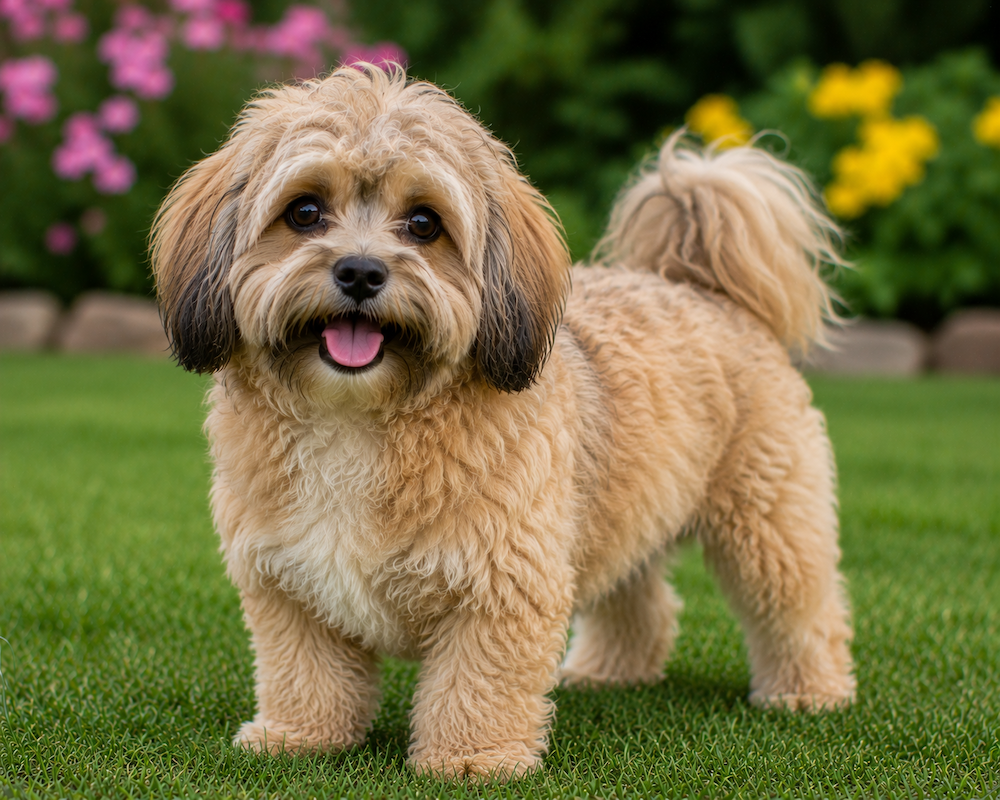







Intelligent, affectionate, and wonderfully fluffy — a charming companion that blends the confidence of the Lhasa Apso with the cleverness of the Poodle.
🧠 QUICK SNAPSHOT
- Temperament: Affectionate, intelligent, playful
- Energy Level: Moderate
- Size: Small
- Good With Families: Yes
- Trainability: High
- Grooming: High
- Best For: Families, apartment living, companionship
📚 OVERVIEW
The Lhasapoo is a cross between a Lhasa Apso and a Poodle, creating an affectionate and intelligent companion with a soft, often curly coat. These small dogs inherit the Lhasa Apso’s loyalty and confidence along with the Poodle’s eagerness to learn, making them both entertaining and devoted family pets.
Lhasapoos adapt well to apartments and family homes, provided they receive plenty of companionship, regular exercise, and consistent grooming.
✅ PROS & CONS
Pros
- Loving and devoted companion
- Highly intelligent and easy to train
- Often low shedding depending on coat type
- Adaptable to a variety of living environments
Cons
- Requires regular grooming and coat maintenance
- Can develop separation anxiety
- Needs daily mental stimulation
- May inherit an independent streak from the Lhasa Apso
Is a Lhasapoo a Good Family Dog?
Yes. A Lhasapoo can be an affectionate, intelligent and playful family companion, particularly when well socialised from puppyhood.
The Lhasapoo combines the Lhasa Apso with a Toy or Miniature Poodle, so temperament can vary considerably. Some inherit the Poodle’s outgoing sociability, while others show more of the Lhasa’s independent and watchful personality.
What Is a Lhasapoo?
A Lhasapoo is a cross between a Lhasa Apso and a Poodle, usually a Toy or Miniature Poodle.
It’s also sometimes called a Lhasa Poo, Lhasa-poo or Lhasadoodle.
It’s a designer cross rather than a formally standardised breed.
How Much Exercise Does a Lhasapoo Need?
Most need around 30–60 minutes of daily exercise, along with mental stimulation.
Walks, games, trick training and scent activities are excellent choices.
Dogs inheriting more Miniature Poodle drive may need considerably more activity than particularly laid-back individuals.
Is a Lhasapoo a High-Energy Dog?
Usually moderate energy.
They’re generally more active than their small teddy-bear appearance suggests but don’t normally require the exercise levels of highly athletic working breeds.
Young Lhasapoos can be extremely playful.
Is a Lhasapoo Easy to Train?
Usually, although temperament varies.
Poodles are famously trainable, while Lhasa Apsos tend to be more independent.
A Lhasapoo can therefore inherit everything from enthusiastic cooperation to a dog that understands the lesson perfectly but would like to renegotiate the terms.
Are Lhasapoos Intelligent?
Yes.
Both parent breeds are intelligent, although their intelligence developed for different purposes.
The Poodle brings highly cooperative working intelligence, while the Lhasa contributes independent alertness and problem-solving ability.
Are Lhasapoos Stubborn?
Some certainly can be.
A Lhasapoo inheriting the Lhasa Apso’s independent temperament may be less eager to obey simply for the sake of pleasing its owner.
Positive, reward-based training usually works best.
Are Lhasapoos Difficult to Toilet Train?
Some can be.
Small companion dogs can require patience with house training, and the Lhasa side may add an independent streak.
A consistent routine and frequent outdoor toilet opportunities are important during puppyhood.
Does a Lhasapoo Shed?
Many Lhasapoos shed relatively little, but low shedding isn’t guaranteed.
Coat genetics vary considerably in crossbred dogs.
Some inherit a strongly Poodle-like curly coat, while others have a straighter or more Lhasa-like coat.
Is a Lhasapoo Hypoallergenic?
No dog is genuinely hypoallergenic.
A low-shedding Lhasapoo may be easier for some allergy sufferers to live with, but allergens are also present in saliva and skin secretions.
Crossing two relatively low-shedding breeds improves the chances of a low-shedding coat but doesn’t guarantee an allergy-friendly dog.
What Type of Coat Does a Lhasapoo Have?
The coat can be straight, wavy, loosely curled or tightly curled.
Some dogs have a silky Lhasa-like texture, while others develop a woollier Poodle-style coat.
Even puppies from the same litter can have noticeably different coats.
Does a Lhasapoo Have Hair or Fur?
Lhasapoos are commonly described as having hair because both parent breeds have relatively long-growing, low-shedding coats.
Biologically, hair and fur are the same material.
The important practical difference is that a Lhasapoo’s coat generally requires regular cutting and maintenance.
How Often Should You Groom a Lhasapoo?
Most should be thoroughly brushed or combed several times each week, with some coats requiring daily attention.
Mats commonly develop behind the ears, under the legs, around the collar and wherever the coat experiences friction.
Regular grooming should begin during puppyhood.
How Often Does a Lhasapoo Need a Haircut?
Many need professional grooming approximately every six to eight weeks.
Owners who prefer longer coats will need considerably more home maintenance.
A short puppy-style clip is popular because it’s practical and comfortable.
Do Lhasapoos Mat Easily?
Yes.
Low-shedding coats can actually mat very easily because loose hairs become trapped among growing hairs rather than falling onto the floor.
Curly and wavy coats can be particularly demanding.
Can You Shave a Lhasapoo?
A Lhasapoo can be clipped short when appropriate.
If the coat becomes severely matted, shaving may be the most humane solution.
Regular brushing and grooming should ideally prevent mats from reaching that stage.
What Health Problems Are Common in Lhasapoos?
Potential concerns can come from either parent breed, including patellar luxation, eye disorders, dental disease, hip problems, allergies and certain inherited neurological or renal conditions.
Toy and Miniature Poodle ancestry can introduce additional genetic risks depending on the bloodline.
Responsible breeders should health-test both parent breeds rather than assuming crossbreeding automatically creates healthier puppies.
Are Lhasapoos Healthier Than Purebred Dogs?
Not automatically.
Crossbreeding can increase genetic diversity, but a puppy can still inherit disease-associated variants from either parent.
The greatest health advantage comes from healthy, properly screened parents and responsible breeding, not simply attaching “Doodle” to a dog’s name.
Are Lhasapoos Prone to Patellar Luxation?
They can be.
Patellar luxation occurs in both small companion breeds and can cause the kneecap to move out of its normal position.
Affected dogs may occasionally skip or carry a hind leg.
Are Lhasapoos Prone to Eye Problems?
Potentially.
Both Lhasa Apsos and Poodles can be affected by inherited eye disorders.
Responsible breeders should therefore use appropriate ophthalmic and genetic screening.
Are Lhasapoos Prone to Dental Problems?
Yes.
Small jaws can contribute to crowded teeth and periodontal disease.
Daily tooth brushing is one of the most useful preventive habits an owner can establish.
Are Lhasapoos Prone to Ear Infections?
They can be.
Drop ears combined with hair around the ear canal can reduce ventilation and trap moisture.
Regular monitoring is particularly important after bathing or swimming.
How Long Does a Lhasapoo Live?
Lhasapoos commonly live around 12–16 years, although individual lifespan varies.
Both parent breeds can be relatively long-lived.
Healthy weight, good dental care and preventive veterinary attention can help maximise longevity.
How Big Does a Lhasapoo Get?
Size depends heavily on whether the Poodle parent is Toy or Miniature.
Many adult Lhasapoos weigh approximately 4–10 kg and stand around 23–35 cm, although dogs outside this range certainly occur.
There’s no single official size standard.
Is There a Mini Lhasapoo?
“Mini Lhasapoo” is an informal term rather than an officially recognised size.
It usually refers to a Lhasapoo bred using a smaller Poodle.
Because the cross isn’t standardised, breeders may use the term differently.
Is There a Toy Lhasapoo?
Some breeders use “Toy Lhasapoo” for dogs produced using Toy Poodles.
Again, this isn’t an official breed variety.
Adult size can’t be predicted with absolute precision from a marketing label.
Is There a Teacup Lhasapoo?
There’s no recognised Teacup Lhasapoo.
The term generally refers to deliberately very small dogs rather than an established variety.
Extreme miniaturisation can increase risks involving fragile bones, dental crowding, hypoglycaemia and other health problems.
Can a Lhasapoo Live in an Apartment?
Yes.
Their compact size and moderate exercise requirements make them well suited to apartment living.
The main potential problem is barking, particularly in dogs inheriting the Lhasa’s strong watchdog instincts.
Does a Lhasapoo Need a Backyard?
No.
Daily walks, play and mental stimulation can meet their needs without a private garden.
A secure outdoor area is convenient but not essential.
Can a Lhasapoo Be Left Alone?
Adult Lhasapoos can usually learn to tolerate reasonable periods alone.
However, some inherit strong companion-dog attachment and may struggle with long periods of isolation.
Gradual independence training should begin early.
Are Lhasapoos Prone to Separation Anxiety?
Some can be.
Poodles can be strongly people-oriented, while Lhasa Apsos also form close bonds with their families.
A Lhasapoo combining those traits may become highly attached to one or more people.
Are Lhasapoos Velcro Dogs?
Many are.
Some follow their owners from room to room and want to participate in everything.
Others inherit more Lhasa independence and are perfectly happy supervising from a strategically selected cushion.
Are Lhasapoos Cuddly?
Usually.
Many are affectionate lap dogs that enjoy close physical contact.
However, individual dogs can inherit the Lhasa’s more selective approach to affection.
Are Lhasapoos Good With Children?
They can be excellent with respectful children.
Their small size means rough handling can cause injury, and some Lhasapoos may dislike being grabbed or carried unexpectedly.
Supervision is especially important with younger children.
Are Lhasapoos Good With Other Dogs?
Usually.
Early socialisation can help produce confident, appropriate interactions.
Some dogs may inherit the Lhasa’s surprisingly assertive attitude toward much larger dogs.
Are Lhasapoos Good With Cats?
Many can live successfully with cats.
Neither parent breed is generally characterised by extremely high prey drive.
Careful introductions remain important.
Do Lhasapoos Have a Strong Prey Drive?
Usually low to moderate.
Individual dogs may chase birds, squirrels or other small animals, but intense hunting behaviour isn’t generally the defining characteristic of this cross.
Are Lhasapoos Good Off Leash?
They can develop good recall, but reliability varies.
Poodle influence may produce excellent handler focus, while Lhasa independence can make some dogs less predictable.
Secure off-leash environments are safest.
Do Lhasapoos Bark a Lot?
Some do.
The Lhasa Apso was historically an alert watchdog, so barking at visitors, unfamiliar noises or activity outside can be strongly inherited.
Early training is especially useful for apartment dogs.
Are Lhasapoos Good Watchdogs?
Yes.
Many are exceptionally alert and quick to announce unfamiliar activity.
Their small size doesn’t prevent them from producing a surprisingly convincing alarm.
Are Lhasapoos Good Guard Dogs?
No.
They’re far too small to function as serious physical protection dogs.
They can tell you someone is at the door; dealing with the visitor is generally your department.
Are Lhasapoos Aggressive?
Aggression shouldn’t be considered normal.
However, some can be reserved with strangers or defensive when frightened or handled roughly.
Good breeding, early socialisation and respectful handling are important.
Are Lhasapoos Friendly With Strangers?
It varies considerably.
A Poodle-like Lhasapoo may enthusiastically greet new people, while a dog inheriting stronger Lhasa traits may prefer to observe first.
Neither response is unusual for the cross.
When Does a Lhasapoo Calm Down?
Many become noticeably more settled between one and three years old.
They often remain playful well into adulthood.
Their relatively long lifespan means they can retain youthful behaviour for many years.
Do Lhasapoos Get the Zoomies?
Yes.
Young Lhasapoos can produce impressive bursts of speed around the house.
The combination of small body, fluffy coat and rapidly changing direction can make them look remarkably like a runaway mop.
Are Lhasapoos Good Walking Dogs?
Yes.
They generally enjoy daily neighbourhood walks and exploring new environments.
Their exercise requirements are manageable for many households.
Can Lhasapoos Go Hiking?
Healthy adults can enjoy moderate hikes.
Dogs with longer coats need to be checked for burrs, grass seeds and debris afterward.
Very small individuals shouldn’t be expected to cover extreme distances.
Can Lhasapoos Swim?
Most can swim physically, and some enjoy water.
Poodle ancestry may increase enthusiasm, but there’s no guarantee an individual Lhasapoo will enjoy swimming.
Supervision around water is essential.
Can Lhasapoos Handle Cold Weather?
Generally, reasonably well.
Both parent breeds have coat characteristics that can provide useful insulation.
Dogs kept in very short clips may need additional protection in particularly cold conditions.
Can Lhasapoos Handle Hot Weather?
Care is needed during hot conditions.
A dense coat can retain heat, while some dogs inheriting a shorter Lhasa-style muzzle may be less comfortable in high temperatures.
Exercise during Australian summers is best scheduled for cooler parts of the day.
What Does a Lhasapoo Look Like?
There’s no single standard appearance.
Most are small, fluffy dogs with drop ears, expressive dark eyes, substantial facial hair and a straight, wavy or curly coat.
Some resemble miniature teddy bears, while others look much more obviously like one parent breed.
What Colours Can Lhasapoos Be?
They can occur in numerous colours, including black, white, cream, apricot, red, brown, grey, gold and various parti-colour combinations.
The enormous colour range comes from both parent breeds.
Do Lhasapoos Change Colour?
They can.
Poodle colour-fading genes can cause some coats to become significantly lighter with age.
A dark puppy may therefore mature into a much lighter adult.
Can a Lhasapoo Be Black?
Yes.
Black occurs in both parent breeds.
Some black puppies remain dark, while others may lighten considerably as they mature.
Can a Lhasapoo Be White?
Yes.
White and predominantly white Lhasapoos can occur.
Coat colour doesn’t determine temperament or whether the dog will shed.
Can a Lhasapoo Be Red or Apricot?
Yes.
Red and apricot colouring can come particularly from the Poodle side.
These colours are popular but may fade as the dog matures.
Can a Lhasapoo Be Merle?
Merle isn’t a traditional colour in either the Lhasa Apso or Poodle.
A merle Lhasapoo therefore indicates additional breed ancestry somewhere in the pedigree rather than simply an unusual expression of the two intended parent breeds.
Why Does My Lhasapoo Look More Like a Lhasa Apso?
Crossbred puppies don’t inherit exactly half of each parent’s visible characteristics.
One puppy may inherit a longer, straighter Lhasa-like coat and shorter muzzle, while a littermate may look much more Poodle-like.
Genetic inheritance isn’t visual averaging.
Why Does My Lhasapoo Look More Like a Poodle?
The same principle applies.
Traits involving coat curl, body shape, muzzle and colouring can make some Lhasapoos strongly resemble Poodles.
Appearance alone can’t tell you the precise percentage of ancestry expressed in every trait.
Is a Lhasapoo the Same as a Lhasa Apso?
No.
A Lhasa Apso is an established Tibetan breed with a documented breed standard.
A Lhasapoo is a cross involving a Lhasa Apso and a Poodle.
Is a Lhasapoo the Same as a Shih Poo?
No.
A Shih Poo is a Shih Tzu × Poodle, while a Lhasapoo uses a Lhasa Apso.
Because Lhasa Apsos and Shih Tzus already resemble each other, the resulting crosses can look extremely similar.
Is a Lhasapoo the Same as a Maltipoo?
No.
A Maltipoo combines a Maltese with a Poodle.
Lhasapoos tend to have potential for a somewhat sturdier build and more independent watchdog temperament because of the Lhasa ancestry.
Is a Lhasapoo the Same as a Cavapoo?
No.
The Cavapoo combines a Cavalier King Charles Spaniel with a Poodle.
Both can be small curly-coated companions, but their non-Poodle parent breeds have very different histories and temperaments.
Is a Lhasapoo a Doodle?
Broadly, yes.
“Doodle” has become an informal umbrella term for many Poodle crosses, although not every cross actually has “doodle” in its commonly used name.
Lhasapoo remains the more familiar name.
Is a Lhasapoo a Recognised Dog Breed?
Generally, no.
Major traditional kennel clubs don’t recognise the Lhasapoo as a distinct pedigree breed.
Individual designer-dog registries may record the cross, but that’s different from recognition as a standardised breed.
Is a Lhasapoo a Purebred Dog?
No.
A first-generation Lhasapoo is deliberately produced from two different recognised breeds.
Later-generation Lhasapoos can have Lhasapoo parents, but the population still isn’t generally considered an established pure breed.
What Is an F1 Lhasapoo?
An F1 Lhasapoo is the first-generation cross between a purebred Lhasa Apso and a purebred Poodle.
In pedigree terms, it’s approximately 50% of each parent breed.
That doesn’t mean every physical or behavioural characteristic will appear exactly 50/50.
What Is an F1B Lhasapoo?
An F1B is usually produced by crossing an F1 Lhasapoo back to one of its parent breeds.
With Doodle-type crosses, this often means breeding back to a Poodle, but F1B technically doesn’t guarantee which parent breed was used.
Buyers should ask rather than relying on the label alone.
What Is an F2 Lhasapoo?
An F2 is generally produced by breeding two F1 Lhasapoos together.
Second-generation litters can display considerable variation because different combinations of parental genes are reshuffled.
What Is a Multigenerational Lhasapoo?
A multigenerational Lhasapoo has multiple generations of crossbred ancestry rather than being produced directly from two purebred parents.
Responsible multigenerational breeding could theoretically make traits more predictable over time.
However, there is currently no universal Lhasapoo standard controlling how this should be done.
Does an F1B Lhasapoo Shed Less?
It may, particularly if the backcross is to a Poodle, but there’s no absolute guarantee.
Coat inheritance involves multiple genes.
Generation labels are probabilities, not promises.
Does an F1B Lhasapoo Mean 75% Poodle?
If an F1 Lhasapoo is bred back to a pure Poodle, its puppies are approximately 75% Poodle and 25% Lhasa Apso by pedigree ancestry.
If the backcross is instead to a Lhasa Apso, the percentages reverse.
This is why knowing the actual parents matters.
Why Were Lhasa Apsos Crossed With Poodles?
The likely goal was to combine the small size, loyalty and distinctive personality of the Lhasa Apso with the intelligence and low-shedding coat characteristics of the Poodle.
However, crossbreeding doesn’t guarantee that every puppy receives only the preferred traits from each parent.
When Was the Lhasapoo Created?
There’s no well-documented single creation date.
Purposeful Lhasapoo breeding appears to have developed during the late 20th-century and early 21st-century expansion of Poodle crosses.
Claims assigning one exact year should therefore be treated cautiously.
Who Created the First Lhasapoo?
There is no reliably documented individual recognised as the creator of the Lhasapoo.
Different breeders probably produced Lhasa Apso × Poodle crosses independently.
It’s very different from breeds with a documented founder and organised original breeding programme.
Was the Lhasapoo Created in Australia?
There’s no strong evidence that the Lhasapoo originated specifically in Australia.
Australia played an important role in the modern Labradoodle story, but that shouldn’t automatically be extended to every Poodle cross.
The early history of the Lhasapoo is poorly documented.
Did Wally Conron Create the Lhasapoo?
No.
Australian breeder Wally Conron is associated with the development and promotion of the modern Labradoodle, not the Lhasapoo.
The enormous popularity of Labradoodles helped fuel interest in many later Poodle crosses, but that doesn’t make Conron their creator.
Does the Lhasapoo Have Working-Dog Ancestry?
Surprisingly, yes — on both sides.
The Poodle developed from European water-retrieving dogs, while the Lhasa Apso was an alert sentinel associated with Tibetan monasteries and important households.
The modern fluffy companion therefore combines a water retriever with an ancient-style watchdog.
What Did the Lhasa Apso Originally Do?
The Lhasa Apso developed in Tibet as a companion and indoor sentinel.
Its job was to notice unfamiliar activity and raise the alarm.
That heritage can explain why some Lhasapoos are surprisingly serious watchdogs.
What Was the Poodle Originally Bred For?
The Poodle developed primarily as a waterfowl retriever.
Its intelligence, athleticism and trainability came from genuine working ancestry rather than life as an ornamental show dog.
This working heritage can contribute considerable mental energy to a Lhasapoo.
Why Can Lhasapoo Puppies Be So Different From Each Other?
Crossing two genetically distinct breeds produces a wide range of possible combinations.
One puppy may inherit Poodle curls, Lhasa independence and Poodle body proportions, while another gets a straighter coat, Lhasa build and highly sociable temperament.
This variability is one of the fundamental characteristics of first-generation crosses.
Does Crossing a Lhasa Apso With a Poodle Automatically Improve Health?
No.
Greater genetic diversity can reduce the chance of some recessive disorders when the parents don’t carry the same harmful variants.
But puppies can still inherit health problems from either breed, and the two breeds share susceptibility to some conditions.
Health testing remains essential.
Can Two Lhasapoos Eventually Produce a Predictable Breed?
Potentially, but creating a genuine new breed requires far more than breeding two crosses together.
Breeders would need a stable standard, consistent selection over many generations, documented pedigrees, health programmes and enough genetic diversity to maintain a viable population.
Until then, variation remains part of the Lhasapoo package.
Why Are Lhasapoos Sometimes Called Teddy Bear Dogs?
Their rounded grooming style, dark eyes, fluffy muzzle and compact body can create an unmistakably teddy-bear-like appearance.
The resemblance is largely a combination of genetics and grooming.
The personality underneath may be rather less passive than the average teddy bear.
Why Does My Lhasapoo Follow Me Everywhere but Still Ignore Me When Called?
That’s one of the more entertaining possible combinations of its ancestry.
The companion side may want to know exactly where you are, while the independent Lhasa side may remain unconvinced that knowing your location requires obeying your instructions.
Training can improve recall considerably.
Why Does My Lhasapoo Sit Somewhere High and Watch Everything?
Some Lhasapoos inherit the Lhasa’s strong observational behaviour.
Historically, Lhasa-type dogs were alert sentinels expected to monitor their surroundings.
A sofa back or elevated chair can therefore become an excellent modern watchtower.
Why Does My Lhasapoo Alert Me to Every Noise?
The Lhasa Apso side provides a very good explanation.
For generations, noticing unfamiliar sounds and announcing them was useful behaviour.
The challenge for modern owners is teaching the dog that the neighbour closing a car door doesn’t require a full security briefing.
Is a Lhasapoo a Good Dog for Older People?
It can be an excellent choice.
Their manageable size, moderate exercise requirements and affectionate temperament suit many older owners.
Professional grooming costs and the possibility of a lively young dog should still be considered.
Is a Lhasapoo a Good First Dog?
Yes, for many people.
They’re compact, intelligent and usually affectionate, but owners need to be prepared for professional grooming, coat maintenance, possible barking and occasional Lhasa-style independence.
Selecting a responsible breeder who health-tests both parent breeds is especially important.
What Makes the Lhasapoo Unique?
The Lhasapoo combines two dogs whose fluffy modern appearances conceal surprisingly serious working histories.
On one side is the Lhasa Apso, the ancient Tibetan companion and sentinel that watched monasteries and important households for anything suspicious. On the other is the Poodle, descended from highly intelligent European water retrievers.
Put those together and you can get a small companion that’s affectionate, highly intelligent, relatively low shedding and remarkably observant.
You can also get considerable variation. One Lhasapoo may be outgoing and eager to train, while another inherits much more of the Lhasa’s independent attitude. One may have tight Poodle curls; another may have a long, flowing coat.
That’s the important thing to understand about the Lhasapoo: it’s a cross, not a miniature breed produced from a fixed recipe.
And occasionally its two ancestral careers combine perfectly.
The Poodle side works out exactly where the strange noise came from.
The Lhasa side then makes absolutely certain everyone in the street knows about it.