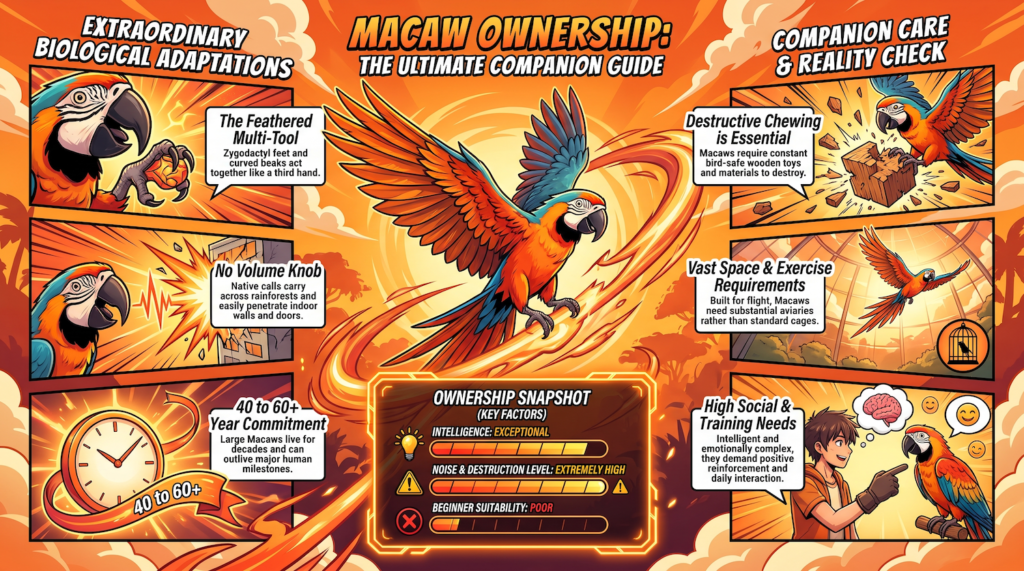








Brilliantly coloured, exceptionally intelligent and bursting with personality, Macaws are among the world's most spectacular parrots. Famous for their powerful beaks, impressive problem-solving abilities and strong social bonds.
🧠 QUICK SNAPSHOT
Trait | Macaw |
|---|---|
Scientific Classification | Several genera, including Ara, Anodorhynchus and Primolius |
Pet Type | Large parrot / Companion bird |
Natural Origin | Central and South America |
Typical Lifespan | Around 30–60+ years, depending on species |
Adult Length | Approximately 30–100 cm, including tail |
Typical Weight | Around 150 g–1.7 kg, depending on species |
Diet | Species-appropriate formulated diet, vegetables, fruit and other suitable foods |
Activity | Diurnal |
Temperament | Intelligent, social, playful and sometimes demanding |
Noise Level | High to extremely high |
Social Needs | Very high |
Trainability | Excellent |
Beginner Friendly? | Generally not recommended |
Famous Feature | Brilliant plumage, powerful beak and long tail |
📚 OVERVIEW
Macaws are a group of remarkable New World parrots, best known for their vivid colours, long tails and powerful curved beaks.
Species range from smaller macaws to giants such as the Hyacinth Macaw, the world’s longest flying parrot. Popular companion species include the Blue-and-Gold Macaw, Scarlet Macaw and Green-Winged Macaw.
Macaws are highly social, intelligent birds that naturally spend considerable time flying, foraging, communicating and interacting with other parrots. In captivity, they require extensive daily attention, substantial space, enrichment and specialised nutrition.
Their beauty is undeniable, but their long lifespan and demanding personalities mean Macaw ownership should never be an impulsive decision.
✅ PROS & CONS
👍 Pros
Spectacular colours and appearance
- Exceptionally intelligent
Can form strong social bonds
Playful and entertaining personalities
Excellent learning and training abilities
Some can mimic human speech
Fascinating natural behaviours
Potentially decades of companionship
👎 Cons
Extremely loud vocalisations
Requires substantial living space
Powerful beak capable of serious injury
Needs extensive daily interaction
Can be destructive without enrichment
Specialised diet and veterinary care
Expensive long-term commitment
May live for several decades
Are Macaws Good Pets?
Yes, for experienced and exceptionally committed owners.
Macaws can become affectionate, intelligent and engaging companions, but their size, noise, social needs and longevity make them challenging pets.
They’re not suitable for households wanting a quiet, low-maintenance bird.
Are Macaws Good for Beginners?
Generally, no.
Macaws require considerable knowledge of parrot behaviour, training, nutrition and environmental enrichment.
Smaller, less demanding bird species may be more suitable for someone gaining their first experience with companion birds.
How Long Do Macaws Live?
Macaw lifespan varies considerably by species.
Many larger Macaws can potentially live 40–60 years or longer with excellent care, while some smaller species have shorter average lifespans.
Ownership may therefore require planning for the bird’s care across several decades.
How Big Do Macaws Get?
Macaws vary enormously in size.
Smaller species may measure around 30–40 cm, while large Macaws can approach 90–100 cm in total length, much of which is their impressive tail.
The Hyacinth Macaw is particularly famous for its extraordinary size.
What Are the Different Types of Macaws?
Several Macaw species are kept as companion birds, including:
Blue-and-Gold Macaw — famous for its brilliant blue back and golden underside
Scarlet Macaw — spectacular red, yellow and blue plumage
Green-Winged Macaw — large, predominantly red parrot with green wing markings
Hyacinth Macaw — enormous cobalt-blue parrot
Military Macaw — predominantly green with a red forehead
Hahn’s Macaw — one of the smaller Macaw varieties
Each species has its own characteristics and care considerations.
Are Macaws Intelligent?
Extremely.
Macaws can solve problems, learn complex behaviours, recognise routines and manipulate objects with remarkable skill.
Their intelligence means mental stimulation is essential, not merely an optional extra.
Can Macaws Talk?
Yes. Many Macaws can learn to imitate human speech and other sounds.
However, speech clarity and vocabulary vary between species and individuals.
A Macaw should never be purchased with the expectation that it will definitely become a talking bird.
Are Macaws Affectionate?
Many Macaws develop strong relationships with familiar caregivers.
They may seek interaction, enjoy appropriate head scratches and participate enthusiastically in training.
However, their affection should always be respected on their terms, particularly because of their powerful beaks.
Do Macaws Bond With One Person?
Some Macaws develop a particularly strong preference for one caregiver.
Positive interaction with several trusted people can help encourage social confidence and reduce excessive dependence on one individual.
Are Macaws Loud?
Very.
Macaws naturally use powerful calls to communicate over long distances.
Even a well-adjusted Macaw may scream or call loudly at certain times of day.
Training cannot eliminate normal parrot vocalisation, so prospective owners must be comfortable with considerable noise.
Why Do Macaws Scream?
Screaming may be associated with communication, excitement, attention-seeking, alarm or frustration.
Some loud calling is completely normal.
Excessive vocalisation may also indicate insufficient enrichment, inadequate sleep or other environmental problems.
What Do Macaws Eat?
Macaws need a balanced, species-appropriate diet.
For many companion species, this includes quality formulated parrot food, suitable vegetables, some fruit and carefully selected nuts or seeds.
Nutritional requirements differ between species, particularly those with specialised natural diets.
Can Macaws Crack Nuts With Their Beaks?
Absolutely.
Macaws possess exceptionally powerful beaks capable of opening tough nuts and manipulating hard objects.
Their beaks are also remarkably precise, allowing them to handle small items delicately despite their strength.
What Foods Are Toxic to Macaws?
Foods including avocado, chocolate, alcohol and caffeine can be dangerous.
Owners should also avoid inappropriate salty, sugary or heavily processed foods.
Always verify unfamiliar foods before offering them to a parrot.
How Big Should a Macaw’s Cage Be?
Macaws require exceptionally spacious housing.
The enclosure must allow the bird to fully extend its wings, move comfortably, climb and interact with enrichment without damaging its feathers.
Large Macaws benefit greatly from purpose-built aviaries and extensive supervised exercise opportunities.
Do Macaws Need Time Outside Their Cage?
Yes.
Daily opportunities for exercise, exploration, training and social interaction are essential.
A Macaw kept in a cage for most of its life without meaningful enrichment is unlikely to have its behavioural needs adequately met.
Can Macaws Fly?
Yes. Healthy Macaws are powerful natural flyers.
In the wild, they may travel substantial distances between feeding and resting locations.
Providing safe opportunities for flight and physical exercise is important for their welfare.
Do Macaws Need Toys?
Absolutely.
Macaws enjoy chewing, shredding, manipulating objects, solving puzzles and searching for food.
Durable bird-safe toys, foraging activities and regular enrichment help prevent boredom.
Their powerful beaks mean toys must also be selected carefully for safety.
Why Do Macaws Chew Everything?
Chewing is a natural parrot behaviour.
Macaws use their beaks to investigate objects, process food and manipulate their environment.
Without suitable chewing opportunities, household furniture and other possessions may become extremely expensive alternatives.
Do Macaws Bite?
Yes, and their bites can cause serious injuries.
Macaws may bite because of fear, overstimulation, territorial behaviour or ignored warning signals.
Understanding body language and using positive reinforcement training are essential.
Can Macaws Live With Other Birds?
Macaws are naturally social, but that doesn’t mean unfamiliar birds should automatically share an enclosure.
Differences in size, temperament and territorial behaviour can create serious risks.
Carefully managed introductions and separate housing are often necessary.
Do Macaws Need Another Macaw?
Macaws have strong social needs and benefit from appropriate companionship.
A compatible parrot companion may provide valuable social interaction, but pairing birds requires careful planning.
Human attention alone may not fully replicate natural parrot social relationships.
How Much Sleep Do Macaws Need?
Macaws generally benefit from around 10–12 hours of uninterrupted nighttime rest, although individual and species needs vary.
A consistent, quiet sleeping environment helps support normal behaviour and wellbeing.
Why Does My Macaw Bob Its Head?
Head bobbing can have several meanings.
It may be associated with excitement, social interaction, begging behaviour or other communication.
Understanding the context and accompanying body language is important.
Why Does My Macaw Fluff Its Feathers?
Brief feather fluffing can be part of normal grooming, relaxation or temperature regulation.
However, persistent fluffing accompanied by lethargy, appetite changes or abnormal breathing may indicate illness.
What Health Problems Are Common in Macaws?
Potential concerns include nutritional deficiencies, obesity, respiratory disease, feather-damaging behaviour and beak or feather disorders.
Macaws may also be affected by infectious diseases such as psittacine beak and feather disease.
Regular care from an avian veterinarian is important.
What Is the Difference Between a Macaw and a Parrot?
A Macaw is a type of parrot.
The term parrot covers a large and diverse group of birds, while Macaws represent several distinctive genera within that broader group.
Their long tails, powerful beaks and often brilliant colours make them especially recognisable.
Why Are Macaws So Colourful?
Macaw feathers contain pigments and microscopic structures that contribute to their brilliant colours.
Their vivid plumage plays a role in visual communication and species recognition.
Despite their striking appearance, these colours can also blend surprisingly well into the complex light and foliage of tropical forests.
Where Do Macaws Come From?
Macaws are native to Central and South America, with different species inhabiting tropical forests, woodlands, savannas and other environments.
Many wild species depend on large areas of suitable habitat and access to seasonal food sources.
Are Macaws Endangered?
Several Macaw species are threatened by habitat destruction, trapping and illegal wildlife trade.
Conservation status varies considerably between species, and some are critically endangered or extinct in the wild.
Responsible sourcing is particularly important.
Are Macaws Legal to Keep as Pets?
Ownership and trade regulations vary by species and location.
Many Macaws are protected under international wildlife trade agreements, and some countries or regions impose additional restrictions.
Always verify local requirements and obtain birds only through responsible, legal sources.
Is a Macaw a Good First Parrot?
Usually not.
Macaws combine extraordinary intelligence with powerful beaks, loud calls, extensive social needs and potentially decades of responsibility.
For experienced owners who can provide appropriate care, however, they can be among the most fascinating companion birds imaginable.
What Makes the Macaw Unique?
Imagine a bird with the colours of a tropical sunset.
A tail that seems impossibly long.
And a beak powerful enough to crack open tough nuts.
That’s a Macaw.
But the spectacular appearance is only the beginning.
That enormous beak isn’t simply a nutcracker.
It’s also a remarkably precise tool.
A Macaw can manipulate small objects, investigate complicated toys and carefully handle food with extraordinary control.
Then there’s the intelligence.
Macaws learn routines, recognise familiar people and can develop strong social relationships.
And in the wild, their powerful calls help them communicate across vast forest environments.
To us, that call may sound like an ear-splitting scream.
To another Macaw, it’s communication.
Their natural abilities are extraordinary.
But perhaps the most remarkable thing about keeping one is the commitment involved.
A young Macaw may potentially remain part of a household for half a century or more.
You’re not simply choosing one of the world’s most beautiful birds. You’re taking responsibility for one of its most intelligent, demanding and long-lived companions.
Discover why Macaws have such powerful beaks, how intelligent these spectacular parrots really are, why they scream, how they communicate in the wild and what it takes to care for a bird that may live for decades.
Watch our Macaw video and discover what makes these colourful giants some of the most extraordinary parrots on Earth.