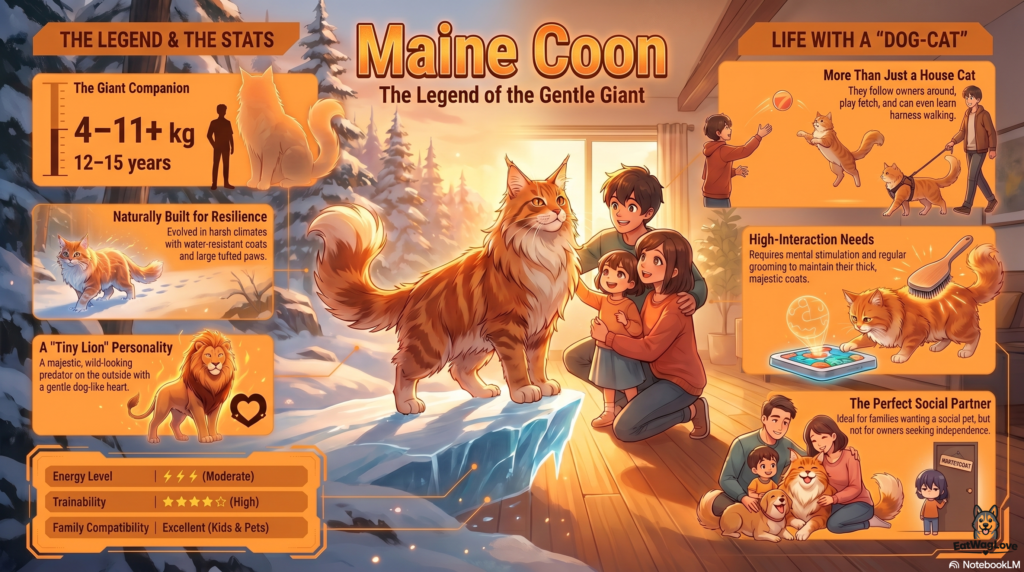
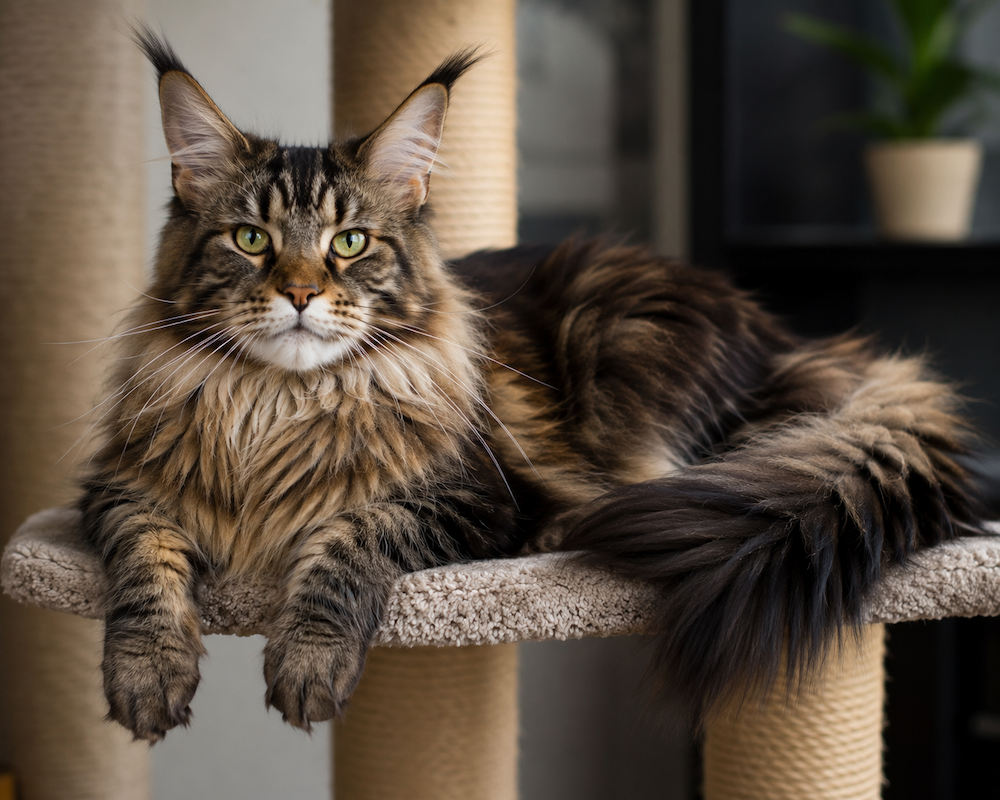




Gentle, majestic, and full of personality — a giant feline companion with a friendly and affectionate nature.
🧠 QUICK SNAPSHOT
- Temperament: Friendly, intelligent, gentle
- Energy Level: Moderate
- Size: Large
- Good With Families: Yes
- Trainability: Moderate
- Grooming: High
- Best For: Families, indoor companionship, larger homes
📚 OVERVIEW
The Maine Coon is one of the largest domestic cat breeds in the world, known for its fluffy coat, bushy tail, and calm personality. Despite their impressive size, they are affectionate and social cats that enjoy being around people.
They are playful, intelligent, and often described as “dog-like” because of their loyalty and interactive nature.
✅ PROS & CONS
Pros
- Gentle and affectionate temperament
- Great with families and children
- Intelligent and playful
- Stunning appearance and size
Cons
- Requires regular grooming
- Heavy shedding at times
- Needs space and enrichment
- Can be expensive to maintain
Is a Maine Coon a Good Family Cat?
Yes. The Maine Coon is generally an affectionate, sociable, playful and good-natured family cat.
They’re famous for being gentle despite their impressive size and often enjoy being involved in family life without constantly demanding attention.
Their easygoing temperament has helped earn them the nickname “gentle giant.”
How Much Exercise and Play Does a Maine Coon Need?
Most Maine Coons benefit from around 30–60 minutes of interactive activity spread throughout the day.
Fishing-rod toys, climbing towers, puzzle feeders, chasing games and retrieving toys are excellent options.
They’re large, athletic cats and need more than simply having toys left on the floor.
Is a Maine Coon a High-Energy Cat?
They’re generally moderately active.
Kittens can be extremely energetic, while adults often combine enthusiastic play with long periods of relaxation.
Many remain remarkably playful throughout their lives and can mature more slowly than smaller breeds.
Is a Maine Coon Easy to Train?
Yes.
Maine Coons are intelligent and often highly food- or play-motivated.
Many can learn sit, come, fetch, high-five, harness walking and other tricks using positive reinforcement.
Their willingness to interact with people makes training particularly enjoyable.
Are Maine Coons Intelligent?
Yes.
They’re observant, curious and excellent problem-solvers.
Puzzle feeders, interactive toys and training can help prevent boredom, particularly for indoor cats.
Some become remarkably skilled at opening cupboards, doors or containers their owners believed were secure.
Can Maine Coons Play Fetch?
Yes.
Retrieving toys is surprisingly common among Maine Coons.
Some naturally bring balls or toys back to their owners repeatedly.
This dog-like behaviour is one reason the breed is sometimes described as the “dog of the cat world.”
Does a Maine Coon Shed?
Yes.
Their substantial semi-long coat sheds throughout the year and can shed more heavily during seasonal coat changes.
Regular grooming helps remove loose hair before it ends up around the house.
Is a Maine Coon Hypoallergenic?
No.
Maine Coons produce normal feline allergens, including Fel d 1, and aren’t considered hypoallergenic.
Their large body and substantial coat can also distribute considerable hair and dander around the home.
What Type of Coat Does a Maine Coon Have?
The Maine Coon has a shaggy, water-resistant semi-long coat with a softer undercoat.
Hair is generally shorter over the shoulders and longer around the stomach, flanks and tail.
Many develop a dramatic neck ruff, particularly in winter.
How Often Should You Groom a Maine Coon?
Most should be thoroughly combed around two or three times each week.
Some coats require more frequent attention, particularly during shedding seasons.
The belly, armpits and hindquarters are common places for tangles to develop.
Do Maine Coons Get Mats?
Yes.
Despite the coat often being easier to maintain than some long-haired breeds, mats can still form.
Regular combing is considerably easier than removing established matting from a very large cat that has decided grooming time is officially over.
Should You Shave a Maine Coon?
Routine shaving isn’t recommended.
Their coat provides protection and insulation.
Severe matting may occasionally require veterinary or professional grooming intervention, but prevention through regular combing is preferable.
What Health Problems Are Common in Maine Coons?
Important concerns include hypertrophic cardiomyopathy (HCM), hip dysplasia and spinal muscular atrophy (SMA).
Polycystic kidney disease and other conditions can also occur within some lines.
Responsible breeders should use appropriate genetic, cardiac and orthopaedic screening rather than relying on DNA testing alone.
What Is HCM in Maine Coons?
Hypertrophic cardiomyopathy is a disease in which the muscular wall of the heart becomes abnormally thickened.
It can range from mild disease to serious heart failure, blood clots or sudden death.
A known Maine Coon-associated genetic variant can be tested for, but a negative DNA result doesn’t eliminate every possible form of HCM, making cardiac screening important.
What Is Spinal Muscular Atrophy in Maine Coons?
Spinal muscular atrophy, or SMA, is an inherited neurological condition affecting motor neurons.
Affected kittens develop muscle weakness and an abnormal gait.
A DNA test is available, allowing responsible breeders to avoid producing affected kittens.
Are Maine Coons Prone to Hip Dysplasia?
Yes.
Their unusually large body size makes hip dysplasia particularly relevant.
Affected cats may show reduced jumping, stiffness, discomfort or changes in movement, although cats can be remarkably good at concealing pain.
How Long Does a Maine Coon Live?
Many Maine Coons live around 12–15 years, with some reaching their late teens.
Genetics, weight, diet, lifestyle and preventive veterinary care all influence lifespan.
Keeping such a large cat lean is particularly important for joint health.
How Big Does a Maine Coon Get?
Maine Coons are among the largest domestic cat breeds.
Adult males commonly weigh around 6–9 kg, although some are larger, while females are often around 4–6 kg.
Their long body, enormous tail and heavy coat make them look even bigger.
How Tall Is a Maine Coon?
Maine Coons aren’t exceptionally tall in the way some long-legged breeds are, but they’re substantial cats.
Their body can be remarkably long from nose to tail.
The enormous tail contributes considerably to their overall measurements.
How Long Can a Maine Coon Get?
Very large individuals can exceed one metre from nose to tail tip.
Several Maine Coons have achieved world-record attention for exceptional length.
These individuals shouldn’t be treated as the normal expected size of every Maine Coon.
Is the Maine Coon the Largest Domestic Cat Breed?
It’s one of the largest established domestic breeds.
Savannah cats can be taller, while individual cats from several breeds may exceed particular Maine Coons.
The Maine Coon’s combination of weight, body length and heavy coat makes it one of the most physically imposing domestic cats.
What Is the Largest Maine Coon Ever Recorded?
Several Maine Coons have held records for exceptional length.
One of the most famous was Stewie, a Nevada Maine Coon measured at approximately 123 cm from nose to tail tip, who held a Guinness record for the longest domestic cat.
Record holders shouldn’t be used as normal breed-size expectations.
Why Are Maine Coons So Big?
Their size is partly genetic and has been reinforced through breed development.
The traditional population in northeastern North America consisted of robust, long-bodied cats suited to harsh conditions.
Modern selective breeding has maintained the breed’s substantial frame.
How Long Does It Take a Maine Coon to Reach Full Size?
Maine Coons mature slowly.
Many continue filling out until around three to four years old, considerably longer than the roughly one-year maturation people often expect from ordinary domestic cats.
This doesn’t mean they continue growing rapidly for four years; development gradually slows.
Is There a Giant Maine Coon?
“Giant Maine Coon” isn’t a separate recognised variety.
Some bloodlines and individuals are naturally larger than others.
Advertising kittens specifically as “giant” should be treated cautiously, particularly when extreme size is prioritised over health.
Is There a Miniature Maine Coon?
No recognised miniature Maine Coon exists.
A very small cat sold under that description may simply be undersized, mixed breed or marketed using an unofficial label.
Can a Maine Coon Live Indoors or in an Apartment?
Yes.
Maine Coons can live very successfully indoors, including in apartments, provided they have enough vertical space, enrichment and exercise.
Their physical size means ordinary cat furniture may be inadequate.
A sturdy oversized scratching post and strong climbing tower are worthwhile investments.
Does a Maine Coon Need to Go Outside?
No.
A Maine Coon can live an enriched indoor life.
Secure cat enclosures, catios or harness walks can provide outdoor stimulation without the risks associated with unrestricted roaming.
Can You Walk a Maine Coon on a Lead?
Yes.
Many adapt well to harness training, particularly when introduced gradually as kittens.
Their confident temperament and curiosity can make supervised outdoor exploration enjoyable.
A secure cat harness is essential because cats can reverse out of poorly fitted equipment remarkably easily.
Do Maine Coons Need Bigger Litter Boxes?
Usually, yes.
Many conventional litter trays become ridiculously small once a male Maine Coon reaches full size.
An extra-large tray gives the cat enough room to turn, dig and position itself comfortably.
Do Maine Coons Need Special Cat Trees?
They need strong cat trees capable of supporting their weight.
Platforms designed for small cats may wobble or collapse.
Large sleeping platforms, thick scratching posts and securely anchored climbing furniture are preferable.
Are Maine Coons Cuddly?
Many are affectionate, but not all are classic lap cats.
Some prefer lying beside their owner rather than directly on them.
Considering the size of a fully grown male, this arrangement can be mutually beneficial.
Are Maine Coons Lap Cats?
Some are.
Others enjoy affection while maintaining a little personal space.
The breed is generally sociable and people-oriented, but individual personality matters more than breed stereotypes.
Are Maine Coons Velcro Cats?
Some can be.
Many enjoy following their owners around the house and observing whatever they’re doing.
They’re often companionable without being excessively demanding.
Can Maine Coons Be Left Alone?
Adult Maine Coons can generally tolerate normal periods alone.
However, they’re social, intelligent cats and shouldn’t routinely be left without interaction or enrichment for extremely long periods.
Puzzle feeders, climbing opportunities and appropriate companionship can help.
Are Maine Coons Good With Children?
Usually.
Their gentle temperament and sturdy size can make them excellent companions for respectful children.
Children still need to understand that even an enormous friendly cat doesn’t want to be pulled, chased or carried against its wishes.
Are Maine Coons Good With Other Cats?
Generally, yes.
They’re often sociable and tolerant in multi-cat households.
Introductions should still be gradual rather than assuming breed friendliness guarantees instant acceptance.
Are Maine Coons Good With Dogs?
Many are.
Confident Maine Coons can coexist extremely well with cat-friendly dogs.
Their substantial size may also make them less intimidated by calm dogs than particularly tiny cats.
Do Maine Coons Have a Strong Prey Drive?
Yes.
Their history as practical farm and household cats meant hunting rodents was useful.
Modern Maine Coons can still be highly motivated by moving toys, insects, birds and rodents.
This is another reason unrestricted outdoor access can be problematic.
Are Maine Coons Good Mousers?
Historically, yes.
They developed among farms, homes and ships in a region where controlling rodents was valuable.
Their size doesn’t prevent them from being agile and effective hunters.
Do Maine Coons Meow a Lot?
Many are vocal, but they often don’t rely exclusively on conventional meows.
They’re famous for producing chirps, trills, squeaks and conversational noises.
The surprisingly delicate voice coming from such an enormous cat is part of their charm.
Why Do Maine Coons Chirp and Trill?
Chirping and trilling are common forms of social communication.
A Maine Coon may trill as a greeting, while following its owner or when asking for attention.
Mother cats also use similar sounds when communicating with kittens.
Why Does My Maine Coon Have Such a Tiny Voice?
Large body size doesn’t require a deep voice.
Many Maine Coons communicate using soft chirps and trills rather than powerful meows.
A nine-kilogram cat approaching with the sound of a tiny bird can be wonderfully incongruous.
Do Maine Coons Like Water?
Many show unusual curiosity about water.
Some paw at water bowls, investigate showers, play with dripping taps or drop toys into water.
Not every Maine Coon enjoys getting wet, however, so the breed shouldn’t be treated as universally water-loving.
Can Maine Coons Swim?
Cats can generally swim when necessary, and some Maine Coons willingly enter water.
Their water-resistant coat may help in wet conditions.
However, historical claims that they evolved specifically as swimming ship cats are considerably harder to prove.
Why Does My Maine Coon Put Its Paw in the Water Bowl?
Pawing at water may be play, curiosity or an attempt to investigate the water’s depth and movement.
Some Maine Coons seem particularly fascinated by moving water.
A drinking fountain can therefore become both hydration equipment and entertainment.
Do Maine Coons Like Snow?
Many tolerate cold conditions extremely well because of their dense coat and heavily furred feet.
Individual cats may enjoy exploring snow in safe conditions.
Cold tolerance doesn’t mean a pet cat should be left outside in dangerous winter weather.
Can Maine Coons Handle Cold Weather?
Yes, exceptionally well for a domestic cat.
Their shaggy coat, bushy tail, large body and heavily furred paws provide substantial protection.
The breed developed in Maine and surrounding northeastern North America, where winters can be severe.
Can Maine Coons Handle Hot Weather?
They can adapt, but hot weather requires care.
Fresh water, shade, ventilation and cool indoor areas are important.
Regular grooming helps remove dead undercoat, but routinely shaving the cat isn’t necessary.
Why Do Maine Coons Have Such Big Paws?
Large paws support their substantial bodies and provide a broad surface for moving across uneven terrain.
Heavy tufts of fur between the toes add protection in cold conditions.
They’re sometimes poetically described as natural “snowshoes.”
Do Maine Coons Have Webbed Feet?
Cats naturally have some skin between their toes, and Maine Coons’ large, heavily furred paws can exaggerate this appearance.
Claims that they possess uniquely webbed feet specifically for swimming are often overstated.
Their feet are much more notable for their size and heavy fur.
Why Do Maine Coons Have Hair Between Their Toes?
Toe tufts help protect the feet from cold surfaces and snow.
They also contribute to the enormous paw appearance characteristic of the breed.
Long tufts are particularly noticeable in winter-coated cats.
Why Do Maine Coons Have Ear Tufts?
Maine Coons often have long hair growing from within and around the ears.
This provides some protection from cold and debris.
The pointed tufts at the ear tips contribute to their famous wild, lynx-like appearance.
Are Maine Coon Ear Tufts Called Lynx Tips?
The longer hairs projecting from the ear tips are commonly called lynx tips.
The term describes their appearance rather than indicating any relationship to lynxes.
Not every Maine Coon has equally dramatic ear-tip furnishings.
Is a Maine Coon Part Lynx?
No.
Maine Coons are fully domestic cats and have no established lynx ancestry.
Their large bodies, tufted ears and huge paws simply create a superficially wild appearance.
Domestic cats and lynxes are also far more distantly related than popular folklore suggests.
Is a Maine Coon Part Bobcat?
No.
Stories claiming Maine Coons originated from domestic cats breeding with bobcats are biologically unsupported.
The resemblance comes from convergent physical features such as ear tufts, substantial bodies and shaggy coats.
Is a Maine Coon Part Raccoon?
Absolutely not.
One of the most famous Maine Coon legends claims domestic cats crossed with raccoons, supposedly explaining the breed’s bushy striped tail.
Cats and raccoons are far too genetically different to interbreed.
It makes a memorable story, but impossible biology.
Did the Name Maine Coon Come From Raccoons?
The “Maine” part clearly reflects the breed’s strong association with the state of Maine.
The origin of “Coon” is less certain.
The raccoon resemblance may have influenced the name, but other historical explanations have also been proposed.
Is the Maine Coon Related to the Norwegian Forest Cat?
They’re separate breeds.
Both developed large bodies, long weather-resistant coats, bushy tails and heavily furred paws suited to cold climates.
Historical Viking-cat ancestry is frequently proposed for Maine Coons, but a direct documented line from Norwegian Forest Cats hasn’t been proven.
Is the Maine Coon Related to the Siberian Cat?
They’re distinct natural breeds that developed in cold environments.
Similar environmental pressures helped produce comparable adaptations such as substantial bodies and dense coats.
This doesn’t make one a descendant of the other.
How Can You Tell a Maine Coon From a Norwegian Forest Cat?
Maine Coons typically have a longer, more rectangular body and a noticeably square muzzle.
Norwegian Forest Cats generally have a more triangular head profile.
Both can be large, long-haired and heavily furnished, making casual identification difficult.
How Can You Tell a Maine Coon From a Siberian Cat?
Maine Coons generally have a rectangular body, square muzzle and very long outline.
Siberians tend to look rounder and more compactly powerful.
Coat texture and head shape also differ.
What Does a Maine Coon Look Like?
The breed is large and rectangular with a broad chest, square muzzle, substantial bone, large tufted ears, enormous paws and a very long bushy tail.
Its shaggy coat is uneven in length rather than flowing uniformly like a Persian’s.
The overall impression should be powerful but athletic.
Why Do Maine Coons Have Square Muzzles?
The broad, square muzzle is one of the breed’s most recognisable characteristics.
Selective breeding has reinforced this distinctive head shape.
It helps differentiate the Maine Coon from other long-haired breeds with more triangular or rounded faces.
Why Is a Maine Coon’s Tail So Long?
The long, heavily furred tail is characteristic of the breed.
Cats can wrap their tails around themselves while resting, potentially providing additional insulation in cold conditions.
It also contributes to balance when climbing and moving.
What Colours Can Maine Coons Be?
Maine Coons occur in an enormous variety of colours and patterns, including brown tabby, black, blue, red, cream, silver, white, tortoiseshell and many combinations with white.
Brown tabby is probably the appearance most strongly associated with the breed.
Can a Maine Coon Be Black?
Yes.
Solid black Maine Coons are genuine and can look particularly dramatic because their large size and shaggy coat emphasise the dark silhouette.
Black smoke is another striking variation.
Can a Maine Coon Be White?
Yes.
White Maine Coons occur and may have blue, gold, green or odd-coloured eyes.
As with other white cats, congenital deafness can be associated with certain white-coat and blue-eye genetics.
Can a Maine Coon Be Orange?
Yes.
Red Maine Coons — commonly called orange or ginger — are well established.
Because of feline sex-linked colour genetics, red cats are more commonly male.
Can a Maine Coon Be Blue?
Yes.
“Blue” in cat terminology means a diluted greyish version of black rather than literally blue.
Blue Maine Coons can be solid, tabby, smoke or combined with white.
Can a Maine Coon Be Silver?
Yes.
Silver Maine Coons can have spectacular high-contrast coats.
Silver tabby, shaded and smoke patterns can occur depending on the underlying colour genetics.
Can a Maine Coon Be Calico?
Yes.
Calico Maine Coons occur and, because of the genetics controlling orange and black colouring, are overwhelmingly female.
Male calicos are extremely rare and usually have unusual sex-chromosome genetics.
Can a Maine Coon Have Blue Eyes?
Yes, particularly white cats or cats with substantial white spotting.
Blue eyes aren’t typical across the breed as a whole.
Eye colour is influenced strongly by coat genetics.
Can Maine Coons Have Different-Coloured Eyes?
Yes.
Odd-eyed Maine Coons can occur, particularly among white or predominantly white cats.
One eye may be blue while the other is gold, green or another permitted colour.
Can Maine Coons Be Polydactyl?
Yes — and this is one of the breed’s most fascinating historical traits.
Polydactyl Maine Coons have extra toes, sometimes producing enormous mitten-like paws.
Polydactyly was historically common among cats in parts of northeastern North America and remains present in some Maine Coon lines.
How Many Toes Can a Polydactyl Maine Coon Have?
Normal cats usually have 18 toes: five on each front paw and four on each rear paw.
Polydactyl cats can have additional digits on one or more feet.
The number varies because several anatomical forms of polydactyly occur.
Why Were Polydactyl Maine Coons Common?
Extra-toed cats were historically common among northeastern American and maritime cat populations.
Their broad feet inspired stories that they were better at balancing on ships or walking over snow.
Those explanations are plausible folklore, but the mutation itself persists primarily because it wasn’t necessarily harmful and became common in particular populations.
Is Polydactyly a Health Problem in Maine Coons?
Usually not by itself.
Many polydactyl cats live completely normal lives.
Owners need to monitor additional claws carefully because unusual positioning can allow some claws to overgrow.
Are Polydactyl Maine Coons Purebred?
They can be.
Polydactyly has genuine historical roots within the Maine Coon population.
Recognition in show rings depends on the rules of the particular cat organisation, but extra toes don’t automatically indicate mixed ancestry.
Why Are Polydactyl Cats Called Hemingway Cats?
Writer Ernest Hemingway became famously associated with polydactyl cats at his home in Key West, Florida.
His descendants’ cats helped popularise the nickname “Hemingway cats.”
Polydactyly itself isn’t specific to Maine Coons or Hemingway’s cats.
Where Does the Maine Coon Come From?
The Maine Coon developed in Maine and the broader northeastern United States, where long-haired domestic cats adapted to harsh winters and rural life.
Rather than being created by one breeder, it emerged as a regional natural cat population.
Maine eventually adopted it as its official state cat.
Is the Maine Coon a Natural Breed?
Yes, in the historical sense.
The foundation population developed regionally through natural and human selection before formal cat breeding standardised its appearance.
Modern pedigree Maine Coons are selectively bred, but their foundation wasn’t created from one planned cross.
How Old Is the Maine Coon Breed?
Large long-haired cats recognisable as Maine Coon-type animals were well established in northeastern America by the 19th century.
Their deeper ancestry is uncertain.
Modern pedigree registration and breed standards came later.
What Cats Created the Maine Coon?
Nobody knows the exact combination.
Long-haired cats brought to North America from Europe probably mixed with established domestic cat populations.
Natural selection in a cold environment then favoured robust cats with protective coats.
Claims naming one exact ancestral breed are largely speculative.
Did Vikings Bring the Ancestors of Maine Coons to America?
It’s a popular theory.
Norse sailors could have carried cats aboard ships, and the resemblance between Maine Coons and Scandinavian forest cats makes the idea appealing.
However, there’s no direct evidence demonstrating that Viking cats founded the Maine Coon breed.
Did Marie Antoinette’s Cats Create the Maine Coon?
This is one of the breed’s most romantic legends.
The story claims that during plans to escape the French Revolution, Marie Antoinette’s long-haired cats were sent to Maine, where they later contributed to the breed.
There’s no strong historical evidence establishing this as the Maine Coon’s origin.
Did Marie Antoinette Ever Reach Maine?
No.
Marie Antoinette was executed in France in 1793.
Stories about her possessions or cats being sent ahead to America belong to Maine Coon folklore rather than a documented breed foundation.
Who Was Captain Samuel Clough in the Maine Coon Story?
Captain Samuel Clough of Wiscasset, Maine, appears in versions of the Marie Antoinette legend.
According to the story, his ship was involved in plans to transport the queen and her belongings to America.
The connection to the actual ancestry of Maine Coon cats remains unproven.
Did Maine Coons Develop From Ship Cats?
Maritime cats may well have contributed to the regional population.
Ships routinely carried cats for rodent control, and Maine had extensive shipping connections.
However, the modern Maine Coon probably developed from multiple domestic cat populations rather than one famous ship’s cats.
Were Maine Coons Working Cats?
Yes.
They were practical farm, household and potentially ship cats valued for controlling rodents.
Their development occurred before companion-cat breeding became the dominant focus.
A large, hardy cat capable of surviving a Maine winter had genuine practical value.
Why Did Farmers Value Maine Coons?
They were hardy, intelligent and capable mousers.
Farms provided abundant opportunities for rodents, making effective cats useful rather than merely decorative.
Their thick coats also suited life in cold barns and rural buildings.
Were Maine Coons America’s First Show Cats?
They were among the stars of America’s earliest organised cat shows.
Maine Coons appeared prominently in late 19th-century exhibitions before imported breeds such as Persians became increasingly fashionable.
Who Was Cosey the Maine Coon?
Cosey was a brown tabby female Maine Coon who became one of the most famous cats in breed history.
She won the top award at the major 1895 cat show at Madison Square Garden in New York.
Her victory makes her an important figure in early American cat fancy history.
Did a Maine Coon Win America’s First Major Cat Show?
Cosey’s 1895 victory at Madison Square Garden is frequently described as winning the first major American cat show.
The exact wording around “first” can vary depending on how earlier exhibitions are classified.
What is clear is that Cosey was the celebrated winner of a landmark early American show.
What Happened to Cosey’s Trophy?
The silver collar and medal associated with Cosey’s victory became treasured pieces of American cat-fancy history.
They demonstrate just how prominent Maine Coons were before the breed later declined in popularity.
Why Did Maine Coons Almost Disappear From Cat Shows?
Imported long-haired breeds, particularly Persians, became increasingly fashionable during the early 20th century.
Maine Coons lost show-ring popularity and were sometimes dismissed as ordinary regional farm cats.
Dedicated enthusiasts eventually revived interest.
Did the Maine Coon Nearly Become Extinct?
The breed became seriously unfashionable, but “near extinction” needs some qualification.
Maine Coon-type cats continued existing in northeastern America even when organised show registrations became scarce.
The greater danger was losing the breed as a formally recognised pedigree population.
How Was the Maine Coon Breed Revived?
Enthusiasts began actively promoting and breeding Maine Coons during the mid-20th century.
The Central Maine Cat Club, established in the 1950s, was particularly important in organising shows and rebuilding recognition.
Breed clubs later worked for acceptance by major cat registries.
What Was the Central Maine Cat Club?
The Central Maine Cat Club was formed by Maine Coon enthusiasts who wanted to preserve and promote the breed.
It organised exhibitions and helped demonstrate that the Maine Coon deserved recognition as a distinct American breed.
Its work was important during the breed’s modern revival.
When Was the Maine Coon Officially Recognised?
Recognition occurred at different times among different organisations.
After years of campaigning by enthusiasts, the Cat Fanciers’ Association granted championship status in the 1970s.
From there, the breed’s international popularity grew enormously.
Is the Maine Coon America’s Oldest Natural Cat Breed?
It’s frequently described as one of North America’s oldest natural breeds.
That’s a reasonable description of its regional history.
Claims that it’s definitively the single oldest American breed are harder to establish because domestic cat populations existed long before formal breed records.
Is the Maine Coon the Official Cat of Maine?
Yes.
The Maine Coon is recognised as the official state cat of Maine.
Few cat breeds are as closely identified with one American state.
Why Is the Maine Coon Called the Gentle Giant?
The nickname reflects the contrast between its enormous appearance and generally amiable temperament.
A huge male with lynx-like ears and massive paws can look intimidating.
Then it opens its mouth and produces a tiny trill before asking someone to play fetch.
Why Are Maine Coons Called Dog-Like Cats?
Their social behaviour can resemble traits people commonly associate with dogs.
Many follow their owners, retrieve toys, learn commands, greet visitors and adapt to harness walking.
They’re still thoroughly feline — they simply have a particularly interactive style.
Why Does My Maine Coon Follow Me Everywhere?
Maine Coons tend to be socially interested in what their people are doing.
Following doesn’t necessarily mean separation anxiety.
Many simply prefer supervising household activities from nearby.
Why Does My Maine Coon Sit Beside Me Instead of on Me?
This is common.
Many Maine Coons enjoy companionship without necessarily being permanent lap cats.
Considering their size, sitting beside you may also be the only arrangement under which both parties retain circulation in their legs.
Why Does My Maine Coon Carry Toys Around?
Carrying can be part of play and hunting behaviour.
Some Maine Coons develop favourite toys that they retrieve repeatedly or transport around the home.
Their historical reputation as effective mousers makes the behaviour particularly fitting.
Why Does My Maine Coon Sleep in Strange Positions?
Like many cats, Maine Coons can become extraordinarily flexible when relaxed.
Their long bodies and enormous tails make unusual sleeping positions particularly dramatic.
A cat that appears to occupy half the sofa may still somehow believe it has curled into a compact ball.
Why Does My Maine Coon Look Like a Wild Cat?
The combination of large size, tufted ears, square muzzle, huge paws and shaggy coat creates a distinctly wild appearance.
None of these features require recent wild-cat ancestry.
The Maine Coon is completely domestic.
Are Male Maine Coons Bigger Than Females?
Usually, yes.
Sexual size differences can be quite noticeable.
Adult males often develop heavier bodies, broader heads and more substantial overall appearance, although individual females can also become impressively large.
Are Male and Female Maine Coons Different in Personality?
Broad stereotypes sometimes describe males as more clownish and females as more independent.
Individual personality, upbringing and genetics are far more reliable predictors than sex.
Either can be affectionate, playful or reserved.
Is a Maine Coon a Good First Cat?
Yes, for many households.
They’re generally sociable, intelligent and adaptable.
Prospective owners need to be prepared for large-scale cat equipment, substantial grooming, food costs and important breed-specific health screening, particularly for HCM and hip dysplasia.
What Makes the Maine Coon Unique?
The Maine Coon has one of the most colourful origin stories in the cat world — partly because nobody knows exactly how it began.
Legends have claimed it descended from raccoons, bobcats, Viking ship cats and even Marie Antoinette’s treasured cats. The raccoon and bobcat stories are biologically impossible, while the more romantic historical theories remain unproven.
The more convincing story is arguably better.
Long-haired domestic cats arrived in northeastern America through multiple routes and encountered the brutal winters of Maine. Over generations, a population of large, hardy, heavily coated cats with enormous paws, bushy tails and excellent hunting ability emerged.
By the 19th century, Maine Coons were already famous regional cats. In 1895, a brown tabby named Cosey became the celebrated winner of the landmark Madison Square Garden cat show. The breed later fell from fashion as Persians became popular, only to be rescued as a recognised breed by dedicated enthusiasts.
Today, it’s one of the world’s most recognisable cats.
It can exceed a metre in length, walk around on snowshoe-like paws, hunt rodents, learn to fetch and look remarkably like a small wild animal.
Then this supposed wilderness beast approaches its owner and communicates its urgent demands with perhaps its most distinctive feature of all:
a tiny little chirp.