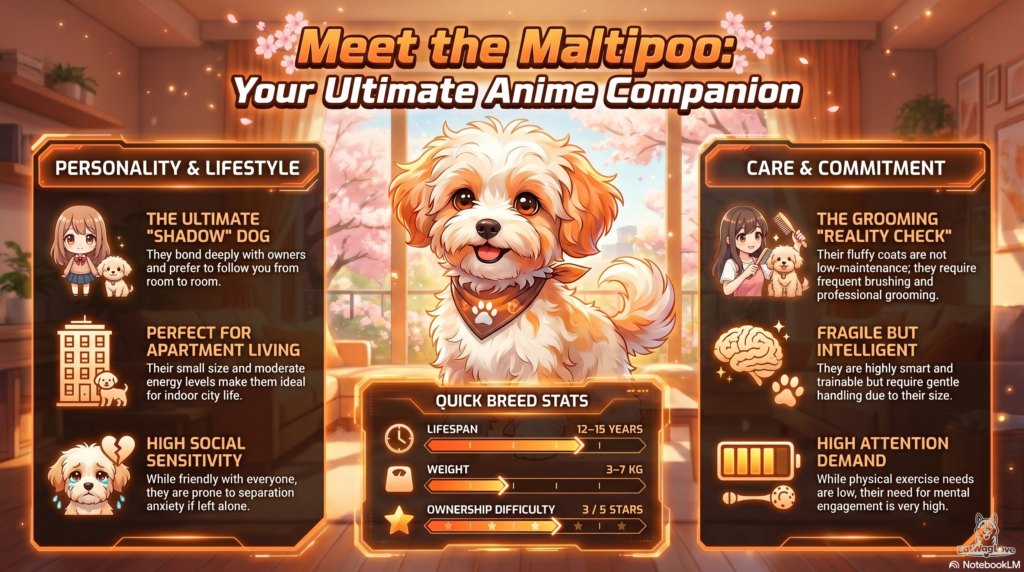





Sweet, playful, and full of affection — a tiny companion that loves being close to you.
🧠 QUICK SNAPSHOT
- Temperament: Gentle, affectionate, playful
- Energy Level: Low to moderate
- Size: Small
- Good With Families: Yes
- Trainability: High
- Grooming: Moderate
- Best For: Families, apartments, companionship
📚 OVERVIEW
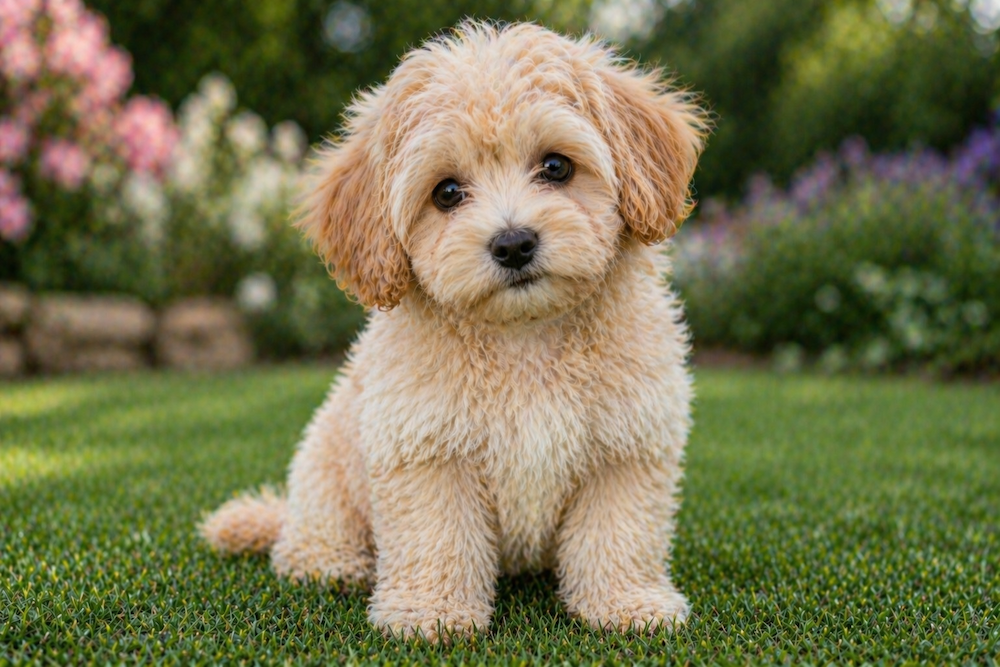
The Maltipoo is a cross between a Maltese and a Poodle, known for its soft coat and loving personality. They are highly social dogs that enjoy being around people and thrive in environments where they receive plenty of attention.
Their small size and adaptable nature make them ideal for both apartments and houses.
✅ PROS & CONS
Pros
- Very affectionate and friendly
- Great for small homes and apartments
- Intelligent and easy to train
- Low shedding (varies by coat)
Cons
- Can develop separation anxiety
- Needs regular grooming
- Requires attention and companionship
- Sensitive temperament
Is a Maltipoo a Good Family Dog?
Yes. The Maltipoo is generally an affectionate, playful, intelligent and highly people-oriented family companion.
A Maltipoo combines the Maltese with a Toy or Miniature Poodle, so many inherit the Maltese’s strong companion temperament together with the Poodle’s intelligence and enthusiasm for learning.
They’re small dogs, so interactions with young children should always be supervised.
What Is a Maltipoo?
A Maltipoo is a cross between a Maltese and a Poodle, usually a Toy or Miniature Poodle.
They’re also sometimes called Maltapoos, Malt-A-Poos or Maltese Poodle crosses.
The Maltipoo is a designer cross rather than a standardised pedigree breed, so size, coat and temperament can vary considerably.
How Much Exercise Does a Maltipoo Need?
Most Maltipoos need around 30–60 minutes of exercise each day, along with play and mental stimulation.
Toy Poodle-influenced dogs may be satisfied toward the lower end, while energetic Miniature Poodle crosses can need considerably more activity.
Puzzle toys and training are particularly valuable because Maltipoos are often mentally active dogs.
Is a Maltipoo a High-Energy Dog?
Usually moderately energetic.
Maltese ancestry contributes a lively companion temperament, while Poodles can add substantial athleticism and drive.
Young Maltipoos often have impressive bursts of energy but usually settle well after appropriate exercise.
Is a Maltipoo Easy to Train?
Generally, yes.
Poodles are exceptionally trainable, while Maltese are intelligent companion dogs that respond well to positive reinforcement.
Maltipoos can learn obedience commands, tricks and household routines very quickly.
Are Maltipoos Intelligent?
Yes.
The Poodle side can contribute excellent problem-solving ability, while Maltese are also bright and highly attentive to people.
Training, food puzzles and interactive games help keep a Maltipoo mentally stimulated.
They’re often extremely good at learning behaviours their owners never intended to teach.
Are Maltipoos Stubborn?
Some can be.
A Maltipoo may inherit the Poodle’s quick intelligence without necessarily inheriting an unlimited desire to follow instructions.
Consistent, reward-based training usually works better than repetitive or harsh methods.
Are Maltipoos Difficult to Toilet Train?
Some can require patience.
Their small bladder means puppies need frequent toilet opportunities, and Maltese-type dogs can sometimes be slower to house-train.
A consistent schedule, close supervision and immediate rewards for successful toileting are important.
Does a Maltipoo Shed?
Many Maltipoos shed very little, but low shedding isn’t guaranteed.
Both parent breeds are relatively low shedding, particularly the Poodle, making heavy shedding less likely than in many crosses.
Individual coat genetics still vary.
Is a Maltipoo Hypoallergenic?
No dog is completely hypoallergenic.
Maltipoos are frequently marketed as allergy-friendly because both parent breeds are relatively low shedding.
However, canine allergens also occur in saliva, skin secretions and dander, so an individual person can still react strongly to a Maltipoo.
What Type of Coat Does a Maltipoo Have?
Maltipoo coats can be straight, wavy, loosely curled or tightly curled.
Some inherit finer, silkier Maltese-like hair, while others develop dense Poodle-type curls.
Even puppies from the same litter can have noticeably different coats.
Does a Maltipoo Have Hair or Fur?
The Maltipoo’s coat is commonly described as hair because both parent breeds have long-growing, relatively low-shedding coats.
Biologically, hair and fur are made from the same material.
The practical difference is that Maltipoo coats generally continue growing and need regular trimming.
How Often Should You Groom a Maltipoo?
Most Maltipoos need brushing several times each week, and curly or longer coats may require daily combing.
Areas behind the ears, beneath the legs and around the collar are particularly prone to matting.
Grooming should begin during puppyhood.
Do Maltipoos Mat Easily?
Yes.
This is one of the biggest surprises for new Maltipoo owners.
Low-shedding hair can remain trapped within the coat, where it tangles with growing hair and quickly creates mats.
A fluffy Maltipoo is usually a high-maintenance coat disguised as a teddy bear.
How Often Does a Maltipoo Need Professional Grooming?
Many require professional grooming approximately every six to eight weeks.
Dogs kept in longer teddy-bear styles may require more frequent maintenance.
A shorter puppy clip can significantly reduce daily grooming.
Can You Shave a Maltipoo?
Yes, when necessary.
Unlike double-coated breeds that generally shouldn’t be routinely shaved, Maltipoo hair can be clipped short.
Severe matting sometimes makes a close clip the most humane solution, although regular grooming should prevent this.
Why Does My Maltipoo Get Tear Stains?
Tear staining can be particularly visible on white, cream and apricot Maltipoos.
Possible causes include normal tear pigments, excessive tearing, blocked tear ducts, allergies, eye irritation or facial hair rubbing against the eye.
Persistent tearing should be investigated rather than treated purely as a cosmetic issue.
What Health Problems Are Common in Maltipoos?
Potential concerns include patellar luxation, dental disease, eye disorders, Legg-Calvé-Perthes disease, allergies, heart disease and inherited neurological conditions.
Maltese-related liver and tracheal problems may also occur, while Poodle ancestry introduces its own inherited risks.
Responsible breeders should health-test both parent breeds.
Are Maltipoos Healthier Than Purebred Dogs?
Not automatically.
Crossbreeding can increase genetic diversity, but it doesn’t erase inherited disease.
A Maltipoo can inherit health risks from either the Maltese or Poodle side.
“Hybrid vigour” shouldn’t be used as a substitute for proper health screening.
Are Maltipoos Prone to Patellar Luxation?
Yes.
Patellar luxation is found in many small breeds, including both sides of the Maltipoo family.
The kneecap moves out of its normal position, potentially causing intermittent skipping, hopping or lameness.
Are Maltipoos Prone to Dental Problems?
Yes.
Their small jaws can result in crowded teeth, increasing plaque accumulation and periodontal disease.
Daily tooth brushing is particularly important for Maltipoos.
Are Maltipoos Prone to Ear Infections?
They can be.
Floppy ears combined with substantial hair around the ear canal can trap warmth and moisture.
Dogs that inherit particularly hairy Poodle-like ears may require careful monitoring.
Are Maltipoos Prone to Allergies?
Some are.
Skin irritation, paw licking and recurring ear problems can sometimes be associated with allergies.
Persistent symptoms should be assessed by a veterinarian rather than repeatedly treated without identifying the underlying cause.
How Long Does a Maltipoo Live?
Maltipoos commonly live around 12–15 years, with some reaching their late teens.
Smaller dogs generally enjoy relatively long lifespans.
Genetics, body weight, dental health and preventive veterinary care all influence longevity.
How Big Does a Maltipoo Get?
Most Maltipoos weigh approximately 3–9 kg, although the range can extend beyond this depending on the Poodle parent.
Toy Poodle crosses are generally smaller than those produced from Miniature Poodles.
There is no single official Maltipoo size standard.
How Tall Does a Maltipoo Get?
Many stand around 20–35 cm at the shoulder.
Again, Poodle parentage matters enormously.
A Maltipoo produced from a particularly small Toy Poodle can look very different from one with a larger Miniature Poodle parent.
Is There a Toy Maltipoo?
“Toy Maltipoo” usually describes a Maltipoo produced using a Toy Poodle.
It’s an informal size description rather than a separately recognised breed variety.
Knowing the actual size of both parents is more useful than relying on marketing terminology.
Is There a Mini Maltipoo?
“Mini Maltipoo” usually refers to a Maltipoo involving a Miniature Poodle, although breeders don’t use the terminology consistently.
One breeder’s Mini Maltipoo may be another breeder’s standard-sized Maltipoo.
There is no universal Maltipoo size standard.
Is There a Teacup Maltipoo?
There’s no recognised Teacup Maltipoo.
The term is generally used to market exceptionally small dogs.
Extreme miniaturisation can increase risks including fragile bones, hypoglycaemia, dental crowding and other health problems.
Can a Maltipoo Live in an Apartment?
Yes.
Their small size and moderate exercise requirements make Maltipoos excellent apartment dogs.
Barking and separation anxiety are more likely to create problems than lack of physical space.
Does a Maltipoo Need a Backyard?
No.
Daily walks, play and mental stimulation can meet their needs.
A secure garden is convenient but isn’t necessary.
Can a Maltipoo Be Left Alone?
Adult Maltipoos can learn to tolerate reasonable periods alone.
However, the Maltese is strongly companion-oriented and Poodles can also become intensely attached to their families.
Teaching independence from puppyhood is important.
Are Maltipoos Prone to Separation Anxiety?
Yes, some can be.
This is one of the more important behavioural issues prospective owners should consider.
A Maltipoo that spends every minute with its owner as a puppy may struggle badly when suddenly expected to remain alone.
Are Maltipoos Velcro Dogs?
Many are.
They often follow their owners from room to room and enjoy being involved in everyday activities.
Combining a devoted Maltese with an intelligent, people-focused Poodle can produce an extremely dedicated personal supervisor.
Are Maltipoos Cuddly?
Usually.
Many enjoy laps, beds and close physical contact.
Individual personality still matters, and some more energetic Poodle-like dogs prefer playing beside their owners rather than sitting still for extended cuddles.
Are Maltipoos Good With Children?
Generally, particularly with respectful children.
Their small size means rough handling can cause injury.
Very tiny Toy Maltipoo-type dogs may be better suited to households with older children.
Are Maltipoos Good With Other Dogs?
Usually.
Good socialisation helps them develop confidence around dogs of different sizes.
Their sociable companion background generally makes multi-dog living possible.
Are Maltipoos Good With Cats?
Many are.
Their prey drive is generally low to moderate.
Careful introductions remain important, particularly if the dog hasn’t previously lived with cats.
Do Maltipoos Have a Strong Prey Drive?
Usually not, although Poodles do have genuine hunting and retrieving ancestry.
An individual Maltipoo may chase birds, squirrels or rodents.
They’re generally less prey-driven than terriers or sighthounds.
Are Maltipoos Good Off Leash?
They can develop excellent recall.
Their strong attachment to people and Poodle trainability can work in the owner’s favour.
Secure areas remain safest around roads or wildlife.
Do Maltipoos Bark a Lot?
Some do.
Both parent breeds can be alert, and Maltipoos may quickly learn to announce visitors, neighbours, delivery vehicles and suspicious-looking leaves.
Early training can prevent alert barking becoming excessive.
Are Maltipoos Good Watchdogs?
They can be good alarm dogs.
They’re often observant and quick to announce unfamiliar activity.
Their small size obviously limits their usefulness once the alert has been delivered.
Are Maltipoos Good Guard Dogs?
No.
They’re companion dogs rather than physical protection dogs.
A Maltipoo’s security strategy generally consists of detect, bark and outsource the rest to the humans.
Are Maltipoos Aggressive?
Aggression isn’t considered a normal Maltipoo characteristic.
Poor socialisation, fear, pain and inappropriate handling can cause behavioural problems in any dog.
Small dogs need the same behavioural boundaries and training as larger dogs.
Are Maltipoos Friendly With Strangers?
Many are.
Poodles and Maltese can both be sociable, although individual dogs may initially be cautious.
Positive early socialisation helps develop confidence around unfamiliar people.
When Does a Maltipoo Calm Down?
Many become noticeably calmer between one and three years old.
Poodle-influenced individuals can remain energetic and playful for longer.
Even mature Maltipoos often retain a puppy-like enthusiasm.
Do Maltipoos Get the Zoomies?
Absolutely.
A Maltipoo can transform from sleeping teddy bear to high-speed household projectile with almost no warning.
Fortunately, the transformation usually lasts only a few minutes.
Are Maltipoos Good Walking Dogs?
Yes.
Healthy Maltipoos generally enjoy daily walks and exploring new environments.
Their small size shouldn’t be interpreted as meaning they should be carried everywhere.
Can Maltipoos Go Hiking?
Healthy adults can enjoy moderate hikes.
Larger Miniature Poodle-influenced Maltipoos may be surprisingly athletic.
Distance should be adjusted for size, fitness, temperature and terrain.
Are Maltipoos Good Running Dogs?
Some larger, athletic Maltipoos can accompany owners on shorter runs after reaching physical maturity.
Very small Toy Poodle crosses aren’t ideal distance-running partners.
The individual dog’s build and fitness matter more than the Maltipoo label.
Can Maltipoos Swim?
Many can, and Poodle ancestry can contribute a natural enthusiasm for water.
The Poodle was originally developed as a waterfowl retriever, despite its modern reputation as an ornamental dog.
Not every Maltipoo inherits that enthusiasm, so water introductions should be gradual.
Do Maltipoos Get Cold Easily?
Small Maltipoos can.
Their small bodies lose heat relatively quickly, particularly when the coat is clipped short.
A jumper or coat may be useful during genuinely cold weather.
Can Maltipoos Handle Hot Weather?
Generally, but extreme heat still requires caution.
Walks should be scheduled during cooler parts of hot days, particularly during Australian summers.
Water, shade and cool indoor areas should always be available.
What Does a Maltipoo Look Like?
Maltipoos are generally small dogs with dark expressive eyes, drop ears and soft, fluffy coats.
Some have straight or wavy Maltese-like hair.
Others develop the dense curls and broader coat volume associated with Poodles.
What Colours Can Maltipoos Be?
Maltipoos can occur in many colours, including white, cream, apricot, red, black, brown, grey and combinations of these colours.
Their broader colour range comes largely from Poodle ancestry.
This distinguishes them from the modern Maltese, which is overwhelmingly white.
Can a Maltipoo Be Black?
Yes.
Black Poodles can contribute genes for a black coat.
Solid black Maltipoos are less visually associated with the cross than cream or apricot dogs but are entirely possible.
Can a Maltipoo Be Brown?
Yes.
Chocolate or brown colouring can come from Poodle ancestry.
Brown dogs may also have brown rather than black nose pigmentation.
Can a Maltipoo Be Red?
Yes.
Red and deep apricot Maltipoos have become particularly popular.
These colours largely reflect Poodle colour genetics.
Can a Maltipoo Be White?
Absolutely.
White Maltipoos can strongly resemble Maltese, particularly if their coat is relatively straight.
Coat texture and body structure may provide additional clues to the Poodle ancestry.
Can a Maltipoo Be Parti-Coloured?
Yes.
Poodle ancestry can produce parti-colour and other patterned coats.
Colour genetics can become increasingly complex in multigenerational Maltipoo breeding.
Can a Maltipoo Be Merle?
Merle isn’t naturally present in the Maltese and isn’t a historically established Poodle colour.
A merle Maltipoo therefore indicates additional merle-carrying ancestry somewhere in its breeding history.
It shouldn’t simply be marketed as a rare Maltipoo colour without explaining where the gene originated.
Do Maltipoo Puppies Change Colour?
They can.
Poodles carry several genes capable of causing coats to lighten or “fade” with age.
A dark puppy can therefore mature into a considerably lighter adult.
Why Is My Maltipoo Getting Lighter?
Poodle colour genetics are frequently responsible.
Red, apricot, brown and black dogs can sometimes lighten substantially as they mature.
The final adult colour may not become obvious during early puppyhood.
Why Does My Maltipoo Look More Like a Maltese?
Crossbreeding doesn’t produce an exact 50/50 visual blend.
A puppy can inherit straighter hair, a finer frame and facial characteristics strongly resembling the Maltese.
Another puppy from the same litter may look dramatically more Poodle-like.
Why Does My Maltipoo Look More Like a Poodle?
The dog may have inherited stronger Poodle coat, body and facial traits.
Curly hair can particularly dominate the overall appearance.
In F1B and multigenerational dogs, the proportion of Poodle ancestry may also be greater.
Is a Maltipoo the Same as a Maltese?
No.
The Maltese is an established pure breed with a long history as a Mediterranean companion dog.
The Maltipoo combines Maltese ancestry with Toy or Miniature Poodle ancestry.
Is a Maltipoo the Same as a Maltichon?
No.
A Maltichon is Maltese × Bichon Frise, while a Maltipoo is Maltese × Poodle.
Both can be small, fluffy, low-shedding companion dogs, so they can look surprisingly similar.
Is a Maltipoo the Same as a Cavapoo?
No.
A Cavapoo combines a Cavalier King Charles Spaniel and Poodle.
Both crosses can inherit curly coats and affectionate temperaments, but the non-Poodle parent is completely different.
Is a Maltipoo the Same as a Cockapoo?
No.
A Cockapoo combines a Cocker Spaniel and Poodle.
Cockapoos are generally larger and can inherit considerably more sporting-dog characteristics.
Is a Maltipoo a Doodle?
Broadly, yes.
“Doodle” is an informal umbrella term for Poodle crosses.
Maltipoos are usually discussed separately because the name predates much of the modern “-doodle” naming convention, but genetically they’re part of the same general Poodle-cross phenomenon.
Is a Maltipoo a Purebred Dog?
No.
The Maltipoo is a cross between two established breeds.
Even multigenerational Maltipoos aren’t currently a recognised pedigree breed under the major traditional kennel organisations.
Is the Maltipoo a Recognised Dog Breed?
Generally, no.
Major kennel clubs such as the AKC, The Kennel Club and Dogs Australia don’t recognise the Maltipoo as an established breed.
Designer-dog registries may record them, but that isn’t equivalent to full breed recognition.
What Is an F1 Maltipoo?
An F1 Maltipoo is produced from a purebred Maltese × purebred Poodle mating.
Its pedigree is approximately 50% Maltese and 50% Poodle.
Its visible characteristics don’t necessarily appear in equal proportions.
What Is an F1B Maltipoo?
An F1B Maltipoo is produced by breeding an F1 Maltipoo back to one of the original parent breeds.
Most commonly, the backcross is to a Poodle, producing approximately 75% Poodle and 25% Maltese ancestry.
However, F1B technically describes the generation structure, so buyers should confirm which parent breed was used.
What Is an F1BB Maltipoo?
An F1BB usually results from breeding an F1B Maltipoo back to a Poodle again.
When that convention is followed, the dog has an even higher proportion of Poodle ancestry.
These crosses are sometimes bred in an attempt to increase coat predictability and reduce shedding, but neither result is guaranteed.
What Is an F2 Maltipoo?
An F2 is generally produced by breeding two F1 Maltipoos together.
Second-generation puppies can display considerable genetic variation.
An F2 isn’t automatically more predictable than an F1.
What Is a Multigenerational Maltipoo?
A multigenerational Maltipoo has Maltipoo ancestry extending through several generations rather than simply being a first-generation Maltese × Poodle cross.
Careful multigenerational breeding can potentially increase predictability.
Poorly planned multigenerational breeding can simply reproduce health and temperament problems repeatedly.
Is an F1B Maltipoo More Hypoallergenic?
Not reliably.
Increasing Poodle ancestry can increase the likelihood of a curly, low-shedding coat, but allergy reactions depend on more than visible shedding.
No Maltipoo generation can guarantee that an allergy sufferer won’t react.
Why Were Maltese Crossed With Poodles?
Breeders generally sought to combine the Maltese’s affectionate companion temperament and small size with the Poodle’s intelligence, trainability and low-shedding coat.
The resulting teddy-bear appearance also became enormously commercially popular.
However, crosses don’t guarantee the best characteristics of both parents.
Does the Maltipoo Have Working-Dog Ancestry?
Yes — surprisingly, through the Poodle.
The Maltese side comes primarily from an ancient companion-dog tradition.
The Poodle, however, developed as an athletic water retriever used by hunters, particularly for retrieving waterfowl.
That means the Maltipoo combines lap-dog ancestry with genuine sporting-dog ancestry.
Was the Poodle Originally a Hunting Dog?
Yes.
Long before Poodles became associated with elaborate show grooming, they were water retrievers.
Even the famous Poodle clip has historical associations with working in water, although modern show styles have evolved far beyond purely functional grooming.
Why Are Maltipoos So Good at Learning Tricks?
Both sides contribute.
Maltese have been selected for close human interaction, while Poodles are exceptionally intelligent and trainable.
The combination can produce a dog that’s both highly attentive to people and quick to understand what earns a reward.
Where Does the Maltipoo Come From?
The exact origin of the Maltipoo isn’t well documented.
Deliberate Maltese × Poodle crosses became increasingly popular during the late 20th and early 21st centuries, particularly as demand grew for small, low-shedding companion crosses.
There isn’t a universally recognised founder or first litter.
Who Created the First Maltipoo?
No reliably documented breeder is recognised as the Maltipoo’s creator.
Maltese and Poodles could have been crossed long before the modern designer-dog market existed.
The combination became commercially identifiable only much later.
Was the Maltipoo Created in Australia?
There’s no strong evidence that the Maltipoo itself originated in Australia.
Australia is enormously important to modern Poodle-cross history because of the development of the Labradoodle, but that doesn’t mean every subsequent Poodle cross originated there.
Did Wally Conron Create the Maltipoo?
No.
Australian breeder Wally Conron became internationally associated with the modern Labradoodle while working with guide dogs.
He didn’t create the Maltipoo.
The Labradoodle’s publicity did, however, help fuel the enormous later interest in Poodle crosses.
Did the Maltipoo Exist Before the Labradoodle?
Maltese and Poodles may certainly have been crossed earlier.
What isn’t well documented is a recognised Maltipoo breeding movement under that name before the modern designer-dog era.
Accidental or informal crosses shouldn’t automatically be treated as the beginning of an organised breed type.
Is the Maltipoo an Ancient Breed?
No.
Its parent breeds have long histories, particularly the Maltese, but the Maltipoo itself is a modern cross.
Claims describing Maltipoos as an ancient breed confuse the ancestry of the parents with the history of the cross.
Could the Maltipoo Become a Recognised Breed?
Potentially, but it would require far more than repeatedly crossing Maltese and Poodles.
Breeders would need to establish a stable multigenerational population with predictable characteristics, pedigrees, a defined standard, health programmes and sufficient genetic diversity.
At that point, it would begin functioning as a breed rather than simply a cross.
Why Are Maltipoos So Popular?
They combine several traits highly desirable in modern companion dogs:
small size
affectionate temperament
low-shedding potential
high intelligence
apartment suitability
teddy-bear appearance
Their photogenic appearance has also made them particularly popular on social media.
Why Are Maltipoos Called Teddy Bear Dogs?
A rounded haircut combined with dark eyes, a short fluffy face and soft wavy or curly hair can create a striking teddy-bear appearance.
This look is primarily the result of coat genetics plus grooming.
A Maltipoo left ungroomed for months looks considerably less like a teddy bear and considerably more like an urgent appointment with a groomer.
Why Does My Maltipoo Follow Me Everywhere?
Both sides of its ancestry encourage close interaction with people.
The Maltese has spent centuries primarily as a companion, while Poodles were bred to work cooperatively with humans.
Many Maltipoos therefore consider following their owner from room to room completely normal.
Why Does My Maltipoo Stare at Me?
Maltipoos are highly attentive to human behaviour.
They may stare because they’re anticipating food, play, a walk or simply watching for cues about what happens next.
If staring has previously produced a reward, an intelligent Maltipoo can become extraordinarily committed to the technique.
Why Does My Maltipoo Paw at Me?
Pawing is commonly used to request attention, play or physical contact.
Owners can accidentally reinforce it by immediately responding every time it happens.
For an intelligent dog, one successful experiment can rapidly become established company policy.
Why Does My Maltipoo Want to Sit on My Lap?
The Maltese side provides centuries of lap-dog heritage.
The Poodle side contributes a strong interest in interacting with humans.
For many Maltipoos, sitting on their owner’s lap isn’t simply affection — it’s ancestral career development.
Are Maltipoos Good Therapy Dogs?
They can be.
Their small size, intelligence and affectionate temperament can suit therapy work extremely well.
Individual dogs still need calm confidence, good socialisation and appropriate training.
Are Maltipoos Good at Agility?
Yes.
Poodle ancestry can make Maltipoos surprisingly athletic.
Smaller agility equipment and appropriate training can provide excellent physical and mental stimulation.
Are Maltipoos Good at Trick Training?
Excellent.
Their intelligence and strong engagement with people make trick training particularly suitable.
Many quickly learn spins, paw, fetch, roll over, touch targets and more complex behaviour chains.
Is a Maltipoo a Good Dog for Older People?
Often, yes.
Their small size, affectionate temperament and moderate exercise requirements can make them excellent companions.
Prospective owners should consider the ongoing cost of professional grooming and the dog’s need for regular companionship.
Is a Maltipoo a Good First Dog?
Yes, for many owners.
They’re generally intelligent, affectionate, adaptable and physically manageable.
The main challenges are grooming, dental care, toilet training, barking and preventing excessive dependence on their owners.
What Makes the Maltipoo Unique?
The Maltipoo combines two dogs whose ancestors had remarkably different careers.
On one side is the Maltese, descended from an ancient Mediterranean companion-dog tradition in which tiny dogs spent centuries living alongside people in wealthy households and European courts.
On the other is the Poodle — an intelligent, athletic water retriever developed to plunge into water and retrieve birds for hunters.
Modern breeders brought those histories together in a small companion dog.
That’s why one Maltipoo can spend the morning learning new tricks with extraordinary speed, the afternoon retrieving a ball repeatedly and the evening refusing to move because it has secured the best position on someone’s lap.
It has inherited two very different ancestral job descriptions:
the Poodle says, “Give me something intelligent to do.”
The Maltese says, “Excellent. You can start by carrying me.”