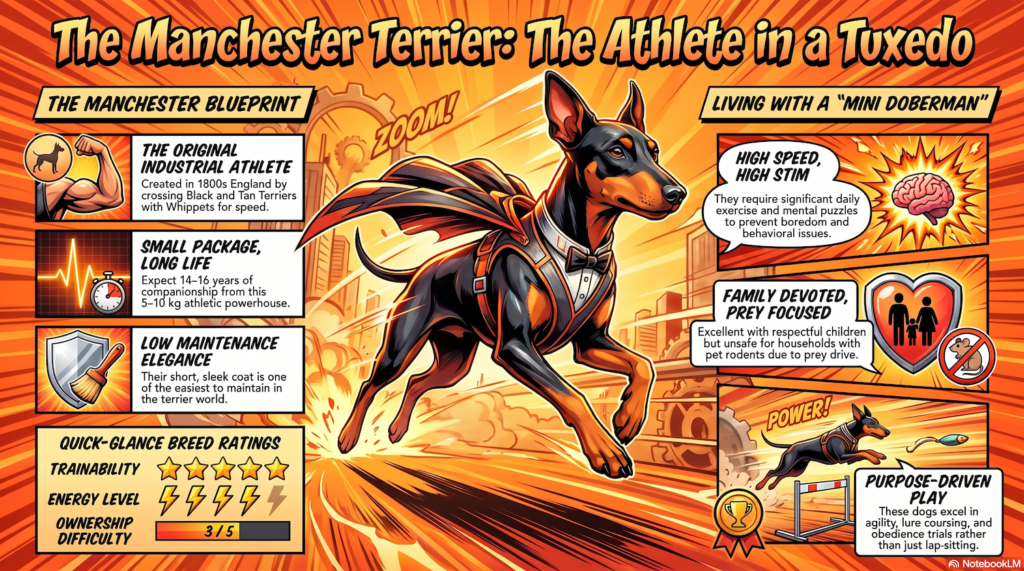







Sleek, intelligent, and full of energy — a lively companion with a sharp mind and an elegant appearance.
🧠 QUICK SNAPSHOT
- Temperament: Intelligent, loyal, alert
- Energy Level: High
- Size: Small to medium
- Good With Families: Yes
- Trainability: High
- Grooming: Low
- Best For: Active families, apartments, companionship
📚 OVERVIEW
The Manchester Terrier is a graceful and athletic breed originally developed in England to hunt rats and other vermin. Known for its sleek black-and-tan coat and alert expression, this breed combines the determination of a terrier with the elegance of a toy breed.
Manchester Terriers are intelligent, affectionate, and energetic companions that form strong bonds with their families. They enjoy both outdoor adventures and relaxing at home with the people they love.
✅ PROS & CONS
Pros
- Highly intelligent and easy to train
- Loyal and affectionate with family
- Low-maintenance coat
- Excellent watchdog
Cons
- Strong prey drive
- Needs regular exercise and mental stimulation
- Can be reserved with strangers
- May become vocal or mischievous if bored
Is a Manchester Terrier a Good Family Dog?
Yes. The Manchester Terrier can be an affectionate, intelligent, lively and deeply loyal family dog, particularly in active households.
They often form strong bonds with their people but retain the alertness and determination of a genuine working terrier.
Their relatively fine build means children should learn to handle them respectfully.
How Much Exercise Does a Manchester Terrier Need?
Most Manchester Terriers need around 60 minutes of exercise each day, although energetic individuals may happily do more.
Walks should be combined with running, games, training and mental stimulation.
Despite their elegant appearance, these are athletic dogs descended from serious working terriers.
Is a Manchester Terrier a High-Energy Dog?
Yes, generally.
They’re lively, fast and playful but can settle well indoors after sufficient activity.
Young Manchester Terriers can be particularly energetic and benefit from having constructive outlets for their intelligence.
Is a Manchester Terrier Easy to Train?
Generally, yes.
Manchester Terriers are intelligent and quick learners, but they can also be independent.
Short, interesting training sessions using positive reinforcement usually work much better than repetitive drilling.
Are Manchester Terriers Intelligent?
Very.
Their ancestors needed the speed, reactions and problem-solving ability to hunt vermin independently.
Modern Manchester Terriers often excel at trick training, obedience, scent activities and dog sports.
Are Manchester Terriers Stubborn?
They can be.
Like many terriers, they’re capable of making independent decisions rather than constantly waiting for instructions.
Consistency and motivation are much more effective than trying to overpower that terrier determination.
Are Manchester Terriers Difficult to Toilet Train?
They’re generally reasonably trainable.
A consistent routine, frequent opportunities outside and immediate positive reinforcement usually work well.
Toy Manchester Terriers have smaller bladders and may need more frequent toilet breaks as puppies.
Does a Manchester Terrier Shed?
Yes, but usually not heavily.
The breed has a short, smooth, close-fitting coat that’s relatively easy to maintain.
Regular brushing removes loose hair and helps keep the coat glossy.
Is a Manchester Terrier Hypoallergenic?
No.
Although their short coat is low maintenance, Manchester Terriers still shed and produce normal canine allergens.
Short hair doesn’t make a dog hypoallergenic.
How Often Should You Groom a Manchester Terrier?
Usually once a week is enough.
A soft brush or grooming mitt removes loose hair and distributes natural skin oils.
They rarely need professional coat grooming.
Does a Manchester Terrier Need Haircuts?
No.
The short coat naturally remains at its correct length.
Routine clipping or shaving isn’t necessary.
What Health Problems Are Common in Manchester Terriers?
Potential concerns include von Willebrand disease, eye disorders, thyroid problems and patellar luxation, particularly depending on variety and bloodline.
Legg-Calvé-Perthes disease can also be relevant in smaller dogs.
Responsible breeders should perform the health screening recommended for their breeding population.
What Is von Willebrand Disease in Manchester Terriers?
Von Willebrand disease is an inherited blood-clotting disorder.
Affected dogs can experience excessive or prolonged bleeding.
DNA testing can identify relevant genetic status and is useful within responsible breeding programmes.
Are Manchester Terriers Prone to Eye Problems?
Some inherited eye disorders can occur.
Responsible breeders should use appropriate eye examinations and genetic testing where relevant.
Changes in vision, persistent irritation or unusual eye appearance should receive veterinary attention.
How Long Does a Manchester Terrier Live?
Manchester Terriers commonly live around 14–16 years, with some living longer.
Their relatively light, athletic build contributes to good longevity.
Maintaining healthy weight and providing appropriate dental and preventive veterinary care remain important.
How Big Does a Manchester Terrier Get?
This depends partly on which kennel-club system you’re using.
The Standard Manchester Terrier is a small-to-medium, fine-boned terrier, generally around 5–10 kg.
American breed classification also includes a much smaller Toy variety.
Is There a Toy Manchester Terrier?
Yes — particularly in the United States.
The American Kennel Club recognises Standard and Toy varieties of the Manchester Terrier, differentiated primarily by size and ear conventions.
In Britain, the closely related small variety developed as a separately recognised breed called the English Toy Terrier (Black & Tan).
Is a Toy Manchester Terrier the Same as an English Toy Terrier?
They’re extremely closely related historically, but modern kennel organisations classify them differently.
In the United States, the smaller dog is the Toy Manchester Terrier.
In Britain and some other countries, the English Toy Terrier (Black & Tan) is treated as a distinct breed.
Is There a Miniature Manchester Terrier?
There’s no separate recognised “Miniature Manchester Terrier.”
The recognised small variety in the American system is the Toy Manchester Terrier.
“Miniature” may simply be an informal or marketing description.
Is There a Teacup Manchester Terrier?
No recognised Teacup Manchester Terrier exists.
Extreme miniaturisation can create additional health and fragility concerns.
Buyers should be wary of breeders using “teacup” primarily to justify unusually high prices.
Can a Manchester Terrier Live in an Apartment?
Yes.
Their relatively compact size makes apartment living practical, provided their exercise and mental-stimulation needs are met.
Barking and boredom are more likely to cause problems than lack of physical space.
Does a Manchester Terrier Need a Backyard?
No.
Regular walks, training and opportunities to run safely can meet their needs.
A garden is useful, but it needs to be securely fenced because terrier prey drive can encourage escape attempts.
Can a Manchester Terrier Be Left Alone?
Adult dogs can learn to tolerate reasonable periods alone.
Manchester Terriers tend to form strong relationships with their families and shouldn’t routinely spend extremely long periods isolated.
Gradual independence training is valuable.
Are Manchester Terriers Prone to Separation Anxiety?
Some can be.
Their strong attachment to owners can become excessive if they’re never taught to spend time independently.
Exercise and mental enrichment can also reduce boredom-related destructive behaviour.
Are Manchester Terriers Velcro Dogs?
Many can be surprisingly attached to their favourite people.
They’re often more companion-oriented than people expect from a traditional working terrier.
A Manchester Terrier may spend an hour independently investigating everything outside and then insist on following its owner into every room indoors.
Are Manchester Terriers Cuddly?
Many are.
Their smooth coat and love of warmth can make laps, blankets and sofas extremely attractive.
Individual personalities vary, but many become very affectionate household companions.
Are Manchester Terriers Good With Children?
They can be excellent with respectful children.
They’re playful and energetic enough to enjoy family activities.
Young children should be supervised because the breed is relatively fine-boned, particularly the Toy variety.
Are Manchester Terriers Good With Other Dogs?
Many are, particularly with good early socialisation.
Terrier confidence can occasionally produce assertiveness around other dogs.
Individual temperament matters considerably.
Are Manchester Terriers Good With Cats?
Some can live successfully with cats when raised alongside them.
However, the Manchester Terrier has serious historical vermin-hunting ancestry, so prey drive shouldn’t be underestimated.
A running unfamiliar cat may trigger chasing even in a dog that lives peacefully with its own cat.
Can a Manchester Terrier Live With Rabbits or Guinea Pigs?
Extreme caution is required.
Manchester Terriers were deliberately developed to hunt and kill rats and other small animals.
A friendly household temperament doesn’t remove instinctive predatory behaviour.
Do Manchester Terriers Have a Strong Prey Drive?
Yes.
Strong prey drive is one of the breed’s most historically important characteristics.
Rodents, rabbits and other rapidly moving animals can trigger pursuit.
Are Manchester Terriers Good Off Leash?
Some develop excellent recall, but prey drive can make off-leash exercise risky.
Once a terrier spots a rabbit or other small animal, training can suddenly face extremely strong competition.
Secure fenced areas are safest.
Are Manchester Terriers Fast?
Yes.
They’re remarkably quick and agile.
The breed was deliberately developed from terrier and coursing-dog ancestry to produce a dog capable of both catching rats and pursuing rabbits.
Why Does a Manchester Terrier Look Like a Miniature Doberman?
The resemblance is striking: both can have sleek black-and-tan coats, wedge-shaped heads and athletic bodies.
However, the Manchester Terrier is the older breed.
The resemblance isn’t because Manchester Terriers were created by miniaturising Dobermans.
Is the Manchester Terrier Related to the Doberman?
There’s a historical connection.
Manchester-type black-and-tan terriers are commonly considered among the breeds or types that contributed to the development of the Doberman in Germany during the late 19th century.
The exact recipe behind the early Doberman isn’t completely documented.
Did the Manchester Terrier Exist Before the Doberman?
Yes.
Manchester Terriers were already established in Britain before Karl Friedrich Louis Dobermann began developing the dog that would bear his name during the late 19th century.
So the Manchester Terrier didn’t descend from the Doberman.
If anything, historical influence runs in the opposite direction.
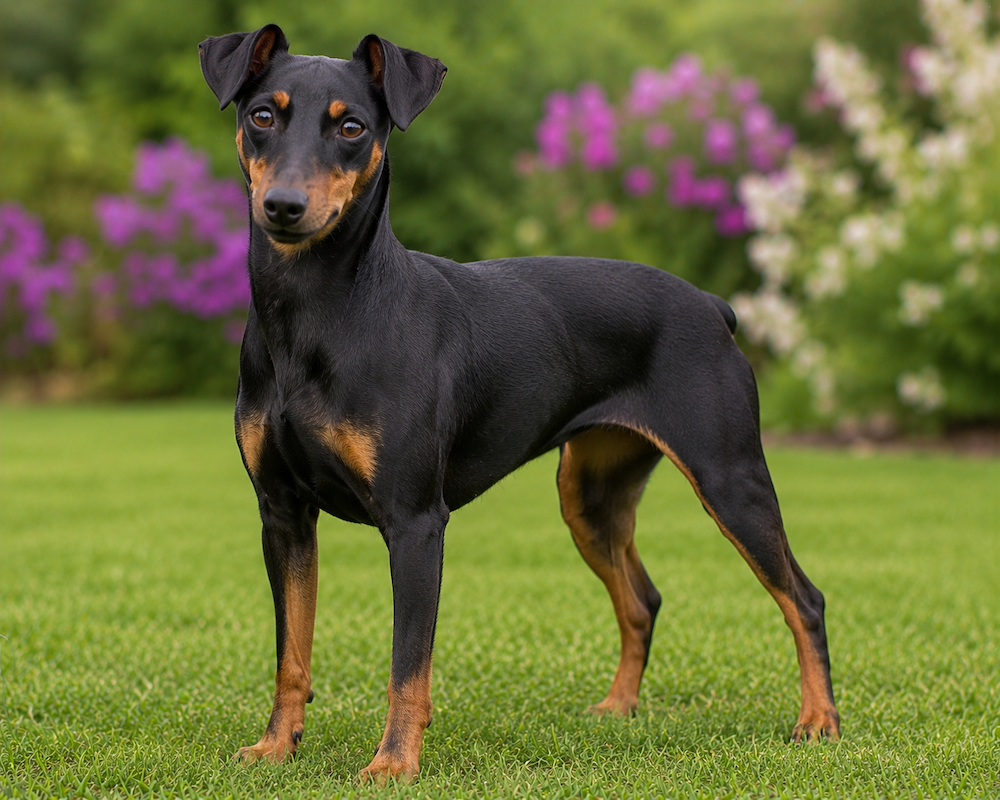
What Does a Manchester Terrier Look Like?
The Manchester Terrier is sleek, elegant and athletic with a long wedge-shaped head, dark almond-shaped eyes, smooth coat and distinctive black-and-tan markings.
Its body should look streamlined rather than heavy.
The appearance combines elegance with obvious speed.
What Colour Is a Manchester Terrier?
The characteristic colour is jet black with clearly defined rich mahogany-tan markings.
The placement of the tan markings is an important part of the breed’s traditional appearance.
Unlike many breeds, there isn’t a large recognised palette of Manchester Terrier colours.
Can a Manchester Terrier Be Brown?
Brown or chocolate isn’t the characteristic recognised Manchester Terrier colour.
The classic breed is black and tan.
Dogs advertised in unusual colours should be evaluated carefully for pedigree authenticity.
Can a Manchester Terrier Be Blue?
Blue isn’t a standard Manchester Terrier colour.
Dilute colouring can occur genetically in dogs, but it isn’t part of the traditional recognised breed appearance.
Can a Manchester Terrier Be Merle?
Merle isn’t a traditional Manchester Terrier colour.
A merle dog marketed as a pure Manchester Terrier should raise serious questions about ancestry.
Merle doesn’t simply appear as a rare version of the breed’s normal black-and-tan coat.
Why Does a Manchester Terrier Have Tan Spots Above Its Eyes?
The small tan markings above the eyes are part of the breed’s characteristic black-and-tan pattern.
Similar markings occur in several breeds with related colour genetics.
They sometimes give the dog a wonderfully expressive “four-eyed” appearance.
Do Manchester Terriers Get Cold Easily?
Yes.
Their very short coat and relatively lean body provide limited insulation.
Many appreciate coats during cold or wet weather.
Why Do Manchester Terriers Love Blankets?
Warmth.
A Manchester Terrier has little coat protecting it from cold surfaces and draughts.
Blankets, sunny windows and human laps can therefore become extremely valuable resources.
Can Manchester Terriers Handle Hot Weather?
Generally reasonably well, but they’re still vulnerable to overheating during strenuous exercise.
Fresh water, shade and avoiding intense activity during extreme heat remain important.
Their dark black coat can absorb substantial solar heat.
Do Manchester Terriers Bark a Lot?
They can be vocal.
They’re alert terriers and may quickly announce visitors or unfamiliar noises.
Training can help prevent normal alert barking from developing into constant commentary.
Are Manchester Terriers Good Watchdogs?
Yes.
They’re alert, observant and quick to notice unusual activity.
Their history required them to be attentive to movement, making them naturally effective alarm dogs.
Are Manchester Terriers Good Guard Dogs?
They’re better watchdogs than physical guard dogs.
The Standard variety may provide some visual deterrence, but the breed isn’t large enough for serious protection work.
Its greatest security contribution is detecting and announcing something unusual.
Are Manchester Terriers Aggressive?
A well-bred Manchester Terrier shouldn’t be indiscriminately aggressive.
They can be confident, determined and highly predatory toward small animals, but prey drive isn’t the same thing as human-directed aggression.
Early socialisation remains important.
Are Manchester Terriers Friendly With Strangers?
Many are somewhat reserved initially.
They often bond more intensely with their own family than with every person they meet.
Properly socialised dogs should be confident rather than fearful or unnecessarily hostile.
When Does a Manchester Terrier Calm Down?
Many become noticeably more settled between two and three years old.
They remain lively and alert throughout adulthood.
This isn’t generally a breed that becomes completely uninterested in activity.
Do Manchester Terriers Get the Zoomies?
Definitely.
Their combination of speed and compact size can turn a hallway into an impromptu racetrack.
Fortunately, they usually remember where the furniture is.
Usually.
Are Manchester Terriers Good Running Dogs?
Healthy Standard Manchester Terriers can make capable running companions.
They’re athletic and built for speed.
Distance should be introduced gradually after physical maturity rather than assuming a fast dog automatically has unlimited endurance.
Are Manchester Terriers Good Hiking Dogs?
Yes.
Their manageable size, athleticism and curiosity can make them excellent hiking companions.
Wildlife encounters need careful management because prey drive can quickly override sightseeing.
Can Manchester Terriers Swim?
Most can swim physically, but enthusiasm varies.
They’re not specialised water dogs.
A life jacket and gradual introduction are sensible around deep water.
Are Manchester Terriers Good at Agility?
Yes.
Their speed, intelligence and athleticism can make them excellent agility dogs.
They can also enjoy rally, obedience, scent work, Fast CAT-type activities and trick training.
Are Manchester Terriers Good Ratters?
Historically, exceptionally so.
The Manchester Terrier developed partly as a specialist vermin-control dog, particularly for killing rats.
Speed, quick reactions and determination were deliberately selected.
Were Manchester Terriers Used for Rat Killing?
Yes.
Rat killing was both practical pest control and, unfortunately, part of organised rat-baiting entertainment in 19th-century Britain.
Dogs competed to kill large numbers of rats inside enclosed pits.
The activity is now illegal, but it played a significant role in the breed’s history.
What Was a Rat Pit?
A rat pit was an enclosed area in which dogs were set against live rats while spectators watched and wagered on the outcome.
This became a popular blood sport in parts of 19th-century Britain.
Manchester-type terriers became famous for extraordinary speed in these contests.
Who Was Billy the Famous Ratting Terrier?
Billy was one of the celebrated rat-killing terriers of early 19th-century England.
Historical accounts credited him with killing 100 rats in only a few minutes during organised rat-pit contests.
Dogs like Billy illustrate the intense working selection that existed before the modern Manchester Terrier was standardised.
Who Was Tiny the Wonder?
Tiny, sometimes remembered as “Tiny the Wonder,” was another famous ratting terrier associated with 19th-century rat-pit competition.
Despite being extremely small, he became celebrated for killing remarkable numbers of rats.
Such dogs contributed to the mythology surrounding Britain’s early black-and-tan terriers.
Were Ratting Terriers Really Timed Killing 100 Rats?
Yes.
Organised competitions sometimes involved releasing large numbers of rats and timing how quickly a dog could kill them.
Historical records from the period describe extraordinary performances.
It’s a grim part of dog history, but it explains why early breeders valued lightning-fast reactions and intense prey drive.
What Dog Did the Manchester Terrier Develop From?
The breed’s principal foundation was the old Black and Tan Terrier of Britain.
These dogs were practical vermin hunters rather than one perfectly standardised pedigree breed.
Selective breeding gradually produced the sleek Manchester type recognised today.
What Was the Old Black and Tan Terrier?
The Black and Tan Terrier was an old British working-terrier type used primarily for vermin control.
It existed before modern kennel-club breed standards.
Its descendants and related populations contributed to several later British terrier breeds.
Is the Black and Tan Terrier Extinct?
The original historical Black and Tan Terrier no longer exists as a separate modern breed in its old form.
Its genetic and physical legacy survives through breeds including the Manchester Terrier and English Toy Terrier.
In that sense, its descendants are still very much with us.
Was the Manchester Terrier Crossed With a Whippet?
Whippet-like or other small coursing-dog ancestry is traditionally credited with helping refine the Manchester Terrier’s speed and elegant outline.
Historical breeding records from the formative period aren’t complete enough to reconstruct every cross with certainty.
The resulting dog combined terrier vermin-killing ability with remarkable speed.
Why Were Manchester Terriers Bred to Be So Fast?
They weren’t only expected to kill rats.
Some were also used for rabbit coursing, where speed mattered enormously.
A fast, agile terrier capable of both vermin control and pursuit was a highly useful working dog.
Were Manchester Terriers Used for Rabbit Coursing?
Yes.
The breed’s speed made it useful for pursuing rabbits as well as controlling rats.
This dual role helps explain why the Manchester Terrier is much more streamlined and elegant than many stockier earth-working terriers.
Why Is the Manchester Terrier So Slim?
Its body reflects its historical work.
Rather than digging underground like some terriers, Manchester Terriers needed speed, agility and rapid acceleration.
Selection therefore favoured a relatively light, streamlined build.
Where Does the Manchester Terrier Come From?
The Manchester Terrier developed in England, becoming particularly associated with the industrial city of Manchester during the 19th century.
Black-and-tan working terriers existed earlier, but Manchester became an important centre for breeding and popularity.
The city’s name eventually became permanently attached to the breed.
Why Is It Called a Manchester Terrier?
Manchester became strongly associated with breeding and enthusiasm for these sleek black-and-tan ratting dogs.
During the 19th century, the city was a major industrial centre where rats were an enormous practical problem.
The Manchester name ultimately replaced more generic descriptions such as Black and Tan Terrier.
Was the Manchester Terrier Created in Manchester?
The modern type became strongly associated with Manchester, but its ancestors weren’t created from nothing within the city.
Black-and-tan terriers already existed elsewhere in Britain.
Manchester breeders helped refine and popularise the form that eventually carried the city’s name.
How Old Is the Manchester Terrier?
Its Black and Tan Terrier ancestry reaches back centuries.
The recognisable modern Manchester Terrier emerged primarily during the 19th century, when organised breeding and dog shows began standardising many British breeds.
It’s therefore both an old working lineage and a Victorian-era standardised breed.
Why Were Ratting Dogs So Important in Victorian Britain?
Rapid urbanisation created ideal conditions for rats.
Food storage, rubbish, sewers, warehouses, stables and densely populated housing provided enormous rodent populations.
Before modern pest-control methods, an effective ratting terrier could provide genuinely valuable practical service.
Why Was Manchester Particularly Associated With Ratting Dogs?
Manchester was one of the great industrial cities of 19th-century Britain.
Factories, warehouses, stables and dense urban populations created plentiful opportunities for rodents.
The city’s working-class sporting culture also helped ratting terriers become particularly prominent.
What Happened to Manchester Terriers When Rat Baiting Was Banned?
The breed gradually shifted away from blood-sport competition toward dog shows and companionship, while retaining its vermin-hunting instincts.
Britain’s Cruelty to Animals Act of 1835 prohibited major animal-baiting sports, although underground rat-pit contests persisted afterwards.
Changing social attitudes eventually ended organised ratting contests.
Were Manchester Terriers Popular Victorian Dogs?
Yes.
Their elegant appearance and practical usefulness attracted considerable attention during the Victorian era.
They moved from rat pits and working environments into the rapidly developing world of pedigree dog shows.
Why Were Manchester Terriers Once Called Black and Tan Terriers?
That description referred directly to their characteristic colouring.
Before breed names became standardised, working dogs were frequently identified by appearance, job or region.
“Manchester Terrier” became established as the breed developed a more defined identity.
Did Queen Victoria Own Manchester Terriers?
Small black-and-tan terriers were fashionable during the Victorian period, but claims connecting particular historical dogs with today’s exact Manchester Terrier should be treated cautiously.
Breed terminology was still evolving.
The breed certainly benefited from the broader Victorian enthusiasm for toy and companion dogs.
How Did the Toy Manchester Terrier Develop?
Breeders selected increasingly small black-and-tan terriers, particularly as tiny companion dogs became fashionable.
This produced dogs substantially smaller than the working Manchester Terrier.
The resulting population eventually became the Toy variety in America and contributed to the English Toy Terrier identity in Britain.
Were Toy Manchester Terriers Once Extremely Tiny?
Yes.
Victorian enthusiasm for miniaturisation sometimes produced extremely small dogs.
Breeders occasionally prioritised tiny size to an unhealthy degree.
Modern breed standards aim for sound dogs rather than the smallest animal physically possible.
Were Manchester Terriers’ Ears Ever Cropped?
Yes.
Ear cropping was historically practised, particularly on working and show dogs.
When cropping was prohibited in Britain, breeders had to adapt the appearance of the breed through natural ear selection.
Ear rules and accepted appearance subsequently developed differently between countries and varieties.
Did the Ear-Cropping Ban Hurt the Manchester Terrier?
It contributed to difficulties for the breed in Britain because the preferred appearance had been strongly associated with cropped ears.
Breeders needed time to establish attractive, consistent natural ears.
This wasn’t the only factor affecting population numbers, but it was an important historical transition.
Did Manchester Terriers Nearly Disappear?
The breed suffered severe population declines, particularly around the First and Second World Wars.
Like many British breeds, wartime food shortages and disruption made maintaining breeding populations difficult.
Dedicated breeders preserved the remaining lines and rebuilt numbers.
Why Is the Manchester Terrier Rare Today?
The breed never regained the enormous popularity enjoyed by many modern companion breeds.
Its strong prey drive, energetic terrier personality and relatively low public profile all contribute.
In Britain, the Manchester Terrier has at times been included among vulnerable native breeds because of low registration numbers.
Is the Manchester Terrier a Vulnerable Native Breed?
In the UK, Manchester Terrier registrations have at times been low enough for the breed to receive Vulnerable Native Breed attention from The Kennel Club.
The classification is based on registration numbers and can change over time.
It highlights how surprisingly uncommon this historically important British breed has become.
Did Manchester Terriers Help Create Other Breeds?
They’re commonly associated with the ancestry or development of several later breeds and types.
The best-known connection is the Doberman, whose creator is believed to have used Manchester-type terriers among his foundation stock.
Historical breeding records aren’t complete enough to turn every claimed relationship into certainty.
Is the Manchester Terrier Related to the Miniature Pinscher?
They resemble one another, but the Miniature Pinscher developed separately in Germany.
The Miniature Pinscher isn’t simply a miniature Doberman, and the Manchester Terrier isn’t simply an English version of either German breed.
Their similar black-and-tan appearance can make the three easy to confuse.
Is the Manchester Terrier Related to the German Pinscher?
They’re separate breeds that arose from different regional working-dog traditions.
Both were historically useful around vermin and developed sleek, athletic forms.
Visual similarity doesn’t establish direct modern ancestry.
Is a Manchester Terrier the Same as a Black and Tan Coonhound?
No.
The Black and Tan Coonhound is a much larger American scent hound developed for trailing quarry.
The similarity ends primarily with the colour description.
Is a Manchester Terrier a True Terrier?
Absolutely.
Unlike some breeds historically given “terrier” names despite having little terrier working ancestry, the Manchester Terrier descends directly from Britain’s vermin-hunting terrier tradition.
Its sleek appearance shouldn’t disguise the fact that this was once an extremely serious ratting dog.
Are Manchester Terriers Still Used for Ratting?
Some owners still use terrier instincts for legal pest-control work where appropriate.
Most modern Manchester Terriers are companions or sport dogs.
Their prey drive and rapid reactions nevertheless remain obvious reminders of the breed’s original occupation.
Why Does My Manchester Terrier Chase Squirrels?
Because pursuing small, rapidly moving animals is extraordinarily consistent with its genetic history.
Generations of ancestors were selected precisely because they noticed and pursued vermin.
Training can improve control, but it can’t simply erase centuries of selection.
Why Does My Manchester Terrier Shake Toys So Hard?
The grab-and-shake behaviour resembles part of the predatory sequence historically useful to ratting terriers.
For modern dogs, toys provide a safe outlet for these instincts.
Tug toys and controlled games can be particularly satisfying.
Why Does My Manchester Terrier Stare at Small Animals?
Terriers can become intensely visually focused when prey drive activates.
The dog may become very still before attempting pursuit.
Owners should recognise this behaviour early rather than assuming a silent dog has lost interest.
Why Does My Manchester Terrier Want to Sleep Under Blankets?
Warmth and comfort are the most likely explanations.
Their short coat offers very little insulation compared with shaggy terriers.
After generations of chasing rats, the modern Manchester Terrier has apparently concluded that being completely buried beneath a duvet is an acceptable retirement plan.
Are Manchester Terriers Good Therapy Dogs?
They can be.
Affectionate, confident individuals may enjoy therapy work, although the breed can be more alert and energetic than stereotypical therapy breeds.
Temperament matters more than breed alone.
Is a Manchester Terrier a Good Dog for Older People?
It can be for active older owners.
The breed is compact, relatively easy to groom and affectionate.
However, its exercise needs, speed and prey drive need to suit the owner’s lifestyle.
Is a Manchester Terrier a Good First Dog?
It can be, provided the owner understands terriers.
They’re intelligent, manageable in size and low maintenance to groom.
The principal challenges are prey drive, exercise requirements, independent thinking and reliable recall around small animals.
What Makes the Manchester Terrier Unique?
The Manchester Terrier is a fascinating reminder that elegant appearance doesn’t necessarily mean elegant origins.
Its ancestors were Britain’s Black and Tan Terriers — practical vermin killers developed in a world where rats were a serious everyday problem. During the 19th century, Manchester became famous for sleek, incredibly fast dogs capable of dispatching rats in timed contests and pursuing rabbits across open ground.
Breeders refined that working dog into something remarkably graceful: jet black, sharply marked with mahogany tan, streamlined and almost miniature-Doberman-like.
Except the historical timeline runs the other way.
The Manchester Terrier was already established before the Doberman appeared, and Manchester-type terriers are commonly considered among the dogs that contributed to the later German breed.
Today, most Manchester Terriers have swapped Victorian rat pits for sofas, agility courses and family homes.
But place one beside a warm blanket and a squeaky toy and you’ll see both halves of its personality immediately:
one minute it’s an elegant little aristocrat buried beneath the duvet; the next, the squeaky rat has made a catastrophic historical mistake.