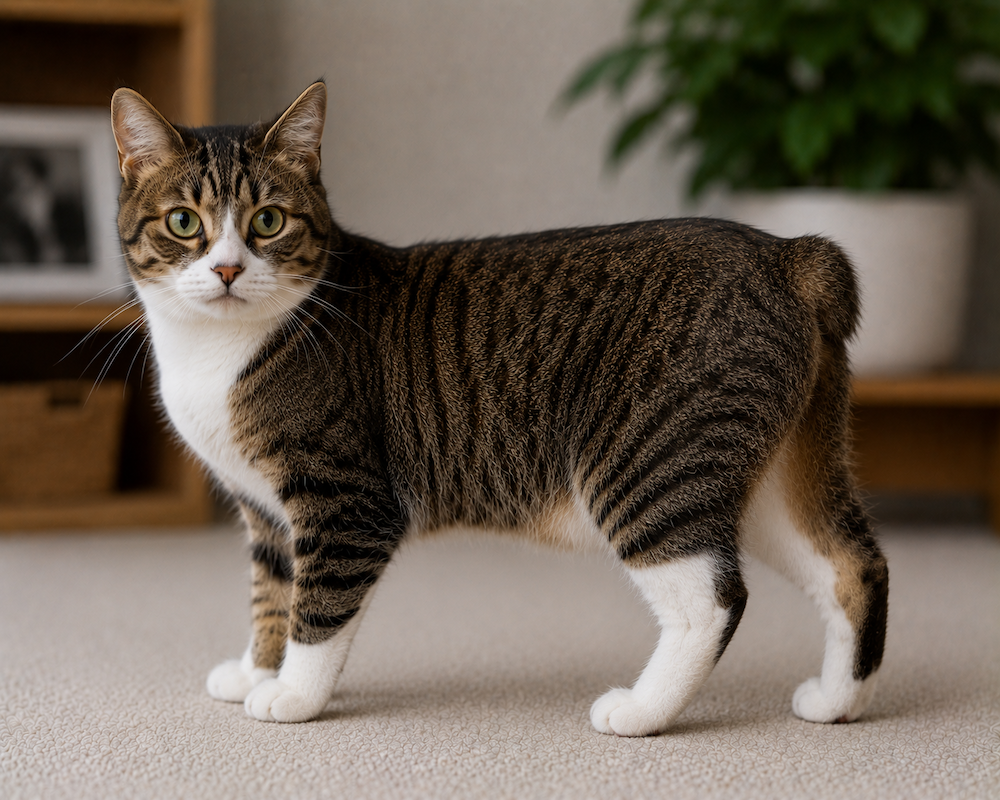







Playful, loyal, and instantly recognisable — a unique companion famous for its naturally tailless appearance.
🧠 QUICK SNAPSHOT
- Temperament: Friendly, loyal, playful
- Energy Level: Moderate
- Size: Medium
- Good With Families: Yes
- Trainability: Moderate to high
- Grooming: Low to moderate
- Best For: Families, indoor living, companionship
📚 OVERVIEW
The Manx is a distinctive cat breed best known for its naturally shortened tail or complete lack of a tail. Originating from the Isle of Man, these cats are intelligent, affectionate, and often described as having dog-like loyalty.
They form strong bonds with their family and enjoy being involved in everyday household activities.
✅ PROS & CONS
Pros
- Loyal and affectionate personality
- Unique tailless appearance
- Intelligent and playful
- Great family companion
Cons
- Potential genetic health concerns in some lines
- Can be protective of favourite family members
- Needs regular play and enrichment
- May be difficult to find in some regions
Is a Manx a Good Family Cat?
Yes. The Manx is generally an affectionate, intelligent, playful and people-oriented family cat.
Many form strong bonds with their households and enjoy participating in family life rather than simply watching from a distance.
They’re often confident, entertaining cats, although temperament varies between individuals.
Can a Manx Live Indoors or in an Apartment?
Yes.
A Manx can live very successfully indoors or in an apartment provided it has climbing opportunities, scratching surfaces, interactive toys and daily play.
They’re relatively active cats, so environmental enrichment is important.
How Much Exercise and Play Does a Manx Need?
Most Manx cats benefit from several interactive play sessions each day.
Chasing toys, puzzle feeders, climbing structures and games that imitate hunting are particularly useful.
Their powerful hindquarters can make them surprisingly athletic.
Is a Manx a High-Energy Cat?
Usually moderately to highly energetic.
They’re playful without necessarily being constantly frantic.
Many alternate between energetic bursts of activity and long periods relaxing near their favourite people.
Is a Manx Easy to Train?
Yes.
Manx cats are generally considered intelligent and responsive.
Many can learn their names, household routines, simple tricks and even games such as fetch.
Food rewards and short positive training sessions work particularly well.
Are Manx Cats Intelligent?
Very.
They often show strong problem-solving ability and quickly learn how doors, cupboards and household routines work.
Puzzle feeders and interactive toys can help prevent boredom.
Does a Manx Shed?
Yes.
Most have a dense double coat that sheds throughout the year and more heavily during seasonal coat changes.
Regular brushing helps control loose hair.
Is a Manx Hypoallergenic?
No.
The Manx isn’t considered a hypoallergenic cat.
Like other cats, it produces allergenic proteins in saliva and skin secretions regardless of tail length.
How Often Should You Groom a Manx?
Usually once or twice a week.
During periods of heavier shedding, more frequent brushing can help remove loose undercoat.
Longhaired Manx cats need additional grooming to prevent tangles.
Can a Manx Have Long Hair?
Yes.
Longhaired kittens can occur naturally in Manx litters.
The longhaired variety is commonly known as the Cymric, although some cat organisations simply classify it as a longhaired Manx rather than a completely separate breed.
What Is the Difference Between a Manx and a Cymric?
The principal difference is coat length.
The traditional Manx is shorthaired, while the Cymric has a semi-long coat.
Both share the same fundamental tailless genetics and Isle of Man ancestry.
What Health Problems Are Common in Manx Cats?
The most important concerns involve the genetic mutation responsible for the breed’s shortened or absent tail.
Some affected cats can develop spinal abnormalities, nerve dysfunction, bowel or bladder problems and mobility difficulties.
This collection of problems is often referred to as Manx syndrome.
Not every Manx develops these conditions, but they’re a particularly important welfare consideration in the breed.
What Is Manx Syndrome?
Manx syndrome describes neurological and skeletal problems associated with abnormal development of the lower spine.
Affected cats may experience weakness or paralysis of the hind legs, abnormal gait, urinary or faecal incontinence, constipation or spinal deformity.
Severity varies enormously.
Why Can Taillessness Cause Health Problems in a Manx?
A cat’s tail is an extension of its vertebral column.
The mutation that shortens the Manx tail can therefore affect more than the visible tail itself.
In severely affected kittens, development of the sacral and lower spinal vertebrae may also be abnormal.
Are All Manx Cats Unhealthy?
No.
Many Manx cats live healthy, active lives.
The concern is that the same mutation responsible for the breed’s characteristic appearance can produce serious developmental abnormalities in some individuals.
Responsible breeding is therefore particularly important.
Why Do Responsible Manx Breeders Avoid Breeding Two Completely Tailless Cats?
The Manx tailless gene is dominant but can be lethal when a kitten inherits two copies.
Embryos inheriting the mutation from both parents generally don’t survive development.
Responsible breeding programmes therefore need to understand the breed’s unusual genetics rather than simply selecting the shortest possible tails.
Are Some Manx Kittens Lost Before Birth?
Yes.
Because inheriting two copies of the Manx mutation is generally lethal during embryonic development, affected embryos are lost before birth.
This can result in smaller-than-expected litters.
It’s one of the most important genetic facts about the breed.
How Long Does a Manx Live?
A healthy Manx can commonly live around 12–15 years, with some reaching their late teens.
Longevity depends partly on whether the cat has significant spinal or neurological abnormalities.
Routine veterinary care and maintaining a healthy body weight are particularly important.
How Big Does a Manx Get?
Most adult Manx cats weigh approximately 3.5–5.5 kg, although males can be larger.
They’re medium-sized cats with substantial bodies and strong hindquarters.
Their rounded appearance can make them look heavier than they actually are.
Is a Manx a Large Cat?
Usually medium-sized rather than genuinely large.
They can feel surprisingly solid when picked up because of their muscular build.
They’re considerably smaller than giant breeds such as the Maine Coon.
Is There a Miniature Manx?
No recognised Miniature Manx variety exists.
Unusually small cats may occur naturally, but “Mini Manx” isn’t an established breed classification.
Are All Manx Cats Completely Tailless?
No.
This is one of the biggest misconceptions about the breed.
Manx kittens can be born with no visible tail, a tiny stump, a partial tail or even a nearly full-length tail.
What Is a Rumpy Manx?
A rumpy Manx has no visible tail.
There may be a small hollow or depression where the tail would normally begin.
This is the appearance most strongly associated with the breed.
What Is a Rumpy Riser Manx?
A rumpy riser has a tiny amount of tail vertebrae.
When the cat is relaxed or excited, a small rise may sometimes be felt or seen at the base of the spine.
It’s slightly more tail than a true rumpy.
What Is a Stumpy Manx?
A stumpy has a short, obvious partial tail.
The length and shape can vary considerably.
Stumpies are genuine Manx cats even though they aren’t completely tailless.
What Is a Longy Manx?
A longy — sometimes called a tailed Manx — has a substantially longer tail, potentially approaching normal length.
The cat can still be genetically and pedigreed as Manx.
Tail length alone doesn’t determine whether a cat belongs to the breed.
Can Manx Kittens in the Same Litter Have Different Tail Lengths?
Absolutely.
One litter can potentially contain rumpies, risers, stumpies and longer-tailed kittens.
That’s because expression of the Manx mutation varies.
A Manx litter can therefore look remarkably diverse from behind.
Does a Manx Cat Need Its Tail Removed?
No.
The characteristic shortened tail is caused genetically; it isn’t created by routine docking.
A naturally tailed Manx shouldn’t have its tail removed simply to make it look more typical of the breed.
Can a Manx Cat Move a Tail Stump?
Some can.
Cats with remaining tail vertebrae may retain movement in the stump or partial tail.
The amount of movement depends on the individual anatomy.
Can a Manx Balance Without a Tail?
Yes.
Although cats normally use their tails as part of balance and body communication, healthy Manx cats adapt extremely well to having little or no tail.
Their strong hindquarters and normal inner-ear balance system allow them to run, jump and climb effectively.
Does a Manx Walk Differently From Other Cats?
Healthy Manx cats can move normally, but their longer hind legs and powerful rear quarters can create a distinctive gait.
Some owners describe the movement as slightly rabbit-like.
A pronounced hopping gait, weakness or difficulty walking should not simply be dismissed as normal breed behaviour because neurological problems can occur.
Why Does a Manx Look Like a Rabbit When It Runs?
The Manx typically has powerful hindquarters with rear legs appearing longer than the front legs.
When running quickly, this can produce a bounding motion reminiscent of a rabbit.
The missing tail exaggerates the visual effect.
Is a Manx Part Rabbit?
No.
Despite centuries of colourful folklore, a cat and rabbit cannot produce offspring together.
The Manx is 100% domestic cat.
Its rabbit-like hindquarters and absent tail simply inspired some very imaginative stories.
What Is a Cabbit?
“Cabbit” is a fictional or folkloric term for a supposed cat × rabbit hybrid.
Stories about Manx cats sometimes claimed they were cabbits because of their short tails and hopping appearance.
Such a hybrid is biologically impossible.
Are Manx Cats Good Jumpers?
Yes.
Their powerful hindquarters can make healthy Manx cats excellent jumpers.
Tall cat trees and sturdy climbing structures provide useful outlets for this athletic ability.
Can Manx Cats Climb?
Absolutely.
Taillessness doesn’t prevent a healthy Manx from climbing.
Like other cats, they benefit from vertical territory where they can observe their surroundings from above.
Are Manx Cats Good Hunters?
Traditionally, yes.
Manx cats developed a reputation as effective mousers and farm cats on the Isle of Man.
Their athleticism, intelligence and hunting instincts made them useful as well as companionable.
Do Manx Cats Have a Strong Prey Drive?
Many do.
They’re often enthusiastic hunters and may chase rodents, birds and insects.
Indoor cats can satisfy these instincts through wand toys, chase games and puzzle feeders.
Do Manx Cats Play Fetch?
Some do.
The breed has a reputation for retrieving toys and interacting with people in unusually dog-like ways.
It’s not universal, but fetch can be an excellent game for an interested Manx.
Are Manx Cats Dog-Like?
They’re frequently described that way.
Many follow their owners, learn routines, retrieve toys and become strongly attached to their families.
Some will even greet household members at the door.
Do Manx Cats Follow Their Owners Around?
Many do.
They’re often highly people-oriented and curious about household activity.
A Manx may follow its favourite person from room to room simply to remain involved.
Are Manx Cats Cuddly?
Many are affectionate and enjoy physical contact.
Some become dedicated lap cats, while others prefer sitting nearby.
They’re generally known for forming strong bonds rather than being aloof.
Are Manx Cats Good With Children?
Usually, provided children treat them respectfully.
Their playful, sturdy nature can suit family life well.
Children should never pull or manipulate a Manx’s tail stump or lower spine.
Are Manx Cats Good With Dogs?
Many can live successfully with cat-friendly dogs.
Confident Manx cats may become remarkably comfortable around canine companions.
Slow introductions are still essential.
Are Manx Cats Good With Other Cats?
Usually.
Early socialisation and adequate resources help multi-cat households succeed.
Each cat should have access to appropriate litter trays, food, resting areas and escape spaces.
Are Manx Cats Good With Small Pets?
Care is required.
Their historical reputation as mousers means rodents and small birds may trigger hunting behaviour.
Secure separation is safest.
Are Manx Cats Vocal?
Usually moderately vocal rather than exceptionally noisy.
Many communicate with chirps, trills and conversational sounds.
Individual personality matters more than breed alone.
Do Manx Cats Like Water?
Some have a reputation for unusual curiosity about water.
A Manx may investigate dripping taps, sinks or baths more readily than expected.
This doesn’t mean every Manx enjoys swimming.
Can Manx Cats Swim?
Cats can generally swim when necessary, and the Manx is no exception.
However, swimming isn’t a defining breed characteristic.
A fascination with running water is much more commonly reported than enthusiastic recreational swimming.
Can a Manx Go Outside?
It can, but unrestricted roaming exposes cats to traffic, predators, disease, poisoning and wildlife conflicts.
A secure cat enclosure, cat-proof garden or harness training can provide outdoor stimulation with substantially greater control.
Can You Walk a Manx on a Harness?
Yes.
Their intelligence and people-oriented temperament can make harness training successful, particularly when introduced gradually during kittenhood.
Positive reinforcement is essential.
Are Manx Cats Good for First-Time Cat Owners?
They can be.
They’re generally affectionate, intelligent and engaging companions.
However, prospective owners need to understand the breed’s unique spinal genetics and potential Manx syndrome, making responsible breeder selection particularly important.
What Does a Manx Cat Look Like?
The Manx has a rounded, substantial body, broad chest, strong hindquarters and rear legs that are longer than the front legs.
The head is rounded with prominent cheeks and alert ears.
The missing or shortened tail creates the breed’s unmistakable silhouette.
Why Is the Manx So Round?
Roundness is a major part of the traditional breed appearance.
The body, head and hindquarters all contribute to a compact, curved silhouette.
Even the way the cat stands can emphasise this rounded appearance.
What Colours Can Manx Cats Be?
Manx cats occur in a wide range of colours and patterns.
These can include black, white, blue, red, cream, tabby, tortoiseshell, calico and various combinations.
Breed organisations differ somewhat in which colours or patterns they accept for exhibition.
Can a Manx Be Black?
Yes.
Solid black Manx cats occur naturally.
The tailless mutation isn’t linked exclusively to any particular coat colour.
Can a Manx Be White?
Yes.
White Manx cats occur, as do cats with varying amounts of white spotting.
As with other predominantly white cats, congenital deafness can be associated with certain white-coat genetics, particularly in blue-eyed individuals.
Can a Manx Be Orange?
Yes.
Red — commonly called orange or ginger — occurs in the breed.
Red tabby Manx cats can be particularly striking.
Can a Manx Be Calico?
Yes.
Calico Manx cats occur and, as with cats generally, they’re overwhelmingly female because the major orange/black colour genes are carried on the X chromosome.
Can a Manx Have Blue Eyes?
Yes, depending on coat colour and genetics.
Blue eyes are particularly associated with white or strongly white-patterned cats.
Eye colour isn’t connected to the Manx tailless mutation itself.
Is a Manx a Natural Cat Breed?
Yes.
The Manx developed as a naturally occurring island population rather than being deliberately created recently by crossing two established pedigree breeds.
A spontaneous tail-shortening mutation became unusually common within the geographically isolated cat population of the Isle of Man.
Where Does the Manx Come From?
The Manx comes from the Isle of Man, an island in the Irish Sea between Great Britain and Ireland.
Tailless cats became strongly established there centuries ago.
Geographic isolation helped the mutation become unusually common within the island’s relatively small cat population.
Is the Manx Named After the Isle of Man?
Yes.
“Manx” means of or relating to the Isle of Man.
The term is used not only for the cat but also for the island’s people, culture and historically its Gaelic language.
How Did Manx Cats Lose Their Tails?
A spontaneous genetic mutation affecting spinal development appeared within the island’s domestic cat population.
Because the Isle of Man had a relatively isolated population, the mutation could become common through what geneticists call the founder effect and genetic drift.
No rabbit involvement was required.
What Is the Founder Effect in Manx Cats?
The founder effect occurs when a population develops from a relatively small number of individuals.
If one or more founders carry an unusual genetic variant, that variant can become disproportionately common in later generations.
Island populations provide particularly good conditions for this to happen.
How Old Is the Manx Breed?
Tailless cats have been associated with the Isle of Man for several centuries.
The population existed long before modern cat registries.
However, today’s formal breed standards developed during the organised cat-fancy movement of the 19th and 20th centuries.
Were Manx Cats Around in the 1800s?
Yes.
Manx cats were already well known by the 19th century and attracted attention because of their unusual lack of tails.
They became one of the breeds represented during the early development of organised cat shows.
Was the Manx One of the First Show Cat Breeds?
Yes.
Manx cats were among the distinctive breeds shown during the early years of the organised British cat fancy.
Their unusual appearance made them immediately recognisable to Victorian cat enthusiasts.
Was the Manx Shown at the Crystal Palace Cat Shows?
Manx cats were represented during the formative era of British cat shows associated with London’s Crystal Palace in the late 19th century.
These early exhibitions helped transform naturally occurring cat populations into formally described pedigree breeds.
Was Harrison Weir Involved With the Manx?
Harrison Weir, one of the founders of the organised cat fancy and organiser of the famous 1871 Crystal Palace cat show, wrote about and helped classify many breeds known in Victorian Britain.
The Manx was among the distinctive established types recognised during this early cat-fancy period.
When Did the Manx Become a Recognised Pedigree Cat?
The Manx was recognised very early in organised pedigree-cat history.
It was among the breeds registered during the formative years of major cat associations in Britain and North America.
Unlike many modern breeds, it didn’t need to be newly created before registration — the island population already existed.
Did Charles Darwin Write About Manx Cats?
Darwin discussed tailless cats in the broader context of variation under domestication.
Nineteenth-century naturalists were fascinated by unusual inherited traits such as taillessness.
The Manx therefore attracted scientific curiosity as well as interest from cat enthusiasts.
Did the Manx Come From Shipwrecked Cats?
There are numerous legends claiming the breed descended from cats arriving aboard wrecked ships.
Spanish Armada ships are particularly popular in these stories.
Cats certainly travelled aboard ships, but there is no need for a shipwreck story to explain the Manx mutation, and specific Armada-origin claims aren’t well established.
Did the Spanish Armada Create the Manx Cat?
Probably not.
One popular legend claims tailless cats reached the Isle of Man after a Spanish Armada ship was wrecked nearby in 1588.
It’s a wonderful story, but there’s no convincing evidence that the Manx breed originated this way.
Did Manx Cats Come From Japanese Bobtails?
Another theory proposes that tailless Asian cats arrived through maritime trade.
Cats certainly moved around the world on ships, but the Manx mutation and Japanese Bobtail genetics aren’t simply the same thing.
The visual similarity of shortened tails doesn’t prove direct ancestry.
Is the Manx Related to the Japanese Bobtail?
Not in any straightforward breed-development sense.
Both have unusual tails, but different genetic mechanisms are involved.
The Japanese Bobtail usually has a short pom-pom-like tail containing several vertebrae, while a Manx can completely lack visible tail vertebrae.
Is the Manx Related to the American Bobtail?
They’re separate breeds.
The American Bobtail developed much more recently in North America and has different breed history and genetics.
A short tail can arise through several different genetic mechanisms in domestic cats.
Is the Manx Related to the Kurilian Bobtail?
No close breed-development relationship is established.
The Kurilian Bobtail developed in the Kuril Islands region of Russia and has its own naturally occurring bobtail genetics.
Both demonstrate how tail mutations can independently become established in isolated cat populations.
Is the Manx Related to the Pixie-bob?
Not as a direct breed ancestor in the usual sense.
The Pixie-bob is a modern North American breed with naturally shortened tails in many individuals.
Despite folklore surrounding wildcat ancestry, it isn’t simply an American Manx.
Why Are There So Many Bobtailed Island Cats?
Isolation can allow unusual mutations to become much more common than they would be in a large mainland population.
If a tail mutation appears within a relatively small island population, limited gene flow can help it spread.
The Manx is one of the best-known examples.
Did Noah Slam the Manx Cat’s Tail in the Ark Door?
According to one famous Manx legend, the cat was late boarding Noah’s Ark, and Noah accidentally closed the door on its tail.
This supposedly explains why its descendants were tailless.
Genetics offers a somewhat less dramatic explanation.
Are There Other Legends About Why the Manx Has No Tail?
Many.
Folklore has blamed everything from Noah’s Ark and shipwrecks to Vikings, rabbits and ancient warriors.
One particularly colourful story claims people cut off cats’ tails to decorate their helmets, causing mother cats to bite off their kittens’ tails for protection.
None of these stories explains the breed scientifically, but they’re part of the Manx’s rich cultural history.
Is the Manx Important to the Isle of Man?
Very.
The cat has become one of the island’s best-known animal symbols.
Its distinctive appearance and unusual history make it closely associated with Manx identity internationally.
Has the Manx Cat Appeared on Isle of Man Coins?
Yes.
Manx cats have appeared on coins, stamps and other Isle of Man imagery and collectibles.
The breed’s silhouette is instantly recognisable and has become strongly associated with the island.
Has the Manx Cat Appeared on Postage Stamps?
Yes.
The Manx has appeared on stamps issued by the Isle of Man and elsewhere.
It’s a natural subject for the island because few cat breeds are so closely connected with a specific geographic location.
What Does “Manx” Mean?
“Manx” means something or someone originating from or associated with the Isle of Man.
So the breed’s name effectively means “the cat from the Isle of Man.”
Is the Manx British?
Geographically and politically, the answer requires some nuance.
The Isle of Man lies in the British Isles but isn’t part of the United Kingdom. It’s a self-governing Crown Dependency.
The Manx is therefore most precisely described as originating from the Isle of Man.
Why Is the Manx Different From Most Modern Cat Breeds?
Many modern cat breeds were deliberately created by breeders selecting or crossing cats for a particular appearance.
The Manx began as a naturally occurring island population with an unusual mutation.
Humans later standardised and exhibited the type, but they didn’t originally invent the tailless cat.
Are Manx Cats Rare?
They’re uncommon compared with globally popular breeds such as the British Shorthair, Ragdoll or Maine Coon.
Responsible breeding is also constrained by the genetics of taillessness.
That makes preservation of healthy breeding populations particularly important.
Why Don’t Breeders Just Select Completely Tailless Manx Cats?
Because maximising taillessness without considering genetics would create serious welfare problems.
The mutation affects spinal development, and inheriting two copies is generally lethal before birth.
Responsible breeding therefore prioritises health, genetic management and sound structure, not simply producing the shortest possible tail.
Can a Long-Tailed Manx Be Important for Breeding?
Yes.
Longer-tailed Manx cats can be valuable within responsible breeding programmes because they’re part of the same breed population.
A visible tail doesn’t make the cat genetically worthless.
Maintaining health and diversity matters much more than producing every kitten completely tailless.
Is a Manx a Good Mouser?
Historically, yes.
Manx cats developed a reputation as effective farm and household mousers on the Isle of Man.
Their powerful hindquarters, alert temperament and hunting instincts made them useful working cats.
Were Manx Cats Farm Cats?
Yes.
Before becoming famous show cats, they lived as practical domestic and farm cats.
Controlling rodents would have been particularly valuable around stored food, barns and homes.
Are Manx Cats Good Therapy Cats?
Some can be.
Their affectionate, confident and people-oriented nature can make suitable individuals excellent therapy animals.
Temperament, socialisation and comfort with unfamiliar environments matter more than taillessness.
Is a Manx a Good Cat for Older People?
It can be.
Many are affectionate, interactive and happy living indoors.
Prospective owners should understand the potential health issues associated with the breed’s spinal mutation and choose a responsibly bred cat.
Why Does My Manx Sit Like a Rabbit?
The breed’s large, rounded hindquarters and longer rear legs can produce unusual sitting positions.
Without a long tail extending behind the body, the resemblance becomes even stronger.
It’s one of several features that helped inspire the old cat-rabbit legends.
Why Does My Manx Follow Me From Room to Room?
Manx cats are often strongly bonded to their families.
Many enjoy supervising household activity and dislike being excluded from anything potentially interesting.
A Manx may therefore follow its owner almost like a small dog.
Why Does My Manx Bring Me Toys?
Retrieving behaviour is reported surprisingly often in the breed.
An intelligent, playful Manx can learn that bringing a toy causes its human to throw it again.
Once that connection is understood, the cat may effectively train the owner to play fetch on demand.
Why Does My Manx Watch the Door?
Their alertness and strong attachment to household members can make them very aware of arrivals and departures.
Some owners describe Manx cats greeting family members at the door.
This behaviour contributes to their reputation for being dog-like.
What Makes the Manx Unique?
The Manx is one of the clearest examples of how geography, genetics and folklore can combine to create an extraordinary cat breed.
Somewhere within the domestic cats living on the Isle of Man, a mutation appeared that shortened the tail. Because the island population was relatively isolated, that unusual gene became common enough to create an instantly recognisable population of tailless and short-tailed cats.
People naturally wanted a more entertaining explanation.
So over the centuries the Manx supposedly lost its tail because Noah shut it in the Ark door, Spanish Armada cats were shipwrecked on the island, Vikings stole cats’ tails, or cats somehow bred with rabbits.
The scientific explanation is less colourful but considerably more fascinating: a dominant mutation affecting development of the spine became concentrated within an island population.
That same mutation also makes the breed unusual from a welfare perspective. A Manx can be perfectly healthy and athletic, but the genetics responsible for its famous silhouette can also cause serious spinal problems, which is why careful breeding matters so much.
And perhaps the most surprising Manx fact of all?
A genuine Manx doesn’t actually have to be tailless.
One litter can contain a completely tailless rumpy, a tiny-tailed riser, a stumpy and a kitten with a substantial tail.
After centuries of legends trying to explain where the Manx’s tail went, sometimes the answer is wonderfully simple:
it didn’t go anywhere — that particular Manx was born with one.