






Loyal, protective, and independent — a natural guardian with a calm presence.
🧠 QUICK SNAPSHOT
- Temperament: Protective, Loyal, Independent
- Energy Level: Moderate
- Size: Large
- Good with Families: Yes (experienced homes)
- Training Difficulty: Moderate to Hard
📚 OVERVIEW
The Maremma Sheepdog is an ancient Italian breed developed to guard livestock. Known for their thick white coat and calm, watchful nature, they are highly independent thinkers. They form strong bonds with their family or flock and are naturally protective.
✅ PROS & CONS
Pros
- Extremely loyal and protective
- Calm and steady temperament
- Excellent natural guardian
Cons
- Strong independence can make training challenging
- Requires space and purpose
- Not suited to apartment living
Is a Maremma Sheepdog a Good Family Dog?
Yes, but the Maremma Sheepdog is best suited to families that understand large, independent livestock guardian dogs.
Maremmas can be calm, affectionate and deeply devoted to their household. However, they were developed to make decisions independently while protecting livestock, so they aren’t typically as eager to obey as breeds created to work under constant human direction.
Space, secure fencing, early socialisation and realistic expectations are important.
Is a Maremma Sheepdog Good With Children?
Maremmas can be gentle and protective with children they know.
Their large size means interactions with young children should still be supervised, and children shouldn’t interfere with a dog while it’s eating, sleeping or guarding animals.
A Maremma may also attempt to position itself between children and something it considers suspicious.
How Much Exercise Does a Maremma Sheepdog Need?
Most adult Maremmas need around 60–90 minutes of physical activity each day, although working livestock guardians may naturally cover considerably greater distances while patrolling.
They’re built for steady movement and endurance rather than frantic exercise.
Mental stimulation and opportunities to patrol or investigate their environment are equally important.
Is a Maremma Sheepdog a High-Energy Dog?
Usually moderately energetic.
A Maremma may appear extremely calm while resting but can immediately become active when something unusual happens.
Working dogs often spend much of their time conserving energy between patrols and responding to potential threats.
Is a Maremma Sheepdog Easy to Train?
Maremmas are intelligent but independent rather than conventionally obedient.
They were bred to make decisions without waiting for a shepherd’s instructions.
Basic manners, recall, leash walking and handling should begin early, but owners shouldn’t expect Border Collie-style obedience.
Are Maremma Sheepdogs Intelligent?
Very.
Their intelligence is particularly evident in independent judgement, environmental awareness and assessing potential threats.
A Maremma may understand exactly what its owner is requesting and still decide that watching something at the far end of the property is currently more important.
Are Maremma Sheepdogs Stubborn?
They can certainly appear stubborn.
However, much of this behaviour comes from centuries of selection for independent decision-making.
A livestock guardian that needed constant instructions from a shepherd wouldn’t have been particularly useful when predators appeared in the middle of the night.
Does a Maremma Sheepdog Shed?
Yes — heavily.
The Maremma has a thick double coat consisting of a protective outer coat and dense undercoat.
Seasonal shedding can be substantial, particularly when the undercoat is released.
Is a Maremma Sheepdog Hypoallergenic?
No.
Maremmas shed considerable amounts of hair and produce normal canine allergens.
They’re not considered suitable for people specifically seeking a low-shedding breed.
How Often Should You Groom a Maremma Sheepdog?
Usually at least once or twice a week.
During heavy seasonal shedding, more frequent brushing can help remove loose undercoat.
Working farm dogs also benefit from regular checks for grass seeds, burrs, ticks and skin problems.
Should You Shave a Maremma Sheepdog?
Generally, no.
The double coat helps protect the dog from weather and environmental exposure.
Routine shaving can interfere with the coat’s normal protective function and isn’t an appropriate solution to shedding.
What Health Problems Are Common in Maremma Sheepdogs?
Potential concerns include hip dysplasia, elbow dysplasia, eye disorders and other orthopaedic conditions seen in large dogs.
Responsible breeders should screen breeding animals for relevant inherited problems.
Maintaining a lean body condition is particularly important for protecting joints.
How Long Does a Maremma Sheepdog Live?
Maremmas commonly live around 10–13 years.
That’s a respectable lifespan for a large working breed.
Good genetics, healthy weight, appropriate exercise and preventive veterinary care all influence longevity.
How Big Does a Maremma Sheepdog Get?
Adult males commonly stand around 65–73 cm at the shoulder, with females approximately 60–68 cm.
Males are typically around 35–45 kg, with females somewhat lighter.
They’re substantial dogs without having the extremely heavy build of some mastiff breeds.
Is the Maremma Sheepdog a Giant Breed?
It’s generally considered a large livestock guardian breed rather than one of the heaviest true giant breeds.
Its build is functional and relatively athletic.
A working Maremma needs enough strength to confront predators while retaining the stamina to patrol large areas.
Is There a Miniature Maremma Sheepdog?
No.
There is no recognised Miniature Maremma.
A significantly undersized dog marketed as a “Mini Maremma” isn’t an established breed variety.
Can a Maremma Sheepdog Live in an Apartment?
It’s generally a poor choice.
Although an adult Maremma can be surprisingly calm indoors, the breed’s size, territorial instincts, barking and desire to patrol make apartment living difficult.
A securely fenced rural or spacious suburban property is much more appropriate.
Does a Maremma Sheepdog Need a Large Backyard?
A substantial secure outdoor area is highly desirable.
However, space alone doesn’t replace exercise, socialisation or interaction.
A bored Maremma left permanently in a backyard may bark, dig, patrol obsessively or attempt to escape.
Can a Maremma Sheepdog Be Left Alone?
Maremmas are more independent than many companion breeds.
However, they’re social animals and shouldn’t simply be isolated from people or livestock for long periods.
Working Maremmas often derive companionship from the animals they’re protecting.
Are Maremma Sheepdogs Prone to Separation Anxiety?
They’re generally less dependent on constant human attention than strongly companion-oriented breeds, although individual dogs can still develop separation problems.
Their bigger behavioural challenge is often having insufficient purpose, territory or stimulation rather than simply being separated from an owner.
Are Maremma Sheepdogs Velcro Dogs?
Usually not in the conventional sense.
They can be extremely devoted to their people while remaining independently minded.
A Maremma may love its owner deeply while deciding that lying near the gate watching the horizon is more important than following them into the kitchen.
Are Maremma Sheepdogs Cuddly?
Many are affectionate with their families.
Some enjoy substantial physical contact, while others prefer simply resting nearby.
Their affection can be quiet and understated compared with highly demonstrative companion breeds.
Are Maremma Sheepdogs Good With Other Dogs?
They can be, particularly when properly socialised.
However, mature livestock guardian dogs may become territorial or assertive, especially toward unfamiliar dogs entering their property.
Same-sex conflict can also occur.
Are Maremma Sheepdogs Good With Cats?
Many can live successfully with cats they recognise as part of their household or livestock group.
Early introductions help.
An unfamiliar animal entering guarded territory may receive a very different response.
Are Maremma Sheepdogs Good With Chickens?
They can be excellent poultry guardians when properly introduced and trained.
A young Maremma shouldn’t simply be placed unsupervised with chickens and expected to understand its job immediately.
Puppies may chase, mouth or play with birds before developing appropriate guardian behaviour.
Can Maremma Sheepdogs Protect Sheep?
Yes.
Protecting sheep is one of the breed’s traditional jobs.
Maremmas bond with livestock, remain close to them and use their presence, barking, scent marking and defensive behaviour to discourage predators.
Can Maremma Sheepdogs Protect Goats?
Yes.
They can protect goats as well as sheep and may also work with poultry, alpacas and other livestock.
Successful guardian work depends on the dog’s breeding, upbringing, bonding and management.
Do Maremma Sheepdogs Herd Sheep?
No — and this distinction is important.
A Maremma is a livestock guardian dog, not a herding dog.
A Border Collie moves sheep under a handler’s direction. A Maremma lives with or near the sheep and protects them from danger.
How Does a Maremma Sheepdog Protect Livestock?
The first line of defence usually isn’t fighting.
Maremmas patrol, scent-mark, watch their surroundings and bark to advertise that livestock are protected.
They may position themselves between the flock and a threat and escalate their response if the threat continues approaching.
Do Maremma Sheepdogs Fight Predators?
They can confront predators when necessary, but successful livestock guarding is largely about deterrence.
A predator that hears guardian dogs barking, smells their territorial markings and sees them approaching may decide that hunting elsewhere is safer.
Avoiding the physical fight protects both livestock and dog.
Do Maremma Sheepdogs Have a Strong Prey Drive?
Generally less than hunting breeds, because livestock guardians were selected to coexist peacefully with animals they protected.
However, they’re still dogs, and individuals can chase wildlife or unfamiliar animals.
Young dogs need supervision while learning appropriate behaviour around livestock.
Are Maremma Sheepdogs Good Off Leash?
On their own securely contained property, working Maremmas may operate with considerable independence.
In public spaces, reliable recall can be challenging because guardian instincts encourage them to investigate perceived threats.
Secure containment is extremely important.
Are Maremma Sheepdogs Escape Artists?
They can be.
A Maremma that decides something beyond the boundary requires investigation may climb, dig or exploit weaknesses in fencing.
Strong, appropriately high fencing is important.
Electronic boundary systems aren’t an ideal substitute for physical containment with a determined livestock guardian.
Do Maremma Sheepdogs Dig?
Yes, many do.
They may dig to create a cool resting place, investigate scents or patrol boundaries.
Digging can be particularly noticeable during hot weather.
Do Maremma Sheepdogs Bark a Lot?
Yes.
Barking is part of the breed’s job.
Livestock guardians use deep, repeated barking to warn potential predators that they’re present and to alert the flock and other guardian dogs.
This behaviour can become challenging in suburban environments.
Why Does My Maremma Bark at Night?
Predators and unfamiliar animals are often more active after dark.
For centuries, Maremmas were expected to remain alert while shepherds and livestock slept.
Night-time barking isn’t necessarily meaningless nuisance behaviour from the dog’s perspective — it can be the Maremma reporting for the night shift.
Can You Train a Maremma Not to Bark?
You can teach reasonable limits and reduce unnecessary barking, but completely eliminating alert barking conflicts with the breed’s fundamental guardian instincts.
Management, adequate exercise and sensible property placement matter enormously.
A Maremma living beside noise-sensitive suburban neighbours can be challenging even with excellent training.
Are Maremma Sheepdogs Good Watchdogs?
Excellent.
They’re naturally alert, territorial and attentive to unusual activity.
They usually don’t need specialised training to recognise that something unfamiliar has entered their environment.
Are Maremma Sheepdogs Good Guard Dogs?
They’re excellent livestock and property guardians, but their guarding style differs from conventional personal-protection breeds.
Maremmas were bred to assess situations independently rather than wait for attack commands.
Trying to intensify an already powerful natural guardian through aggressive protection training is generally unnecessary and can create serious management problems.
Are Maremma Sheepdogs Aggressive?
A well-bred Maremma shouldn’t be indiscriminately aggressive.
The desired temperament is calm, confident and discerning.
However, the breed can respond forcefully to something it genuinely perceives as threatening its animals, territory or family.
Are Maremma Sheepdogs Friendly With Strangers?
They’re often reserved or suspicious rather than immediately friendly.
This is appropriate for a livestock guardian.
Early socialisation helps the dog distinguish normal visitors and everyday activity from genuine threats.
How Should Visitors Be Introduced to a Maremma?
Introductions should be controlled and calm.
The owner should clearly communicate that the visitor is welcome rather than allowing an unfamiliar person to simply walk into guarded territory.
A dog accustomed to regular visitors is usually easier to manage than one raised in complete isolation.
When Does a Maremma Sheepdog Calm Down?
Maremmas mature slowly.
Many don’t reach full mental maturity until around two to three years of age, and some take longer.
A large adolescent Maremma can therefore have an adult-sized body while still possessing some very questionable puppy judgement.
When Do Maremmas Develop Their Guardian Instincts?
Guardian behaviour can begin during puppyhood but usually strengthens as the dog matures.
Young Maremmas shouldn’t be expected to perform like experienced adult livestock guardians immediately.
Learning from mature, reliable guardian dogs can be extremely valuable.
Are Maremma Puppies Difficult?
They can be challenging.
They’re large, intelligent, independent and still learning how to control their instincts.
A puppy may chase livestock, dig, bark, test fences and ignore instructions while simultaneously growing rapidly toward 40 kg.
How Quickly Do Maremma Puppies Grow?
Very quickly during their first year.
Like other large breeds, their developing bones and joints shouldn’t be subjected to excessive forced exercise, repetitive jumping or inappropriate nutrition.
A properly formulated large-breed puppy diet is important.
Should Maremma Puppies Take Extra Calcium?
Not unless specifically recommended by a veterinarian.
Excess calcium can interfere with normal skeletal development in rapidly growing large-breed puppies.
A complete, correctly balanced large-breed puppy diet should already contain appropriate mineral levels.
Are Maremma Sheepdogs Good Running Dogs?
They’re capable of running, but repetitive long-distance road running isn’t what they were developed for.
Their traditional work involves walking, patrolling, observing and occasionally accelerating rapidly when necessary.
Hiking and varied natural movement are generally more appropriate.
Are Maremma Sheepdogs Good Hiking Dogs?
Yes, healthy adults can be excellent hiking companions.
They have considerable stamina and were developed to work in rugged landscapes.
Reliable leash handling is important around unfamiliar dogs, livestock and wildlife.
Can Maremma Sheepdogs Swim?
Most can swim physically, although enthusiasm varies.
They’re not specialised water dogs.
Their dense coat becomes extremely heavy when saturated, so supervision around deep water is sensible.
Can Maremma Sheepdogs Handle Cold Weather?
Very well.
Their thick double coat was developed for outdoor work in mountainous regions where weather can be harsh.
Cold, wind and snow are generally easier for a healthy Maremma to tolerate than extreme heat.
Can Maremma Sheepdogs Handle Hot Weather?
They can adapt, but heat requires careful management.
Shade, plentiful water and cool resting areas are essential, particularly in Australian summers.
Exercise should occur during cooler parts of the day.
Why Is the Maremma Sheepdog White?
The white coat was extremely useful in a livestock guardian.
It allowed shepherds to distinguish their dogs from wolves and other predators, particularly at a distance or in poor light.
The pale coat also helped the dogs visually blend with sheep.
Are All Maremma Sheepdogs White?
The traditional breed is white.
Some standards permit limited ivory, pale yellow or light orange shading, particularly around the ears.
Strong patches of black, brown or other colours aren’t characteristic of the recognised breed.
Can a Maremma Sheepdog Be Black?
No, not as a standard purebred colour.
A black dog described as a Maremma would raise serious questions about ancestry.
The breed’s white coat is one of its defining characteristics.
Can a Maremma Sheepdog Be Merle?
No.
Merle isn’t a traditional Maremma colour.
A merle dog marketed as a purebred Maremma indicates ancestry outside the recognised breed population.
Why Does a Maremma Have a Black Nose?
Strong dark pigmentation around the nose, lips and eyes creates a characteristic contrast with the white coat.
This pigmentation is part of the traditional breed appearance.
A pale or depigmented nose isn’t preferred.
What Does a Maremma Sheepdog Look Like?
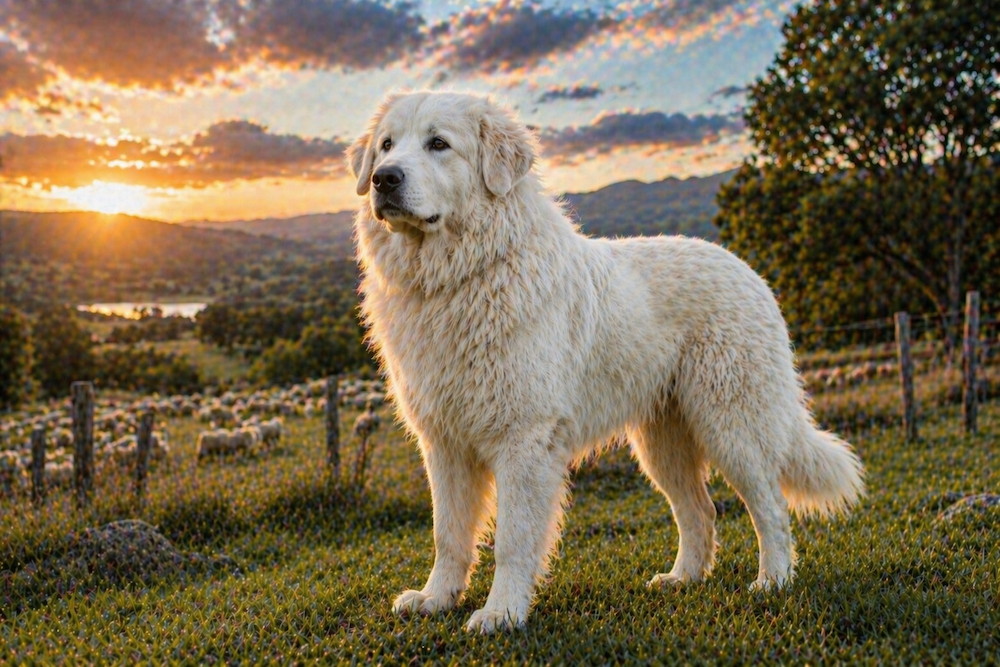
The Maremma is a large, powerful white dog with a substantial head, triangular drop ears, dark eyes, thick double coat and heavily coated tail.
It should look strong without being excessively heavy.
The overall impression is of a rugged working guardian rather than an exaggerated show dog.
Is a Maremma Sheepdog the Same as a Great Pyrenees?
No.
They perform similar livestock-guardian work and can look remarkably alike, but they’re distinct breeds.
The Great Pyrenees developed around the Pyrenean mountain region between France and Spain, while the Maremma developed in Italy.
How Can You Tell a Maremma From a Great Pyrenees?
Maremmas are generally somewhat more moderate and athletic in build.
Great Pyrenees may be larger and can have characteristic badger, grey or tan markings as well as white.
Great Pyrenees also traditionally have double rear dewclaws, which aren’t a defining Maremma feature.
Is a Maremma Sheepdog the Same as a Kuvasz?
No.
The Kuvasz is a Hungarian livestock guardian with its own breed history.
Both are large white guardian dogs because similar working requirements produced similar characteristics.
Is a Maremma Sheepdog the Same as an Akbash?
No.
The Akbash developed in Turkey and is another white livestock guardian.
Its body type is often leaner and more sighthound-like than the Maremma.
Is a Maremma Sheepdog the Same as an Anatolian Shepherd?
No.
The Anatolian Shepherd represents a different Turkish livestock-guardian tradition and occurs in colours other than white.
Both breeds share the fundamental job of independently protecting livestock from predators.
Is a Maremma Sheepdog the Same as a Kangal?
No.
The Kangal comes from Turkey and is typically fawn with a dark mask.
The Maremma is Italian and predominantly white.
Their similar guardian behaviour reflects similar work rather than the breeds being interchangeable.
Why Do So Many Livestock Guardian Dogs Look Similar?
Their jobs imposed similar requirements.
A successful guardian needed to be large, weather-resistant, independent, courageous, attentive and capable of living peacefully among livestock.
White colouring also developed in several sheep-guarding populations.
This is an example of working function strongly influencing appearance.
Where Does the Maremma Sheepdog Come From?
The Maremma Sheepdog comes from central Italy, particularly the regions historically associated with the Maremma plains and the Abruzzo mountains.
For centuries, large white guardian dogs accompanied flocks as they moved between mountain summer grazing and lower winter pastures.
The modern breed preserves this ancient Italian livestock-guardian tradition.
What Does “Maremma” Mean?
Maremma is the name of a historic coastal and inland region of Tuscany and northern Lazio in Italy.
The area was strongly associated with pastoral farming and livestock.
The breed’s English name reflects this geographic connection.
Why Is the Breed Called the Maremma Sheepdog?
English speakers commonly call it the Maremma Sheepdog or simply Maremma.
In Italy, its formal name is Cane da Pastore Maremmano-Abruzzese, reflecting historical associations with both the Maremma region and Abruzzo.
What Does Maremmano-Abruzzese Mean?
It essentially identifies the dog with Maremma and Abruzzo, two regions important to its pastoral history.
For years, regional guardian dogs were sometimes treated as distinct types.
Eventually they were brought together under one recognised breed identity.
Were There Once Separate Maremmano and Abruzzese Dogs?
Yes.
Historically, guardian dogs associated with the Maremma lowlands and Abruzzo mountains were sometimes considered separate regional types.
However, seasonal livestock movement meant the populations weren’t truly isolated from one another.
They were eventually standardised as a single breed.
Why Were the Maremmano and Abruzzese Types Combined?
Italian shepherds practised transhumance — moving livestock seasonally between different grazing regions.
Dogs travelled with those flocks, meaning the supposed regional populations regularly encountered and bred with one another.
Recognising them as completely separate breeds therefore became increasingly difficult to justify.
What Is Transhumance?
Transhumance is the seasonal movement of livestock between grazing areas.
Italian shepherds traditionally moved sheep between mountain summer pastures and lower winter grazing lands.
Maremma-type guardian dogs travelled with the flocks throughout these journeys.
How Old Is the Maremma Sheepdog?
Its livestock-guardian ancestry is very old, extending back many centuries.
Large white flock guardians resembling modern Maremmas appear in historical descriptions and artwork.
However, the modern pedigree breed and its formal standard are much more recent than the ancient working tradition behind it.
Is the Maremma an Ancient Roman Dog?
Claims that today’s Maremma has existed unchanged since Roman times should be treated cautiously.
Ancient Roman writers described large livestock-guardian dogs, including pale or white flock dogs.
These descriptions demonstrate a very old Italian guardian tradition, but they don’t prove that a modern registered Maremma is genetically identical to a specific Roman dog population.
Did Ancient Romans Use White Sheepdogs?
Yes.
Roman agricultural writers described livestock guardian dogs and discussed the usefulness of white colouring, which helped shepherds distinguish their dogs from predators.
This provides fascinating evidence that the functional logic behind white Italian flock guardians is thousands of years old.
Did the Roman Writer Columella Describe Dogs Like the Maremma?
Yes.
The first-century Roman agricultural writer Columella described large dogs used to protect livestock and discussed desirable characteristics for flock guardians.
His descriptions are frequently connected with the ancestry of later Italian guardian dogs.
It’s safer to regard them as evidence of an ancient guardian tradition rather than a modern Maremma breed standard.
Did Varro Write About Livestock Guardian Dogs?
Yes.
The Roman scholar Marcus Terentius Varro also discussed dogs used by shepherds to protect livestock.
His writings demonstrate how important specialised guardian dogs already were in ancient Italian pastoral agriculture.
Were Maremmas Bred to Protect Sheep From Wolves?
Yes.
Wolves were among the major predators threatening Italian sheep flocks.
Maremmas were selected to remain with the flock and deter wolves through barking, territorial behaviour, group defence and physical confrontation when necessary.
Did Maremmas Protect Livestock From Bears?
Historically, large predators in parts of Italy also included bears.
Guardian dogs could contribute to flock defence against a variety of threats.
However, their greatest effectiveness comes from working as part of a broader shepherding system rather than being expected to defeat enormous predators single-handedly.
Did Maremma Sheepdogs Work in Packs?
Often, yes.
Large flocks could be protected by several guardian dogs working together.
Multiple dogs allow them to watch different approaches and provide a much stronger deterrent to wolves.
Teamwork remains useful in modern livestock-guardian programmes.
Did Maremma Sheepdogs Wear Spiked Collars?
Livestock guardian dogs in wolf country have historically been fitted with protective collars, including designs with spikes or metal reinforcement.
These helped protect the vulnerable neck area during predator encounters.
Similar collars developed independently in several European and Asian livestock-guardian cultures.
Did Maremma Sheepdogs Travel With Shepherds for Hundreds of Kilometres?
Traditional transhumance could involve substantial seasonal journeys between grazing regions.
The dogs travelled with shepherds and livestock rather than remaining permanently on one farm.
That history helps explain their impressive endurance and ability to adapt to changing territory.
Did Shepherds Train Maremmas to Stay With Sheep?
Young guardian dogs were traditionally raised around livestock so that strong social bonds formed with the animals they would protect.
Much of their work relied on instinct combined with experience, rather than detailed commands from a shepherd.
This principle remains central to modern livestock-guardian training.
Why Do Maremmas Bond With Sheep?
Livestock guardian puppies raised appropriately among sheep learn to regard the flock as part of their social group.
Their inherited guardian instincts then encourage them to remain nearby and respond to perceived threats.
It’s fundamentally different from a predator-prey relationship.
Do Maremma Puppies Think Sheep Are Their Family?
Not literally in the human sense, but early social bonding can become extremely strong.
A properly raised guardian may prefer remaining with its flock and become visibly concerned when animals are distressed.
This attachment is one of the keys to successful livestock protection.
Are Maremma Sheepdogs Still Working Dogs in Italy?
Yes.
Maremmas continue to be used as livestock guardians in Italy and elsewhere.
The return and recovery of wolf populations in parts of Europe has renewed interest in traditional non-lethal livestock-protection methods.
Are Maremma Sheepdogs Used in Australia?
Yes.
Maremmas are used on Australian farms to protect livestock and poultry from predators.
They have become particularly well known for guarding animals against foxes and wild dogs, and for an unusual conservation project involving penguins.
Did Maremma Sheepdogs Save Penguins in Australia?
Maremmas became famous for helping protect a colony of Little Penguins on Middle Island near Warrnambool, Victoria.
Fox predation had devastated the colony.
Guardian dogs were introduced to deter foxes from entering the island, and the project became an internationally recognised example of livestock-guardian behaviour being adapted for wildlife conservation.
Why Were Maremmas Used to Protect Penguins?
The idea grew from observing that Maremmas could bond with and protect animals other than sheep.
Rather than hunting foxes, the dogs created a guardian presence that discouraged foxes from entering the penguin colony.
This made their traditional predator-deterrence behaviour useful in an entirely new conservation setting.
Who Was Oddball the Maremma?
Oddball was a Maremma associated with the pioneering effort to protect Little Penguins from foxes near Warrnambool.
Her story became famous and helped bring international attention to the conservation programme.
She demonstrated that livestock guardian instincts could potentially be redirected toward protecting vulnerable wildlife.
Was There a Movie About Oddball the Maremma?
Yes.
The Australian family film Oddball, released in 2015, was inspired by the real penguin-protection story.
The film dramatised events, so it shouldn’t be treated as a documentary account, but it introduced the Maremma to a huge new audience.
Did the Penguin Project Really Work?
The Middle Island guardian-dog programme became an important conservation success story.
Maremmas helped deter foxes from the penguin colony as part of a broader management programme.
It’s one of the most remarkable modern examples of an ancient working breed being given a completely new job.
Are Maremmas Used for Conservation Elsewhere?
Livestock guardian dogs are increasingly used in conservation programmes around the world.
By protecting livestock from predators, they can reduce pressure for farmers to kill native predators.
Maremmas are particularly interesting because the Middle Island project showed that guardian behaviour could also be applied directly to vulnerable wildlife.
Can Maremmas Protect Chickens From Foxes?
Yes, and this is one reason they’ve become useful on Australian properties.
A properly trained Maremma can deter foxes through presence, scent marking, barking and patrol behaviour.
However, young dogs must first learn that the poultry themselves aren’t toys.
Can Maremmas Protect Livestock From Dingoes or Wild Dogs?
They can contribute to protecting livestock from wild dogs and dingoes.
Effectiveness depends on the number of guardian dogs, property size, predator pressure, fencing and management.
No guardian dog should be viewed as an invincible solution acting completely alone.
Why Are Maremmas Useful for Non-Lethal Predator Control?
Their strategy is primarily deterrence rather than hunting predators down.
By making livestock territory risky and difficult to approach, guardian dogs can reduce predator attacks without necessarily requiring predators to be killed.
This makes livestock guardian dogs increasingly relevant where agriculture and wildlife conservation overlap.
Are Maremma Sheepdogs Popular Pets?
They’re much less common as ordinary suburban pets than breeds such as Labradors or Golden Retrievers.
Their independence, barking, size and territorial instincts require a particular lifestyle.
In the right environment they’re extraordinary companions; in the wrong environment their natural behaviour can become extremely difficult to manage.
Is a Maremma Sheepdog Good for a First-Time Dog Owner?
Usually not.
Their size, independence, territorial instincts and guardian behaviour can challenge inexperienced owners.
A first-time owner with substantial research, suitable property and experienced support could succeed, but the Maremma isn’t generally an easy beginner breed.
What Makes the Maremma Sheepdog Unique?
The Maremma Sheepdog represents one of humanity’s oldest partnerships with working dogs: don’t move the sheep — live with them and keep them alive.
For centuries, Italian shepherds moved enormous flocks between the mountains of Abruzzo and the grazing lands of central Italy. Their big white dogs travelled alongside them, sleeping near the flock, patrolling after dark and warning wolves that approaching the sheep wasn’t worth the risk.
The strategy worked so well that the basic job survives today.
But perhaps the most extraordinary chapter in Maremma history happened thousands of kilometres from Italy.
On Middle Island near Warrnambool in Victoria, foxes were devastating a colony of Little Penguins. Maremmas were introduced not to attack the foxes, but to do exactly what generations of Italian livestock guardians had always done:
convince predators to stay away.
The programme became famous, Oddball became a conservation celebrity, and an ancient Italian sheepdog found itself protecting tiny Australian seabirds.
It’s difficult to imagine a better demonstration of what makes the Maremma special.
For centuries its ancestors had one fundamental rule:
if it’s part of my flock, I protect it.
Apparently nobody ever told the Maremma that the flock had to be sheep.