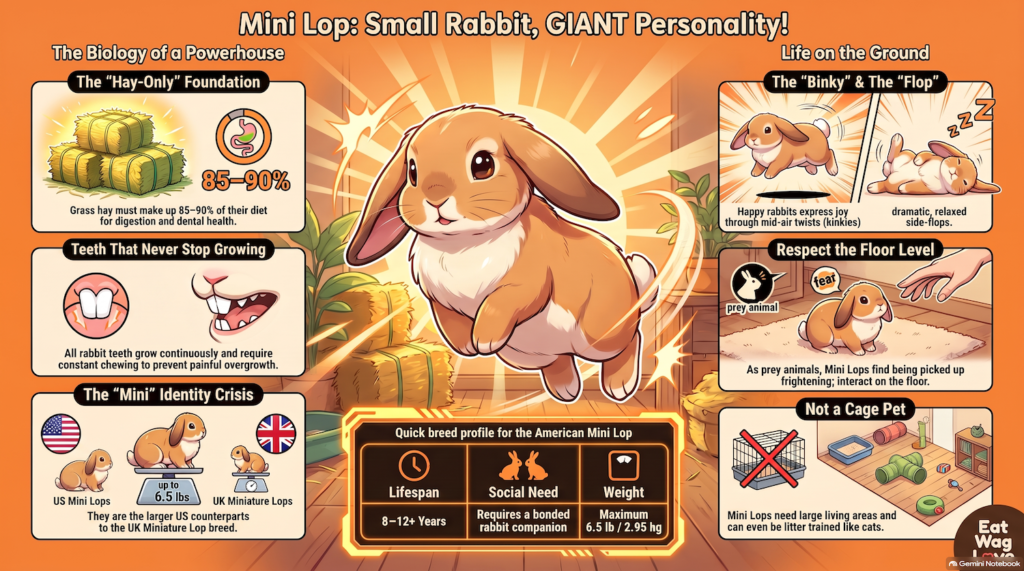
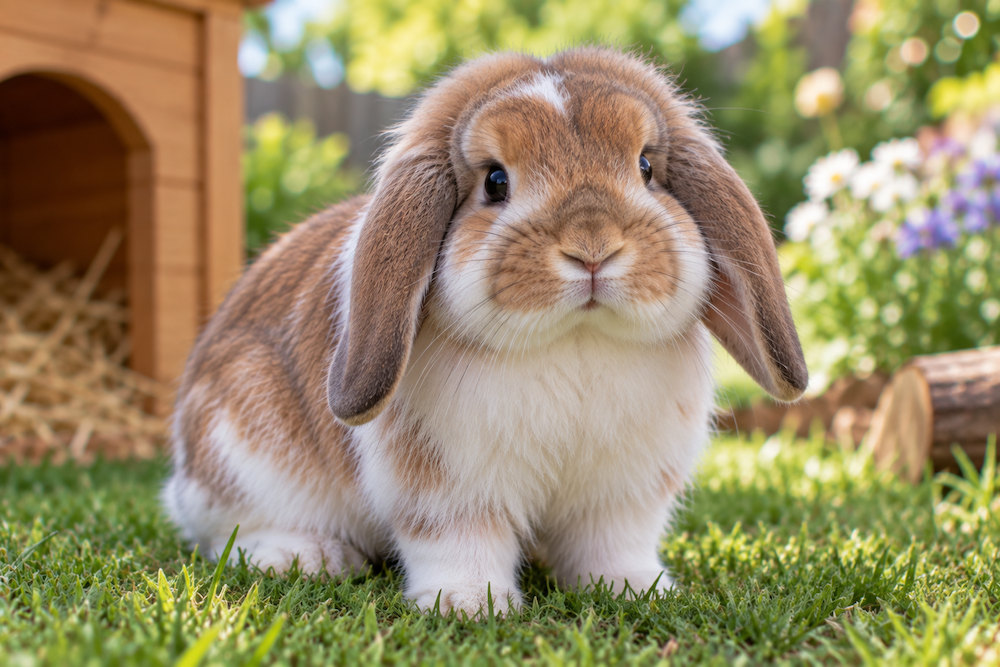







Compact, floppy-eared, and bursting with personality — the Mini Lop is a popular companion rabbit known for its rounded body, distinctive lop ears, playful intelligence, and ability to form surprisingly strong bonds with the humans who earn its trust.
🧠 QUICK SNAPSHOT
- Temperament: Friendly, curious, playful
- Activity Level: Moderate to High
- Size: Small to Medium
- Adult Weight: Commonly around 2–3 kg, depending on breed standard and country
- Good With Families: Very Good with appropriate handling
- Indoor Living: Excellent
- Trainability: High
- Grooming: Moderate
- Social Needs: High — rabbits generally benefit from compatible rabbit companionship
- Typical Lifespan: Around 8–12 years with excellent care
- Best For: Families with older children, adults, indoor homes, owners wanting an interactive small pet
📚 OVERVIEW
The Mini Lop is one of the world’s most recognisable companion rabbits.
Its appeal isn’t difficult to understand.
A compact rounded body, broad head and ears hanging down either side of the face give the Mini Lop an almost permanently adorable expression.
But beneath those floppy ears is a surprisingly intelligent and active animal.
Mini Lops can learn routines, recognise familiar people, use litter trays, respond to reward-based training and develop strong preferences about everything from food to furniture arrangements.
The breed’s modern history traces back to European lop-eared rabbits, with important development occurring in Germany before rabbits were taken to the United States during the 1970s and developed into the American Mini Lop.
There is one important complication: “Mini Lop” doesn’t mean exactly the same thing everywhere.
The American Mini Lop is considerably larger than the British Mini Lop. In Australia and other countries, naming and standards can also follow different traditions.
So prospective owners should check the standard used by their local breeder or rabbit organisation rather than relying on the word “mini”.
More importantly, Mini Lops aren’t low-maintenance cage pets.
They require space, companionship, enrichment, an appropriate hay-based diet and rabbit-savvy veterinary care.
Treat a Mini Lop like an intelligent companion rather than a decorative animal in a hutch and an entirely different personality emerges.
✅ PROS & CONS
Pros
- Friendly and engaging personality
- Can form strong bonds with owners
- Intelligent and trainable
- Can learn to use a litter tray
- Well suited to indoor living
- Playful and entertaining
- Available in many colours and patterns
- Doesn’t require outdoor walks
- Can live for a decade or more with excellent care
Cons
- Needs considerably more space than a traditional rabbit hutch provides
- Lop ears can increase the risk of ear problems
- Teeth require lifelong attention
- Needs constant access to appropriate hay
- Can chew furniture, cables and household objects
- Usually dislikes being picked up despite enjoying human company
- Veterinary care can be expensive and requires rabbit expertise
- Needs daily exercise and enrichment
- Rabbits are social animals and companionship needs must be considered
- Can live 8–12 years, making ownership a substantial commitment
Is a Mini Lop Rabbit a Good Family Pet?
Yes, a Mini Lop can be an excellent family pet, particularly for families prepared to understand rabbit behaviour rather than expecting a cuddly toy.
Many Mini Lops become affectionate and confident around familiar humans. They may approach for attention, investigate what family members are doing and enjoy gentle interaction at ground level.
However, rabbits are prey animals.
Being lifted from the ground can trigger fear because being grabbed from above resembles capture by a predator.
This means a rabbit that loves having its forehead stroked may still strongly dislike being picked up.
Young children should always be supervised.
Rabbits also have relatively delicate skeletons and powerful hind legs, so struggling while being held incorrectly can result in serious injury.
For families willing to interact with the rabbit on the rabbit’s terms, Mini Lops can become wonderfully engaging companions.
How Much Space Does a Mini Lop Rabbit Need?
A Mini Lop needs far more space than a traditional small rabbit hutch provides.
Rabbits need enough room to run, hop, stretch fully, stand upright and perform energetic jumps known as binkies.
For indoor rabbits, a large exercise pen, rabbit-proofed room or secure free-roaming area can provide an excellent living environment.
The rabbit should have comfortable resting areas, hiding places, litter trays, hay stations, toys and surfaces that provide secure footing.
Outdoor accommodation needs protection from predators, weather extremes, insects and escape.
Daily exercise shouldn’t simply involve occasionally removing a rabbit from a tiny cage.
Its normal living environment should allow meaningful movement.
A rabbit may be relatively small.
Its world shouldn’t be.
How Much Exercise Does a Mini Lop Rabbit Need?
Mini Lops need several hours of opportunity for unrestricted movement and exploration every day, ideally through an environment where exercise is naturally available rather than scheduled as a brief event.
Rabbits are surprisingly athletic.
They run, leap, twist, dig and explore.
Tunnels, cardboard boxes, platforms, digging areas and safe chew toys encourage natural activity.
Food can also become enrichment.
Instead of serving every pellet in a bowl, appropriate portions can be hidden or scattered to encourage foraging.
A healthy rabbit that suddenly performs a spectacular mid-air twist isn’t necessarily malfunctioning.
It may be doing a binky — one of the clearest signs of excitement in rabbit behaviour.
Are Mini Lop Rabbits Easy to Train?
Yes. Mini Lops can be surprisingly trainable.
Most importantly for indoor homes, rabbits can learn to use litter trays.
Rabbits naturally tend to choose particular toilet areas, making litter training easier than many new owners expect.
Spaying or neutering often improves litter habits as well as providing other behavioural and health benefits.
Using positive reinforcement, rabbits can also learn to come when called, enter carriers, touch targets and perform simple tricks.
Food rewards are powerful motivators, although treats should remain appropriate and limited.
Punishment isn’t effective or appropriate.
A frightened rabbit learns to avoid the human, not necessarily to understand what the human wanted.
Mini Lops may have floppy ears.
They’re still paying considerably more attention than many owners realise.
What Should a Mini Lop Rabbit Eat?
A Mini Lop’s diet should be built primarily around unlimited access to appropriate grass hay.
Hay provides fibre essential for normal digestive function and also encourages the prolonged chewing needed to wear continuously growing teeth.
Fresh leafy greens can provide additional variety and nutrition.
A measured amount of quality rabbit pellets may also form part of the diet, depending on age, health and veterinary recommendations.
Fresh water should always be available.
Fruit, carrots and commercial treats should generally be regarded as occasional treats rather than dietary staples because many contain substantial sugar.
Contrary to the cartoon stereotype, rabbits shouldn’t live on carrots.
Bugs Bunny has a lot to answer for nutritionally.
Does a Mini Lop Rabbit Need Grooming?
Yes, although the Mini Lop’s normal coat is relatively straightforward to maintain.
Regular brushing removes loose fur and becomes particularly important during heavy moulting periods.
Rabbits groom themselves and can swallow loose hair. Unlike cats, rabbits cannot vomit hairballs, so good grooming and a high-fibre diet are important.
Nails require regular trimming.
The ears deserve particular attention because lop-eared rabbits can be more vulnerable to ear-canal problems.
Owners should also regularly check the rabbit’s rear end, skin, feet and teeth.
Rabbits should not routinely be bathed.
Immersion bathing can cause severe stress and temperature problems, and a rabbit that becomes persistently dirty may have an underlying medical or husbandry issue requiring investigation.
Can a Mini Lop Rabbit Live Alone?
Rabbits are highly social animals, and many benefit greatly from living with a compatible rabbit companion.
Human attention is valuable but doesn’t completely reproduce rabbit-to-rabbit communication, grooming and companionship.
A properly bonded, neutered pair can eat, sleep, explore and groom one another.
However, rabbits shouldn’t simply be placed together and expected to become friends.
Introductions require careful bonding because unfamiliar rabbits can fight.
Sex, neuter status, temperament and individual compatibility all matter.
Where keeping a bonded pair isn’t possible, a single rabbit requires substantial daily social interaction and enrichment.
A Mini Lop may be small enough to live alone physically.
That doesn’t mean social isolation is automatically ideal.
How Long Do Mini Lop Rabbits Live?
A well-cared-for Mini Lop can commonly live around 8–12 years, with individual rabbits sometimes exceeding this.
This surprises people who still think of rabbits as short-term children’s pets.
Modern indoor husbandry, improved nutrition and rabbit-specific veterinary medicine have dramatically changed expectations for companion rabbits.
Good dental care, appropriate diet, healthy body weight, exercise and preventive veterinary care all contribute to longevity.
Spaying females is particularly important because unspayed female rabbits have a substantial risk of reproductive disease, including uterine cancer, as they age.
Getting a Mini Lop can therefore represent a commitment comparable in duration to owning some dogs.
That tiny rabbit you bring home today could still be rearranging your furniture a decade from now.
What Health Problems Are Common in Mini Lop Rabbits?
Mini Lops can experience several important health problems, with dental disease, gastrointestinal problems and ear disease deserving particular attention.
Rabbit teeth grow continuously. Poor alignment or insufficient appropriate chewing can contribute to overgrown teeth, painful dental disease and difficulty eating.
Gastrointestinal stasis, commonly called GI stasis, is a potentially life-threatening condition in which normal digestive movement slows dramatically. A rabbit that stops eating or producing normal droppings requires urgent veterinary attention.
Lop-eared rabbits can also be predisposed to ear-canal narrowing and accumulation of wax or debris, potentially contributing to inflammation and infection.
Obesity, sore hocks, respiratory disease and urinary problems can also occur.
Rabbits frequently hide signs of illness because they’re prey animals.
By the time a rabbit looks obviously sick, the problem may already be serious.
With rabbits, “I’ll see how it looks tomorrow” can sometimes be a dangerous strategy.
⭐ Is a Mini Lop the Same as a Holland Lop?
No. The Mini Lop and Holland Lop are separate breeds under American rabbit standards.
Confusingly, the Mini Lop is actually larger than the Holland Lop.
The Holland Lop generally weighs around 1–2 kg, while the American Mini Lop is considerably more substantial.
Both have compact bodies and characteristic lop ears, so casual observers can easily confuse them.
The situation becomes even more confusing internationally because breed names and standards differ between countries.
A rabbit advertised simply as a “mini lop” therefore deserves a second question:
Mini Lop according to which country’s breed standard?
In the rabbit world, apparently even the word “mini” needed regional variations.
⭐ Why Is the Mini Lop Bigger in America Than in Britain?
Because the name Mini Lop refers to different breed standards in different countries.
The American Mini Lop developed from rabbits imported from Germany and became a compact but relatively substantial breed.
In Britain, the breed called the Miniature Lop — commonly Mini Lop — was developed along different lines and is considerably smaller.
Australia has also been influenced by British rabbit terminology.
This can create enormous confusion when researching the breed online.
An American website and an Australian or British breeder may both be discussing a “Mini Lop” while describing rabbits of noticeably different adult sizes.
For EWL’s global audience, this distinction is particularly important.
When buying a rabbit, ask about the expected adult weight of that actual breeding line rather than relying entirely on the breed name.
⭐ Where Did the Mini Lop Come From?
The modern American Mini Lop traces much of its development to German lop-eared rabbits.
During the 1970s, American rabbit breeder Bob Herschbach encountered small lop rabbits at a German rabbit show and brought breeding animals back to the United States.
The rabbits were initially associated with the name Klein Widder, essentially meaning “small ram” in German.
American breeders subsequently worked to establish a consistent compact lop type.
After further development and refinement, the Mini Lop gained recognition through the American Rabbit Breeders Association.
So despite being enormously popular in American homes, the breed’s story has an important European chapter.
⭐ Why Do Mini Lop Rabbits Have Floppy Ears?
Lop ears result from inherited anatomical differences affecting how the ears are supported.
Instead of standing upright like the ears of wild rabbits, the ears hang down alongside the head.
Humans have deliberately selected this appearance over generations, creating several lop-eared breeds.
But floppy ears aren’t purely cosmetic.
Research into lop-eared rabbits has raised welfare concerns because their ear anatomy can make normal ventilation and drainage more difficult.
Some lop rabbits can develop increased wax accumulation, narrowed ear canals and ear disease.
The very feature that makes the Mini Lop instantly recognisable can therefore require additional health monitoring.
Cute anatomy can still have medical consequences.
⭐ Do Mini Lop Rabbits Really Recognise Their Owners?
Yes. Rabbits can learn to recognise familiar people through combinations of scent, sound, appearance and routine.
A bonded Mini Lop may approach when its owner enters the room, respond to familiar sounds or anticipate particular daily activities.
Some rabbits learn their names or at least learn that a particular sound predicts attention or food.
They can also distinguish between people they trust and unfamiliar visitors.
This relationship often develops differently from the obvious enthusiasm displayed by many dogs.
A rabbit may show affection by sitting beside you, nudging your hand, grooming you or relaxing completely in your presence.
Rabbit affection can be subtle.
Once you understand the language, however, it becomes much easier to see.
⭐ What Does It Mean When a Mini Lop Does a Binky?
A binky is an energetic jump in which a rabbit may leap into the air, twist its body and flick its feet.
It is commonly associated with excitement and positive arousal.
Some rabbits perform a single spectacular jump.
Others launch into a full sequence of running, jumping and twisting sometimes called the “zoomies”.
New rabbit owners can initially be alarmed because the movement looks so sudden and uncontrolled.
In most circumstances, it’s exactly the opposite of something being wrong.
You’re watching an animal physically expressing enthusiasm.
Dogs wag their tails.
Cats purr.
A happy rabbit may suddenly launch itself sideways into the air like its software briefly malfunctioned.
⭐ Why Does a Mini Lop Thump Its Back Feet?
Rabbits thump their powerful hind feet primarily as an alarm signal.
Wild rabbits use thumping to warn other rabbits that potential danger is nearby.
Domestic Mini Lops retain the behaviour.
A rabbit may thump after hearing an unfamiliar sound, seeing something frightening or becoming irritated by a situation.
Some rabbits also seem remarkably willing to use thumping when they disapprove of their humans.
Understanding the context matters.
Repeated unexplained thumping can indicate that something in the environment is causing fear or stress.
The Mini Lop may not bark.
But it still possesses a surprisingly effective method for announcing:
“I have concerns.”
⭐ Why Do Mini Lop Rabbits Chew Everything?
Because chewing is biologically essential for rabbits.
Rabbit teeth grow continuously throughout life.
The abrasive action created by chewing fibrous foods — particularly hay and grasses — helps maintain normal tooth wear.
Rabbits also explore and manipulate their environment using their mouths.
This is why electrical cables, skirting boards, furniture and houseplants can become targets in an inadequately rabbit-proofed home.
Safe chew materials should always be available.
Electrical cables need physical protection or complete removal from accessible areas.
Potentially toxic plants must also be kept out of reach.
A rabbit chewing the furniture isn’t plotting revenge.
It’s simply performing normal rabbit behaviour on an object you mistakenly assumed still belonged to you.
⭐ Do Mini Lop Rabbits Sleep With Their Eyes Open?
They can.
Rabbits sometimes sleep or doze with their eyes partially or fully open, an adaptation that makes sense for a prey species needing to remain alert to danger.
At other times, particularly when a rabbit feels extremely safe, it may close its eyes completely.
Rabbits can also enter a deeply relaxed position called a flop, suddenly falling onto their side.
To inexperienced owners, the first dramatic flop can be terrifying.
The rabbit can appear as though it has suddenly collapsed.
A relaxed body position and normal breathing generally reveal what’s actually happening.
One of the great milestones in rabbit ownership is progressing from:
“Oh no, what’s wrong with him?”
to:
“Never mind. He’s having another extremely dramatic nap.”
⭐ Can Mini Lop Rabbits Purr?
Rabbits don’t purr exactly like cats, but they can produce a similar behaviour known as tooth purring.
A relaxed rabbit may gently and rhythmically grind its teeth while being stroked or resting comfortably.
The vibration can sometimes be felt through the rabbit’s head.
This soft tooth grinding is usually associated with contentment.
However, context is extremely important.
Loud or forceful tooth grinding can indicate pain, particularly when accompanied by a hunched posture, reduced appetite or other behavioural changes.
Learning the difference between relaxed tooth purring and pain-related grinding is therefore valuable for rabbit owners.
The same basic sound-producing equipment can communicate two very different messages.
⭐ Why Does a Mini Lop Eat Its Own Droppings?
Because some of what looks like ordinary droppings is actually a specialised nutritional package the rabbit needs to eat.
Rabbits produce two main types of faecal material.
The familiar dry round pellets are waste.
The other type, called cecotropes, is softer and nutrient-rich. Rabbits normally consume cecotropes directly from the anus, often so quickly that owners never notice.
This allows them to extract additional nutrients produced during fermentation within the digestive system.
It’s an essential part of normal rabbit biology.
So while humans may find the behaviour deeply unappealing, the rabbit isn’t doing something disgusting or abnormal.
It’s essentially sending part of its dinner through the digestive system twice because the first pass wasn’t finished yet.
⭐ Can a Mini Lop Be Litter Trained?
Yes. Mini Lops can often become excellent litter-tray users.
Rabbits naturally tend to urinate and defecate in preferred locations, which owners can use to their advantage.
A large litter tray placed where the rabbit already wants to toilet is usually more successful than insisting on a location chosen purely for human convenience.
Placing hay near or above the litter area can also help because rabbits naturally like to eat while toileting.
Spaying or neutering frequently improves litter habits by reducing hormone-driven territorial marking.
Occasional stray dry pellets may still appear, even in a well-trained rabbit.
But many indoor rabbits become reliable enough to enjoy substantial freedom around rabbit-proofed parts of the home.
⭐ Why Is Spaying or Neutering a Mini Lop Important?
Spaying or neutering can provide important health, behavioural and social benefits.
For females, spaying is particularly significant because intact female rabbits have a substantial risk of developing uterine disease, including uterine cancer, as they age.
Neutering males can reduce hormone-driven behaviours such as spraying, mounting and territorial aggression.
Desexing also makes successful bonding between companion rabbits considerably easier.
Timing should be discussed with a veterinarian experienced in rabbit medicine because age, sex, size and individual health all matter.
Rabbit anaesthesia and surgery require species-specific expertise, so finding an experienced veterinarian is important.
⭐ How Long Is a Mini Lop’s Memory?
There isn’t a useful scientific number such as “a Mini Lop remembers something for exactly six months.”
What we do know is that rabbits are capable of long-term learning and recognition.
They can remember familiar humans, other rabbits, locations, routines and learned behaviours.
They can also remember frightening experiences.
That is one reason gentle handling matters so much.
Repeatedly chasing and grabbing a rabbit can teach it that human hands predict danger.
Conversely, consistently pairing human interaction with safety, food and positive experiences can build considerable trust.
A rabbit’s brain may be small.
Its memories of how you treat it can matter enormously.