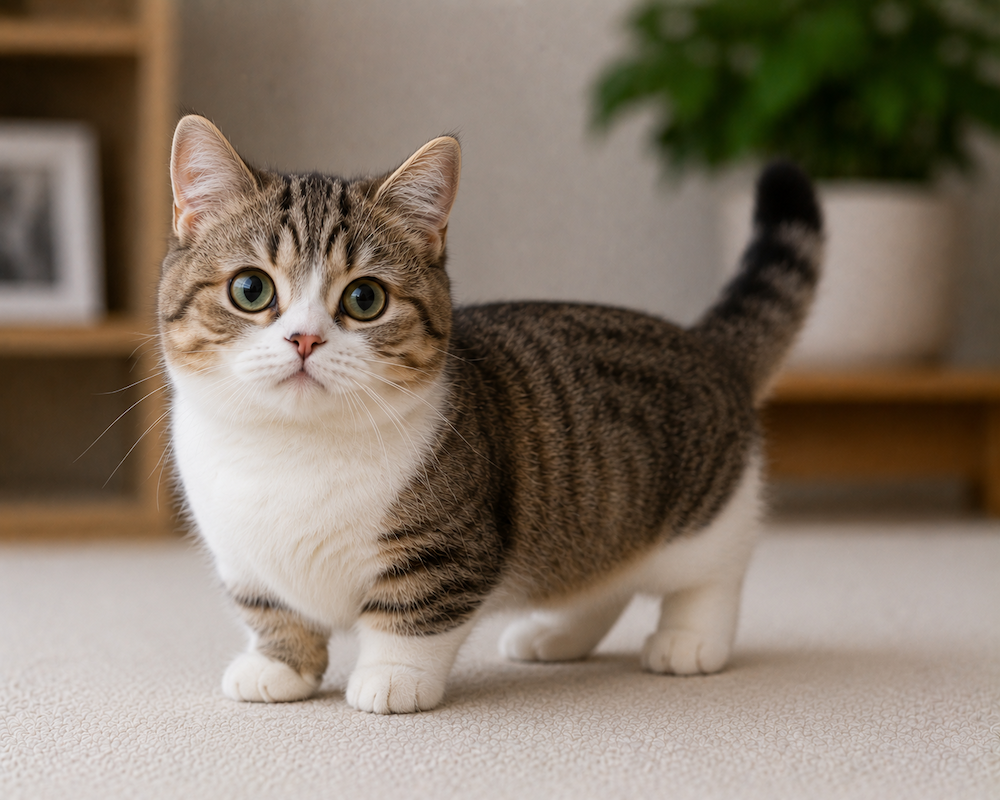






Playful, curious, and full of charm — a unique companion known for its short legs and big personality.
🧠 QUICK SNAPSHOT
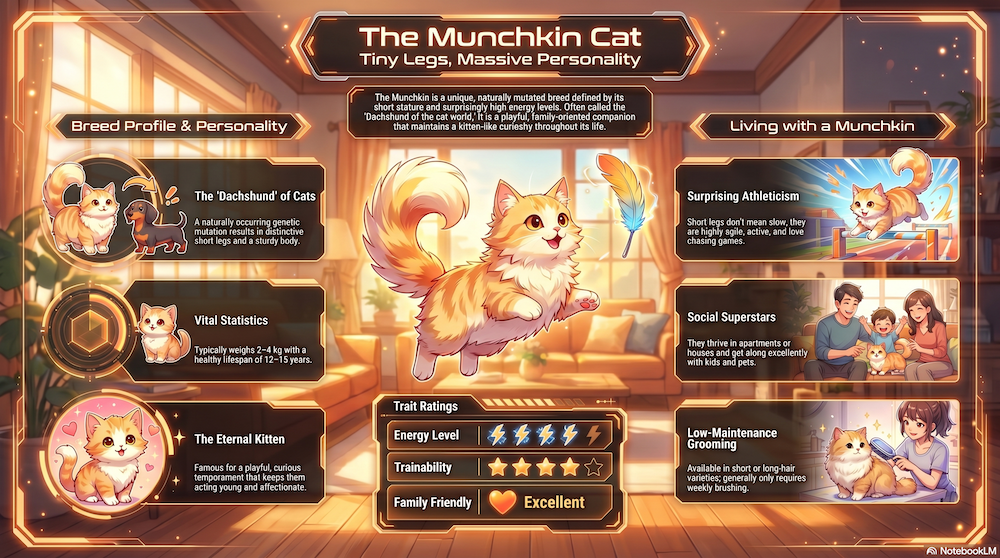
- Temperament: Playful, affectionate, outgoing
- Energy Level: Moderate to high
- Size: Small to medium
- Good With Families: Yes
- Trainability: Moderate
- Grooming: Low to moderate
- Best For: Families, indoor living, companionship
📚 OVERVIEW
The Munchkin is a distinctive cat breed famous for its short legs, which are caused by a natural genetic mutation. Despite their unusual appearance, Munchkins are active, agile, and surprisingly quick.
They are friendly, social cats that enjoy interaction and are often described as playful well into adulthood.
✅ PROS & CONS
Pros
- Friendly and affectionate personality
- Playful and entertaining
- Adapts well to family life
- Unique and memorable appearance
Cons
- Potential health concerns related to body structure
- May have limitations with jumping compared to other cats
- Requires regular play and enrichment
- Can be difficult to find in some regions
Is a Munchkin a Good Family Cat?
Yes. Munchkins can be affectionate, playful, sociable and highly people-oriented family cats.
Their unusually short legs don’t prevent most healthy individuals from enjoying active family life. Many remain playful well into adulthood and enjoy following their owners around the home.
As with any cat, temperament varies between individuals, and children should be taught to handle them gently.
Is a Munchkin Good With Children?
Usually, provided the children are respectful.
Munchkins tend to be playful and social, which can make them entertaining companions for older children.
Their unusual body structure means they shouldn’t be dropped, roughly handled or encouraged to make unnecessarily dangerous jumps.
How Much Exercise and Play Does a Munchkin Need?
Munchkins benefit from several interactive play sessions each day.
Chasing toys, puzzle feeders, tunnels and lower climbing structures can provide excellent exercise.
Their short legs don’t mean they should live sedentary lives.
Is a Munchkin an Active Cat?
Yes.
Many Munchkins are surprisingly energetic, fast and playful.
They may not jump as high as long-legged cats, but they can race around the house with impressive speed.
Can Munchkin Cats Run Normally?
Most can run very effectively.
Their low body position creates a distinctive appearance, but many can move remarkably quickly.
Owners sometimes compare them with ferrets or low-slung sports cars when they’re racing around the house.
Can Munchkin Cats Jump?
Yes, but generally not as high as cats with normal-length legs.
Many compensate by finding intermediate surfaces and reaching high places in stages.
A strategically positioned chair can therefore become the first stage of a carefully planned kitchen-bench operation.
Can Munchkin Cats Climb?
Yes.
They’re still cats and retain strong climbing instincts.
Providing stable cat furniture with closely spaced platforms makes climbing easier and reduces the need for large jumps.
Is a Munchkin Easy to Train?
Generally, yes.
Munchkins are intelligent and often food-motivated.
Many can learn their names, household routines, simple tricks, harness walking and even games such as fetch.
Are Munchkin Cats Intelligent?
Yes.
They’re curious, observant cats that often enjoy puzzle toys and interactive games.
Some become particularly skilled at discovering where interesting objects or treats are stored.
Does a Munchkin Shed?
Yes.
Both shorthaired and longhaired Munchkins shed.
The amount varies according to coat length, density, season and individual genetics.
Is a Munchkin Hypoallergenic?
No.
Munchkins aren’t considered hypoallergenic.
Like other cats, they produce allergenic proteins in saliva and skin secretions regardless of their leg length.
Can Munchkin Cats Have Long Hair?
Yes.
Munchkins occur in both shorthaired and longhaired varieties.
Longhaired cats require more frequent grooming to prevent tangles and mats.
How Often Should You Groom a Munchkin?
A shorthaired Munchkin may need brushing around once a week, while longhaired individuals generally benefit from grooming several times weekly.
Nail trimming, dental care and regular body-condition checks are also important.
What Health Problems Are Common in Munchkin Cats?
The major discussion surrounding Munchkin health concerns the skeletal mutation responsible for their shortened legs and whether breeding specifically for dwarfism creates additional welfare risks.
Reported concerns can include lordosis, in which the spine curves abnormally downward, and pectus excavatum, a chest-wall deformity. Arthritis, mobility and spinal health are also areas worth discussing with a veterinarian, particularly as a cat ages.
Not every Munchkin develops serious problems, and supporters of the breed argue that many live active lives. However, welfare organisations and some cat registries oppose breeding cats specifically for shortened limbs.
What Causes a Munchkin Cat’s Short Legs?
Munchkins have a naturally occurring genetic mutation that affects long-bone development.
This produces disproportionately shortened legs while leaving the body comparatively normal in length.
The trait is a form of feline dwarfism.
Is the Munchkin a Dwarf Cat?
Yes.
The Munchkin’s characteristic short legs result from a genetic form of disproportionate dwarfism.
The body remains relatively normal in size while the limbs are shortened.
Are Munchkin Cats Healthy?
Many individual Munchkins live active lives, but the breed is controversial from an animal-welfare perspective because its defining characteristic is a skeletal mutation.
Breed supporters argue that Munchkins can enjoy normal quality of life, while critics question whether deliberately breeding for shortened limbs is ethically appropriate and whether it increases musculoskeletal risks.
Prospective owners should look beyond appearance and investigate the health, mobility and breeding practices behind any kitten.
Do Munchkin Cats Have Back Problems Like Dachshunds?
Not necessarily.
Although both animals have short legs, the underlying anatomy and genetic mechanisms aren’t identical.
It isn’t accurate to assume that a Munchkin automatically experiences the same spinal problems as a Dachshund.
That doesn’t mean skeletal health should be ignored, particularly because the long-term welfare implications of intentionally breeding for feline dwarfism remain debated.
What Is Lordosis in Munchkin Cats?
Lordosis is an abnormal inward curvature of the spine.
Severe cases can compress the chest cavity and potentially affect internal organs.
It’s one of the health conditions frequently discussed in relation to Munchkin cats, although it isn’t exclusive to the breed.
What Is Pectus Excavatum in Munchkin Cats?
Pectus excavatum is a deformity in which the breastbone and chest wall develop abnormally inward.
Severity varies.
Significant cases can interfere with normal heart and lung function and require veterinary assessment.
Do Munchkin Cats Get Arthritis?
Any cat can develop arthritis as it ages.
Because Munchkins have altered limb proportions, owners should pay particular attention to mobility, reluctance to jump, stiffness, grooming difficulties and changes in activity.
Regular veterinary assessment becomes increasingly valuable as the cat gets older.
How Long Does a Munchkin Cat Live?
Munchkins are often reported to live around 12–15 years, although individual longevity varies considerably.
Genetics, body weight, lifestyle and veterinary care all matter.
Because the breed is relatively modern, responsible long-term health monitoring remains particularly valuable.
How Big Does a Munchkin Cat Get?
Most Munchkins are small-to-medium cats, commonly weighing around 2.5–4.5 kg.
Their bodies aren’t dramatically miniature.
It’s primarily the shortened legs that create their distinctive low-to-the-ground appearance.
Is There a Miniature Munchkin Cat?
The standard Munchkin is already a short-legged cat, but it isn’t necessarily miniature in overall body size.
Terms such as “Mini Munchkin” aren’t standard breed classifications.
Extreme size should never be prioritised over health.
What Is a Teacup Munchkin?
“Teacup Munchkin” is primarily a marketing term rather than a recognised breed category.
It generally refers to an unusually small cat.
Deliberately selecting for both dwarfism and extreme overall miniaturisation raises additional welfare concerns.
Can a Munchkin Live in an Apartment?
Yes.
Munchkins can adapt extremely well to indoor and apartment living.
Provide scratching surfaces, interactive toys, hiding places and accessible climbing structures.
Does a Munchkin Need Special Cat Furniture?
Not necessarily, but thoughtful furniture design can help.
Cat trees with shorter distances between platforms, ramps or intermediate steps allow the cat to climb without needing enormous jumps.
This can become particularly useful for older individuals.
Can a Munchkin Use a Normal Litter Tray?
Most can.
A standard tray with a reasonably accessible entrance is usually fine.
Older cats or individuals with mobility problems may benefit from a lower-entry litter tray.
Can Munchkin Cats Go Up Stairs?
Most healthy Munchkins can manage ordinary stairs.
Their movement may look different because of their short legs, but they can generally climb effectively.
Mobility should be monitored if a cat becomes reluctant to use stairs it previously managed comfortably.
Can a Munchkin Cat Live Outdoors?
An indoor lifestyle or secure outdoor access is generally safer.
A Munchkin’s shorter legs may reduce some of its ability to jump away from dogs or other threats compared with a normally proportioned cat.
A secure catio can provide outdoor enrichment without unrestricted roaming.
Can You Walk a Munchkin on a Harness?
Yes.
Many can learn harness walking if introduced gradually using positive reinforcement.
Their curious personalities can make supervised outdoor exploration particularly rewarding.
Are Munchkin Cats Cuddly?
Many are.
They’re often described as affectionate, sociable cats that enjoy spending time near their owners.
Some become enthusiastic lap cats, while others prefer remaining nearby without constant physical contact.
Are Munchkin Cats Velcro Cats?
Some certainly are.
They can form strong attachments and may follow their favourite person from room to room.
However, personality varies considerably because the Munchkin population includes diverse genetic backgrounds.
Can Munchkin Cats Be Left Alone?
Adult cats can generally tolerate reasonable periods alone, provided they have food, water, litter facilities and enrichment.
Munchkins that are particularly social may benefit from another compatible pet or additional interaction when their owners are home.
Are Munchkin Cats Good With Other Cats?
Generally, yes.
Many are sociable and playful with other cats.
Normal gradual introductions remain important.
Are Munchkin Cats Good With Dogs?
They can be.
A confident Munchkin raised around a calm, cat-friendly dog may form a strong relationship.
Because a Munchkin may have less jumping ability than a typical cat, it should always have safe escape spaces the dog cannot access.
Do Munchkin Cats Have a Strong Prey Drive?
They can.
Short legs don’t eliminate normal feline hunting instincts.
Many enthusiastically stalk toys, insects and small animals.
Are Munchkin Cats Good Mousers?
Some are surprisingly capable hunters.
Their reduced jumping ability doesn’t prevent them from stalking and pursuing prey at ground level.
However, individual hunting ability varies considerably.
Are Munchkin Cats Vocal?
Usually moderately vocal.
Some are highly conversational, while others are relatively quiet.
There isn’t one distinctive Munchkin voice.
Do Munchkin Cats Like Water?
Some are curious about running water, but there’s no strong reason to consider water fascination a defining characteristic of the breed.
Individual personality matters more.
When Does a Munchkin Cat Calm Down?
Many become noticeably calmer after their first few years.
However, Munchkins are often described as playful well into adulthood.
Their short legs shouldn’t be mistaken for a low-energy temperament.
Do Munchkin Cats Get the Zoomies?
Absolutely.
A Munchkin may be vertically disadvantaged, but horizontal speed can be a completely different matter.
Their low-slung zoomies are one of the behaviours owners often find particularly entertaining.
Why Does My Munchkin Sit Up on Its Hind Legs?
Some Munchkins are known for sitting upright on their hindquarters to get a better view.
Their short front legs make this posture particularly noticeable.
It’s sometimes compared with the upright stance of a rabbit or meerkat.
Why Are Munchkin Cats Sometimes Called Magpie Cats?
Munchkins have acquired a reputation for being attracted to small shiny objects and carrying or hiding them.
This has led to comparisons with magpies.
It’s an entertaining breed anecdote rather than something every Munchkin will necessarily do.
Do Munchkin Cats Steal Shiny Objects?
Some owners report this behaviour.
A curious cat may carry jewellery, bottle tops, hair ties or other small objects away for play.
Potentially dangerous objects should be kept securely out of reach regardless of breed.
What Does a Munchkin Cat Look Like?
The defining feature is a normal-sized feline body carried on unusually short legs.
Otherwise, appearance varies enormously.
Munchkins can have different head shapes, colours, patterns and coat lengths because the founding population wasn’t selected from one narrow traditional breed type.
Are a Munchkin’s Front Legs Shorter Than Its Back Legs?
All four limbs are shortened, although proportions can vary.
Some cats appear slightly higher through the rear.
The overall result is the breed’s characteristic low-slung stance.
Are All Munchkin Cats Extremely Short-Legged?
No.
Expression of the trait can vary, and breeders sometimes use informal descriptions for different leg lengths.
There isn’t necessarily one identical leg length across every Munchkin.
What Are Rug-Hugger, Super-Short and Standard Munchkin Legs?
These are informal breeder terms used to describe degrees of leg shortening.
“Rug hugger” is often used for extremely short legs, while “super short” and “standard” describe progressively longer limbs.
These aren’t universally standardised scientific categories, so buyers shouldn’t treat them as precise measurements.
Can Munchkin Cats Have Normal-Length Legs?
Yes.
Because of the genetics involved, litters can include kittens with normal-length legs.
These kittens may share the same ancestry but don’t display the defining short-legged phenotype.
Why Can Two Munchkins Produce Normal-Legged Kittens?
The short-legged trait is inherited as a dominant characteristic, but viable short-legged cats generally carry one copy of the relevant mutation.
A kitten that inherits the normal version from both parents will have ordinary-length legs.
This creates mixed leg lengths within litters.
Why Shouldn’t Two Short-Legged Munchkins Produce Only Short-Legged Kittens?
Because the genetics don’t work that way.
When two short-legged Munchkins are bred, some embryos can inherit the short-leg mutation from both parents.
Evidence indicates that inheriting two copies is embryonically lethal, so those embryos don’t develop into viable kittens.
Surviving kittens can therefore include both short-legged and normal-legged individuals.
Is the Munchkin Gene Dominant?
Yes.
Only one copy is needed for the characteristic short-legged appearance.
This is why a short-legged Munchkin can produce both short-legged and normal-legged offspring.
Is the Munchkin Gene Lethal?
One copy produces the characteristic short legs.
Two copies are generally understood to be lethal during embryonic development.
This genetic feature is one of the important considerations surrounding responsible breeding of Munchkins.
What Colours Can Munchkin Cats Be?
Almost every common domestic-cat colour and pattern can occur.
These include black, white, blue, red, cream, tabby, tortoiseshell, calico and colour combinations.
Both short and long coats occur as well.
Can a Munchkin Be Black?
Yes.
Solid black Munchkins occur naturally within the breed population.
Leg length and coat colour are inherited independently.
Can a Munchkin Be Orange?
Yes.
Red or ginger Munchkins occur, including red tabbies.
Their shortened legs don’t restrict the normal range of domestic-cat colours.
Can a Munchkin Be Calico?
Yes.
As with cats generally, almost all calico Munchkins are female because of the X-linked genetics controlling orange and black coat colouring.
Can a Munchkin Have Blue Eyes?
Yes.
Eye colour depends largely on coat-colour genetics rather than the short-leg mutation.
Blue eyes can occur particularly in white, colourpoint or other genetically appropriate cats.
Can a Munchkin Have Folded Ears?
A standard Munchkin has normal upright ears.
However, breeders have crossed Munchkins with Scottish Folds to create short-legged, folded-ear cats.
These crosses raise additional welfare concerns because the Scottish Fold mutation affects cartilage throughout the body, not just the ears.
What Is a Scottish Kilt Cat?
“Scottish Kilt” is a name sometimes used for a Munchkin × Scottish Fold-type cross, combining shortened legs with folded ears.
This combination deliberately brings together two skeletal/cartilage mutations and is controversial from an animal-welfare perspective.
It isn’t simply another coat or colour variety of ordinary Munchkin.
What Is a Minuet Cat?
The Minuet, formerly known as the Napoleon, was developed by crossing Munchkins with Persian-family cats.
It combines the short-legged trait with a more Persian-influenced body, head and coat.
It has been developed as a distinct breed under some cat registries.
Is a Minuet the Same as a Munchkin?
No.
The Munchkin is the foundational short-legged breed, while the Minuet was developed using Munchkin and Persian-group ancestry.
They can share short legs but have different breed standards and histories.
What Is a Bambino Cat?
The Bambino is a short-legged hairless cat developed primarily from Munchkin and Sphynx ancestry.
It combines the Munchkin’s shortened limbs with the hairlessness associated with the Sphynx.
It’s separate from the standard Munchkin.
What Is a Lambkin Cat?
The Lambkin is an experimental or developing short-legged cat associated with Munchkin and Selkirk Rex ancestry.
The goal has generally been to combine shortened legs with a curly coat.
Recognition varies significantly between registries.
What Is a Kinkalow Cat?
The Kinkalow is a rare developing cross associated with Munchkin and American Curl ancestry.
It combines short legs with the American Curl’s backward-curving ears.
It’s not the same breed as the Munchkin.
What Is a Dwelf Cat?
The Dwelf is an experimental-type cat combining ancestry from breeds including the Munchkin, Sphynx and American Curl.
It was developed to combine short legs, hairlessness and curled ears.
Such multi-mutation breeding is controversial and isn’t universally recognised.
Why Are There So Many Munchkin Crosses?
The Munchkin’s short-legged trait is dominant, making it possible to introduce the characteristic into other cat populations relatively quickly.
This has encouraged breeders to combine short legs with folded ears, curled ears, hairlessness, curly coats and Persian-type features.
However, combining unusual mutations can create additional welfare concerns and requires particularly careful consideration.
Is the Munchkin Recognised by TICA?
Yes.
The International Cat Association (TICA) has recognised the Munchkin and played an important role in the breed’s formal development.
Not every major feline organisation agrees with that decision.
Is the Munchkin Recognised by the CFA?
The Cat Fanciers’ Association (CFA) doesn’t recognise the Munchkin as a championship breed.
This reflects the lack of universal agreement within the pedigree-cat world about deliberately breeding for the short-legged mutation.
Is the Munchkin Recognised by Every Major Cat Registry?
No.
Recognition is one of the most controversial aspects of the breed.
Some registries recognise the Munchkin, while others refuse recognition because of concerns about deliberately perpetuating a skeletal abnormality.
Why Is the Munchkin Cat Controversial?
The controversy centres on whether deliberately breeding cats for disproportionately shortened limbs is ethically acceptable.
Supporters point to healthy, active Munchkins that run, play and enjoy normal lives.
Critics argue that a physical mutation affecting skeletal development shouldn’t itself be the defining feature breeders deliberately reproduce.
The disagreement involves animal welfare, genetics and differing philosophies about what constitutes responsible breed development.
Are Munchkin Cats Banned Anywhere?
Rules vary by country and jurisdiction, and legislation can change.
Some countries or animal-welfare systems restrict breeding animals specifically for traits considered harmful, while cat registries may separately refuse to recognise Munchkins.
Prospective breeders should therefore check current local animal-welfare legislation rather than assuming that registry recognition makes breeding legal everywhere.
Is It Ethical to Breed Munchkin Cats?
There is genuine disagreement.
Supporters argue that carefully bred Munchkins can be active, healthy cats and that short legs don’t automatically mean poor quality of life.
Critics, including some veterinary and animal-welfare organisations, argue that intentionally selecting a skeletal mutation for appearance creates unnecessary welfare risk.
Anyone considering the breed should understand both positions rather than treating the debate as settled.
Where Does the Munchkin Cat Come From?
Short-legged cats have appeared spontaneously at different times and places, but the modern Munchkin breed was developed in the United States.
Its modern foundation is particularly associated with short-legged cats discovered in Louisiana during the early 1980s.
The breed was subsequently developed from those cats and eventually presented to the organised cat fancy.
Were Short-Legged Cats Known Before the Modern Munchkin?
Yes.
Reports of unusually short-legged cats existed decades before the modern breed was established.
Similar cats were described in different countries during the 20th century, demonstrating that the mutation wasn’t unique to one American litter.
Those earlier populations generally disappeared rather than becoming permanent registered breeds.
Were Short-Legged Cats Reported in Britain in the 1940s?
Yes.
Veterinary descriptions from Britain documented generations of short-legged cats during the mid-20th century.
Those cats didn’t become the direct continuous foundation of today’s recognised Munchkin population.
They do demonstrate that feline short-legged mutations existed before the modern breed.
Who Was Blackberry the Munchkin Cat?
Blackberry was a short-legged female found in Louisiana in the early 1980s and became enormously important in the development of the modern Munchkin.
She produced kittens, including short-legged offspring, demonstrating that the unusual characteristic was heritable.
Modern Munchkin history is strongly associated with her descendants.
Who Found Blackberry?
Blackberry is associated with Sandra Hochenedel, who encountered the short-legged cat in Louisiana.
Blackberry was pregnant when found.
Her subsequent offspring helped establish the modern breeding population.
Who Was Toulouse the Munchkin Cat?
Toulouse was one of Blackberry’s short-legged male offspring.
He became another important early foundation cat and contributed to establishing a wider population of short-legged cats.
Blackberry and Toulouse are therefore central names in modern Munchkin breed history.
When Was the Munchkin First Shown to the Public?
The developing breed received major attention when short-legged cats were presented publicly through TICA in the early 1990s.
The appearance immediately generated both fascination and controversy.
Debate over the breed has continued ever since.
Why Is It Called a Munchkin Cat?
The name references the Munchkins from L. Frank Baum’s The Wonderful Wizard of Oz and its later popular adaptations.
The name was chosen because of the cats’ unusually short stature.
It became permanently associated with the developing breed.
Is the Munchkin an Ancient Breed?
No.
Short-legged mutations have appeared historically, but the organised Munchkin breed is modern.
Its recognised development dates primarily from the 1980s and 1990s.
Claims that today’s Munchkin is an ancient established pedigree breed would therefore be misleading.
Was the Munchkin Deliberately Created Through Genetic Engineering?
No.
The short-legged mutation occurred naturally.
Humans didn’t engineer the original genetic change.
What breeders subsequently did was select cats carrying that naturally occurring mutation and deliberately reproduce the characteristic.
Is the Munchkin Related to the Dachshund?
No.
The resemblance comes from convergent appearance: both have relatively long bodies carried on unusually short legs.
The Munchkin wasn’t created by mixing cats with Dachshunds — which is biologically impossible.
Is the Munchkin the Dachshund of the Cat World?
It’s a popular nickname because of the obvious visual similarity.
However, the comparison shouldn’t be taken literally.
Cats and dogs have different anatomy, and the genetic mechanisms producing shortened limbs aren’t simply identical.
Is the Munchkin Related to the Corgi?
No.
Again, the similarity is superficial.
Corgis and Munchkins both have shortened limbs, but they’re completely different species with independent genetic histories.
Is the Munchkin a Purebred Cat?
A registered Munchkin can be considered a pedigree breed under organisations that recognise it.
However, its relatively recent development and broad founding population mean it differs historically from long-established breeds with centuries of closed breeding.
Other major registries don’t recognise it at all.
Can Normal-Legged Cats Be Part of Munchkin Breeding Programs?
Yes.
Normal-legged offspring can be important within breeding populations.
They may carry much of the same ancestry without expressing the dominant short-leg phenotype.
Healthy breeding programmes shouldn’t treat normal leg length as though it makes an otherwise healthy cat worthless.
Why Doesn’t Every Munchkin Kitten Have Short Legs?
Because a short-legged parent doesn’t transmit the relevant mutation to every kitten.
Normal-legged offspring are therefore an expected genetic outcome.
This is another reason “Munchkin” genetics are more complicated than simply breeding two short cats and obtaining an entire litter of tiny-legged kittens.
Is a Munchkin a Good Cat for Older People?
It can be.
Munchkins are often affectionate, playful and manageable in size.
Owners should be prepared to monitor mobility as the cat ages and provide accessible furniture if jumping becomes difficult.
Is a Munchkin a Good Cat for First-Time Owners?
Potentially.
Their basic care isn’t dramatically different from other domestic cats.
However, first-time owners should understand the health and welfare debate surrounding the breed, select breeders very carefully and avoid being attracted purely by extreme leg shortening.
Are Munchkin Cats Good Therapy Cats?
Individual Munchkins with calm, confident and sociable temperaments can potentially succeed in therapy work.
Their unusual appearance can make them particularly engaging to people.
Temperament and comfort with unfamiliar environments matter much more than leg length.
Why Does My Munchkin Follow Me Everywhere?
Many Munchkins are highly social and curious.
Following their owners allows them to participate in whatever is happening around the house.
Their short legs don’t appear to have reduced the normal feline conviction that all human activity requires supervision.
Why Does My Munchkin Stand Up Like a Meerkat?
Standing upright gives the cat a better view when its normal eye level is relatively close to the floor.
Some Munchkins appear particularly comfortable sitting back on their hindquarters.
Combined with their short front legs, the result can look remarkably meerkat-like.
Why Does My Munchkin Take the Long Way Up to Furniture?
Because many Munchkins solve height problems differently from long-legged cats.
Instead of making one large jump, they may use a chair, box or lower shelf as an intermediate stage.
This demonstrates how effectively cats can adapt their behaviour to their physical proportions.
What Makes the Munchkin Cat Unique?
Few cats demonstrate the difference between “unusual” and “simple” better than the Munchkin.
At first glance, its defining characteristic seems obvious: it’s a cat with extremely short legs.
But behind those legs is a fascinating genetic story.
Short-legged cats appeared spontaneously long before anyone established the Munchkin breed. Then, in 1980s Louisiana, a short-legged female named Blackberry produced kittens carrying the same characteristic. Her descendants helped establish a population that eventually became the modern Munchkin.
The mutation turned out to be dominant, meaning only one copy is required to produce short legs. But inheriting two copies appears to be lethal during embryonic development. That means two short-legged parents can still produce normal-legged kittens — while some embryos inheriting the mutation twice never survive.
Then humans took the characteristic even further, crossing Munchkins with other breeds to produce cats with Persian features, hairlessness, curled ears, folded ears and curly coats.
And that’s where the Munchkin becomes more than simply an unusual-looking cat.
It raises an important question about pedigree breeding:
Just because humans can deliberately reproduce an unusual physical trait, should we?
Supporters point to active Munchkins racing through homes, climbing furniture and living ordinary feline lives. Critics argue that intentionally perpetuating skeletal dwarfism for appearance is fundamentally different from simply caring for a cat born with it.
That debate is unlikely to disappear.
Meanwhile, the Munchkin itself appears largely uninterested in the controversy.
It’s too busy proving that having short legs doesn’t prevent a cat from finding its way onto the kitchen bench.