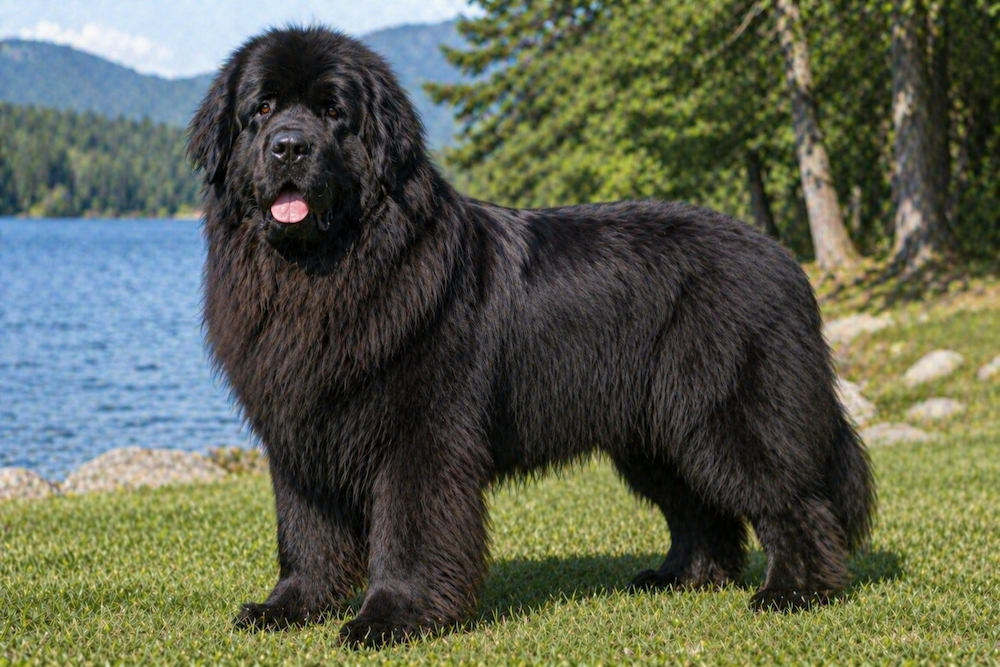






Gentle, powerful, and incredibly loyal — a giant companion with a calm and loving nature.
🧠 QUICK SNAPSHOT
- Temperament: Gentle, calm, protective
- Energy Level: Moderate
- Size: Giant
- Good With Families: Yes
- Trainability: Moderate
- Grooming: High
- Best For: Families with space, calm households
📚 OVERVIEW
The Newfoundland is a large, powerful breed known for its gentle temperament and natural swimming ability. Often referred to as a “gentle giant,” they are incredibly patient and affectionate, especially with children.
They thrive in environments where they have space and close contact with their family.
✅ PROS & CONS
Pros
- Extremely gentle and affectionate
- Great with children
- Calm and patient nature
- Strong and capable swimmer
Cons
- Very large size requires space
- Heavy shedding and grooming needs
- Can drool significantly
- Needs regular care and maintenance
Is a Newfoundland a Good Family Dog?
Yes. The Newfoundland is renowned as a gentle, affectionate, patient and devoted family dog.
Despite its enormous size, a well-socialised Newfoundland is typically calm and good-natured around the home. The breed has an especially strong reputation for patience with children.
However, families need enough space, time and budget to manage a dog that can weigh more than many adults.
Are Newfoundlands Good With Children?
Generally, yes.
Newfoundlands have such a strong reputation for gentleness with children that they’re sometimes called “nanny dogs.” Their patient temperament can make them wonderful family companions.
However, they’re enormous dogs capable of accidentally knocking over a small child, so supervision remains essential.
How Much Exercise Does a Newfoundland Need?
Most adult Newfoundlands need around 45–60 minutes of moderate exercise each day.
They’re powerful working dogs but aren’t generally hyperactive.
Walking, swimming and controlled outdoor activities usually suit them better than repetitive high-impact exercise.
Is a Newfoundland a High-Energy Dog?
Usually not.
Newfoundlands tend to have moderate energy levels and are often surprisingly calm indoors.
They still require regular exercise to maintain healthy muscles, joints and body weight.
Is a Newfoundland Easy to Train?
Generally, yes.
Newfoundlands are intelligent, cooperative and usually eager to work with people.
Early training is particularly important because an untrained 60-kilogram dog can turn relatively minor behavioural problems into major logistical ones.
Are Newfoundlands Intelligent?
Yes.
Their historical work required them to make decisions in challenging environments, particularly around water.
Modern Newfoundlands can excel at obedience, water rescue, carting, therapy work and other activities requiring both intelligence and cooperation.
Are Newfoundlands Stubborn?
They can occasionally be independent, but they’re generally less stubborn than many guardian or terrier breeds.
Positive reinforcement and patient training usually work extremely well.
Harsh handling is unnecessary and can undermine the trust of this sensitive breed.
Does a Newfoundland Shed?
Yes — a lot.
Newfoundlands have a dense double coat and shed throughout the year, with particularly heavy seasonal shedding.
Anyone wanting a virtually hair-free home should probably keep scrolling through the breed directory.
Is a Newfoundland Hypoallergenic?
No.
Newfoundlands shed heavily and produce normal canine allergens.
They’re generally a poor choice for people seeking a low-shedding or allergy-friendly breed.
How Often Should You Groom a Newfoundland?
Usually at least two to three times per week, with more frequent grooming during heavy seasonal shedding.
Their dense coat can mat, particularly behind the ears, beneath the legs and around the furnishings.
Regular grooming also provides an opportunity to check the skin.
Does a Newfoundland Need Haircuts?
Routine full-body haircuts aren’t necessary.
The coat is naturally designed to protect the dog from cold and wet conditions.
Trimming around the feet and tidying furnishings may be useful, but shaving the entire double coat is generally unnecessary unless medically required.
Should You Shave a Newfoundland in Summer?
Generally, no.
The double coat provides insulation and protection from sunlight as well as cold.
Summer management should focus on shade, cool indoor spaces, fresh water, careful grooming and avoiding strenuous exercise during hot weather.
Do Newfoundlands Drool?
Yes.
Their loose lips and large jowls mean many Newfoundlands produce considerable amounts of drool.
Some individuals are messier than others, but prospective owners should expect water and saliva around bowls, floors, walls and occasionally ceilings.
Why Does a Newfoundland Drool So Much?
The structure of the lips and mouth allows saliva to escape more easily than in tight-lipped breeds.
Excitement, food and drinking can increase it considerably.
Keeping towels strategically positioned around the house is a surprisingly normal part of Newfoundland ownership.
What Health Problems Are Common in Newfoundlands?
Important concerns include hip and elbow dysplasia, heart disease, cystinuria, gastric dilatation-volvulus (bloat), orthopaedic problems and some eye conditions.
A particularly important inherited cardiac condition is subaortic stenosis.
Responsible breeders should perform appropriate health screening before breeding.
What Is Subaortic Stenosis in Newfoundlands?
Subaortic stenosis, or SAS, is a heart condition involving abnormal narrowing below the aortic valve.
Severity ranges from mild to potentially life-threatening.
Because Newfoundlands are among the breeds predisposed to SAS, cardiac screening of breeding dogs is particularly important.
What Is Cystinuria in Newfoundlands?
Cystinuria is an inherited disorder affecting the kidneys’ handling of certain amino acids.
Cystine can accumulate in the urine and form stones, potentially causing urinary obstruction.
Genetic testing can help breeders reduce the risk of producing affected puppies.
Are Newfoundlands Prone to Hip Dysplasia?
Yes.
Their large size and rapid growth make good hip development particularly important.
Responsible breeding, controlled puppy growth, appropriate exercise and maintaining a lean body condition can all help reduce unnecessary stress on developing joints.
Are Newfoundlands Prone to Bloat?
Yes.
As a large, deep-bodied breed, Newfoundlands can develop gastric dilatation-volvulus (GDV).
The stomach fills with gas and may twist, cutting off blood supply.
GDV is a life-threatening emergency requiring immediate veterinary treatment.
How Long Does a Newfoundland Live?
Newfoundlands generally live around 8–10 years.
Unfortunately, giant breeds typically have shorter lifespans than smaller dogs.
Responsible breeding, maintaining a healthy weight and good preventive veterinary care can help maximise both lifespan and quality of life.
How Big Does a Newfoundland Get?
Newfoundlands are giant dogs.
Adult males commonly stand around 71 cm at the shoulder and may weigh approximately 60–70 kg, while females are generally around 66 cm and approximately 45–55 kg.
Some individuals are considerably larger.
Is a Newfoundland a Giant Breed?
Yes.
The Newfoundland is firmly classified as a giant dog breed.
Its huge skeleton, powerful musculature and substantial coat can make an adult appear even larger than its already impressive measurements suggest.
When Is a Newfoundland Fully Grown?
Newfoundlands can approach adult height by around 18 months, but physical development continues much longer.
Many don’t fully mature in body until around two to three years old.
Their growth should be carefully managed rather than accelerated.
How Fast Should a Newfoundland Puppy Grow?
Slow, controlled growth is preferable to making a giant-breed puppy grow as quickly as possible.
A nutritionally balanced diet formulated for large or giant-breed puppies helps manage energy and mineral intake.
Excess weight places unnecessary strain on developing joints.
Should Newfoundland Puppies Take Calcium Supplements?
Not unless specifically recommended by a veterinarian.
A correctly formulated giant-breed puppy food should already contain appropriately balanced minerals.
Unnecessary calcium supplementation can interfere with normal skeletal development.
Is There a Miniature Newfoundland?
No.
There is no recognised Miniature Newfoundland.
Dogs marketed under that description may be unusually small Newfoundlands or crosses designed to resemble them.
Can a Newfoundland Live in an Apartment?
Potentially, but it’s not ideal for everyone.
Newfoundlands are relatively calm indoors, which can make them surprisingly adaptable behaviourally.
The practical issue is accommodating a 50–70 kg dog, enormous bed, giant food bowls, wet coat, shedding and drool in limited space.
Does a Newfoundland Need a Big Backyard?
Not necessarily, although space is certainly helpful.
A Newfoundland still needs structured exercise rather than simply being left in a garden.
Access to cool, secure outdoor space is useful, particularly in mild climates.
Can a Newfoundland Be Left Alone?
Adult Newfoundlands can learn to tolerate reasonable periods alone.
However, they’re highly social dogs that historically worked closely with people.
They generally don’t thrive when routinely isolated from their families for long periods.
Are Newfoundlands Prone to Separation Anxiety?
Some can be.
Their strong attachment to people means independence training should begin gradually.
Exercise, enrichment and a predictable routine can help dogs relax when family members are away.
Are Newfoundlands Velcro Dogs?
Many are.
Despite occupying an enormous amount of physical space, Newfoundlands often want to remain very close to their people.
Personal space can become more theoretical than practical.
Are Newfoundlands Cuddly?
Very often.
Many are gentle, physically affectionate dogs that enjoy leaning against or lying beside their owners.
The main obstacle to lap-dog behaviour is that nobody has successfully explained to the Newfoundland that it isn’t one.
Are Newfoundlands Good With Other Dogs?
Generally, yes.
Their typical temperament is sociable and relatively tolerant.
Early socialisation remains important, particularly because their enormous size can intimidate smaller dogs even when their intentions are friendly.
Are Newfoundlands Good With Cats?
Many can live successfully with cats.
Their prey drive is generally less intense than that of many hunting and terrier breeds.
Careful introductions are still necessary.
Do Newfoundlands Have a Strong Prey Drive?
Usually not exceptionally strong.
Their historical work centred on hauling, water work and helping people rather than independently hunting prey.
Individual dogs can still chase wildlife.
Are Newfoundlands Aggressive?
Aggression isn’t characteristic of a well-bred Newfoundland.
The breed is famous for its gentle, steady and benevolent temperament.
Poor breeding, fear, pain or inadequate socialisation can still cause behavioural problems in any dog.
Are Newfoundlands Protective?
They can be naturally watchful and devoted without being highly aggressive.
Their enormous size alone provides an impressive deterrent.
Many Newfoundlands are more inclined to position themselves between their family and something concerning than immediately react aggressively.
Are Newfoundlands Good Guard Dogs?
They’re generally better described as protective companions and watchdogs than specialist guard dogs.
They may alert to unusual activity and their appearance is formidable.
However, the traditional Newfoundland temperament emphasises gentleness rather than aggressive property defence.
Do Newfoundlands Bark a Lot?
Usually not excessively.
They may bark to alert their family or communicate excitement.
Chronic barking is less characteristic than in many smaller watchdog breeds.
Are Newfoundlands Friendly With Strangers?
Usually.
A well-socialised Newfoundland is generally calm and approachable around unfamiliar people.
Some individuals may initially be reserved, but indiscriminate suspicion isn’t typical.
When Does a Newfoundland Calm Down?
Many begin becoming noticeably more settled between two and three years old.
Newfoundland puppies can be surprisingly energetic, clumsy and mischievous.
The transformation from enormous adolescent to dignified adult may take considerably longer than owners initially expect.
Are Newfoundland Puppies Difficult?
They can be challenging simply because they become enormous very quickly.
Jumping, pulling on the lead or stealing objects may seem amusing in a small puppy but become dramatically less convenient months later.
Training polite behaviour early is essential.
Are Newfoundlands Good Off Leash?
Many can develop reliable recall because they’re generally cooperative and people-oriented.
Training should still be thorough.
Their size means owners need excellent control around other people, dogs and wildlife.
Are Newfoundlands Good Walking Dogs?
Yes.
They generally enjoy steady daily walks.
They’re better suited to moderate sustained exercise than constant high-speed activity.
Are Newfoundlands Good Running Dogs?
They’re not ideal long-distance running companions.
Their giant size places substantial stress on joints, and they’re particularly vulnerable to overheating.
Walking, swimming and controlled hiking are generally more appropriate.
Are Newfoundlands Good Hiking Dogs?
Healthy adults can enjoy moderate hiking, particularly in cool weather.
Distance and terrain should be appropriate for a giant breed.
Heat management is crucial because their dense coat can make warm-weather hiking dangerous.
Can Newfoundlands Swim?
Absolutely.
Swimming is one of the activities most strongly associated with the breed.
Newfoundlands are exceptionally powerful swimmers and have a remarkable historical reputation for water rescue.
Why Are Newfoundlands Such Good Swimmers?
Several physical characteristics help.
They have powerful bodies, substantial lung capacity, a dense water-resistant double coat and large feet.
Their swimming style and strong natural affinity for water make them exceptionally capable aquatic working dogs.
Do Newfoundlands Have Webbed Feet?
Their toes are connected by skin like those of other dogs, but Newfoundlands have large, broad paws with pronounced webbing between the toes.
These substantial feet provide useful surface area while swimming.
Calling them “webbed feet” is reasonable in everyday descriptions, although they’re not webbed like a duck’s feet.
What Swimming Stroke Does a Newfoundland Use?
Newfoundlands are often described as using a swimming action different from the simple dog paddle associated with many breeds.
Their powerful limbs can move in a more outward-and-downward motion, helping propel their enormous bodies through water.
Whatever terminology is used, they’re remarkably efficient swimmers.
Can a Newfoundland Rescue a Drowning Person?
A trained Newfoundland can perform extraordinary water-rescue tasks.
Dogs can swim to people in difficulty, carry flotation equipment, tow individuals through water and even pull small boats.
Modern water-rescue demonstrations preserve these traditional skills.
Can a Newfoundland Tow a Boat?
Yes.
Their enormous strength and swimming ability allowed Newfoundlands and related working dogs to tow small boats and lines through water.
This wasn’t simply a circus trick — it had genuine practical value to fishermen and coastal communities.
Can Newfoundlands Dive Underwater?
Some trained Newfoundlands will enter the water enthusiastically and can retrieve objects from beneath the surface.
They’re not specialist diving animals, but their confidence around water can be remarkable.
Do Newfoundlands Like Water Naturally?
Many do.
A strong affinity for water is deeply associated with the breed’s history.
However, individual dogs vary, and not every Newfoundland puppy automatically loves swimming.
Are Newfoundlands Good Water Rescue Dogs Today?
Yes.
Newfoundland clubs around the world conduct water-work and rescue-style trials that test swimming, retrieving, towing and lifesaving-related skills.
Some trained dogs also participate in genuine water-safety activities.
Can Newfoundlands Pull Carts?
Yes.
Carting and draft work are traditional Newfoundland activities.
Their enormous strength allowed them to transport loads on land when they weren’t working around water.
Modern draft competitions preserve these skills.
How Much Can a Newfoundland Pull?
A properly conditioned Newfoundland can move loads far heavier than its own body weight using an appropriate cart or harness.
However, dramatic record-style weights shouldn’t be treated as normal exercise.
Draft work requires correct equipment, conditioning and attention to joint health.
Do Newfoundlands Get Cold Easily?
Usually not.
Their dense double coat was developed for extremely challenging cold and wet environments.
Most healthy adults tolerate cold conditions exceptionally well.
Can Newfoundlands Handle Snow?
Yes.
They’re extremely well equipped for snow and cold weather.
Their thick coat, large body and substantial paws make them far more comfortable in winter conditions than many breeds.
Can Newfoundlands Handle Hot Weather?
Heat is one of their biggest environmental challenges.
Their giant body and dense coat make overheating a serious concern.
In warm climates, exercise should occur during cooler parts of the day, and access to air conditioning or other effective cooling can be extremely valuable.
Is a Newfoundland Suitable for Australia?
It can be, but heat management is essential.
Newfoundlands living in warmer parts of Australia need cool indoor environments, constant fresh water, shade and carefully timed exercise.
They’re much better adapted to Newfoundland winters than Australian summer heat.
What Does a Newfoundland Look Like?
The Newfoundland is a massive, powerful dog with a broad head, deep chest, strong limbs, substantial bone and dense water-resistant double coat.
Its expression should appear gentle rather than harsh.
Despite its size, a well-built Newfoundland should move smoothly and efficiently.
What Colours Can Newfoundlands Be?
Recognised colours vary somewhat between kennel organisations.
Commonly recognised colours include black, brown and black-and-white, while grey is accepted under some standards.
Black remains the colour most strongly associated with the breed.
Can a Newfoundland Be Brown?
Yes.
Brown is a well-established Newfoundland colour.
It can range from relatively light chocolate tones to deep dark brown.
Can a Newfoundland Be Black and White?
Yes.
Black-and-white Newfoundlands have an especially important place in breed history.
This colour pattern is commonly associated with the name Landseer.
What Is a Landseer Newfoundland?
A Landseer Newfoundland is generally a predominantly white Newfoundland with distinctive black markings.
The name comes from British painter Sir Edwin Landseer, who famously depicted black-and-white Newfoundland-type dogs.
However, “Landseer” doesn’t mean exactly the same thing everywhere.
Is the Landseer a Separate Breed?
It depends on the kennel system.
In some countries, the Landseer European Continental Type is recognised as a separate breed.
Elsewhere, black-and-white is simply recognised as a Newfoundland colour pattern.
The two usages shouldn’t be confused.
Who Was Sir Edwin Landseer?
Sir Edwin Landseer was a famous 19th-century British artist particularly celebrated for his paintings of animals.
His paintings of black-and-white Newfoundland-type dogs became so influential that the colour pattern eventually became associated with his name.
What Is the Famous Landseer Painting of a Newfoundland?
One of the most famous is A Distinguished Member of the Humane Society, painted in 1838.
It depicts a magnificent black-and-white Newfoundland-type dog named Bob.
The painting helped cement the breed’s association with lifesaving and noble character.
Who Was Bob the Newfoundland?
Bob was the dog depicted in Landseer’s famous painting A Distinguished Member of the Humane Society.
Stories associated with Bob credited him with saving numerous people from drowning in London.
Some details have become embellished through retelling, but Bob became one of the most iconic lifesaving dogs in art.
Can a Newfoundland Be Grey?
Grey Newfoundlands occur genetically and are accepted by some kennel organisations, including the AKC.
Other breed standards don’t accept every colour in the same way.
Recognition therefore depends on the country and registry.
Can a Newfoundland Be White?
A nearly all-white dog wouldn’t represent the classic Newfoundland colour pattern.
Traditional black-and-white Newfoundlands have white backgrounds with characteristic black areas.
Breed standards specify preferred markings.
Can a Newfoundland Be Merle?
Merle isn’t a traditional Newfoundland colour.
A dog marketed as a “rare merle purebred Newfoundland” should raise questions about ancestry.
Merle isn’t simply an uncommon established colour within the breed.
Is a Newfoundland the Same as a Saint Bernard?
No.
Both are giant breeds famous for rescue associations, but they developed in completely different environments.
The Newfoundland was shaped around Canadian maritime work, while the Saint Bernard developed in the Swiss Alps.
Is a Newfoundland Related to the Labrador Retriever?
Yes, historically.
Both breeds ultimately emerged from working dog populations associated with Newfoundland and Labrador in Canada.
Their histories intersect through the famous St. John’s water dogs.
Is a Newfoundland Just a Giant Labrador?
No.
The breeds share regional historical connections but developed into very different dogs.
The Newfoundland became a massive hauling and water-rescue dog, while the Labrador developed as a smaller, more athletic retrieving breed.
Is a Newfoundland Related to the St. John’s Water Dog?
Yes.
The extinct St. John’s water dog is central to the history of several modern retriever breeds and Newfoundland-associated dogs.
The exact historical relationships among Newfoundland’s working dog populations are complicated, but the region’s water dogs ultimately influenced both Newfoundlands and Labradors.
What Was the St. John’s Water Dog?
The St. John’s water dog was a working dog from Newfoundland used by fishermen.
It was generally smaller and shorter-coated than the modern Newfoundland.
Its descendants and exported dogs contributed enormously to the development of Labrador Retrievers and other retrievers in Britain.
Where Does the Newfoundland Dog Come From?
The Newfoundland developed on the island of Newfoundland in what is now Canada.
Dogs working alongside fishermen were selected for strength, swimming ability, tolerance of cold water and willingness to cooperate with people.
The harsh North Atlantic environment profoundly shaped the breed.
What Was the Newfoundland Originally Bred For?
Newfoundlands were versatile working dogs associated particularly with fishermen and coastal communities.
Their jobs included retrieving objects from the water, carrying lines between boats and shore, towing small craft, hauling loads and assisting people in danger.
Their famous lifesaving reputation grew naturally from these abilities.
Did Newfoundland Dogs Work on Fishing Boats?
Yes.
Dogs accompanied fishermen and performed practical jobs both aboard vessels and around shore.
A powerful swimming dog capable of retrieving equipment or carrying a rope through rough water could be genuinely valuable.
Did Newfoundland Dogs Pull Fishing Nets?
They’re historically associated with helping fishermen retrieve equipment, lines and nets.
Accounts vary in detail, and romantic retellings can exaggerate particular tasks.
What is clear is that these dogs were versatile maritime workers rather than purely decorative companions.
Why Did Fishermen Need Newfoundland Dogs?
Fishing around Newfoundland involved freezing water, rough seas, heavy equipment and dangerous working conditions.
A strong, water-loving dog could retrieve objects, carry lines, haul loads and potentially assist a person who fell overboard.
Few environments could have produced a more appropriate breed for aquatic rescue.
What Dogs Created the Newfoundland?
The precise ancestry isn’t completely documented.
European dogs brought to Newfoundland by fishermen and settlers mixed with established local working populations over generations.
Various mastiff-type and water-dog ancestries have been proposed, but simple recipes assigning the breed to one or two ancestors should be treated cautiously.
Did Vikings Create the Newfoundland Dog?
There are theories connecting large dogs brought by Norse explorers to Newfoundland’s later dog populations.
However, there’s insufficient evidence to claim that Vikings directly created the modern Newfoundland breed.
The breed’s documented development occurred much later through working dog populations on the island.
Is the Newfoundland Related to the Great Pyrenees?
Great Pyrenees ancestry has sometimes been proposed in historical theories about Newfoundland development.
European fishing fleets could certainly transport dogs across the Atlantic.
However, the exact contribution of particular European breeds remains uncertain.
Is the Newfoundland Related to Mastiffs?
Mastiff-type ancestry has long been proposed as part of the breed’s background.
Its enormous size, bone and head make the suggestion plausible.
However, Newfoundland’s early working population developed before modern pedigree documentation could provide a neat genetic recipe.
What Were Greater and Lesser Newfoundland Dogs?
Historical accounts sometimes distinguished between larger Newfoundland dogs and smaller working water dogs from the region.
The larger dogs contributed to the modern Newfoundland, while smaller St. John’s-type dogs became especially influential in Britain’s retriever development.
The terminology wasn’t always used consistently.
How Did Newfoundland Dogs Reach Britain?
British fishermen and merchants had extensive connections with Newfoundland.
Working dogs from the island were imported to Britain, where their swimming ability, retrieving instincts and temperament attracted considerable attention.
British breeders then played an important role in standardising the modern breed.
Did Newfoundlands Help Create Other Dog Breeds?
Yes.
Dogs exported from Newfoundland had an enormous influence on British retriever development.
The region’s smaller St. John’s dogs were particularly important ancestors of the Labrador Retriever, Flat-Coated Retriever and other retriever lines.
Large Newfoundland-type dogs also influenced other working breeds.
Did the Newfoundland Help Create the Leonberger?
Newfoundland and Landseer-type dogs were among the breeds traditionally associated with the early development of the Leonberger in Germany.
Heinrich Essig’s breeding programme is generally described as involving Newfoundland/Landseer-type dogs alongside Saint Bernard and Pyrenean-type ancestry.
Why Did Newfoundlands Become Famous as Lifesaving Dogs?
Their combination of strength, swimming ability, cold-water tolerance, intelligence and cooperative temperament made them exceptionally suited to rescue.
Stories of individual dogs saving drowning people circulated widely during the 18th and 19th centuries.
Artists and writers then helped transform those real working abilities into an international reputation.
Who Was Seaman the Newfoundland?
Seaman was the famous Newfoundland dog that accompanied explorers Meriwether Lewis and William Clark during their expedition across North America from 1804 to 1806.
He travelled thousands of kilometres with the expedition.
References in expedition journals confirm that he was far more than a later legend.
What Did Seaman Do on the Lewis and Clark Expedition?
Seaman served as a companion and useful working dog.
Journal accounts describe him retrieving game, dealing with wildlife and travelling through extraordinarily difficult conditions alongside the expedition.
His survival across such an immense journey demonstrates the toughness behind the Newfoundland’s gentle modern image.
Did Lewis and Clark Really Have a Newfoundland?
Yes.
Meriwether Lewis purchased Seaman before the expedition.
The dog appears repeatedly in expedition records, making him one of the best-documented individual dogs in early American exploration history.
Who Was Boatswain the Newfoundland?
Boatswain was the beloved Newfoundland of poet Lord Byron.
When Boatswain died in 1808, Byron had a monument built for him at Newstead Abbey and wrote the famous Epitaph to a Dog.
The memorial is extraordinarily large and demonstrates the depth of Byron’s attachment to his dog.
What Did Lord Byron Write About His Newfoundland?
Byron’s famous epitaph praised Boatswain’s loyalty and virtues while contrasting them with human shortcomings.
The memorial helped reinforce the Newfoundland’s 19th-century reputation for loyalty, nobility and devotion.
Boatswain remains one of history’s most famous literary dogs.
Was Lord Byron’s Dog’s Tomb Bigger Than His Own?
Boatswain’s monument at Newstead Abbey is famously substantial and is often described as larger or grander than Byron’s own eventual memorial arrangements.
Byron reportedly intended to be buried near his dog.
The story has become one of the most memorable examples of a famous person’s devotion to a pet.
Did Napoleon Bonaparte Have an Encounter With a Newfoundland?
A famous story claims that during Napoleon’s escape from Elba in 1815, he fell into the water and was rescued by a fisherman’s Newfoundland.
The tale is widely repeated in breed histories.
However, the documentary evidence isn’t strong enough to treat every detail as firmly established historical fact.
Who Was Swansea Jack?
Swansea Jack was a famous black dog from Wales credited with rescuing numerous people from the water during the 1930s.
He’s commonly described as a Newfoundland or Newfoundland-type dog.
His lifesaving exploits earned widespread recognition and made him one of Britain’s most celebrated rescue dogs.
How Many People Did Swansea Jack Save?
Accounts commonly credit Swansea Jack with more than 20 rescues, although exact totals vary between sources.
He became internationally famous and received awards for bravery.
Whatever the precise number, his documented reputation as a lifesaving dog was extraordinary.
Did Newfoundlands Work During Shipwrecks?
Newfoundland-type dogs became strongly associated with ships, harbours and coastal rescue.
Their ability to swim through rough water while carrying ropes made them useful during maritime emergencies.
Some historical rescue stories have undoubtedly grown in the retelling, but the breed’s underlying lifesaving abilities are genuine.
Did Newfoundlands Serve in Wars?
Newfoundlands and Newfoundland-type dogs have served in military contexts as messengers, draft dogs, mascots and companions.
Their strength and trainability made them useful for transporting equipment.
Individual wartime dogs also became famous for particular acts of courage.
Who Was Gander the Newfoundland?
Gander was a Newfoundland who served with Canadian soldiers during the Second World War.
He became famous for his actions during the Battle of Hong Kong in 1941.
Accounts describe him confronting enemy soldiers and ultimately carrying away a thrown grenade, which exploded and killed him while helping protect Canadian troops.
Did Gander Receive a Medal?
Yes.
Gander was posthumously awarded the Dickin Medal in 2000, an award recognising conspicuous gallantry or devotion to duty by animals in wartime.
His story is one of the most remarkable chapters in Newfoundland history.
Was Nana From Peter Pan a Newfoundland?
Nana, the Darling family’s nursemaid dog in J. M. Barrie’s Peter Pan, is strongly associated with the Newfoundland.
Barrie’s own Newfoundland, Luath, helped inspire the character.
Some stage and film versions have depicted Nana differently, including as a Saint Bernard.
Did J. M. Barrie Own a Newfoundland?
Yes.
Barrie owned a Newfoundland named Luath.
The dog influenced his portrayal of Nana, helping cement the Newfoundland’s cultural image as a patient and protective companion to children.
Why Is the Newfoundland Called a Nanny Dog?
Its reputation for gentleness around children was reinforced by generations of family ownership and popular culture.
Nana from Peter Pan became perhaps the most famous fictional example.
“Nanny dog” is an affectionate description rather than a reason to leave any dog unsupervised with children.
Are Newfoundlands Still Working Dogs?
Yes.
Although most are now companions, Newfoundlands continue participating in water rescue, water trials, carting, draft work, therapy programmes and other working activities.
These activities preserve skills closely connected to the breed’s original purpose.
Are Newfoundlands Used in Real Water Rescue Teams?
Yes, particularly in parts of Europe.
Specially trained Newfoundlands and related water-rescue breeds can work alongside human rescue teams.
Their ability to tow people and equipment remains genuinely useful rather than merely historical.
Why Are Newfoundlands So Gentle Despite Their Size?
Temperament was crucial to their historical usefulness.
A dog working closely with fishermen and potentially assisting people in distress needed strength without uncontrolled aggression.
Generations of selection for cooperation and steadiness helped create the characteristic gentle temperament.
Is a Newfoundland a Good Dog for Older People?
Potentially, but practical handling needs careful consideration.
Their calm temperament can be ideal, but an adult Newfoundland may weigh 50–70 kg.
Owners need enough physical ability and support to manage grooming, transport and veterinary care.
Is a Newfoundland a Good First Dog?
Potentially, although its size makes mistakes expensive.
Newfoundlands are generally trainable and forgiving, but first-time owners need to be prepared for giant-breed costs, heavy shedding, drool, grooming, joint management and early training.
Temperament may be relatively easy; logistics aren’t.
How Expensive Is a Newfoundland to Own?
Usually considerably more expensive than a medium-sized dog.
Food, medication, parasite prevention, grooming, beds, crates, boarding and veterinary procedures can all cost more because of the dog’s enormous size.
A giant breed should be budgeted for as a giant breed.
What Makes the Newfoundland Unique?
The Newfoundland is often described as a gentle giant, but that phrase barely captures what made this breed extraordinary.
It developed beside fishermen on the cold North Atlantic island of Newfoundland, where a dog couldn’t survive on good looks alone. These dogs swam through freezing water, retrieved equipment, carried lines between boats and shore, hauled loads and sometimes helped save people from drowning.
Their physical design reflects that history: an enormous powerful body, dense water-resistant coat, huge paws and exceptional swimming ability.
Then there are the dogs themselves.
Seaman crossed North America with Lewis and Clark.
Boatswain inspired Lord Byron to build one of history’s most famous monuments to a dog.
Gander died helping Canadian soldiers during the Battle of Hong Kong and was later awarded the Dickin Medal.
And the Newfoundland helped inspire Nana, the devoted canine nursemaid in Peter Pan.
Few breeds have combined enormous physical strength with such a persistent historical reputation for gentleness.
Perhaps that’s the Newfoundland’s greatest contradiction.
This is a dog powerful enough to tow a boat through the water — yet generations of people have trusted it to lie quietly beside their children.
And if you live with one today, its most frequent rescue operation may simply be saving unattended food from the kitchen bench.