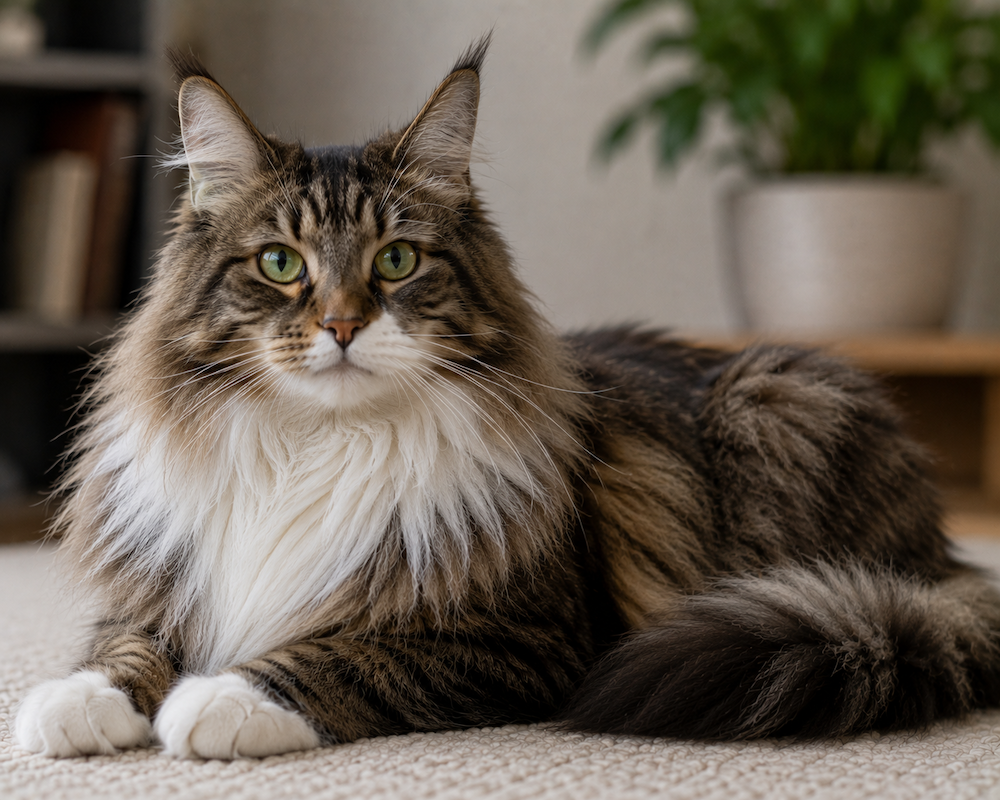







Majestic, intelligent, and built for the cold — a fluffy companion with a calm and adventurous spirit.
🧠 QUICK SNAPSHOT
- Temperament: Gentle, intelligent, independent
- Energy Level: Moderate
- Size: Large
- Good With Families: Yes
- Trainability: Moderate
- Grooming: Moderate to high
- Best For: Families, indoor living, spacious homes
📚 OVERVIEW
The Norwegian Forest Cat is a large, powerful breed known for its thick double coat and rugged appearance. Originally developed to survive harsh Scandinavian winters, they are agile climbers with a calm and affectionate nature.
They are independent but still enjoy companionship and tend to form strong bonds with their family.
✅ PROS & CONS
Pros
- Beautiful long, thick coat
- Calm and gentle temperament
- Intelligent and adaptable
- Great climbers and playful companions
Cons
- Requires regular grooming
- Heavy seasonal shedding
- Needs space and enrichment
- Can be reserved with strangers
Is a Norwegian Forest Cat a Good Family Cat?
Yes. The Norwegian Forest Cat can be an affectionate, gentle, intelligent and playful family companion.
Often called a “Wegie” by enthusiasts, the breed tends to form strong bonds with its household without necessarily demanding constant attention. Many enjoy being close to their people while retaining a confident, independent side.
Their sturdy build and generally even temperament can suit families well, provided children handle them respectfully.
Are Norwegian Forest Cats Good With Children?
Generally, yes.
They’re substantial, playful cats that are usually less physically delicate than many smaller breeds.
They often enjoy interactive play with children, but normal supervision is important, particularly with younger children.
How Much Exercise and Play Does a Norwegian Forest Cat Need?
Most benefit from several interactive play sessions each day plus opportunities to climb, explore and investigate.
They’re athletic cats rather than permanent sofa ornaments.
Tall cat trees, climbing shelves, puzzle feeders and hunting-style games are particularly appropriate.
Are Norwegian Forest Cats Active?
Yes.
They’re moderately to highly active, particularly when young.
Their activity often involves climbing and exploring rather than continuously racing around the house.
Are Norwegian Forest Cats Good Climbers?
Exceptional.
Climbing is one of the breed’s most characteristic abilities.
Their powerful bodies, strong legs and large paws allow them to climb surprisingly high, so a sturdy floor-to-ceiling cat tree can be an excellent investment.
Can Norwegian Forest Cats Climb Down Trees Headfirst?
They’re famous for being particularly capable climbers, and Norwegian Forest Cats are sometimes described as descending trees headfirst more readily than many cats.
Their strong claws and athletic build make them highly competent in trees.
That doesn’t mean every individual will demonstrate the behaviour.
Can Norwegian Forest Cats Jump High?
Yes.
They’re powerful jumpers despite their substantial size.
A Norwegian Forest Cat that wants access to a high shelf will usually regard height as a challenge rather than a prohibition.
Is a Norwegian Forest Cat Easy to Train?
Generally, yes.
They’re intelligent cats that can learn household routines, their names, tricks and harness walking.
Positive reinforcement using food, play and praise tends to work best.
Are Norwegian Forest Cats Intelligent?
Yes.
They’re curious, observant and capable problem-solvers.
Puzzle feeders, scent games and interactive toys can help keep them mentally stimulated.
Do Norwegian Forest Cats Play Fetch?
Some do.
Fetch isn’t universal, but intelligent, playful individuals can learn to retrieve toys.
Their willingness to interact with people makes trick training surprisingly successful.
Does a Norwegian Forest Cat Shed?
Yes — considerably.
The breed has a substantial double coat and typically experiences heavy seasonal shedding.
Spring can produce particularly impressive quantities of loose fur as the dense winter coat is released.
Is a Norwegian Forest Cat Hypoallergenic?
No.
Norwegian Forest Cats aren’t considered hypoallergenic.
Their abundant coat also means considerable fur can be distributed around the home.
How Often Should You Groom a Norwegian Forest Cat?
Usually around once or twice each week, increasing during seasonal shedding.
Despite its impressive length, the coat can be less prone to matting than some longhaired breeds because of its texture.
Areas behind the ears, under the legs and around the trousers still deserve particular attention.
Does a Norwegian Forest Cat Need Haircuts?
Generally, no.
Its natural coat is designed to provide protection from cold and wet conditions.
Regular brushing is usually preferable to cutting or shaving unless there’s a medical or severe matting issue.
Should You Shave a Norwegian Forest Cat in Summer?
Usually not.
The coat provides protection as well as insulation.
Instead, remove loose undercoat through regular grooming and provide a cool indoor environment during hot weather.
What Health Problems Are Common in Norwegian Forest Cats?
Important inherited concerns include hypertrophic cardiomyopathy (HCM), hip dysplasia and glycogen storage disease type IV (GSD IV).
Responsible breeders should use appropriate health screening and DNA testing where available.
Maintaining a healthy body weight is also important because excess weight places additional stress on the joints and cardiovascular system.
What Is Glycogen Storage Disease Type IV in Norwegian Forest Cats?
GSD IV is a serious inherited metabolic disorder particularly associated with the Norwegian Forest Cat.
Affected cats cannot process glycogen normally because of a deficiency involving the glycogen branching enzyme.
The condition can be fatal, but a DNA test is available, allowing responsible breeders to avoid producing affected kittens.
Are Norwegian Forest Cats Prone to HCM?
Hypertrophic cardiomyopathy can occur in the breed.
HCM causes abnormal thickening of the heart muscle and ranges considerably in severity.
Veterinary cardiac screening is important, particularly in breeding populations.
Are Norwegian Forest Cats Prone to Hip Dysplasia?
Yes.
Hip dysplasia isn’t exclusively a canine problem and can occur in cats, particularly larger breeds.
Affected cats may become reluctant to jump, develop stiffness or change how they move.
How Long Does a Norwegian Forest Cat Live?
Norwegian Forest Cats commonly live around 12–16 years, although individual lifespan varies.
Genetics, nutrition, weight, lifestyle and veterinary care all influence longevity.
How Big Does a Norwegian Forest Cat Get?
The Norwegian Forest Cat is a large breed.
Adult males commonly weigh around 5–9 kg, while females are generally smaller at approximately 3.5–7 kg.
Some individuals exceed these ranges, but enormous size shouldn’t be treated as the primary breeding objective.
How Long Does a Norwegian Forest Cat Take to Fully Grow?
They’re slow-maturing cats.
A Norwegian Forest Cat may take around four to five years to reach complete physical maturity.
This extended development is one reason young adults can continue filling out long after many other cats appear fully grown.
Is the Norwegian Forest Cat a Giant Cat Breed?
It’s generally considered a large cat breed, although “giant” is an informal description rather than a separate classification.
Large males can certainly look enormous because of their long bodies, heavy winter coats and substantial ruffs.
Is There a Miniature Norwegian Forest Cat?
No.
There’s no recognised Miniature Norwegian Forest Cat.
An unusually small individual may simply be at the lower end of the natural size range or have other ancestry.
Can a Norwegian Forest Cat Live in an Apartment?
Yes, provided its environment offers sufficient vertical space and enrichment.
A Norwegian Forest Cat may value climbing territory more than enormous floor space.
Tall, sturdy cat trees and wall-mounted climbing systems can make apartment life much more interesting.
Can a Norwegian Forest Cat Live Indoors?
Yes.
Norwegian Forest Cats can live very successfully indoors when given exercise, climbing opportunities, scratching surfaces and mental stimulation.
A secure catio provides an excellent way to offer outdoor experiences without unrestricted roaming.
Do Norwegian Forest Cats Need to Go Outside?
No.
Outdoor access isn’t essential.
Harness walks, secure enclosures and indoor enrichment can provide stimulation without exposing the cat to traffic, predators, disease or other outdoor hazards.
Can You Walk a Norwegian Forest Cat on a Harness?
Yes.
Many intelligent, confident individuals can learn to enjoy harness walking.
Training should begin gradually indoors before moving into quiet outdoor environments.
Do Norwegian Forest Cats Need Special Cat Furniture?
They benefit enormously from large, sturdy climbing furniture.
Lightweight cat trees designed for small cats may wobble under a large adult male.
Platforms should be substantial enough for the cat to stretch out comfortably.
Are Norwegian Forest Cats Cuddly?
Many are affectionate, but they aren’t universally lap cats.
A Norwegian Forest Cat may prefer sitting beside its owner rather than directly on them.
Their affection can be strong without being excessively demanding.
Are Norwegian Forest Cats Lap Cats?
Some are, but many prefer being near you rather than on you.
This makes them appealing to people who want an affectionate cat with a degree of independence.
Individual personality remains more important than breed stereotypes.
Are Norwegian Forest Cats Velcro Cats?
Usually not in the extreme sense.
They often form close relationships with their families but tend to retain some independence.
A Wegie may follow you into another room and then choose the chair beside you rather than occupying your lap.
Can Norwegian Forest Cats Be Left Alone?
Adult cats can generally tolerate reasonable periods alone when their physical and emotional needs are met.
Interactive toys, climbing structures, window views and puzzle feeders can provide enrichment.
They still require regular companionship and shouldn’t simply be treated as self-sufficient decoration.
Are Norwegian Forest Cats Good With Other Cats?
Generally, yes.
Their typically calm, confident temperament can make them compatible with other cats when introductions are handled properly.
Individual personality remains important.
Are Norwegian Forest Cats Good With Dogs?
They often can be.
A confident Norwegian Forest Cat can live successfully with a respectful, cat-friendly dog.
Gradual introductions and high escape spaces are important.
Do Norwegian Forest Cats Have a Strong Prey Drive?
Yes.
Their ancestors survived partly through hunting in rural environments.
Modern Norwegian Forest Cats may enthusiastically stalk insects, toys, rodents and birds.
Are Norwegian Forest Cats Good Mousers?
Historically, they developed a reputation as effective hunters around farms, barns and rural settlements.
Their size doesn’t make them slow or clumsy.
They remain athletic cats with normal feline hunting instincts.
Are Norwegian Forest Cats Vocal?
Usually they’re moderately vocal rather than exceptionally noisy.
Many communicate with soft meows, chirps and trills.
Individual variation can be considerable.
Do Norwegian Forest Cats Like Water?
Some show unusual curiosity around water.
Their water-resistant coat may make getting wet less inconvenient than it is for some cats.
However, enthusiasm for swimming isn’t a universal breed characteristic.
Can Norwegian Forest Cats Swim?
Physically, yes.
Cats are generally capable of swimming when necessary.
The Norwegian Forest Cat’s weather-resistant coat is useful in damp environments, but this doesn’t make it a specialised aquatic breed.
Do Norwegian Forest Cats Get the Zoomies?
Absolutely.
Their dignified appearance can disappear remarkably quickly when an adult Wegie decides to sprint through the house.
Because they’re large, their zoomies can sound more substantial than those of a tiny cat.
When Does a Norwegian Forest Cat Calm Down?
Many become more settled between three and five years old, corresponding with their slow physical maturation.
They often remain playful throughout adulthood.
A mature Norwegian Forest Cat can therefore combine a calm household temperament with occasional impressive bursts of activity.
Do Norwegian Forest Cats Like High Places?
Very much.
Height provides security, observation points and an outlet for natural climbing behaviour.
Owners should assume that tall furniture is potentially accessible rather than expecting the cat to respect human definitions of “too high.”
Why Does My Norwegian Forest Cat Sit on Top of Everything?
High positions provide an excellent view of the environment.
For a cat descended from highly capable climbers, the top of a bookcase can look far more logical than the expensive bed placed on the floor.
What Does a Norwegian Forest Cat Look Like?
The Norwegian Forest Cat is a large, powerful, semi-longhaired cat with a triangular head, straight profile, substantial body, tufted ears, large paws and long bushy tail.
The coat forms an impressive ruff around the neck and heavier trousers around the hindquarters.
Its appearance should remain natural and athletic rather than excessively exaggerated.
Why Does a Norwegian Forest Cat Have Such a Thick Coat?
The breed developed in Norway’s cold, wet climate.
Its coat combines a dense insulating undercoat with longer protective guard hairs that help repel moisture.
The result is a remarkably effective natural winter jacket.
Is a Norwegian Forest Cat’s Coat Waterproof?
It’s better described as water-resistant.
The glossy outer guard hairs help shed moisture while the dense undercoat provides insulation.
This would have been extremely useful to cats surviving outdoors in Scandinavian weather.
Why Does a Norwegian Forest Cat Have a Neck Ruff?
The thick ruff provides additional insulation around the neck and chest.
It becomes particularly dramatic in the winter coat.
During warmer seasons, a Norwegian Forest Cat can look surprisingly less enormous after shedding much of its undercoat.
Why Does a Norwegian Forest Cat Have a Bushy Tail?
The long, heavily furnished tail provides warmth as well as balance.
A resting cat can curl its tail around its body for additional insulation.
It also assists balance while climbing.
Why Do Norwegian Forest Cats Have Tufted Paws?
Hair between the toes helps provide insulation against cold surfaces.
The large paws also spread the cat’s weight over snow more effectively than small, narrow feet would.
They’re essentially natural feline winter boots.
Do Norwegian Forest Cats Have Lynx Tips on Their Ears?
Many have noticeable tufts of hair extending from the ear tips.
These are sometimes called lynx tips because they resemble those of a lynx.
They don’t indicate any actual lynx ancestry.
Is a Norwegian Forest Cat Part Lynx?
No.
The Norwegian Forest Cat is a domestic cat.
Its large body, tufted ears and wild appearance may resemble a lynx, but there’s no need for wild-cat ancestry to explain those features.
What Colours Can Norwegian Forest Cats Be?
Norwegian Forest Cats occur in a wide variety of colours and patterns, including black, white, blue, red, cream, tabby, tortoiseshell and combinations with white.
Some colour patterns are excluded under particular breed standards.
The natural breed isn’t defined by one specific coat colour.
Can a Norwegian Forest Cat Be Black?
Yes.
Solid black Norwegian Forest Cats occur.
Their long coat and large silhouette can give black individuals an especially dramatic appearance.
Can a Norwegian Forest Cat Be White?
Yes.
White Norwegian Forest Cats occur and can be striking.
As with white cats generally, congenital deafness can be associated particularly with white cats carrying blue eyes, although not every white cat is deaf.
Can a Norwegian Forest Cat Be Orange?
Yes.
Red, commonly called orange or ginger, is an established colour.
Red tabbies can be particularly striking with the breed’s substantial winter coat.
Can a Norwegian Forest Cat Be Calico?
Yes.
Tortoiseshell-and-white combinations can produce what is commonly called calico.
As in other cats, almost all calicos are female because of the genetics controlling orange and black colouring.
Can a Norwegian Forest Cat Have Blue Eyes?
Blue eyes can occur in genetically appropriate cats, particularly white individuals.
Eye colour isn’t what defines the breed.
Breed standards permit various eye colours depending on the organisation and coat genetics.
Can a Norwegian Forest Cat Be Colourpoint?
Traditional Norwegian Forest Cat standards generally don’t accept the Siamese-style colourpoint pattern.
A pointed cat resembling a Norwegian Forest Cat may therefore have different ancestry.
Can a Norwegian Forest Cat Be Merle?
No.
Merle isn’t a normal domestic-cat coat pattern equivalent to the merle gene familiar in dogs.
Claims about “rare merle Norwegian Forest Cats” should therefore be treated extremely cautiously.
What Is the Difference Between a Norwegian Forest Cat and a Maine Coon?
Both are large, semi-longhaired natural breeds adapted to cold climates, but they’re distinct cats.
The Norwegian Forest Cat typically has a triangular head with a straight profile, while the Maine Coon is known for a broader, more square muzzle and rectangular body.
The Maine Coon developed in North America, while the Norwegian Forest Cat developed in Scandinavia.
Is a Norwegian Forest Cat Bigger Than a Maine Coon?
Usually not.
Both are large breeds, but Maine Coons generally reach greater average sizes and include some exceptionally long individuals.
A large male Norwegian Forest Cat is still an impressively substantial animal.
Is a Norwegian Forest Cat Related to the Maine Coon?
They’re separate natural breeds.
Theories have proposed historical connections through seafaring cats, including Scandinavian cats potentially reaching North America.
However, there’s no need to claim a simple direct Norwegian-Forest-Cat-to-Maine-Coon ancestry without stronger evidence.
What Is the Difference Between a Norwegian Forest Cat and a Siberian Cat?
Both are large northern longhaired breeds, but they developed independently.
The Siberian originated in Russia and generally has a more rounded overall appearance.
The Norwegian Forest Cat is particularly characterised by its triangular head, straight profile and distinctive Scandinavian forest-cat type.
Is a Norwegian Forest Cat the Same as a Siberian?
No.
They’re completely separate recognised breeds.
Their similarities largely reflect comparable adaptation to harsh northern climates.
What Is the Difference Between a Norwegian Forest Cat and a Ragdoll?
The Ragdoll was deliberately developed as a companion breed in the United States and is colourpointed with blue eyes.
The Norwegian Forest Cat developed naturally in Scandinavia and occurs in many colours.
Wegies are also typically more athletic climbers and retain a stronger rustic working-cat character.
What Is the Difference Between a Norwegian Forest Cat and a Domestic Longhair?
A domestic longhair simply describes a mixed or unknown-ancestry cat with long fur.
A genuine Norwegian Forest Cat belongs to a documented pedigree population with a recognised breed standard.
Looking vaguely fluffy and Nordic doesn’t establish breed ancestry.
What Is a Norwegian Forest Cat Called in Norway?
The breed is known in Norwegian as the Norsk skogkatt.
That translates very naturally as Norwegian Forest Cat or “Norwegian forest cat.”
“Skog” means forest and “katt” means cat.
Why Is the Norwegian Forest Cat Called a Wegie?
“Wegie” is an affectionate English-language nickname derived from Norwegian.
It’s particularly common among breed enthusiasts.
It isn’t a separate variety or type of Norwegian Forest Cat.
Where Does the Norwegian Forest Cat Come From?
The Norwegian Forest Cat developed in Norway and the wider Scandinavian environment from domestic cats that adapted over generations to harsh northern conditions.
Its thick weather-resistant coat, powerful body and exceptional climbing ability suited life around forests, farms and rural settlements.
The modern pedigree breed was formally developed much later from these traditional Norwegian cats.
Is the Norwegian Forest Cat a Natural Breed?
Yes.
It’s generally regarded as a natural or landrace-derived breed, meaning its foundation came from a regional population shaped substantially by environment and practical survival rather than being created recently from a planned cross between two pedigree breeds.
Humans later standardised and selectively bred that existing population.
Is the Norwegian Forest Cat an Ancient Breed?
Its underlying Scandinavian cat population is old, but the modern pedigree breed is much newer.
Longhaired cats lived in Norway long before organised cat breeding.
It’s more accurate to distinguish between an old regional cat type and the modern registered Norwegian Forest Cat.
Did Norwegian Forest Cats Live With Vikings?
Cats certainly lived in Viking Age Scandinavia, but identifying those animals specifically as modern Norwegian Forest Cats would go beyond the evidence.
The modern breed hadn’t yet been standardised.
It’s reasonable to connect the breed with Norway’s long domestic-cat history without claiming a documented pedigree stretching directly back to individual Viking cats.
Did Vikings Take Cats on Their Ships?
Cats could travel aboard ships and with human settlements, and Norse communities certainly kept domestic cats.
Cats were useful for controlling rodents around food stores and settlements.
However, popular claims that today’s Norwegian Forest Cat was specifically a purpose-bred “Viking ship cat” are much harder to prove.
Were Norwegian Forest Cats Viking Mousers?
Their ancestors and other Scandinavian domestic cats would certainly have been capable mousers.
Rodent control was extremely valuable wherever humans stored food.
Calling the modern breed a Viking mouser is an appealing shorthand, but it shouldn’t imply that today’s pedigree breed already existed in its modern form.
Did Vikings Bring Longhaired Cats to Norway?
Several theories attempt to explain how the longhair genes entered Scandinavian cat populations.
Longhaired cats could have arrived through trade and movement of people, potentially from different parts of Europe and beyond.
There isn’t enough evidence to identify one specific group of travellers as the definitive source.
Is the Norwegian Forest Cat Related to Angora Cats?
Historical theories have proposed that longhaired cats arriving from elsewhere in Europe or through trade contributed to Scandinavian populations.
Angora-type cats are sometimes mentioned.
The precise ancestry of Norway’s old longhaired cat population isn’t documented well enough to provide a simple breed recipe.
Is the Norwegian Forest Cat Related to British Longhaired Cats?
Cats moved around Europe through trade, settlement and shipping for centuries.
Various European domestic-cat populations could have contributed genes to Scandinavian cats.
The Norwegian Forest Cat nevertheless developed into its distinctive form within Norway.
Did Natural Selection Create the Norwegian Forest Cat’s Coat?
Natural selection likely played an important role.
Cats better able to survive cold, snow, rain and long winters would have had an advantage in outdoor Scandinavian environments.
Over generations, dense insulation and protective outer hairs became characteristic of the regional population.
Did Norwegian Farmers Keep Forest Cats?
Yes.
Large longhaired cats were valuable around farms and rural settlements as companions and rodent hunters.
Their ability to tolerate severe weather made them particularly suited to Norwegian farm life.
Were Norwegian Forest Cats Working Cats?
In the practical sense, yes.
They weren’t “working cats” according to a formal occupational standard, but controlling rodents around barns, food stores and farms provided genuine economic value.
Their athleticism and hunting instincts weren’t merely decorative features.
Are Norwegian Forest Cats Mentioned in Norse Mythology?
Large or unusual cats feature prominently in Norse mythology and Scandinavian folklore.
However, mythological cats shouldn’t automatically be identified as pedigree Norwegian Forest Cats.
The connection is culturally fascinating, but mythology isn’t a breed registry.
What Cats Pulled Freyja’s Chariot?
In Norse mythology, the goddess Freyja is famously associated with a chariot drawn by cats.
Later popular culture frequently imagines them as enormous fluffy Norwegian Forest Cats.
The surviving medieval sources don’t provide enough breed-level detail to identify them as modern Wegies.
Were Freyja’s Cats Norwegian Forest Cats?
We don’t know.
It’s a wonderful modern association because Freyja is Scandinavian and the Norwegian Forest Cat is a large native Scandinavian cat.
But saying definitively that the myth describes Norwegian Forest Cats would turn an attractive interpretation into an unsupported historical claim.
Who Was Freyja?
Freyja is a major figure in Norse mythology associated with love, fertility, beauty, magic and other complex themes.
Her cat-drawn chariot is one of the most memorable feline images in Norse mythology.
This cultural connection has contributed significantly to the romantic image surrounding Norwegian Forest Cats.
Did Thor Encounter a Giant Cat?
Yes, in a famous Norse myth involving Útgarða-Loki, Thor is challenged to lift a cat.
He can raise only part of it from the ground.
The “cat” is eventually revealed to be the enormous Midgard Serpent, Jörmungandr, disguised through magic.
Was Thor’s Giant Cat a Norwegian Forest Cat?
No evidence establishes that.
Modern retellings sometimes connect giant Norse cats with the Norwegian Forest Cat because of the breed’s impressive size and Scandinavian origin.
It’s an entertaining cultural association, not proof of ancient breed identity.
Are Norwegian Forest Cats Part of Norwegian Folklore?
Large forest-dwelling cats appear in Scandinavian folklore and fairy-tale traditions.
Norway’s traditional longhaired cats naturally became intertwined with this cultural imagery.
The modern breed’s dramatic appearance makes the connection particularly compelling.
What Is a Skogkatt in Norwegian Folklore?
Skogkatt literally means forest cat.
The term has become closely associated with the modern Norwegian Forest Cat.
Folkloric descriptions of enormous woodland cats should still be treated as folklore rather than literal documentation of pedigree animals.
Were Norwegian Forest Cats Thought to Climb Sheer Rock Faces?
Folklore surrounding Norwegian forest cats sometimes emphasises extraordinary climbing ability.
This probably reflects the genuine athleticism and powerful claws of regional cats, amplified through storytelling.
Modern Norwegian Forest Cats are certainly exceptional climbers without requiring supernatural assistance.
Did Norwegian Forest Cats Almost Become Extinct?
The traditional Norwegian forest-cat population came under pressure during the 20th century as uncontrolled crossbreeding with ordinary domestic cats threatened to dilute the distinctive type.
Enthusiasts recognised the need to preserve it.
Organised breeding became critical to establishing the modern breed.
When Did People Start Preserving the Norwegian Forest Cat?
Serious preservation efforts developed during the 20th century, particularly from the 1930s onward.
Norwegian cat enthusiasts began identifying and exhibiting cats representing the traditional forest-cat type.
The Second World War then disrupted much of that work.
Did World War II Affect the Norwegian Forest Cat?
Yes.
Organised breeding and preservation efforts were disrupted during the war.
Afterwards, enthusiasts had to continue rebuilding and formalising the population.
Without deliberate preservation, the traditional type might have been increasingly absorbed into Norway’s general domestic-cat population.
Who Helped Save the Norwegian Forest Cat?
Norwegian breeders and cat enthusiasts played the central role in preserving the breed during the 20th century.
Organised clubs established breeding programmes, documented pedigrees and worked toward international recognition.
The rescue of the breed was therefore a collaborative preservation effort rather than the work of one single founder.
Who Was Pans Truls?
Pans Truls became one of the most influential cats in modern Norwegian Forest Cat history.
Born during the 1970s, he strongly represented the type breeders were trying to establish.
His appearance became highly influential in shaping the modern breed standard.
Why Is Pans Truls Important?
Pans Truls is often described as a foundational or model Norwegian Forest Cat because his characteristics closely represented the emerging breed ideal.
His strong triangular head, coat and overall appearance helped breeders define what the modern Norwegian Forest Cat should look like.
He’s one of the names enthusiasts are most likely to encounter when exploring modern Wegie history.
When Was the Norwegian Forest Cat Officially Recognised?
International recognition advanced dramatically during the 1970s.
FIFe recognised the Norwegian Forest Cat as a pedigree breed in 1977, an important milestone that helped establish it internationally.
Recognition by other organisations followed.
Why Was 1977 Important for the Norwegian Forest Cat?
International recognition gave breeders a formal standard and allowed the breed to compete more widely at cat shows.
It also validated decades of Norwegian efforts to preserve a distinctive native cat population.
From there, the breed expanded well beyond Scandinavia.
When Did Norwegian Forest Cats Reach the United States?
Norwegian Forest Cats began becoming established in North America during the late 20th century.
Breeders imported cats from Europe and gradually developed American breeding programmes.
Major North American cat organisations subsequently recognised the breed.
When Did the CFA Recognise the Norwegian Forest Cat?
The Cat Fanciers’ Association accepted the Norwegian Forest Cat for championship competition in the 1990s, following its earlier introduction and development in North America.
This helped increase awareness of the breed in the United States.
Is the Norwegian Forest Cat Rare?
Globally, it’s less common than mainstream breeds such as the British Shorthair or Maine Coon, but it has an established international population.
It’s particularly important culturally in Norway.
Outside Europe, genuine pedigree Wegies may be considerably less common than cats simply advertised as “Norwegian Forest Cat mixes.”
Is the Norwegian Forest Cat Norway’s National Cat?
The Norwegian Forest Cat is widely regarded as Norway’s national cat and has become an important feline symbol of the country.
Its name, appearance, history and adaptation to Norway’s climate make the association particularly strong.
How Can You Tell if Your Cat Is a Norwegian Forest Cat?
Appearance alone can’t confirm pedigree ancestry.
A large longhaired cat with ear tufts and a bushy tail may resemble a Norwegian Forest Cat without having any Norwegian Forest Cat ancestry.
Reliable identification requires documented pedigree records or, in some circumstances, informed genetic ancestry analysis with significant limitations.
Are Most “Norwegian Forest Cat Mixes” Really Part Norwegian Forest Cat?
Not necessarily.
Long hair, large size and tabby colouring occur widely among ordinary domestic cats.
Without documented ancestry, “Norwegian Forest Cat mix” may simply describe a cat that resembles the breed.
Why Does My Norwegian Forest Cat Follow Me Everywhere?
They’re often strongly attached to their people while remaining relatively independent.
Following allows them to participate in household activity without necessarily demanding constant handling.
It’s essentially feline supervision performed from a respectable distance.
Why Does My Norwegian Forest Cat Chirp?
Chirps and trills can be forms of social communication, greeting or excitement.
Many Norwegian Forest Cats develop an expressive but relatively soft vocal repertoire.
The size of the cat doesn’t necessarily predict the size of the voice.
Why Does My Norwegian Forest Cat Sleep in Cold Places?
Its extraordinarily effective coat makes cooler environments comfortable.
A tiled floor, cool window ledge or chilly room that seems unpleasant to a human may feel perfect beneath a Scandinavian winter coat.
Why Does My Norwegian Forest Cat Prefer High Places?
Height provides safety, visibility and an opportunity to exercise natural climbing abilities.
For a cat whose ancestors survived in forests and rural Scandinavian environments, vertical movement was valuable.
The top of your wardrobe is simply the modern equivalent of a tree.
Why Does My Norwegian Forest Cat Have Such Huge Paws?
Large, well-furred paws are useful in snowy environments.
They distribute body weight across a wider surface and provide insulation against cold ground.
Combined with powerful claws, they also contribute to the breed’s exceptional climbing ability.
Why Does My Norwegian Forest Cat Look Much Bigger in Winter?
Seasonal coat development can dramatically change its appearance.
The winter coat develops a dense undercoat, large neck ruff, substantial trousers and extremely bushy tail.
After the spring shed, the same cat can appear to have mysteriously lost several kilograms without actually changing body weight.
Are Norwegian Forest Cats Good at Cat Shows?
Yes.
The breed is recognised by major international cat organisations and has a well-established show population.
Judges evaluate characteristics including head shape, profile, body structure, coat texture, tail and overall balance rather than simply rewarding the largest or fluffiest cat.
Are Norwegian Forest Cats Good Therapy Cats?
Individual Wegies with calm, sociable temperaments can make excellent therapy animals.
Their impressive appearance can attract attention while their generally gentle temperament can suit interaction.
Not every cat enjoys unfamiliar environments, so individual personality matters most.
Is a Norwegian Forest Cat Good for Older People?
Potentially, yes.
They’re affectionate without always being excessively demanding.
Owners need to be comfortable managing a large cat, substantial grooming and heavy seasonal shedding.
Is a Norwegian Forest Cat Good for First-Time Owners?
Yes, for owners prepared for the coat and activity level.
They’re generally intelligent, adaptable and affectionate.
The major practical considerations are grooming, shedding, climbing requirements, large equipment and responsible health screening.
What Makes the Norwegian Forest Cat Unique?
The Norwegian Forest Cat looks almost as though someone designed a domestic cat specifically for a Scandinavian winter.
But nobody needed to.
Generations of life in Norway helped do the job naturally.
It developed a dense insulating undercoat, long water-resistant guard hairs, huge furred paws, a magnificent bushy tail and a powerful body capable of climbing through challenging terrain.
For centuries, cats of this general type lived around Norwegian farms and settlements, where looking impressive was considerably less important than surviving winter and catching rodents.
Then there’s the mythology.
Norse goddess Freyja travelled in a chariot pulled by cats. Thor once tried to lift an apparently enormous cat that turned out to be the Midgard Serpent. Scandinavian folklore filled forests with extraordinary felines.
We can’t turn those mythical animals into registered Norwegian Forest Cats — the evidence simply isn’t there.
But it’s easy to understand why generations of people made the connection.
By the 20th century, Norway’s traditional longhaired cats were at risk of disappearing through unrestricted crossbreeding. Enthusiasts began preserving them, work was interrupted by the Second World War, and organised breeding eventually transformed the old regional forest cat into today’s recognised pedigree breed.
Cats such as Pans Truls helped define its modern appearance, and international recognition in the 1970s took the Norwegian Forest Cat from Norwegian farms to homes around the world.
Yet underneath the pedigree remains something wonderfully rustic.
It still climbs.
It still hunts.
It still grows an extraordinary winter coat.
And it still tends to regard the highest object in your house as the only sensible place from which to supervise you.
The Norwegian Forest Cat may now have championship titles, pedigrees and expensive cat furniture.
Nobody has yet managed to convince it that the bookcase isn’t a tree.