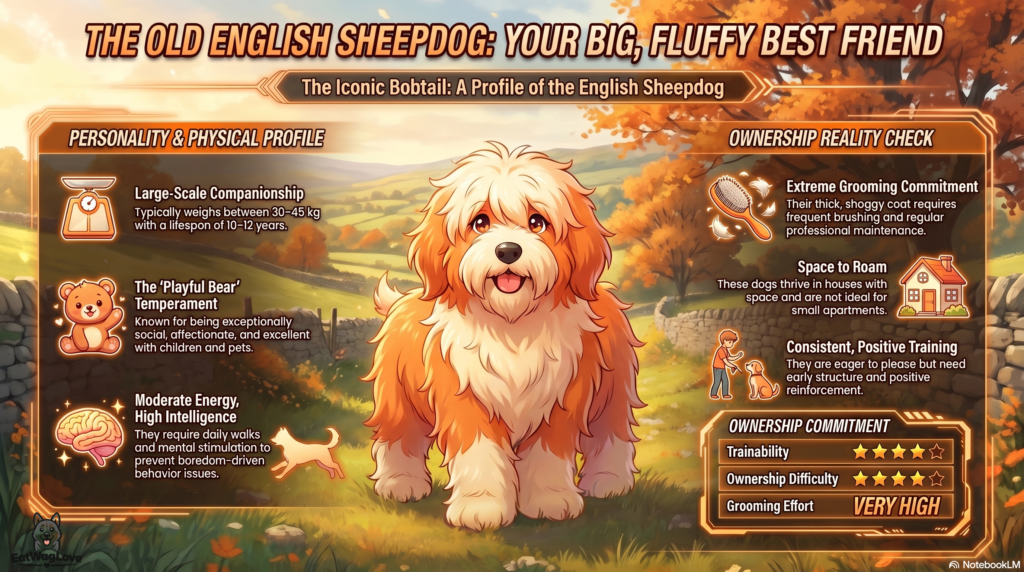
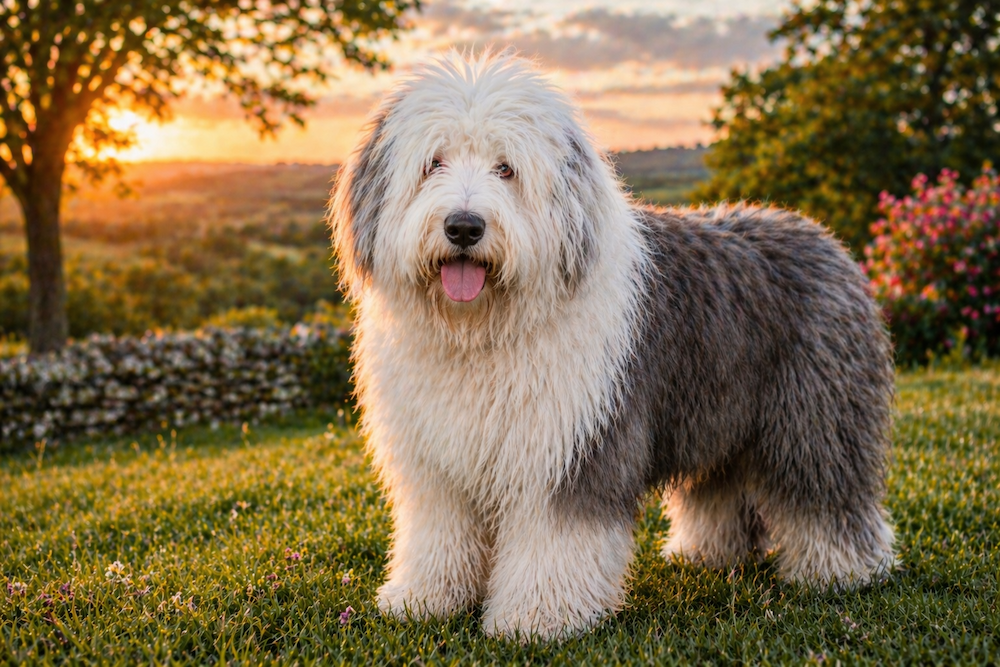







Fluffy, friendly, and full of charm — a big-hearted companion with a playful spirit.
🧠 QUICK SNAPSHOT
- Temperament: Friendly, Playful, Gentle
- Energy Level: Moderate
- Size: Large
- Good with Families: Excellent
- Training Difficulty: Moderate
📚 OVERVIEW
Old English Sheepdogs are known for their shaggy coats and cheerful personalities. Originally bred for herding livestock, they are intelligent, adaptable, and very people-oriented. They form strong bonds with their families and thrive on companionship and interaction.
✅ PROS & CONS
Pros
- Very friendly and great with families
- Playful and affectionate
- Distinctive, fluffy appearance
Cons
- Requires extensive grooming
- Can get dirty easily due to coat
- Needs regular attention and care
Is an Old English Sheepdog a Good Family Dog?
Yes. The Old English Sheepdog can be an affectionate, playful, intelligent and devoted family dog.
Often called an OES, these dogs tend to thrive when they’re closely involved with family life. They’re famous for their shaggy appearance, but underneath all that hair is a substantial working dog with genuine herding instincts.
They’re best suited to families prepared for regular exercise, extensive grooming and a large dog that may remain remarkably puppy-like for several years.
Are Old English Sheepdogs Good With Children?
Generally, yes.
Old English Sheepdogs have a longstanding reputation as affectionate family companions and can be playful and gentle with children.
However, they’re large, enthusiastic dogs that can accidentally knock over small children. Herding behaviours may also appear, so interactions should be supervised.
Why Is the Old English Sheepdog Called the “Nanny Dog”?
The Old English Sheepdog is sometimes described as a “nanny dog” because of its reputation for being watchful and affectionate around children.
The nickname shouldn’t be interpreted literally. No dog should be expected to supervise children without an adult.
It’s better understood as a reflection of the breed’s traditional reputation as a devoted family companion.
How Much Exercise Does an Old English Sheepdog Need?
Most adult Old English Sheepdogs need around 60–90 minutes of exercise each day, together with mental stimulation.
Walks, games, training, hiking and dog sports can all help.
They’re active working dogs, although many are perfectly happy relaxing with their family once their needs have been met.
Is an Old English Sheepdog a High-Energy Dog?
It’s generally a moderately high-energy breed.
Young OES can be particularly exuberant and playful.
Adults often become more settled, but this isn’t a giant shaggy dog designed to spend its entire life sleeping on the sofa.
Is an Old English Sheepdog Easy to Train?
Generally, yes.
Old English Sheepdogs are intelligent and capable learners, but they can have an independent or mischievous streak.
Positive reinforcement, consistency and varied training usually work better than repetitive drilling.
Are Old English Sheepdogs Intelligent?
Yes.
Their herding ancestry required them to understand livestock movement, respond to people and make practical decisions.
Modern OES can excel in obedience, rally, agility, herding and trick training.
Are Old English Sheepdogs Stubborn?
They can be.
Some seem to develop a distinctly humorous approach to obedience, particularly if training becomes repetitive.
Keeping sessions interesting and rewarding tends to produce much better cooperation.
Are Old English Sheepdogs Difficult to Toilet Train?
Usually not.
Their intelligence generally makes house training straightforward when owners provide a consistent routine.
Because puppies grow rapidly, owners should begin good habits immediately rather than allowing behaviours that become difficult when the puppy weighs 30 kilograms.
Does an Old English Sheepdog Shed?
Yes, although the answer is more complicated than its enormous coat suggests.
Old English Sheepdogs do shed, but loose hairs can become trapped within the surrounding coat rather than simply falling onto the floor.
That means low visible shedding doesn’t mean low maintenance — trapped dead hair contributes to tangles and mats unless regularly groomed.
Is an Old English Sheepdog Hypoallergenic?
No.
The Old English Sheepdog isn’t genuinely hypoallergenic.
Even dogs that leave relatively little loose hair around the house still produce allergens through skin flakes, saliva and other sources.
What Type of Coat Does an Old English Sheepdog Have?
The OES has a dense double coat, with a soft insulating undercoat beneath a profuse, shaggy outer coat.
The outer coat should have texture rather than being completely soft and flat.
The coat was functional protection for a dog working outdoors in British weather.
How Often Should You Groom an Old English Sheepdog?
A full-coated OES requires several thorough grooming sessions each week, and many owners perform some grooming daily.
The coat needs to be brushed all the way down to the skin rather than simply smoothing the surface.
Grooming an adult in full coat can take several hours each week.
Do Old English Sheepdogs Mat Easily?
Yes.
The dense coat can mat rapidly, particularly behind the ears, beneath the legs, around the collar, on the belly and around areas exposed to friction or moisture.
Once substantial mats develop, removing them can be uncomfortable and sometimes requires clipping.
Can You Keep an Old English Sheepdog in a Short Coat?
Yes.
Many companion OES owners keep their dogs professionally clipped into a shorter puppy cut because it’s dramatically easier to maintain.
The dog no longer has the classic full show coat, but a practical short trim can make everyday grooming much more manageable.
Should You Shave an Old English Sheepdog?
Routine complete shaving isn’t necessary for a healthy, well-maintained coat.
However, severely matted dogs may need to be clipped short for welfare reasons.
Owners who prefer a shorter pet trim should discuss an appropriate length and maintenance schedule with an experienced groomer.
Why Does an Old English Sheepdog’s Coat Cover Its Eyes?
The breed’s profuse facial hair naturally grows over the eyes.
A healthy dog can generally navigate perfectly well, but owners often tie, trim or manage facial hair for cleanliness and visibility.
The hair shouldn’t be allowed to create persistent irritation or eye problems merely for appearance.
Can Old English Sheepdogs See Through Their Hair?
Yes, to an extent, but that doesn’t mean hair should be deliberately allowed to obstruct the eyes excessively.
Dogs use smell and hearing as well as vision, which can make them surprisingly capable even with substantial facial hair.
Many pet owners keep the eye area more practical.
Why Do Old English Sheepdogs Wear a Topknot?
Owners sometimes tie the hair above the eyes into a topknot to improve visibility and keep the face tidy.
It’s both practical and strongly associated with the breed’s distinctive appearance.
The tie shouldn’t pull tightly or irritate the skin.
What Health Problems Are Common in Old English Sheepdogs?
Potential concerns include hip dysplasia, inherited eye disorders, deafness, thyroid disease, gastric dilatation-volvulus (bloat), and certain neurological conditions.
Responsible breeders should use appropriate hip, eye, hearing and other recommended health screening.
Owners should also maintain a lean body condition because the coat can make excess weight surprisingly difficult to notice.
Are Old English Sheepdogs Prone to Hip Dysplasia?
Yes.
Hip dysplasia is an important consideration in this large breed.
Responsible breeders should evaluate breeding dogs for hip health, while owners should maintain healthy weight and avoid inappropriate repetitive impact during puppy development.
Can Old English Sheepdogs Be Deaf?
Yes.
Congenital deafness occurs in the breed and is associated with pigmentation genetics seen in predominantly white-coated areas.
Responsible breeders may use BAER testing to assess hearing.
Dogs can be deaf in one ear without owners immediately noticing.
Are Old English Sheepdogs Prone to Eye Problems?
Several inherited eye conditions can occur.
Breeding dogs should receive appropriate ophthalmic screening.
Owners should also keep the heavily coated eye area clean and watch for persistent redness, discharge or irritation.
Are Old English Sheepdogs at Risk of Bloat?
Yes.
As a large, deep-bodied breed, the OES can develop gastric dilatation-volvulus (GDV), commonly called bloat.
GDV is a life-threatening emergency in which the stomach becomes distended and may rotate. Owners should know the warning signs and discuss prevention, including whether preventive gastropexy is appropriate, with their veterinarian.
How Long Does an Old English Sheepdog Live?
Old English Sheepdogs commonly live around 10–12 years, although some live longer.
Genetics, weight, exercise, preventive veterinary care and responsible breeding all influence longevity.
How Big Does an Old English Sheepdog Get?
Adult Old English Sheepdogs generally stand at least around 53–56 cm at the shoulder, depending on sex and breed standard, and commonly weigh approximately 27–45 kg.
Males are usually larger and heavier.
The huge coat can make an OES appear substantially larger than its actual body.
Is an Old English Sheepdog a Giant Breed?
It’s usually considered a large breed, although particularly substantial males can certainly give the impression of being giant dogs.
Much of the apparent volume comes from the extraordinary coat.
A wet Old English Sheepdog can therefore produce a surprisingly dramatic before-and-after transformation.
Is There a Miniature Old English Sheepdog?
No.
There is no recognised Miniature Old English Sheepdog.
Dogs marketed under that name are likely to be crosses, unusually small individuals or dogs produced specifically for reduced size.
Is There a Teacup Old English Sheepdog?
No.
“Teacup Old English Sheepdog” isn’t a recognised breed or variety.
Extreme miniaturisation would be completely inconsistent with the structure and historical function of the breed.
When Is an Old English Sheepdog Fully Grown?
Most reach close to adult height by around 12–18 months, but may continue filling out after that.
Mental maturity often takes considerably longer.
A physically enormous OES can therefore remain remarkably puppy-like well into its second or third year.
Can an Old English Sheepdog Live in an Apartment?
Potentially, although it’s not the easiest breed for apartment living.
They’re large, active dogs and their coat occupies an impressive amount of physical space.
An apartment can work with substantial exercise and training, but access to outdoor areas and sufficient indoor room makes life easier.
Does an Old English Sheepdog Need a Backyard?
A yard is useful but isn’t essential if the dog receives adequate exercise elsewhere.
Simply placing an OES in a large garden won’t satisfy its need for companionship, training and activity.
These dogs generally want to participate in family life.
Can an Old English Sheepdog Be Left Alone?
Adult dogs can learn to tolerate reasonable periods alone.
However, Old English Sheepdogs tend to be highly social and often dislike being excluded from family activities.
Long periods of isolation can contribute to boredom, barking or destructive behaviour.
Are Old English Sheepdogs Prone to Separation Anxiety?
Some can be.
Their strong attachment to their families means gradual independence training is worthwhile.
Teaching a puppy that short periods alone are safe can help prevent excessive dependence later.
Are Old English Sheepdogs Velcro Dogs?
Many are.
An OES often wants to know where its family is and participate in whatever they’re doing.
The practical consequence is that a very large, extremely hairy dog may follow you into rooms that were not designed with a very large, extremely hairy dog in mind.
Are Old English Sheepdogs Cuddly?
Many are extremely affectionate.
Their soft-looking appearance and people-oriented temperament contribute to their reputation as enormous teddy bears.
Owners should remember that underneath the teddy bear is still a powerful working dog requiring training and exercise.
Are Old English Sheepdogs Good With Other Dogs?
Generally, yes.
Well-socialised OES often enjoy canine companionship.
Their exuberant play style can be overwhelming for very small or timid dogs, so compatible personalities matter.
Are Old English Sheepdogs Good With Cats?
They often can be.
Dogs raised with cats frequently learn to live peacefully with them.
Some may attempt to herd cats, which the cat may not regard as a useful service.
Do Old English Sheepdogs Have a Strong Prey Drive?
Usually not as strongly as specialised hunting breeds.
Their primary heritage is associated with moving livestock rather than pursuing prey.
Individual dogs can still chase wildlife, so normal training and management remain important.
Do Old English Sheepdogs Herd People?
They can.
Herding instincts may appear as circling, blocking movement, following closely or attempting to keep family members together.
Children running around can be particularly interesting to a young herding dog.
Do Old English Sheepdogs Nip at Heels?
Some may attempt to use their mouths when excited or herding.
This shouldn’t simply be accepted as inevitable.
Early training can teach appropriate ways to interact with people.
Are Old English Sheepdogs Good Off Leash?
Many can develop good recall with training.
They’re generally more handler-oriented than highly independent hunting breeds.
Off-leash freedom should still only occur in safe, legal environments.
Do Old English Sheepdogs Bark a Lot?
They’re generally moderate barkers.
They may bark to announce visitors or unusual activity, and bored individuals can become more vocal.
Their bark can be surprisingly deep and resonant.
What Does an Old English Sheepdog’s Bark Sound Like?
The breed is known for a distinctive, powerful bark sometimes described as having a “pot-casse” or cracked-bell quality.
It’s deeper and more substantial than the dog’s fluffy appearance might suggest.
A single bark can be quite an effective announcement.
Are Old English Sheepdogs Good Watchdogs?
Yes.
They’re alert and their size and deep bark can be impressive.
Many will readily announce visitors.
Are Old English Sheepdogs Good Guard Dogs?
They’re better watchdogs than specialist protection dogs.
Their appearance and bark can deter strangers, but the breed is generally expected to be sociable and even-tempered rather than aggressively defensive.
Are Old English Sheepdogs Aggressive?
Aggression isn’t characteristic of a well-bred OES.
They should generally be confident, friendly and adaptable.
As with any large dog, early socialisation and training are essential because behavioural problems become much harder to manage at adult size.
Are Old English Sheepdogs Friendly With Strangers?
Many are friendly or become friendly quickly once introduced.
Some are initially watchful.
Good socialisation helps produce the confident, stable temperament expected from the breed.
When Does an Old English Sheepdog Calm Down?
Many begin settling noticeably between two and three years old, although some remain puppy-like even longer.
The breed is famous for retaining a playful, clownish personality into adulthood.
Owners expecting instant dignity simply because the dog has reached 35 kilograms may be disappointed.
Do Old English Sheepdogs Get the Zoomies?
Absolutely.
The combination of substantial body weight, enormous coat and enthusiastic cornering can make OES zoomies memorable.
Clear floors are useful.
Are Old English Sheepdogs Clumsy?
They can appear clumsy because of their shaggy coat and exuberant personality, but a fit OES should actually be athletic and coordinated.
These were functional working dogs capable of moving livestock over considerable distances.
The clownish appearance can be deceptive.
Are Old English Sheepdogs Good Walking Dogs?
Yes.
They’re excellent companions for regular walking and benefit greatly from daily outings.
Loose-lead training should begin early before the puppy becomes a powerful adult.
Are Old English Sheepdogs Good Hiking Dogs?
Healthy adult OES can make excellent hiking companions.
They have the stamina and working heritage for substantial walks.
Hot weather requires particular caution because of their dense coat.
Are Old English Sheepdogs Good Running Dogs?
Healthy, physically mature individuals can accompany owners on moderate runs.
They’re generally better suited to walking, hiking and varied activity than intensive long-distance road running.
Joint health and temperature should always be considered.
Can Old English Sheepdogs Swim?
Many can swim, although individual enthusiasm varies.
Their enormous coat absorbs considerable water and becomes very heavy when wet.
Supervision is therefore sensible, particularly in deep or moving water.
Do Old English Sheepdogs Like Snow?
Many do.
Their dense double coat provides excellent protection in cold conditions.
Snow can produce the additional challenge of ice balls forming in the hair around the feet and legs.
Do Old English Sheepdogs Get Cold Easily?
Generally, no.
Their coat was developed to protect them in cool, wet British conditions.
They’re considerably more naturally equipped for cold weather than extreme heat.
Can Old English Sheepdogs Handle Hot Weather?
They require careful management in hot climates.
Exercise should occur during cooler parts of the day, particularly during Australian summers.
Shade, fresh water, air conditioning or other cool indoor areas are extremely valuable, and strenuous activity should be avoided during extreme heat.
What Does an Old English Sheepdog Look Like?
The OES is a large, square-looking, powerful dog covered in a profuse shaggy coat, usually combining grey or blue-grey with white.
Its head appears enormous beneath the hair, and the body has a distinctive shape that rises slightly toward the rear.
The overall appearance is unmistakable.
Why Is an Old English Sheepdog Higher at the Back?
The breed has a characteristic topline that rises toward the loin, making the hindquarters appear higher than the shoulders.
This contributes to the OES’s distinctive outline and movement.
It’s an intentional breed characteristic rather than poor posture.
Why Does an Old English Sheepdog Walk Like a Bear?
The breed is famous for a characteristic rolling or bear-like movement, particularly at slower speeds.
Its structure and broad body contribute to this distinctive gait.
At faster speeds, however, a fit OES should move efficiently and athletically.
What Colours Can Old English Sheepdogs Be?
Traditional colouring includes shades of grey, grizzle or blue combined with white.
The head, neck, forequarters and underside may carry substantial white.
The breed’s distinctive grey-and-white appearance develops as the dog matures.
Are Old English Sheepdog Puppies Born Black and White?
Many puppies are born predominantly black and white.
As they mature, the dark puppy coat changes toward the characteristic grey, grizzle or blue-grey adult colouring.
This transformation can be dramatic.
Why Does an Old English Sheepdog Change Colour?
The coat undergoes a normal developmental change as puppy hair is replaced by the adult coat.
A puppy that appears black and white can eventually become a distinctly grey-and-white adult.
The process occurs gradually rather than overnight.
Can an Old English Sheepdog Be Completely White?
An all-white dog isn’t the classic breed pattern.
Extensive lack of pigmentation can also be associated with increased risk of congenital deafness in dogs.
The recognised OES appearance normally combines white with darker body colouring.
Can an Old English Sheepdog Be Brown?
Brown isn’t a traditional recognised Old English Sheepdog colour.
A brown dog advertised as a rare purebred OES deserves careful investigation.
Can an Old English Sheepdog Be Merle?
The normal mottled or grey appearance of an OES shouldn’t be confused with the merle gene found in breeds such as Australian Shepherds.
Merle isn’t a traditional Old English Sheepdog colour.
Claims of “rare merle OES” should therefore raise questions about ancestry.
Why Do Some Old English Sheepdogs Have No Tail?
Historically, the breed became famous for being bobtailed or having tails docked very short.
This produced the nickname “Bobtail”, which remains associated with the breed in several countries.
Modern laws and changing welfare standards mean many OES now retain their natural tails.
Are Old English Sheepdogs Born Without Tails?
Some dogs can naturally have shortened tails, but historically many of the short-tailed OES seen in photographs had been docked.
A full natural tail is perfectly normal.
Tail docking is now prohibited or heavily restricted in many countries, including Australia except under limited veterinary circumstances.
What Does an Old English Sheepdog’s Natural Tail Look Like?
A natural OES tail is long and well furnished with hair.
It completely changes the silhouette familiar from historical photographs of docked dogs.
In countries where docking has disappeared, seeing tailed Old English Sheepdogs is now entirely normal.
Why Is the Old English Sheepdog Called a Bobtail?
“Bobtail” refers to the breed’s historical association with extremely short tails.
The nickname became so strongly linked with the dog that Bobtail remains a common alternative name internationally.
It doesn’t mean every OES is naturally born without a tail.
Were Old English Sheepdogs Docked Because of a Dog Tax?
A popular story claims working dogs in Britain were exempt from taxation if their tails were docked, making the bobtail evidence of working status.
There were historical taxes and exemptions involving working dogs, but the simple claim that this directly explains the OES’s docked tail is often repeated more confidently than the surviving evidence warrants.
It’s best treated as part of breed folklore rather than a completely settled explanation.
Is an Old English Sheepdog Actually a Sheepdog?
Yes, although its historical work was broader than the modern name suggests.
Dogs of this type were associated with moving and managing livestock, particularly in agricultural regions of England.
Some historical accounts emphasise droving cattle and sheep to markets as much as conventional field herding.
Was the Old English Sheepdog a Herding Dog or a Drover?
Probably both descriptions have relevance, but droving is particularly important to understanding its history.
Drovers needed tough dogs capable of helping move livestock considerable distances along roads to markets.
The OES’s substantial build, stamina and protective coat suited demanding agricultural work.
What Is a Drover Dog?
A drover dog helps move livestock from one place to another, often over considerable distances.
This differs somewhat from the precise flock-control work people commonly associate with modern Border Collies.
A good drover needed stamina, confidence and enough physical presence to influence livestock.
Where Does the Old English Sheepdog Come From?
The Old English Sheepdog developed in England, particularly in western and southwestern agricultural regions, during the 18th and 19th centuries.
Its exact ancestry isn’t completely documented.
The recognisable breed emerged from British working dogs used to move and manage livestock before becoming increasingly standardised during the Victorian dog-show era.
Is the Old English Sheepdog Really Old?
The name is slightly misleading.
It’s old compared with many modern designer breeds, but it isn’t one of the world’s most ancient documented breeds.
The modern OES was largely developed and standardised during the 19th century.
So “Old English” sounds considerably more prehistoric than the documented breed actually is.
What Dogs Created the Old English Sheepdog?
The precise recipe isn’t known.
Various European and British herding dogs have been proposed as contributors, including Bearded Collie-type dogs and continental sheepdogs, but early breeding records are incomplete.
Claims assigning exact percentages to particular foundation breeds should therefore be treated cautiously.
Is the Old English Sheepdog Related to the Bearded Collie?
They share similarities and likely connections within Britain’s shaggy herding-dog tradition.
Historical theories frequently mention Bearded Collie-type ancestry when discussing the OES.
However, the exact relationship isn’t documented as a simple modern cross.
Is the Old English Sheepdog Related to the Briard?
Briards and other continental shaggy herding dogs have sometimes been proposed as influences on the breed.
Trade and livestock movement made exchange between European working-dog populations possible.
The evidence doesn’t support reducing OES ancestry to one definitive continental breed.
Is the Old English Sheepdog Related to the Russian Owtchar?
Historical breed accounts have sometimes proposed Russian or other eastern European shaggy sheepdogs as contributors.
These theories are difficult to verify because early records are incomplete.
The safest conclusion is that the OES emerged from a mixture of working sheepdog and drover traditions rather than one perfectly documented foundation cross.
When Did the Old English Sheepdog First Appear at Dog Shows?
Dogs recognisable as Old English Sheepdogs began appearing at British shows during the 19th century.
The emerging dog-show movement encouraged breeders to standardise appearance and preserve pedigrees.
This gradually transformed a practical agricultural dog into a formal pedigree breed.
When Was the Old English Sheepdog Club Founded?
Britain’s Old English Sheepdog Club was established during the late 19th century, helping formalise the breed standard and promote consistent breeding.
Breed clubs were enormously important in transforming Britain’s regional working dogs into recognised pedigree breeds.
When Did the AKC Recognise the Old English Sheepdog?
The American Kennel Club recognised the Old English Sheepdog in 1888.
The breed became increasingly popular in the United States during the following century.
Its extraordinary appearance made it particularly memorable to the public.
Why Did Old English Sheepdogs Become Popular Show Dogs?
Their dramatic coat made them spectacular in the show ring.
Victorian and later breeders increasingly selected and groomed dogs for appearance as well as working characteristics.
The full show coat eventually became far more elaborate than anything a practical livestock worker would want to maintain on a muddy farm dog.
Were Old English Sheepdogs Used to Make Wool?
No.
A persistent story claims Old English Sheepdog hair was shorn and spun like sheep’s wool.
Dog hair can technically be spun into yarn — sometimes called chiengora — but producing fibre wasn’t the historical purpose of the breed.
They were livestock dogs, not wool-producing animals.
Why Does the Old English Sheepdog Look Like a Sheep?
Its shaggy coat and rounded silhouette certainly create the resemblance.
The coat developed as protection for outdoor work rather than as camouflage among sheep.
Once the breed entered the show ring, its spectacular shaggy appearance became one of its defining features.
Is the Old English Sheepdog Related to the Polish Lowland Sheepdog?
They’re separate breeds from different countries.
Both belong to the wider tradition of shaggy European herding dogs and share some functional similarities.
That doesn’t make one simply a larger or smaller version of the other.
Is an Old English Sheepdog the Same as a Bearded Collie?
No.
The Bearded Collie is generally lighter, more athletic in appearance and has a different breed history.
The OES is larger and more substantial, with its characteristic rising topline and traditional bobtail association.
Is an Old English Sheepdog the Same as a Sheepadoodle?
No.
A Sheepadoodle is generally an Old English Sheepdog × Poodle cross.
Its coat, size, temperament and shedding can vary considerably depending on the parents and generation.
The Old English Sheepdog itself is an established purebred breed.
Is an Old English Sheepdog the Same as an English Sheepdog?
Not necessarily.
“English Sheepdog” is an imprecise term that can refer to several British sheepdog types.
The correct breed name is Old English Sheepdog.
Why Is the Old English Sheepdog So Shaggy?
Its coat originally provided protection against cold, rain and rough outdoor conditions.
Working livestock could involve long days exposed to British weather.
Humans later exaggerated and carefully maintained the dramatic coat through show breeding and grooming.
Why Does My Old English Sheepdog Lean on Me?
Leaning can be a form of social contact and attention-seeking.
Many OES are extremely affectionate and enjoy physical closeness.
When a 35-kilogram dog decides that leaning is an expression of love, the recipient usually notices.
Why Does My Old English Sheepdog Follow Me Everywhere?
The breed tends to form strong social bonds and was developed to work cooperatively around people.
Many OES therefore like keeping their family within sight.
They’re large enough that following you tends to be considerably less subtle than it is with a small companion dog.
Why Does My Old English Sheepdog Try to Round Everyone Up?
Herding and droving behaviours remain embedded in many individuals.
Movement can trigger circling, blocking and following.
The dog may simply have concluded that the family is badly organised livestock.
Why Does My Old English Sheepdog Bump Into Me?
Some herding and droving dogs use body position and physical presence to influence movement.
Young OES can also simply be exuberant and unaware of how large they’ve become.
Training polite spatial boundaries is particularly worthwhile in a powerful breed.
Why Does My Old English Sheepdog Have Hair Everywhere Except on the Floor?
Some shed hairs become caught in the surrounding coat instead of dropping immediately.
This can create the impression that the dog barely sheds.
Unfortunately, those hairs haven’t disappeared — many are waiting inside the coat to become part of a mat unless someone brushes them out.
Why Does My Old English Sheepdog Get So Dirty?
The answer is largely geometry.
A large dog covered from head to toe in long hair provides an extraordinary amount of surface area for collecting mud, leaves, water, grass and unidentified pieces of the outdoors.
Owners who love the full coat generally learn to keep towels near entrances.
Why Does My Old English Sheepdog Get a Wet Beard?
Long facial hair collects drinking water.
An OES can finish at the water bowl and then transport a surprisingly generous portion of that water elsewhere.
For many owners, absorbent mats and towels become standard household equipment.
Are Old English Sheepdogs Good at Herding?
Yes.
Many retain strong natural herding instincts and can participate in organised herding activities.
Working ability varies between lines and individuals because most modern OES are primarily bred as companions or show dogs.
Are Old English Sheepdogs Good at Agility?
Yes.
Despite their bulky appearance, fit Old English Sheepdogs can be surprisingly athletic.
Agility provides exercise, mental stimulation and an opportunity to work closely with their owners.
Are Old English Sheepdogs Good at Obedience?
They can be excellent obedience dogs.
They’re intelligent and capable of learning complex behaviours.
The main challenge is keeping training engaging enough that the dog’s sense of humour doesn’t become the dominant participant.
Are Old English Sheepdogs Good Therapy Dogs?
Many can make excellent therapy dogs.
Their friendly temperament and extraordinary teddy-bear appearance naturally attract attention.
Successful therapy dogs still need calm behaviour, excellent socialisation and comfort around unfamiliar people.
Is an Old English Sheepdog a Good Dog for Older People?
Potentially, but the breed can be physically demanding.
An adult is large and powerful, while coat maintenance can require hours every week.
An active older owner who loves grooming may enjoy the breed, but there are much easier low-maintenance alternatives.
Is an Old English Sheepdog a Good First Dog?
It can be, provided the owner understands the commitment.
They’re generally friendly, intelligent and trainable.
The major challenges are size, grooming, exercise, herding behaviour and the sheer amount of maintenance involved in keeping that spectacular coat healthy.
Are Old English Sheepdogs Rare?
They’re considerably less common today than during periods when the breed enjoyed enormous public popularity.
Changes in lifestyle and the grooming commitment required by the breed likely contribute to lower ownership numbers.
Dedicated breeders continue working to preserve both health and characteristic temperament.
Did the Old English Sheepdog Become Famous Through Advertising?
Yes.
Its unmistakable appearance has made the OES particularly popular in advertising, television and film.
One of the strongest commercial associations is with Dulux paint, whose advertising famously featured an Old English Sheepdog for decades in several countries.
What Is the Dulux Dog?
The Dulux Dog is an Old English Sheepdog used as a long-running advertising mascot for Dulux paint.
The campaign became so famous that many people recognise the shaggy dog before they know its actual breed.
In some countries, “Dulux dog” effectively became an informal nickname for the OES.
Was the Dog in The Shaggy Dog an Old English Sheepdog?
The original 1959 Disney film The Shaggy Dog famously featured a large shaggy canine, helping reinforce public fascination with heavily coated dogs.
However, breed identification around different productions and remakes can become confusing, so the OES shouldn’t automatically be credited as the dog in every version simply because of the title and appearance.
Was an Old English Sheepdog in The Little Mermaid?
Yes. Prince Eric’s dog Max is portrayed as an Old English Sheepdog in Disney’s The Little Mermaid.
The shaggy, affectionate character is one of several appearances that helped make the breed instantly recognisable even to people unfamiliar with its name.
Did Paul McCartney Own an Old English Sheepdog?
Yes.
Paul McCartney famously owned an Old English Sheepdog named Martha.
She became one of the breed’s best-known celebrity dogs.
Was “Martha My Dear” Written About Paul McCartney’s Sheepdog?
McCartney’s dog Martha inspired the title and association of the Beatles song “Martha My Dear”.
However, the song shouldn’t be interpreted simply as a literal song describing his dog.
The connection nevertheless made Martha one of popular music’s most famous canine companions.
Did Old English Sheepdogs Become Popular in the 1960s and 1970s?
Their distinctive appearance, celebrity ownership, advertising and appearances in popular culture contributed to considerable recognition during the mid-to-late 20th century.
The breed became almost impossible to mistake for anything else.
That popularity also demonstrated the downside of fashion-driven demand, because an OES requires far more work than its teddy-bear appearance suggests.
What Makes the Old English Sheepdog Unique?
Few breeds have undergone a more dramatic career change.
The Old English Sheepdog began as a tough British livestock dog, associated particularly with herding and droving animals through agricultural country.
It needed stamina, intelligence, weather protection and enough confidence to move livestock.
Then dog shows discovered the coat.
That practical shaggy covering became increasingly spectacular, eventually creating one of the most instantly recognisable silhouettes in the dog world.
The short-tail tradition gave the breed its famous Bobtail nickname.
Its rolling movement became characteristic.
Its deep, cracked-bell bark became distinctive.
And its enormous grey-and-white coat turned a livestock worker into a television and advertising star.
Then came Dulux, Disney and celebrity dogs such as Paul McCartney’s Martha.
Today, someone encountering an OES may see an enormous walking teddy bear.
The dog underneath still sees things rather differently.
It notices movement.
It watches its family.
It may attempt to organise children, dogs and visitors into more satisfactory positions.
And beneath several kilograms of hair remains an athletic working dog whose ancestors helped move livestock across the English countryside.
Perhaps the greatest trick the Old English Sheepdog ever performed was convincing the world that it was mostly hair.
The hair is just packaging. The sheepdog is still inside.