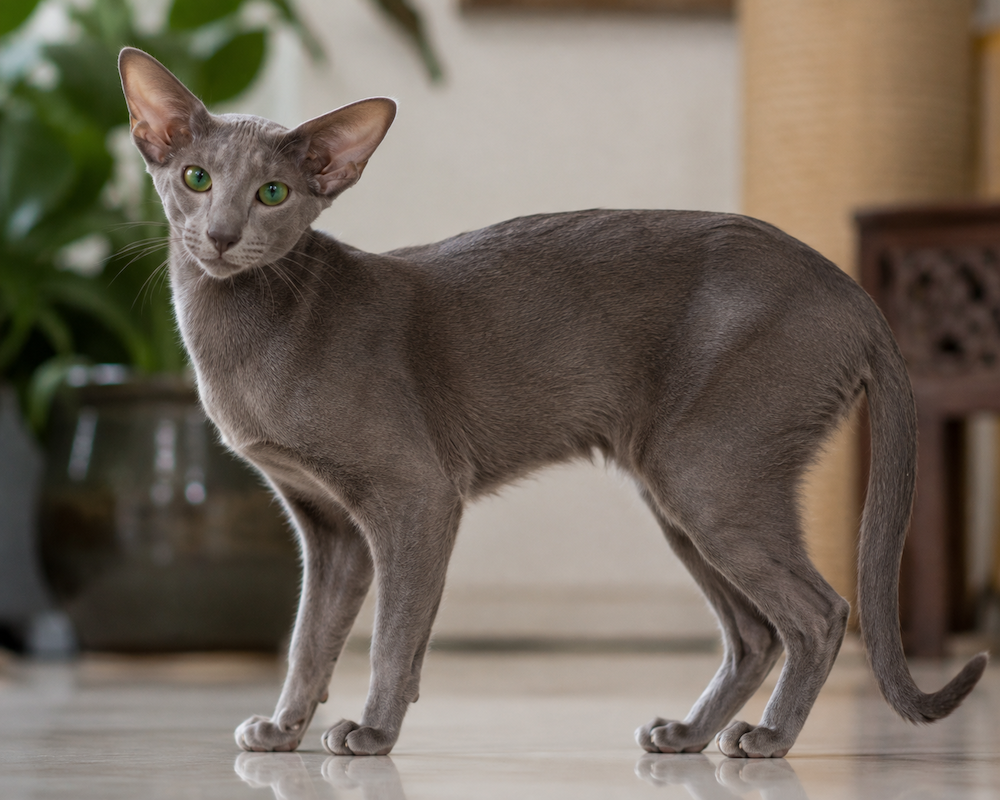







Talkative, intelligent, and overflowing with personality — the Oriental Shorthair is an elegant, people-loving cat famous for its enormous ears, athletic body, extraordinary range of colours, and determination to be involved in everything you do.
🧠 QUICK SNAPSHOT
- Temperament: Affectionate, intelligent, outgoing
- Energy Level: High
- Size: Medium
- Good With Families: Excellent
- Indoor Living: Excellent with sufficient enrichment
- Trainability: Very High
- Grooming: Low
- Best For: Interactive families, multi-pet homes, people wanting a highly social cat
- Typical Lifespan: Around 12–15 years
📚 OVERVIEW
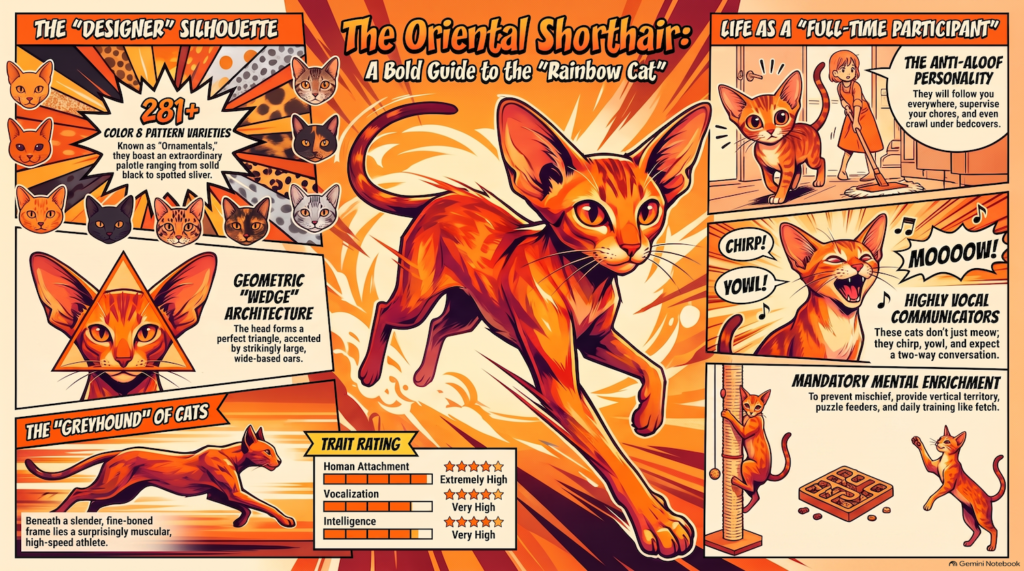
The Oriental Shorthair is closely related to the Siamese, sharing the same long, elegant body, wedge-shaped head, large ears, athletic build, and famously sociable personality. The major visual difference is colour: while Siamese cats are recognised for their distinctive pointed pattern, Oriental Shorthairs come in an enormous variety of coat colours and patterns.
The breed was developed primarily in Britain during the 20th century as breeders explored Siamese-type cats in colours beyond the traditional points. Subsequent breeding programs established the Oriental as a distinctive breed while retaining its strong Siamese heritage.
Personality is arguably even more distinctive than appearance. Oriental Shorthairs tend to be extremely people-oriented, curious, playful, and vocal. Many follow their owners around the house, participate enthusiastically in conversations, inspect shopping bags, supervise cooking, and appear whenever something interesting happens.
This isn’t usually a cat that simply lives somewhere in your house.
An Oriental Shorthair tends to consider itself part of whatever you’re doing — whether invited or not.
✅ PROS & CONS
Pros
- Exceptionally affectionate and people-oriented
- Highly intelligent and trainable
- Very playful and entertaining
- Low-maintenance short coat
- Usually good with other social pets
- Huge variety of colours and patterns
Cons
- Can be extremely vocal
- Doesn’t enjoy prolonged isolation
- Needs substantial daily interaction
- High intelligence means boredom can become a problem
- May be demanding of attention
- Not ideal for someone wanting a quiet, independent cat
Is an Oriental Shorthair a Good Family Cat?
Yes, the Oriental Shorthair is generally an excellent family cat, particularly for households wanting an affectionate and highly interactive companion. These cats usually form powerful bonds with their people and prefer participating in family life rather than observing it from a distance.
Orientals can be wonderful companions for respectful children because they tend to be playful, curious, and enthusiastic about games. Children should still learn to recognise feline body language and allow the cat to leave whenever it wants space.
The breed often does particularly well in multi-pet households. Another friendly cat can provide valuable companionship, especially when owners spend significant periods away from home. Many Orientals can also live happily alongside cat-friendly dogs when introduced gradually.
Prospective owners should understand just how social this breed can be. An Oriental Shorthair may follow you everywhere, demand attention, and loudly announce its opinion when ignored.
For the right family, that’s precisely what makes the breed so entertaining.
Can an Oriental Shorthair Live Indoors or in an Apartment?
Yes, the Oriental Shorthair is very well suited to indoor and apartment living, provided its physical and mental needs are taken seriously.
These cats don’t necessarily require enormous floor space, but they benefit tremendously from vertical territory. Tall cat trees, climbing shelves, window perches, scratching towers, tunnels, and safe elevated resting places allow an Oriental to make much greater use of an indoor environment.
Interactive toys and puzzle feeders are equally important because this intelligent breed can become bored surprisingly quickly.
Apartment owners should also consider the Oriental’s famous voice. Some individuals are extremely talkative, which may matter in buildings with poor sound insulation.
Secure indoor living protects cats from numerous outdoor hazards, while a cat enclosure or carefully introduced harness walking can offer additional enrichment.
The key isn’t the size of the home. An Oriental Shorthair can thrive in a relatively compact apartment when that home provides activity, companionship, climbing opportunities, and interesting things to do.
How Much Exercise and Play Does an Oriental Shorthair Need?
The Oriental Shorthair is a high-energy cat that needs substantial daily play and mental stimulation. Several interactive play sessions spread throughout the day are preferable to expecting the cat to entertain itself indefinitely.
Fishing-wand toys, balls, tunnels, climbing towers, chasing games, and toys that imitate prey are excellent choices. Many Orientals also enjoy retrieving objects and can learn surprisingly sophisticated games.
Their intelligence opens up additional possibilities. Clicker training, puzzle feeders, treat hunts, agility-style activities, and learning tricks can provide valuable mental exercise.
Vertical activity is particularly important. The Oriental’s long, athletic body is designed for climbing and jumping, and these cats frequently seek out the highest accessible location in a room.
Without sufficient enrichment, an intelligent Oriental may invent activities of its own — opening cupboards, stealing objects, investigating shelves, or repeatedly demanding human attention.
This is a breed that thrives when its brain receives as much exercise as its body.
Is an Oriental Shorthair Easy to Train?
Yes, the Oriental Shorthair is one of the more trainable cat breeds because it combines high intelligence with curiosity and a strong desire to interact with people.
Using positive reinforcement, many Orientals can learn to come when called, sit, give a paw, retrieve toys, enter a carrier voluntarily, walk on a harness, or perform tricks.
Food rewards can be extremely effective, although play and attention may be equally motivating for particularly social individuals. Clicker training provides an excellent way to communicate precisely which behaviour has earned a reward.
Training can also make everyday cat ownership easier. Teaching comfortable carrier use, nail handling, grooming, and veterinary examination behaviours reduces stress when these activities become necessary.
Punishment should be avoided. It can create fear without teaching the cat what behaviour is actually wanted.
Short, frequent sessions work particularly well. The challenge with an Oriental often isn’t convincing it to participate — it’s keeping sufficiently ahead of an intelligent cat that learns very quickly.
Does an Oriental Shorthair Shed?
Yes, the Oriental Shorthair sheds, but its short, fine coat is extremely easy to maintain. Compared with long-haired and densely undercoated breeds, the amount of grooming required is minimal.
A gentle brushing approximately once a week is generally sufficient to remove loose hairs, distribute natural skin oils, and keep the coat glossy. Some cats particularly enjoy grooming because it provides additional attention from their owner.
Bathing is rarely necessary unless there is a specific reason. Routine care should instead concentrate on nail trimming, dental health, and regular checks of the ears and skin.
The breed’s enormous ears can make small amounts of normal ear debris particularly noticeable, but excessive discharge, odour, redness, or scratching warrants veterinary assessment rather than aggressive cleaning.
Despite its short coat and relatively modest shedding, the Oriental Shorthair is not hypoallergenic. People with cat allergies react primarily to proteins produced in saliva and skin secretions rather than simply the length of the coat.
What Health Problems Are Common in an Oriental Shorthair?
The Oriental Shorthair shares considerable ancestry with the Siamese, so some health conditions associated with Siamese-family breeds can also occur in Orientals.
One important concern is progressive retinal atrophy (PRA), an inherited eye disorder that can eventually cause blindness. Genetic testing is available for relevant forms, making responsible breeding particularly valuable.
Amyloidosis, in which abnormal proteins accumulate within organs, has also occurred in Siamese-related populations. Other potential concerns include dental disease and certain heart conditions, including hypertrophic cardiomyopathy (HCM).
Not every Oriental Shorthair will develop these problems, and prospective owners should avoid assuming that a list of possible conditions predicts an individual cat’s future health.
Instead, choose a responsible breeder who can discuss health within their breeding lines and explain what screening has been performed.
Regular veterinary examinations, good dental care, balanced nutrition, maintaining a lean body condition, and investigating unexplained changes in weight, appetite, thirst, breathing, behaviour, or activity can help an Oriental Shorthair enjoy a long and healthy life.
⭐ How Many Colours Can an Oriental Shorthair Be?
This is where the Oriental Shorthair becomes extraordinary.
Depending on the cat registry, Orientals are recognised in a huge number of colour and pattern combinations — so many that the breed has sometimes been nicknamed the “Rainbow Cat.”
Coats can include colours such as black, blue, chocolate, lilac, cinnamon, fawn, red, cream, and white, combined with patterns including solid, tabby, tortoiseshell, smoke, shaded, and various combinations involving white.
That means two Oriental Shorthairs can look dramatically different while sharing essentially the same elegant body shape and distinctive personality.
A solid ebony Oriental with brilliant green eyes can appear sleek and almost panther-like, while a tabby-and-white Oriental may look like an entirely different breed at first glance.
Underneath those wildly different coats, however, you’ll still find the characteristic long body, wedge-shaped head, enormous ears, intelligence, athleticism — and usually a cat with plenty to say.
⭐ Why Does the Oriental Shorthair Have Such Huge Ears?
Those extraordinary ears aren’t an accident.
The Oriental Shorthair shares the modern Siamese body type, which emphasises long, elegant lines. Its wedge-shaped head gradually expands outward towards exceptionally large ears, creating the distinctive triangular silhouette associated with the breed.
Kittens can look particularly spectacular because their ears may appear almost comically oversized compared with their small heads.
Despite appearances, those ears don’t give the Oriental some extraordinary super-hearing ability beyond what we’d expect from cats generally. Their dramatic size is primarily a defining feature of the breed’s appearance.
Combined with almond-shaped eyes, a long nose, slender legs, and an athletic body, the ears create one of the most recognisable profiles in the feline world.
And considering how socially involved Oriental Shorthairs tend to be, perhaps enormous ears are appropriate.
After all, this is a cat that really does seem determined to hear everything happening in its household.