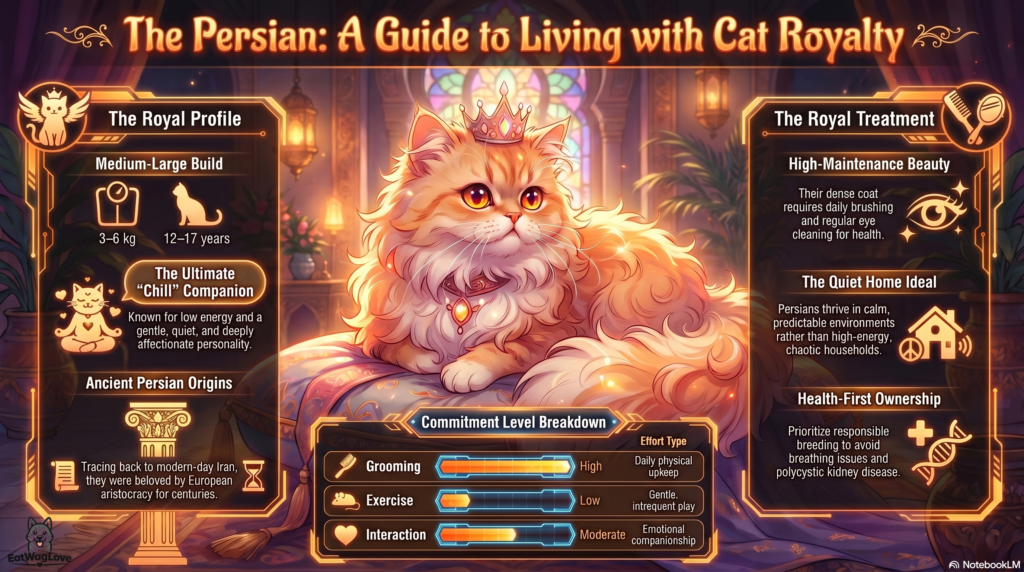
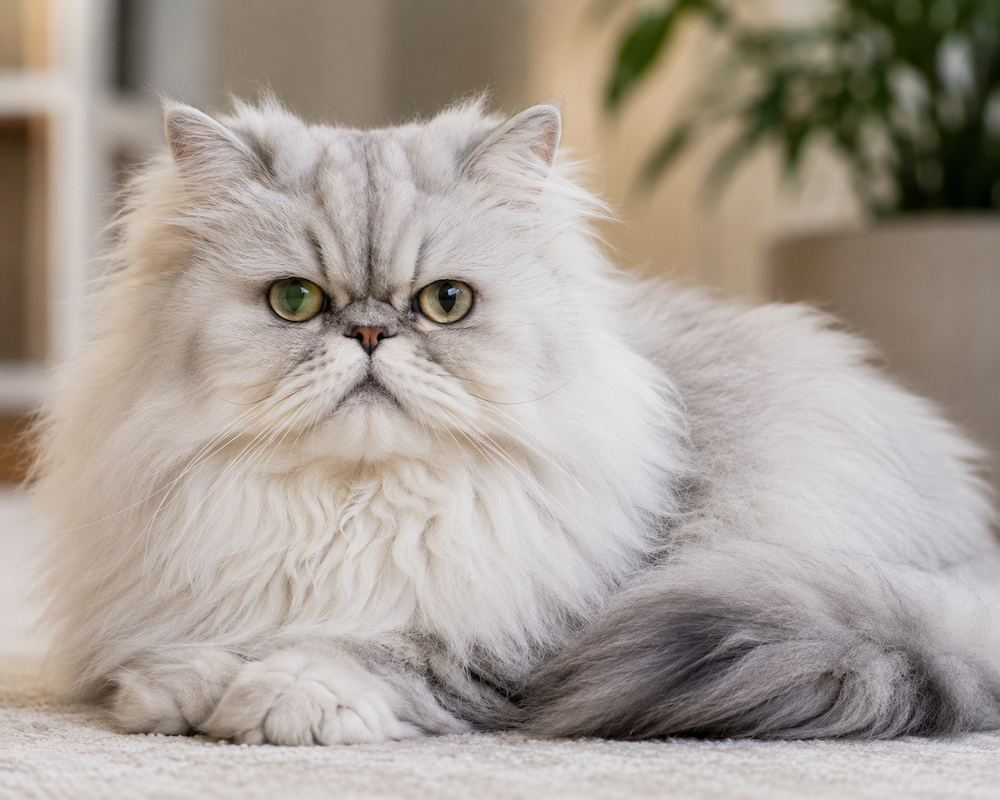







Calm, luxurious, and deeply affectionate — a relaxed indoor companion with an iconic fluffy coat.
🧠 QUICK SNAPSHOT
- Temperament: Calm, affectionate, gentle
- Energy Level: Low
- Size: Medium
- Good With Families: Yes
- Trainability: Low to moderate
- Grooming: Very high
- Best For: Indoor living, calm households, companionship
📚 OVERVIEW
The Persian is one of the world’s most recognisable cat breeds, famous for its long flowing coat, flat face, and relaxed personality. They are quiet, affectionate cats that enjoy peaceful environments and close companionship with their owners.
They prefer calm indoor living and are happiest in relaxed households where they can lounge comfortably and receive plenty of attention.
✅ PROS & CONS
Pros
- Calm and gentle temperament
- Extremely affectionate
- Stunning long coat and appearance
- Great for relaxed indoor living
Cons
- Requires daily grooming
- Can be prone to health issues
- Sensitive to heat
- Coat maintenance can be time-consuming
Is a Persian Cat a Good Family Cat?
Yes. Persian cats can be gentle, affectionate, calm and devoted family companions.
They generally prefer peaceful households to constant activity and often enjoy simply relaxing near their favourite people. They’re playful, but usually less energetic than breeds such as the Bengal or Abyssinian.
Persians are particularly well suited to families wanting a quiet indoor companion and who are prepared for substantial grooming.
Are Persian Cats Good With Children?
Yes, particularly with calm, respectful children.
Persians generally tolerate gentle attention well but may become uncomfortable with rough handling, chasing or excessive noise.
They’re often better suited to older children or quieter households than families wanting a highly energetic playmate.
Are Persian Cats Affectionate?
Yes. Persians are typically affectionate without being excessively demanding.
Many enjoy sitting beside their owners or relaxing on their laps, although individual personalities vary.
Their combination of calmness and affection is one of the main reasons Persians have remained popular companion cats for generations.
Are Persian Cats Cuddly?
Many are very cuddly.
Persians often enjoy being stroked, sitting on laps and sleeping beside their owners.
They’re usually less likely than some highly active breeds to spend the entire day climbing, exploring and demanding games.
How Much Exercise Does a Persian Cat Need?
Persians have low to moderate exercise needs, but daily play remains important.
Several short sessions involving wand toys, balls or other interactive toys can help maintain healthy weight and muscle tone.
Their flat facial structure means strenuous activity in hot conditions should be avoided.
Are Persian Cats Lazy?
Persians are generally calmer and less athletic than many cat breeds, but describing them as lazy oversimplifies their temperament.
They still need play, exploration and mental stimulation.
Given a choice between scaling the curtains and occupying the most comfortable cushion in the house, however, many Persians will choose the cushion.
Are Persian Cats Easy to Train?
Persians can learn household routines, use scratching posts and respond to reward-based training.
They’re intelligent, but usually aren’t as intensely driven by training and interaction as breeds such as Siamese or Bengals.
Short, positive sessions work best.
Do Persian Cats Shed a Lot?
Yes. Persian cats are heavy shedders.
Their exceptionally long, dense coat releases considerable hair and can develop tangles and mats if neglected.
Anyone wanting a Persian should be prepared for both regular grooming and cat hair around the home.
Are Persian Cats Hypoallergenic?
No.
Persians aren’t hypoallergenic.
Cat allergies are primarily associated with proteins produced in saliva and skin glands rather than simply the length of the coat, so a longhaired Persian can still trigger significant allergic reactions.
How Often Should You Groom a Persian Cat?
Ideally, a Persian should be combed every day.
Daily grooming prevents tangles from developing into painful mats and removes loose undercoat before it becomes trapped.
Particular attention is needed around the armpits, belly, chest, behind the ears and other areas where friction encourages matting.
Do Persian Cats Need Haircuts?
Not necessarily if the coat is maintained properly.
However, some pet owners choose a shorter professional trim to make grooming easier.
A popular option is the lion cut, where much of the body coat is clipped while hair remains around the head, feet and tail.
Why Do Persian Cats Have Tear Stains?
Their flat facial structure can interfere with normal tear drainage, causing tears to overflow onto the fur beneath the eyes.
This can create the characteristic brownish staining seen on many light-coloured Persians.
Regular gentle cleaning helps, but persistent discharge, redness or discomfort should be assessed by a veterinarian.
What Health Problems Are Common in Persian Cats?
Important health concerns include polycystic kidney disease (PKD), breathing problems associated with brachycephaly, eye disorders, dental disease and hypertrophic cardiomyopathy (HCM).
Their facial structure can also contribute to excessive tearing and difficulty regulating body temperature.
Responsible breeding should prioritise functional facial structure and appropriate genetic and veterinary health screening.
What Is Polycystic Kidney Disease in Persian Cats?
Polycystic kidney disease (PKD) is an inherited disorder in which fluid-filled cysts develop in the kidneys.
These cysts can enlarge over time and eventually impair kidney function.
PKD was historically a major problem in Persian populations, but DNA testing allows breeders to identify the mutation and avoid breeding affected cats.
Do Persian Cats Have Breathing Problems?
Some do.
Persians are a brachycephalic, or flat-faced, breed, and extreme facial shortening can restrict airflow.
Noisy or laboured breathing, poor exercise tolerance and difficulty coping with heat shouldn’t simply be dismissed as normal Persian characteristics.
Why Do Persian Cats Have Flat Faces?
The extremely flat face seen in many modern Persians is largely the result of selective breeding.
Earlier Persians generally had more pronounced muzzles.
Over time, show breeding increasingly favoured shorter facial structures, eventually producing the extremely flat-faced appearance seen in some modern lines.
What Is the Difference Between a Traditional and Flat-Faced Persian?
A traditional or doll-face Persian generally has a more noticeable muzzle and less extreme facial structure.
A modern show-type or extremely flat-faced Persian may have a nose positioned much higher between the eyes.
Both may be called Persians, but the degree of brachycephaly can make a significant difference to breathing, eye and dental health.
How Long Do Persian Cats Live?
Persian cats commonly live around 12–15 years, although individuals may live longer.
Genetics, kidney and heart health, body weight, dental care and whether the cat lives safely indoors can all affect lifespan.
Responsible breeding is particularly important because several significant inherited conditions occur within Persian populations.
How Big Do Persian Cats Get?
Most adult Persians weigh approximately 3–6 kg, although males are generally larger than females.
Their dense coat makes them appear much larger than their actual body.
Underneath all that hair, the Persian should have a compact, sturdy body rather than an extremely slender build.
When Is a Persian Cat Fully Grown?
Most Persians reach close to adult size by around 12–18 months, although they may continue developing their full coat and mature appearance beyond this.
Their characteristic heavy coat can make changes in body condition difficult to notice.
Regular hands-on weight assessment is therefore useful.
Can Persian Cats Live Indoors?
Yes. Persians are particularly well suited to indoor living.
Their calm temperament, valuable coat and relatively low exercise requirements make them natural indoor companions.
Keeping them indoors also protects the coat from dirt and tangles while reducing exposure to traffic, disease and other outdoor hazards.
Can Persian Cats Live in Apartments?
Yes.
Persians can make excellent apartment cats because they’re generally calm and don’t require enormous amounts of space.
They still need scratching surfaces, comfortable resting areas, toys and daily interaction.
Can Persian Cats Be Left Alone?
Adult Persians can usually tolerate reasonable periods alone, particularly if they have comfortable sleeping areas and enrichment.
However, they’re companion animals and shouldn’t routinely be left without interaction for very long periods.
Some individuals form particularly strong attachments to their owners.
Are Persian Cats Vocal?
Usually not excessively.
Persians are generally quieter than highly vocal breeds such as the Siamese.
Many communicate using relatively soft meows and will rely just as effectively on sitting nearby and staring at their owner.
Are Persian Cats Good With Other Cats?
Generally, yes.
Their calm temperament can make them compatible with other friendly cats when introductions are handled gradually.
Very energetic cats may occasionally overwhelm a particularly laid-back Persian.
Are Persian Cats Good With Dogs?
They can be.
A calm, cat-friendly dog is generally a better match than an extremely excitable or chase-driven dog.
Slow introductions and access to dog-free spaces help a Persian adjust safely.
Are Persian Cats Good Mousers?
Persians retain normal feline hunting instincts, but they’re not particularly famous as working mousers.
Centuries of selection have focused primarily on companionship and appearance.
Individual Persians may still enthusiastically chase insects, toy mice or actual rodents.
What Does a Persian Cat Look Like?
The Persian is famous for its long flowing coat, round head, large round eyes, small ears, short nose and compact body.
The tail is relatively short and heavily furnished.
Modern show Persians can have extremely flat faces, while traditional Persians retain a more noticeable muzzle.
What Colours Can Persian Cats Be?
Persians occur in an enormous range of colours and patterns, including white, black, blue, cream, red, silver, golden, smoke, tabby, tortoiseshell, calico and bicolour.
Different colour divisions were historically important in cat showing.
Few cat breeds offer such a broad range of recognised coat colours.
Can Persian Cats Have Blue Eyes?
Yes.
Eye colour is associated partly with coat genetics.
White Persians can have blue, copper or odd-coloured eyes, while other Persian colour varieties may have copper, green or blue-green eyes depending on the coat type and breed standard.
What Is a Chinchilla Persian?
A Chinchilla Persian is a Persian with a distinctive silver-tipped coat, creating a sparkling pale appearance.
Only the ends of the hairs carry dark pigmentation, while most of each hair shaft remains light.
Chinchilla Persians are also famous for their striking green or blue-green eyes and dark eye outlining.
What Is the Difference Between a Persian and an Exotic Shorthair?
The Exotic Shorthair is closely related to the Persian but has a short, dense coat.
The two breeds share many characteristics, including their round heads, compact bodies and generally calm temperaments.
The Exotic was developed partly using Persian ancestry and is sometimes informally described as a shorthaired Persian, although it’s recognised as a distinct breed.
What Is the Difference Between a Persian and a Himalayan Cat?
The Himalayan was developed by combining Persian-type cats with Siamese colourpoint genetics.
It has the Persian’s long coat and body type combined with pointed colouring and blue eyes.
Depending on the cat registry, Himalayans may be treated as a Persian colour division or as a closely related breed.
What Is the Difference Between a Persian and a British Longhair?
Both can be substantial, longhaired cats, but they’re distinct breeds.
The Persian generally has a much flatter facial profile and more profuse coat, while the British Longhair retains the round but less extremely shortened face associated with British cats.
Their breed histories are also different, although Persian ancestry contributed to the development of longhaired British lines.
Where Do Persian Cats Come From?
The Persian’s modern history developed largely in Europe, particularly Britain, from longhaired cats imported from regions including Persia, now Iran, and surrounding areas.
Longhaired cats from Persia became fashionable in Europe from around the 17th century.
However, the modern Persian was shaped extensively through later European selective breeding, so it shouldn’t simply be regarded as today’s unchanged version of an ancient Iranian cat.
Is the Persian Cat an Ancient Breed?
The Persian has old longhaired ancestry, but the modern pedigree breed is considerably newer.
European records describe longhaired cats imported from Persia and neighbouring regions several centuries ago.
The highly standardised Persian seen today was primarily created through organised breeding and cat showing during the 19th and 20th centuries.
Why Are Persian Cats Called Persian?
The name reflects the historical association of early longhaired cats with Persia, the country now known as Iran.
European travellers and traders brought longhaired cats from parts of the Middle East and western Asia into Europe.
As organised cat breeding developed, “Persian” became established as the name of the emerging longhaired breed.
When Did Persian Cats Become Popular?
Longhaired cats became fashionable among European cat enthusiasts during the 19th century.
Persians appeared at some of the earliest organised cat shows in Britain, including the famous Crystal Palace cat show of 1871.
Their spectacular coats quickly made them stars of the emerging pedigree-cat world.
Why Did Persian Cats Become So Flat-Faced?
Early Persians didn’t generally have the extremely flat faces seen in some modern cats.
During the 20th century, breeders increasingly selected for rounder heads and shorter noses.
A spontaneous extremely flat-faced appearance sometimes called “peke-face” also influenced breeding trends, and progressively exaggerated facial features became desirable in parts of the show world.
Today, concern about the health effects of extreme brachycephaly has increased substantially.
What Is a Peke-Face Persian?
“Peke-face” is a term historically used for extremely flat-faced Persians whose facial appearance was compared with the Pekingese dog.
The term became particularly associated with certain red and red-tabby Persian lines.
It’s now also used more loosely when discussing extremely brachycephalic Persians.
Is a Persian Cat High Maintenance?
Yes. The Persian is one of the higher-maintenance cat breeds.
Daily coat care, eye cleaning, dental attention and monitoring for breed-related health problems can require considerable time.
Anyone attracted primarily by the spectacular coat should understand that keeping that coat healthy is an ongoing commitment.
Is a Persian Cat a Good First Cat?
It can be, particularly for someone wanting a calm indoor companion.
Persians are generally affectionate and relatively easy to live with behaviourally.
The challenge is maintenance: daily grooming, eye care and potentially significant breed-related veterinary issues make them more demanding than many shorthaired cats.
What Makes the Persian Cat Unique?
Few cats have influenced the pedigree-cat world as much as the Persian.
Its story began with longhaired cats associated with Persia and neighbouring regions, but the spectacular modern breed was shaped extensively by European breeders during the rise of organised cat showing.
By the time cats were being exhibited at London’s famous Crystal Palace in 1871, longhaired Persians were already attracting attention.
Then breeders transformed them.
The coat became longer and more spectacular.
The head became rounder.
The nose became shorter.
Eventually, some Persian lines developed the extraordinarily flat face now strongly associated with the breed.
That history has also created an important modern lesson: exaggerating an attractive feature can eventually affect health. Breathing, eye function and overall facial structure should matter more than producing the flattest possible profile.
Behind the glamorous coat, however, the Persian remains fundamentally what generations of owners have loved: a quiet, affectionate companion that generally prefers comfort to chaos.
A Bengal may look at a bookshelf and wonder how quickly it can reach the top.
A Persian is more likely to look at the sofa and wonder why you haven’t already moved out of its seat.