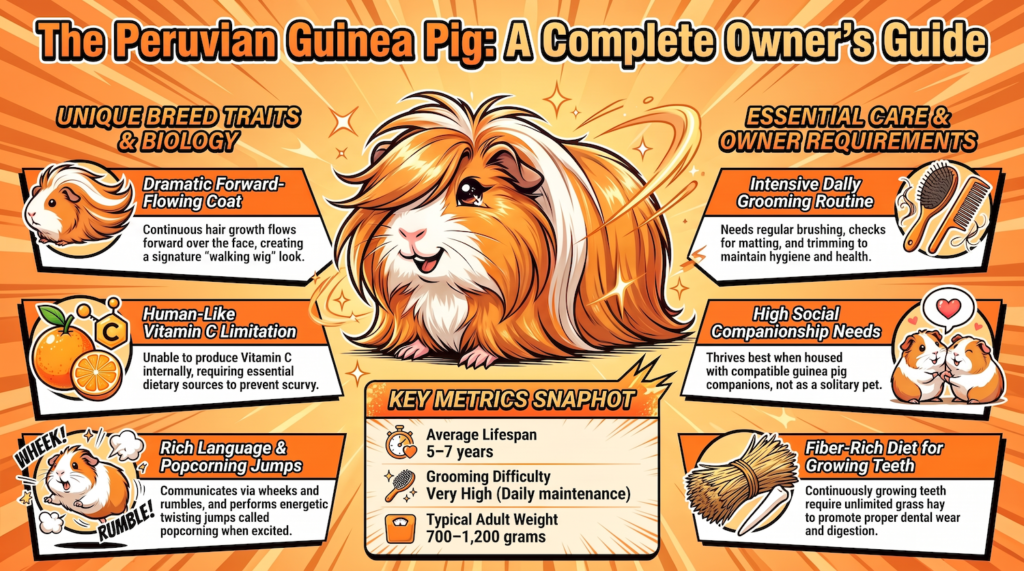




Famous for its spectacular flowing coat, the Peruvian Guinea Pig is one of the most eye-catching guinea pig breeds. Gentle, sociable and full of personality,
🧠 QUICK SNAPSHOT
Trait | Peruvian Guinea Pig |
|---|---|
Scientific Name | Cavia porcellus |
Other Names | Peruvian Cavy, Long-Haired Guinea Pig |
Pet Type | Small mammal / Guinea pig |
Natural Origin | South America; breed developed through selective breeding |
Typical Lifespan | Around 5–8 years |
Adult Size | Approximately 20–30 cm body length |
Adult Weight | Around 700–1,200 g |
Coat Type | Very long, straight, flowing hair |
Coat Colours | White, black, cream, brown, golden and combinations |
Diet | Herbivore |
Activity | Active throughout the day and night |
Temperament | Gentle, social and curious |
Noise Level | Low to moderate |
Social Needs | High; compatible guinea pig companionship |
Grooming | Very high maintenance |
Housing | Spacious indoor enclosure with exercise space |
Beginner Friendly? | Moderate; grooming experience helpful |
Famous Feature | Exceptionally long hair that can flow over its face |
📚 OVERVIEW
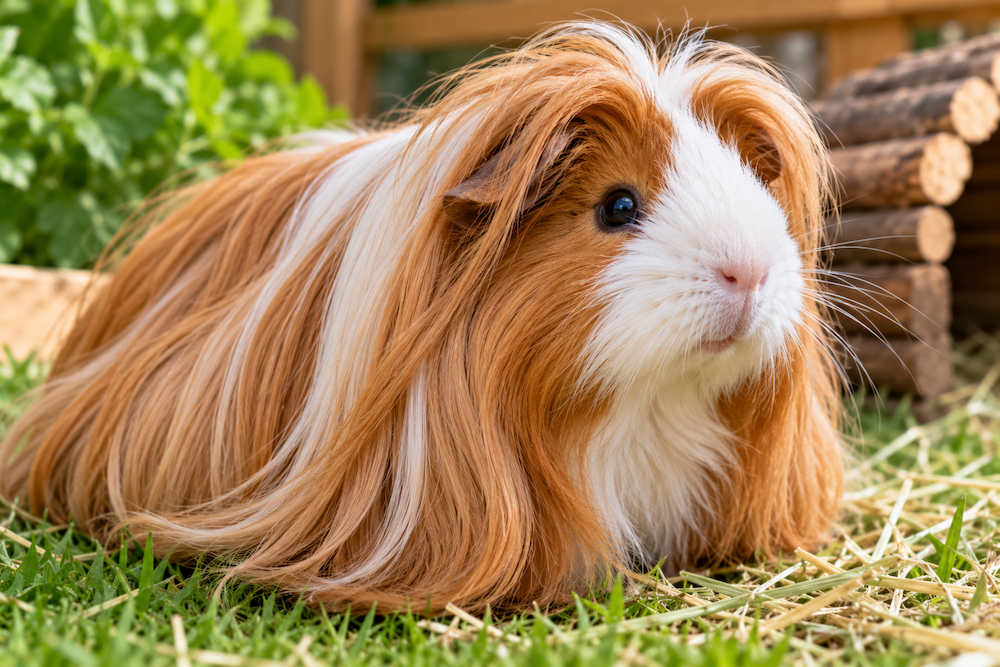
The Peruvian Guinea Pig is a distinctive long-haired variety of the domestic guinea pig, best known for its luxurious coat that grows continuously and can reach remarkable lengths.
Unlike short-haired guinea pigs, Peruvians have long, straight hair that grows from distinctive rosettes, often flowing forward over the head and backwards along the body.
Beneath their impressive hairstyles, they’re typical guinea pigs: gentle, curious, social animals that enjoy exploring, foraging and communicating with their companions.
However, their coat requires daily grooming, regular trimming and careful hygiene. Like all guinea pigs, they also need a high-fibre diet, continuous access to hay, adequate vitamin C and companionship from other compatible guinea pigs.
✅ PROS & CONS
👍 Pros
Beautiful, distinctive long coat
Gentle and sociable temperament
Entertaining personalities
Generally quiet pets
Enjoy companionship
Fascinating vocal communication
Suitable for indoor living
Can become comfortable with gentle handling
👎 Cons
Requires daily grooming
Coat tangles and mats easily
Needs regular hair trimming
Bedding can become trapped in fur
Requires guinea pig companionship
Needs spacious accommodation
Sensitive to excessive heat
Requires regular veterinary care
Are Peruvian Guinea Pigs Good Pets?
Yes. Peruvian Guinea Pigs can make wonderful pets for owners who appreciate gentle, sociable animals.
They’re curious, entertaining and can become comfortable interacting with familiar caregivers.
However, their demanding coat care makes them less suitable for people seeking a low-maintenance pet.
Are Peruvian Guinea Pigs Good for Beginners?
They can be suitable for dedicated beginners willing to learn proper grooming techniques.
However, short-haired guinea pigs are generally easier for first-time owners.
Peruvians require daily coat maintenance in addition to normal guinea pig care.
How Long Do Peruvian Guinea Pigs Live?
Peruvian Guinea Pigs typically live around 5–8 years.
Some individuals may live longer with excellent nutrition, appropriate housing and veterinary care.
Their lifespan is similar to that of other domestic guinea pig breeds.
How Big Do Peruvian Guinea Pigs Get?
Adult Peruvian Guinea Pigs generally measure approximately 20–30 cm in body length.
Most weigh around 700–1,200 grams, although individual size varies.
Their long hair can make them appear considerably larger than they actually are.
How Long Does Peruvian Guinea Pig Hair Grow?
Their hair grows continuously and can become exceptionally long if left untrimmed.
In exhibition animals, coats may reach 30 cm or more, depending on genetics and grooming.
For ordinary pets, keeping the coat at a practical length is usually more comfortable and hygienic.
Do Peruvian Guinea Pigs Need Daily Grooming?
Yes.
Daily gentle brushing or combing helps prevent tangles, mats and trapped bedding.
Particular attention should be given to the underside and hindquarters, where soiling and matting are common.
Should You Cut a Peruvian Guinea Pig’s Hair?
Yes, regular trimming is generally recommended for pet Peruvians.
Keeping the coat shorter helps prevent matting, improves mobility and reduces hygiene problems.
Careful trimming around the hindquarters is especially important.
Do Peruvian Guinea Pigs Shed?
Yes.
Like other guinea pigs, Peruvians naturally lose hair as part of the coat’s growth cycle.
Their long hair makes loose strands and tangles more noticeable.
Regular grooming helps maintain a healthy coat.
Do Peruvian Guinea Pigs Need Baths?
Occasional bathing may be necessary if their long coats become heavily soiled.
However, frequent bathing is generally unnecessary and may cause stress or skin problems.
Spot cleaning and regular coat trimming are preferable whenever possible.
Are Peruvian Guinea Pigs Friendly?
Generally, yes.
Peruvian Guinea Pigs are typically gentle, social animals that can develop trust in familiar people.
Individual temperament varies, and patient handling is important.
Do Peruvian Guinea Pigs Like Being Held?
Some enjoy gentle handling once they feel secure.
However, guinea pigs are prey animals and may initially become frightened when lifted.
Always support the chest and hindquarters, and avoid pulling or trapping their long hair.
Do Peruvian Guinea Pigs Bite?
Biting is relatively uncommon in well-socialised guinea pigs.
However, they may bite when frightened, uncomfortable or handled roughly.
Gentle interactions and recognising warning signs help reduce the risk.
Do Peruvian Guinea Pigs Recognise Their Owners?
Yes.
Guinea pigs can learn to recognise familiar voices, smells and feeding routines.
Many respond with excited squeaks when they hear their caregiver approaching.
Do Peruvian Guinea Pigs Need a Companion?
Yes. Guinea pigs are highly social animals.
They generally thrive with at least one compatible guinea pig companion.
Human interaction cannot fully replace the social contact provided by another guinea pig.
Can Two Male Peruvian Guinea Pigs Live Together?
Yes, compatible males can live together successfully.
However, adequate space, multiple feeding areas and careful introductions are important.
Personality and compatibility matter more than coat type.
What Do Peruvian Guinea Pigs Eat?
Their diet should consist primarily of unlimited grass hay, supplemented with suitable fresh vegetables and a measured amount of quality guinea pig pellets.
Fresh drinking water must always be available.
Guinea pigs also require a reliable dietary source of vitamin C.
Why Do Peruvian Guinea Pigs Need Vitamin C?
Guinea pigs cannot produce sufficient vitamin C themselves.
Without adequate dietary vitamin C, they can develop scurvy, which causes serious health problems.
Suitable vegetables and fortified guinea pig pellets help meet their nutritional needs.
Can Peruvian Guinea Pigs Eat Fruit?
Yes, but only in small amounts.
Suitable fruits such as apple without seeds, strawberries and blueberries can be occasional treats.
Fruit contains natural sugars and shouldn’t replace hay or vegetables.
How Big Should a Peruvian Guinea Pig Cage Be?
Guinea pigs need generous, uninterrupted floor space for movement and exploration.
For a compatible pair, approximately 1.5 square metres of usable floor space is a useful starting point, with larger enclosures strongly preferred.
A solid floor, soft bedding, hiding places and good ventilation are essential.
Can Peruvian Guinea Pigs Live Outside?
They can spend time outdoors in suitable conditions, but their long coats create additional challenges.
Damp ground, dirty bedding and extreme temperatures can quickly cause problems.
A clean, sheltered indoor environment is often easier to manage.
Are Peruvian Guinea Pigs Nocturnal?
No.
Guinea pigs are active at various times throughout the day and night.
They typically alternate between short periods of activity, feeding and rest.
Why Do Peruvian Guinea Pigs Squeak?
Guinea pigs use different vocalisations to communicate.
High-pitched squeaking, often called wheeking, commonly occurs when they’re excited about food.
Other sounds can express curiosity, discomfort or social interaction.
What Is Popcorning in Peruvian Guinea Pigs?
Popcorning describes sudden, energetic jumps and twists.
It’s commonly associated with excitement and playful behaviour.
Young guinea pigs are particularly famous for these entertaining movements.
What Health Problems Are Common in Peruvian Guinea Pigs?
Potential concerns include dental disease, vitamin C deficiency, respiratory infections, skin problems and digestive disorders.
Their long coats also increase the risk of matting, skin irritation and hygiene-related problems.
Regular veterinary examinations and proper grooming are important.
Can Peruvian Guinea Pigs Get Too Hot?
Yes.
Guinea pigs are sensitive to high temperatures, and their thick coats can increase the risk of overheating.
They need a cool, well-ventilated environment with constant access to fresh water.
Heat stress can become life-threatening and requires immediate veterinary attention.
What Is the Difference Between a Peruvian and a Silkie Guinea Pig?
Both are long-haired guinea pig breeds.
However, Peruvian Guinea Pigs have distinctive rosettes and hair that can grow forward over the face.
Silkie Guinea Pigs generally have smooth, flowing coats that sweep backwards from the head without the same forward-growing fringe.
Where Do Peruvian Guinea Pigs Come From?
Domestic guinea pigs originated in the Andean region of South America.
The Peruvian is a selectively developed long-haired variety associated with this broader domestic guinea pig heritage.
Its dramatic coat has been refined through generations of breeding.
What Makes the Peruvian Guinea Pig Unique?
Imagine a guinea pig with hair so long that you can barely tell which end is its head.
That’s the extraordinary Peruvian Guinea Pig.
Unlike most guinea pigs, whose coats remain relatively short, the Peruvian has continuously growing hair that can flow dramatically across its entire body.
Its distinctive rosettes create a hairstyle unlike almost any other small pet.
In some individuals, the hair grows forward over the face, giving the impression of a tiny animal wearing an enormous wig.
But underneath that spectacular coat is a fascinating little personality.
Peruvian Guinea Pigs communicate through squeaks, purrs, rumbles and other sounds.
They can learn familiar routines and may excitedly call out when they recognise the sound of vegetables being prepared.
And when they’re particularly happy or excited, they may perform the famous guinea pig behaviour known as popcorning — suddenly jumping and twisting into the air.
Their luxurious coats also create a remarkable contrast between appearance and behaviour.
Despite looking like miniature show animals, Peruvians still love ordinary guinea pig activities: exploring tunnels, eating hay and socialising with companions.
The Peruvian Guinea Pig isn’t simply a guinea pig with long hair — it’s a charming little character hiding beneath one of the animal kingdom’s most extraordinary hairstyles.