Poodle





🧠 QUICK SNAPSHOT
- Temperament: Intelligent, Alert, Active
- Energy Level: Moderate to High
- Size: Toy, Miniature, Standard
- Good with Families: Yes
- Training Difficulty: Easy
📚 OVERVIEW
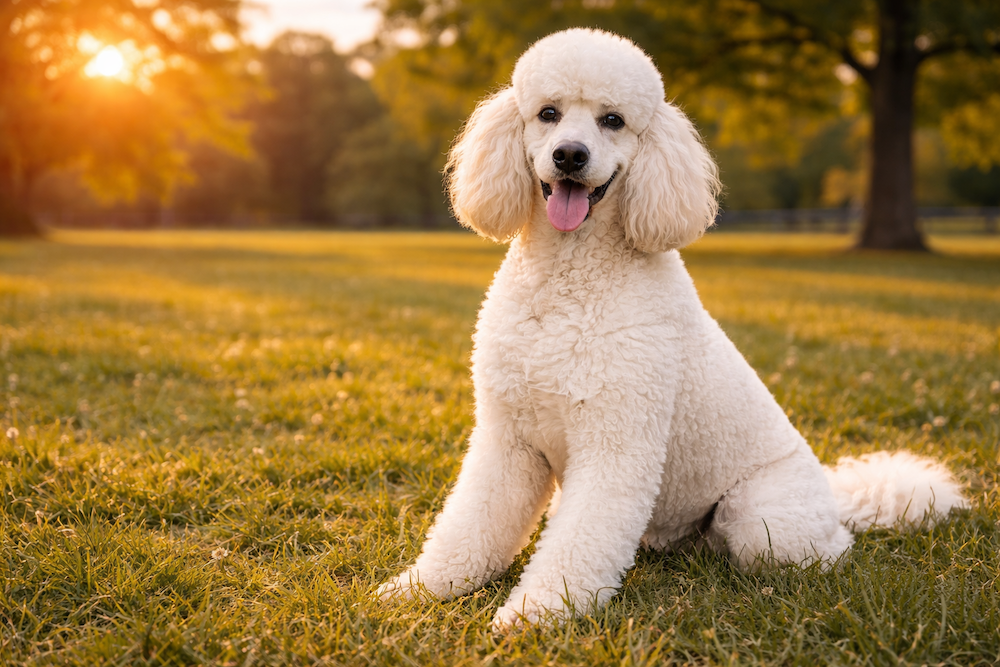
Poodles are known for their intelligence, elegance, and versatility. Available in three sizes — Toy, Miniature, and Standard — they adapt well to different living environments. Originally bred as water retrievers, they are active, responsive, and make excellent companions for engaged owners.
✅ PROS & CONS
Pros
- Extremely intelligent and easy to train
- Low shedding coat (great for allergy sufferers)
- Adaptable to different living environments
Cons
- Requires regular grooming
- Needs mental stimulation to avoid boredom
- Can become anxious if left alone too long
Is a Poodle a Good Family Dog?
Yes. Poodles are intelligent, affectionate, playful and highly trainable family dogs.
They tend to form close relationships with their families and enjoy being involved in everyday activities. Standard Poodles are generally more robust around active children, while Toy Poodles require gentler handling because of their small size.
Poodles need considerably more mental and physical stimulation than their elegant appearance sometimes suggests.
Are Poodles Good With Children?
Generally, yes.
Well-socialised Poodles are usually affectionate and playful with children. Standard Poodles can make particularly good companions for active families.
Toy Poodles are physically more fragile, so interactions with young children should be supervised carefully.
How Much Exercise Does a Poodle Need?
Exercise requirements depend on size and age, but Poodles are active, athletic dogs.
Standard and Miniature Poodles commonly benefit from around 60–90 minutes of daily activity, while Toy Poodles may need somewhat less.
Walking, retrieving, swimming, training and puzzle games are excellent outlets for their energy and intelligence.
Is a Poodle Easy to Train?
Yes. Poodles are considered among the most trainable dog breeds.
They’re quick learners, attentive to their owners and capable of mastering complex behaviours.
Positive reinforcement works particularly well, and Poodles can excel in obedience, agility, retrieving, scent work and many other activities.
Are Poodles Really One of the Smartest Dogs?
Poodles have an exceptional reputation for intelligence.
They’re particularly strong at learning commands, solving problems and working closely with humans.
However, canine intelligence isn’t a single measurable quality, and different breeds were developed to excel at different types of tasks.
Do Poodles Shed?
Poodles are very low-shedding dogs.
Their curly hair tends to trap loose hairs rather than releasing large amounts around the home.
This is one reason Poodles have become such popular parent breeds for crosses such as Labradoodles, Goldendoodles and Cavapoos.
Are Poodles Hypoallergenic?
Poodles are often described as hypoallergenic because they shed very little, but no dog is completely allergen-free.
Dog allergens are found in saliva and skin secretions as well as hair.
Some people with allergies tolerate Poodles better than heavily shedding breeds, but individual reactions vary.
How Often Should a Poodle Be Groomed?
Poodles require substantial regular grooming.
Their coat should be brushed thoroughly several times a week — and often daily when kept long — because loose hair remains trapped within the curls and can form mats.
Most pet Poodles also need professional clipping approximately every four to eight weeks, depending on coat length and style.
Why Do Poodles Need Haircuts?
Unlike breeds whose coats naturally shed and replace themselves in obvious seasonal cycles, Poodle hair continues growing and requires regular trimming.
Without brushing and clipping, the coat can become long, tangled and severely matted.
The famous Poodle haircut therefore isn’t purely decorative — regular coat maintenance is essential.
What Is the Traditional Poodle Haircut For?
The dramatic Poodle clip has historical connections to the breed’s work as a water retriever.
Traditionally, parts of the coat were clipped to reduce drag while hair was retained around important areas for protection in cold water.
Modern show clips became considerably more stylised, but the underlying water-working history helps explain the breed’s unusual grooming tradition.
What Health Problems Are Common in Poodles?
Health concerns vary somewhat between Standard, Miniature and Toy Poodles.
Potential problems include hip dysplasia, eye disorders, patellar luxation, epilepsy and certain inherited diseases. Standard Poodles can also be affected by conditions including Addison’s disease and gastric dilatation-volvulus (bloat).
Responsible breeders should perform health testing appropriate to the particular Poodle variety.
Are Poodles Prone to Bloat?
Standard Poodles can be at increased risk of gastric dilatation-volvulus (GDV) because of their deep-chested build.
GDV occurs when the stomach becomes distended and may twist, creating a life-threatening emergency.
Sudden abdominal swelling, repeated unsuccessful attempts to vomit, restlessness or collapse require immediate veterinary attention.
How Long Do Poodles Live?
Lifespan varies by size.
Standard Poodles commonly live around 12–15 years, while Miniature and Toy Poodles can often live into their mid-teens and sometimes beyond.
Smaller dogs generally have longer average lifespans than larger dogs.
What Are the Different Sizes of Poodle?
The three best-known recognised varieties are:
Standard Poodle – the largest.
Miniature Poodle – medium-sized.
Toy Poodle – the smallest.
They share the same fundamental breed characteristics but are separated primarily according to height under kennel-club standards.
How Big Does a Standard Poodle Get?
Standard Poodles commonly stand over 38 cm at the shoulder, with many substantially taller, depending on the kennel standard and individual dog.
Adults often weigh approximately 18–32 kg.
They’re athletic, substantial dogs rather than simply oversized lap dogs.
How Big Does a Miniature Poodle Get?
Miniature Poodles generally stand approximately 28–38 cm tall, although exact classification differs between kennel organisations.
They commonly weigh around 5–9 kg.
Their combination of manageable size, athleticism and intelligence makes them highly versatile companions.
How Big Does a Toy Poodle Get?
Toy Poodles generally stand under approximately 28 cm tall, depending on the kennel standard, and often weigh around 2–4 kg.
Despite their tiny size, they’re genuine Poodles and can be remarkably energetic, intelligent and trainable.
Is There a Teacup Poodle?
There is no officially recognised Teacup Poodle variety.
“Teacup” is a marketing term generally applied to exceptionally small Toy Poodles.
Deliberately breeding for extreme miniaturisation can increase the risk of fragile bones, dental crowding, hypoglycaemia and other health problems.
Is a Moyen Poodle a Real Poodle?
Yes, although the terminology depends on the country and registry.
“Moyen”, meaning medium in French, is commonly used for an intermediate-sized Poodle between Miniature and Standard.
Some European systems formally recognise a medium size, while other kennel organisations don’t maintain Moyen as a separate Poodle variety.
Can a Poodle Live in an Apartment?
Yes.
Toy and Miniature Poodles can adapt particularly well to apartments, and even Standard Poodles can live successfully in smaller homes when given sufficient exercise.
Mental stimulation is equally important because an under-stimulated Poodle can quickly invent its own entertainment.
Can Poodles Be Left Alone?
Adult Poodles can learn to tolerate reasonable periods alone, but they’re highly social dogs that often become strongly attached to their families.
Long periods of isolation can contribute to boredom or separation-related behaviour.
Teaching independence gradually from puppyhood is beneficial.
Are Poodles Cuddly?
Many are very affectionate and enjoy close physical contact with their owners.
Some are dedicated lap dogs, while others prefer lying nearby.
Their strong attachment to people means many Poodles follow their owners from room to room.
Do Poodles Bark a Lot?
Poodles can be relatively alert and vocal.
Toy and Miniature Poodles in particular may quickly announce visitors or unfamiliar noises.
Exercise, mental stimulation and early training can help prevent alert barking from becoming excessive.
Are Poodles Good With Other Dogs?
Generally, yes.
Well-socialised Poodles are usually sociable and can live successfully with other dogs.
Their playful nature often makes them enthusiastic canine companions, although individual temperament always matters.
Are Poodles Good With Cats?
Many Poodles live successfully with cats, particularly when introduced carefully.
However, Poodles have working and retrieving ancestry, and some individuals have stronger chase instincts than others.
Early socialisation can improve compatibility.
Do Poodles Have a High Prey Drive?
Prey and chase drive varies.
Poodles were historically working water dogs, so Standard Poodles in particular can retain strong retrieving and hunting instincts.
They’re generally highly trainable, which can make these instincts easier to manage than in some more independent hunting breeds.
Do Poodles Like Water?
Many do.
The Poodle’s ancestors were developed as water-working and retrieving dogs, and many modern Poodles remain enthusiastic swimmers.
Individual preference varies, so dogs should be introduced to water gradually rather than simply assuming every Poodle will immediately love swimming.
Are Poodles Good Running Dogs?
Standard Poodles can make excellent running and hiking companions once fully mature and appropriately conditioned.
They’re athletic dogs with considerably more endurance than their fashionable image suggests.
Toy Poodles obviously aren’t suited to the same distances, although they can still be energetic walkers.
What Does a Poodle Look Like Without a Haircut?
A Poodle allowed to grow a natural longer coat looks considerably fluffier and less sculpted than the familiar show dog.
Underneath the elaborate grooming is a lean, athletic, long-legged dog.
A short sporting or pet clip often makes the Poodle’s working-dog structure much easier to see.
What Colours Can Poodles Be?
Poodles occur in numerous colours, including black, white, brown, blue, grey, silver, cream, apricot and red.
Parti-coloured and other patterned Poodles also exist, although acceptance in the show ring differs between kennel organisations.
Coat colour doesn’t determine intelligence or temperament.
Why Do Some Poodles Change Colour?
Some Poodle coat colours can fade significantly as the dog matures.
A puppy that appears very dark may progressively lighten into silver, blue or another shade depending on its genetics.
Red and apricot coats can also become noticeably lighter with age.
What Is the Difference Between a Poodle and a Doodle?
A Poodle is an established breed.
“Doodle” is a broad informal term usually used for a Poodle crossed with another breed, such as a Labrador, Golden Retriever or Cavalier King Charles Spaniel.
Unlike a Poodle, a first-generation Doodle can inherit very different combinations of coat, size, shedding and temperament from its two parent breeds.
Is a Poodle Better for Allergies Than a Doodle?
A Poodle generally provides greater predictability of coat type and shedding than a first-generation Poodle cross.
A Labradoodle, Goldendoodle or other Doodle can inherit a coat that sheds considerably more than expected.
Neither Poodles nor Doodles can be guaranteed safe for everyone with dog allergies.
Are Poodles French or German?
The Poodle is strongly associated with France, but its deeper development is generally linked to German water dogs.
The German name Pudel is connected with splashing in water, reflecting the breed’s original working role.
France later played an enormous role in the breed’s refinement and popularity, and the Poodle became its national dog.
What Were Poodles Originally Bred For?
Poodles were originally developed primarily as water retrievers.
Their job was to enter the water and retrieve birds shot by hunters.
Their intelligence, athleticism, swimming ability and trainability all make much more sense when viewed through this working history.
Were Poodles Hunting Dogs?
Yes.
Before becoming famous as fashionable companions and show dogs, Poodles had a genuine working history retrieving waterfowl.
Some modern Poodles still participate in hunting and retrieving activities.
The breed’s elegant appearance hides a remarkably practical sporting-dog heritage.
Why Are Poodles Associated With France?
Poodles became extraordinarily popular and highly developed in France, where they became closely associated with fashionable society, performance and companionship.
The French name Caniche derives from a term associated with duck hunting, preserving the breed’s water-retrieving history.
Their popularity in France became so strong that the Poodle is widely regarded as the country’s national dog.
Why Were Poodles Used in Circuses?
Their intelligence, athleticism and ability to learn complex behaviours made Poodles particularly successful performing dogs.
They could be taught elaborate tricks relatively quickly and were visually distinctive after grooming.
Their history as performers helped reinforce the public image of the Poodle as an exceptionally clever breed.
Is a Poodle a Good First Dog?
Yes. Poodles can be excellent first dogs for owners prepared to meet their grooming, exercise and mental-stimulation needs.
They’re highly trainable, affectionate and adaptable.
The main surprise for inexperienced owners is often that the Poodle isn’t simply a decorative companion. It’s an intelligent working breed that can become bored when given too little to do.
What Makes the Poodle Unique?
The Poodle may have undergone one of the greatest image transformations in the dog world.
Today, people often picture an immaculate show dog with elaborate haircuts and pom-poms.
But underneath the haircut is an athletic water retriever.
Its ancestors worked in and around water, retrieving birds for hunters. Even the breed’s name is connected with splashing in water, while the traditional clip has roots in managing a working dog’s coat.
Then humans discovered something else.
Poodles were extraordinarily trainable.
They became performers, companions and show dogs, eventually developing an image of elegance so powerful that their working origins were almost forgotten.
That intelligence and low-shedding coat also explain why the Poodle now sits behind an extraordinary number of modern crosses — Labradoodles, Goldendoodles, Cavapoos, Cockapoos, Maltipoos and dozens more.
Yet one of the great ironies of the Doodle boom is that many of the qualities people are trying to create — intelligence, trainability, athleticism and a reliably low-shedding coat — were already sitting together in the Poodle.
Underneath the fancy haircut, it never stopped being a working dog.