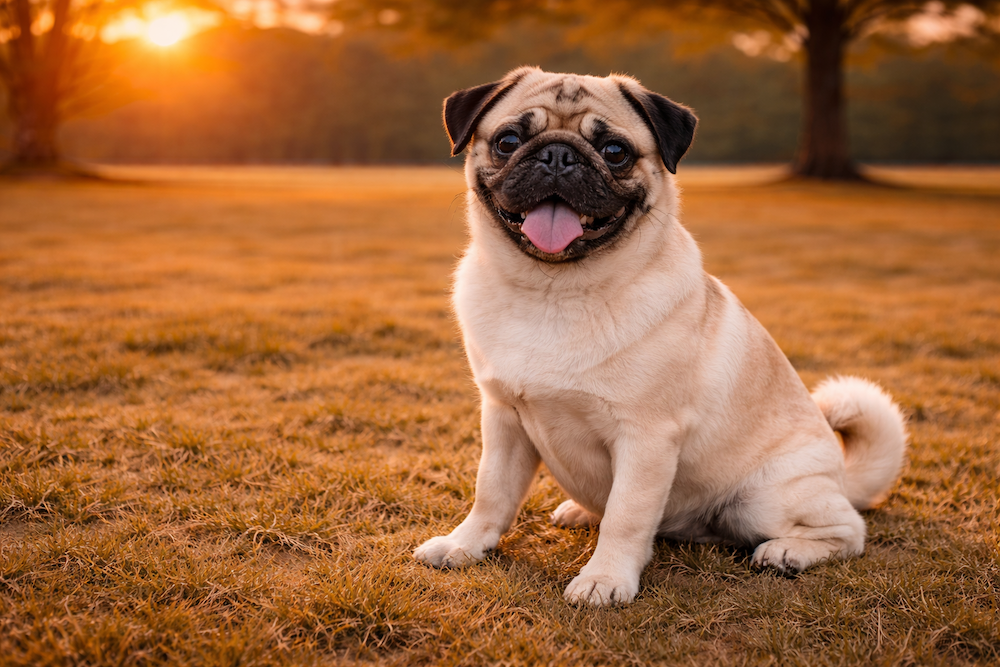







Charming, cheeky, and full of personality — a small dog that brings big smiles.
🧠 QUICK SNAPSHOT
- Temperament: Playful, Affectionate, Mischievous
- Energy Level: Low to Moderate
- Size: Small
- Good with Families: Excellent
- Training Difficulty: Easy
📚 OVERVIEW
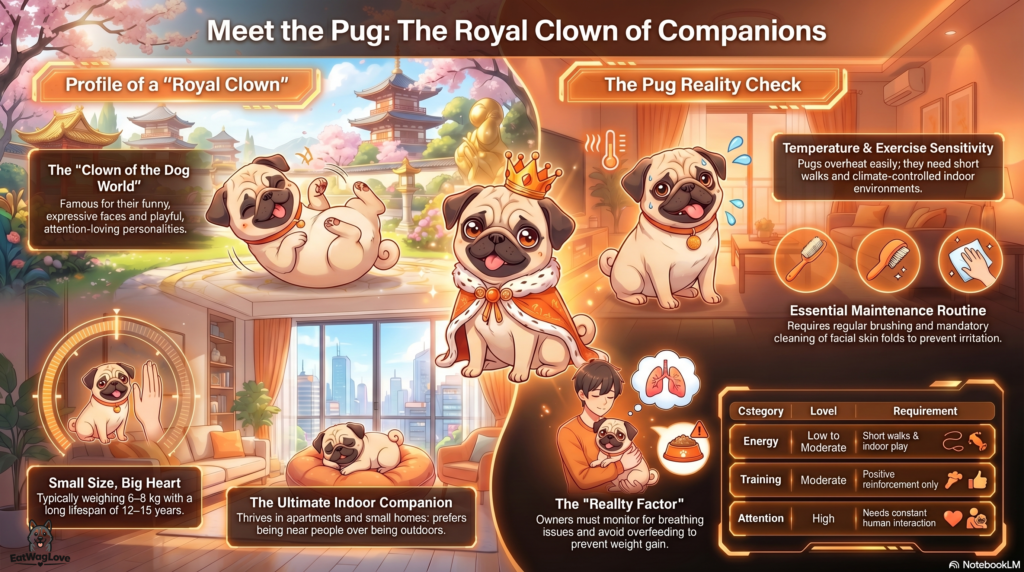
Pugs are small companion dogs known for their wrinkled faces, curled tails, and big personalities. They thrive on attention and love being part of family life. Their playful and affectionate nature makes them one of the most popular companion breeds worldwide.
✅ PROS & CONS
Pros
- Very affectionate and people-focused
- Great for apartments and smaller homes
- Fun, playful personality
Cons
- Prone to breathing and heat-related issues
- Can gain weight easily
- Needs regular care for skin folds
Is a Pug a Good Family Dog?
Yes. Pugs are typically affectionate, playful, sociable and strongly people-oriented family dogs.
They were developed primarily as companions and usually want to be wherever their family is. Their moderate exercise requirements and small size suit many households.
Prospective owners should understand that the Pug’s extremely short muzzle and compact body are associated with significant health concerns.
Are Pugs Good With Children?
Generally, yes.
Pugs are usually friendly, sturdy for their size and playful without having the intense exercise requirements of many working breeds.
As with any dog, interactions with young children should be supervised and children taught to handle the dog respectfully.
How Much Exercise Does a Pug Need?
Most healthy adult Pugs benefit from around 30–60 minutes of gentle daily activity, divided into manageable walks and play sessions.
Their exercise tolerance varies because breathing difficulties can affect some individuals.
Strenuous exercise should be avoided in hot or humid conditions.
Are Pugs Easy to Train?
Pugs are intelligent and usually respond well to positive, food-based training.
They can also be stubborn and easily distracted, so short, enjoyable sessions work particularly well.
Keeping treats small is important because Pugs can gain excess weight easily.
Do Pugs Shed a Lot?
Yes. Despite their short coats, Pugs can be surprisingly heavy shedders.
Many have dense double coats that release considerable amounts of hair throughout the year.
Regular brushing helps remove loose hair before it reaches furniture and clothing.
Are Pugs Hypoallergenic?
No.
Pugs aren’t considered hypoallergenic and can shed considerably.
Dog allergens are also present in saliva and skin secretions, so a short coat doesn’t make a dog allergy-free.
How Often Should You Groom a Pug?
Pugs generally need brushing several times a week, along with regular nail trimming, dental care and ear checks.
Their facial wrinkles require particular attention. Skin folds should be checked and kept clean and dry because trapped moisture and debris can contribute to irritation and infection.
What Health Problems Are Common in Pugs?
Important health concerns include brachycephalic obstructive airway syndrome (BOAS), eye injuries and disorders, skin-fold disease, patellar luxation, spinal problems, dental disease and obesity.
Pugs can also be affected by neurological conditions including Pug Dog Encephalitis.
Responsible breeding should prioritise open nostrils, functional breathing, healthy eyes and sound movement rather than increasingly exaggerated features.
Why Do Pugs Have Breathing Problems?
Pugs are brachycephalic, meaning they have unusually shortened skulls and muzzles.
Their shortened facial structure can be associated with narrow nostrils, an elongated or thickened soft palate and other airway abnormalities collectively known as BOAS.
Snorting and snoring may be common in the breed, but persistent noisy or laboured breathing shouldn’t simply be dismissed as “normal for a Pug.”
Why Do Pugs Have So Many Eye Problems?
The Pug’s shallow eye sockets and very short muzzle leave its prominent eyes relatively exposed.
This can increase the risk of corneal ulcers, trauma, dry eye and other ocular problems.
Squinting, excessive tearing, redness or suddenly keeping an eye closed warrants prompt veterinary attention.
How Long Do Pugs Live?
Pugs commonly live around 11–14 years, although individual lifespan varies substantially with genetics and health.
Maintaining a lean body condition is particularly important because excess weight can worsen breathing, joint and heat-related problems.
How Big Does a Pug Get?
Adult Pugs generally weigh around 6–8 kg, with a compact, muscular build.
They’re small dogs but should feel surprisingly substantial for their height.
An excessively overweight Pug shouldn’t be mistaken for a naturally larger example of the breed.
When Is a Pug Fully Grown?
Most Pugs reach close to their adult height by around 9–12 months.
They may continue filling out and developing physically until around 18 months or beyond.
Care should be taken not to confuse healthy maturity with excessive weight gain.
Is There a Teacup or Miniature Pug?
There is no officially recognised Teacup or Miniature Pug variety.
The Pug is already a small breed.
Dogs marketed as exceptionally tiny Pugs may have been selected for extreme smallness or may involve other ancestry, and very small size can introduce additional health concerns.
Can a Pug Live in an Apartment?
Yes. Pugs can make excellent apartment dogs.
They’re small, generally adaptable and don’t require a large garden.
Their companionship needs and sensitivity to heat mean they’re primarily indoor dogs regardless of the size of the home.
Can Pugs Be Left Alone?
Adult Pugs can learn to tolerate reasonable periods alone, but they’re strongly people-oriented.
They were bred for companionship and many prefer being close to their owners.
Gradually teaching independence can help reduce separation-related problems.
Are Pugs Cuddly?
Usually, yes.
Pugs have been companion dogs for centuries and many actively seek physical contact, laps and comfortable places beside their owners.
A Pug given the choice between an important job and sitting next to its favourite person will often find the second option remarkably compelling.
Do Pugs Bark a Lot?
Pugs aren’t generally among the most persistent barking breeds, although individuals vary.
They may bark at visitors, excitement or unusual noises.
Many Pugs are better known for their impressive collection of snorts, grunts, snores and other vocal noises.
Are Pugs Good With Other Dogs?
Generally, yes.
Pugs are usually sociable and can live successfully with other dogs when appropriately introduced.
Their prominent eyes and breathing limitations mean particularly rough play with larger or highly energetic dogs should be monitored.
Are Pugs Good With Cats?
Many Pugs live very successfully with cats.
They weren’t developed primarily as hunting dogs and generally don’t have the extreme prey drive seen in some breeds.
Individual temperament and careful introductions still matter.
Can Pugs Handle Hot Weather?
Pugs are particularly vulnerable to hot weather.
Their shortened airways make cooling themselves through panting less efficient, increasing the risk of heat stress.
In hot Australian conditions, exercise should be restricted to cooler periods, and Pugs should have constant access to water and a cool indoor environment.
Can Pugs Swim?
Some Pugs can paddle, but many aren’t naturally strong swimmers.
Their short muzzle, broad chest and compact body can make it difficult to keep the nose safely above water.
Pugs should be closely supervised around pools and other water, and a properly fitted canine life jacket is sensible around deeper water.
Why Do Pugs Have Curly Tails?
The tightly curled tail is a characteristic feature of the breed.
Breed standards traditionally favour a high-set tail curled tightly over the hip, with a double curl particularly prized in the show ring.
However, tail appearance should never be prioritised over healthy spinal structure and mobility.
What Colours Can Pugs Be?
The best-known Pug colours are fawn and black.
Depending on the kennel organisation, recognised colours can vary, and other colours are sometimes advertised commercially.
Unusual colour should never be prioritised over health, temperament and responsible breeding.
What Is the Difference Between a Pug and a French Bulldog?
Both are small brachycephalic companion dogs, but they’re distinct breeds.
Pugs generally have folded ears, curled tails and a more rounded overall appearance, while French Bulldogs have characteristic upright “bat ears” and a heavier, more muscular build.
Both breeds can experience serious health problems associated with extreme brachycephaly.
What Is the Difference Between a Pug and a Boston Terrier?
Boston Terriers are generally more athletic-looking, with upright ears, longer legs and distinctive white markings.
Pugs are more compact, typically have folded ears and carry their tails curled over the body.
Both are brachycephalic breeds, although the degree of muzzle shortening varies between individuals.
Why Does My Pug Follow Me Everywhere?
Pugs have been bred for close human companionship for centuries.
Following their owners from room to room is therefore unsurprising and often reflects attachment and curiosity.
If a Pug becomes distressed whenever its owner disappears, however, gradual independence training may be helpful.
Where Do Pugs Come From?
Pugs originated in China, where their ancestors were bred as small companion dogs associated with wealthy and imperial households.
Dogs of this general short-faced companion type have a long history in China.
Pugs later travelled to Europe through international trade and became particularly popular in the Netherlands and Britain, where the modern breed was further developed.
Were Pugs Bred for Chinese Royalty?
Yes. The Pug’s ancestors were part of China’s long tradition of small, short-faced companion dogs kept by elite and imperial households.
These dogs were valued as companions rather than hunters, herders or guards.
This helps explain why the modern Pug remains so intensely focused on human company.
Are Pugs Related to Pekingese?
Pugs and Pekingese share historical connections to China’s tradition of small companion dogs, but they’re distinct modern breeds.
Their exact ancient relationships are difficult to reconstruct with certainty.
Both were ultimately shaped into recognisable modern pedigree breeds through later selective breeding.
Is a Pug a Good First Dog?
Pugs can be good first dogs because they’re affectionate, sociable and usually manageable to train.
However, prospective owners should seriously consider the breed’s potential veterinary needs, breathing problems, heat intolerance and weight management.
Their personality may be relatively easy to live with; their health can be considerably more demanding.
What Makes the Pug Unique?
Few breeds have such a striking contrast between comic personality and serious history.
Pugs were companion dogs in China long before they became familiar pets in Europe. They weren’t bred to retrieve birds, herd sheep or chase foxes.
Their job was essentially to be with people.
Centuries later, they’re still remarkably good at it.
Pugs follow their owners, occupy laps, investigate food and somehow turn snorting, sleeping and looking mildly offended into entertainment.
Unfortunately, selective breeding also pushed the Pug toward an increasingly shortened face. That distinctive appearance can come at a real cost when breathing, eyes or movement are compromised.
The best modern Pug shouldn’t simply have the flattest possible face or the most exaggerated features.
It should still be able to breathe comfortably, move freely, play, exercise and enjoy being a dog.
Because underneath the wrinkles and comedy is something much older and simpler:
a little companion dog whose ancestors spent centuries learning that the best place to be was wherever the humans were.