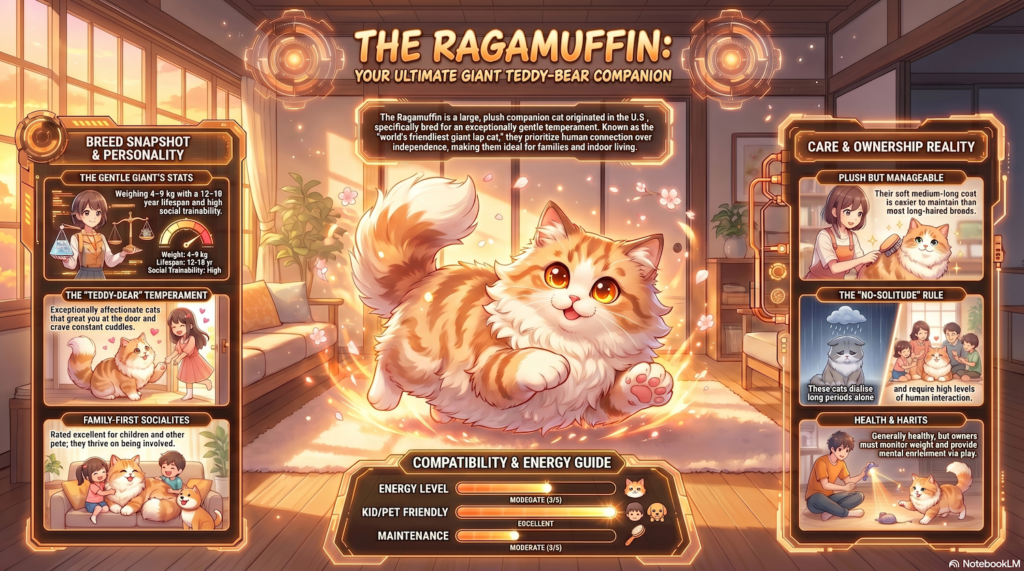







Sweet, gentle, and irresistibly cuddly — a large, affectionate companion that loves spending time with its family.
🧠 QUICK SNAPSHOT
- Temperament: Affectionate, gentle, friendly
- Energy Level: Low to moderate
- Size: Large
- Good With Families: Yes
- Trainability: Moderate
- Grooming: Moderate
- Best For: Families, indoor living, companionship
📚 OVERVIEW
The Ragamuffin is a large, fluffy cat breed known for its affectionate nature and plush coat. Often described as one of the friendliest cat breeds, they thrive on human companionship and enjoy being involved in family life.
They are relaxed, easy-going cats that love attention and are often happy to curl up beside their favourite people.
✅ PROS & CONS
Pros
- Extremely affectionate and loving
- Great with families and children
- Calm and gentle temperament
- Beautiful soft coat and expressive eyes
Cons
- Requires regular grooming
- Can be prone to weight gain
- Prefers companionship and attention
- Best suited to indoor living
Is a Ragamuffin a Good Family Cat?
Yes. Ragamuffins are generally affectionate, gentle, sociable and people-oriented cats, making them excellent family companions.
They often enjoy being close to their owners and are typically calmer than many highly active breeds.
Their easy-going personality can suit families, couples, older people and households wanting an affectionate indoor cat.
Are Ragamuffin Cats Good With Children?
Generally, yes.
Ragamuffins are known for their patient, gentle temperament and often enjoy attention from respectful children.
Because they’re substantial cats, they’re less physically fragile than some smaller breeds, but children should still be taught to handle them appropriately.
Are Ragamuffin Cats Affectionate?
Very often.
Ragamuffins were developed primarily as companion cats and tend to form strong relationships with their families.
Many enjoy sitting beside their owners, sleeping nearby and following people around the home.
Do Ragamuffin Cats Like to Be Held?
Many Ragamuffins tolerate or enjoy being held, although individual preferences vary.
The breed has a reputation for being relaxed and physically affectionate.
However, claims that every Ragamuffin automatically goes completely limp when picked up are an exaggeration. Cats should always be allowed to decide how much handling they enjoy.
Are Ragamuffin Cats Lap Cats?
Many are.
Their calm, affectionate personality makes Ragamuffins more likely than some breeds to seek prolonged physical contact.
The only potential problem is size — an adult Ragamuffin can turn the concept of a “lap cat” into something closer to a weighted blanket.
How Much Exercise Does a Ragamuffin Cat Need?
Ragamuffins have moderate exercise needs.
Daily interactive play with wand toys, balls, climbing structures and puzzle feeders helps maintain healthy weight and provides mental stimulation.
They’re generally less intensely active than breeds such as Bengals or Abyssinians, but they still need regular opportunities to play.
Are Ragamuffin Cats Easy to Train?
Yes. Ragamuffins are intelligent and often highly food motivated.
Many can learn their names, household routines, scratching-post use and simple tricks.
Positive reinforcement works much better than punishment and can make training an enjoyable form of enrichment.
Do Ragamuffin Cats Shed a Lot?
Ragamuffins do shed, although the amount varies between individuals and seasons.
Their coat is medium to medium-long and can release noticeable amounts of hair around the home.
Regular combing helps remove loose hair and reduces tangles.
Are Ragamuffin Cats Hypoallergenic?
No.
Ragamuffins aren’t considered hypoallergenic.
Cat allergies are primarily triggered by proteins found in saliva and skin secretions rather than simply by the length or amount of hair.
How Often Should You Groom a Ragamuffin?
Most Ragamuffins benefit from combing two or three times a week, although some may need more frequent grooming.
Their coat is generally silky and less prone to severe matting than some dense long-haired breeds, but tangles can still develop around the armpits, belly and hindquarters.
Regular grooming also helps control loose hair.
What Health Problems Are Common in Ragamuffin Cats?
Ragamuffins are generally robust cats, but responsible breeders should pay attention to inherited conditions present within related breeding populations.
Potential concerns can include hypertrophic cardiomyopathy (HCM), polycystic kidney disease (PKD) and obesity.
Prospective owners should ask breeders about relevant genetic testing, cardiac screening and the health history of their breeding lines.
How Long Do Ragamuffin Cats Live?
Ragamuffins commonly live around 12–16 years, with some living longer.
Indoor living, appropriate nutrition, maintaining a healthy weight, dental care and regular veterinary examinations can all contribute to longevity.
How Big Do Ragamuffin Cats Get?
Ragamuffins are large, substantial cats.
Adult males can commonly weigh around 6–9 kg or more, while females are usually somewhat smaller.
They have broad chests, substantial bodies and heavy bone structure, but shouldn’t be allowed to become overweight simply because they’re naturally large cats.
When Is a Ragamuffin Cat Fully Grown?
Ragamuffins are slow-maturing cats and may take around four years to reach full physical maturity.
They can look quite substantial before they’re completely developed.
This prolonged growth period is also seen in several other large cat breeds.
Can Ragamuffin Cats Live Indoors?
Yes. Ragamuffins are particularly well suited to indoor living.
They tend to enjoy human companionship and don’t require unrestricted outdoor access to live fulfilling lives.
Cat trees, scratching posts, windows, toys and regular interactive play can provide an enriching indoor environment.
Can Ragamuffin Cats Be Left Alone?
Adult Ragamuffins can tolerate reasonable periods alone, but they’re generally social cats that enjoy companionship.
A cat regularly left alone for long periods may benefit from additional enrichment or a compatible animal companion.
Their relaxed personality shouldn’t be mistaken for a lack of need for social interaction.
Are Ragamuffin Cats Vocal?
Ragamuffins are generally not considered exceptionally noisy cats.
Many communicate with relatively soft meows, chirps or other gentle vocalisations.
Individual personalities vary, but they’re usually less vocal than breeds famous for constant conversation, such as the Siamese.
Are Ragamuffin Cats Good With Other Cats?
Generally, yes.
Their calm and sociable temperament often allows them to live successfully with other cats.
Gradual introductions remain important because compatibility depends on the personalities of the individual animals.
Are Ragamuffin Cats Good With Dogs?
Many Ragamuffins can live successfully with cat-friendly dogs.
Their confident, easy-going temperament can make introductions easier than with particularly nervous cats.
Dogs should still be introduced gradually and prevented from chasing the cat.
What Does a Ragamuffin Cat Look Like?
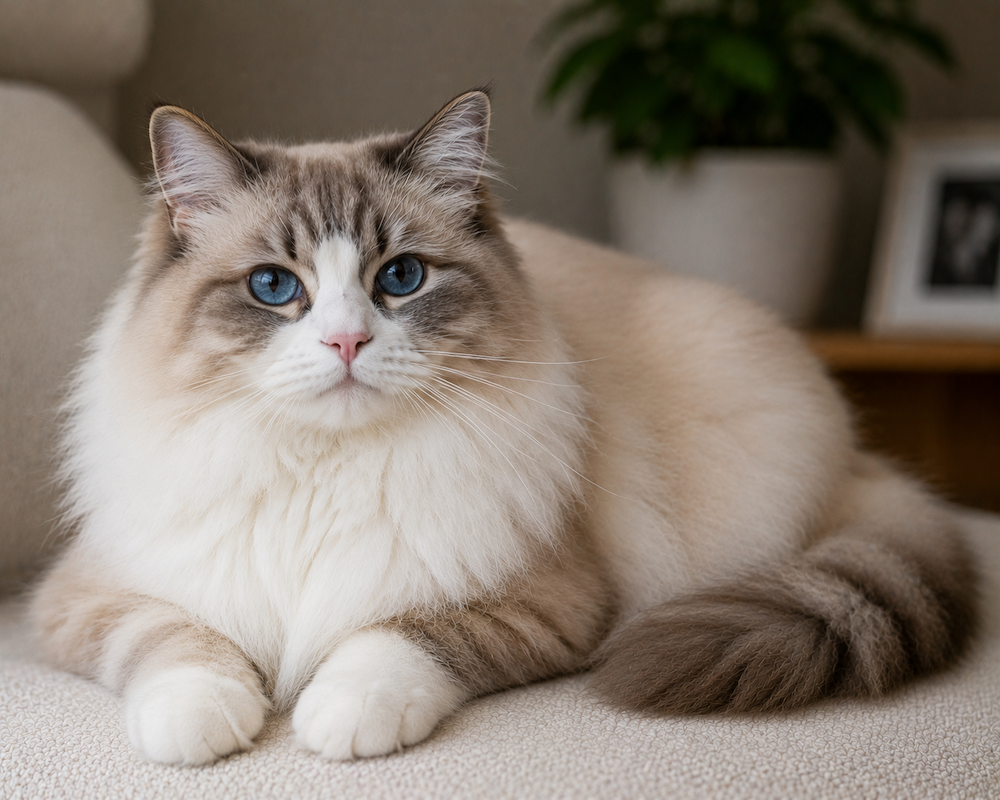
The Ragamuffin is a large, heavily built cat with a soft medium-to-long coat, broad chest, substantial body and expressive eyes.
The head has a rounded appearance rather than extreme angles.
Its luxurious coat and substantial size give the breed a plush, almost teddy-bear-like appearance.
What Colours Do Ragamuffin Cats Come In?
Ragamuffins occur in a very wide range of colours and patterns.
Depending on the registry, these can include solid, tabby, tortoiseshell, shaded and various combinations with white.
This extensive colour variety distinguishes them from the more restricted traditional appearance associated with some related breeds.
What Colour Eyes Do Ragamuffin Cats Have?
Ragamuffins can have several eye colours, including green, gold, amber and blue, depending on coat colour and genetics.
Some cats may also have differently coloured eyes.
The breed is known for its large, expressive eyes, which contribute significantly to its gentle facial expression.
What Is the Difference Between a Ragamuffin and a Ragdoll?
Ragamuffins and Ragdolls are closely connected historically but are now distinct breeds.
Ragdolls traditionally have blue eyes and occur in specific pointed patterns, while Ragamuffins are accepted in a much broader variety of coat colours, patterns and eye colours.
Both are generally large, affectionate companion cats, but their modern breed standards differ.
Is a Ragamuffin the Same as a Ragdoll?
No.
The Ragamuffin developed from breeding lines connected with the early history of the Ragdoll, but it was subsequently developed and recognised separately.
Today, reputable registries treat the Ragamuffin and Ragdoll as distinct breeds with their own standards.
Where Does the Ragamuffin Cat Come From?
The Ragamuffin was developed in the United States.
Its history is closely connected with cats descended from the breeding programme that produced the Ragdoll.
During the 1990s, breeders seeking greater freedom over breeding practices and development began establishing what would become the Ragamuffin as a separate breed.
Why Is It Called a Ragamuffin?
The name Ragamuffin was adopted when breeders needed a new identity for cats being developed separately from the Ragdoll.
The similarity between the names reflects their historical connection.
What began as a practical naming necessity ultimately became the permanent name of the new breed.
Is a Ragamuffin Cat Rare?
Ragamuffins are considerably less common than Ragdolls and many mainstream pedigree cat breeds.
Availability varies greatly between countries, and prospective owners may need to search carefully for an established breeder.
Their relative rarity also makes verifying breeder reputation and health testing particularly important.
Is a Ragamuffin a Good First Cat?
Yes. Ragamuffins can be excellent first cats.
Their gentle temperament, moderate activity level and affectionate personality are generally easy to live with.
New owners should be prepared for regular grooming, a large adult cat and the costs associated with maintaining a pedigree pet throughout a potentially long lifespan.
What Makes the Ragamuffin Cat Unique?
The Ragamuffin combines three characteristics people often want in a companion cat: large size, a spectacular fluffy coat and an exceptionally affectionate personality.
Its history is also unusual.
The breed didn’t develop as an ancient natural population or a working farm cat. It emerged from breeding lines closely connected with the Ragdoll before breeders took the cats in a separate direction, ultimately establishing the Ragamuffin.
That helps explain why the two breeds still share some obvious characteristics while differing in areas such as accepted colours, patterns and eye colours.
And despite the Ragamuffin’s impressive size, many haven’t received the message that large cats are supposed to maintain some dignity.
A fully grown Ragamuffin may weigh considerably more than the average cat, yet still decide that the ideal sleeping location is directly on top of you.
At that point, you don’t really own a lap cat.
You own a very affectionate blanket that occasionally demands dinner.