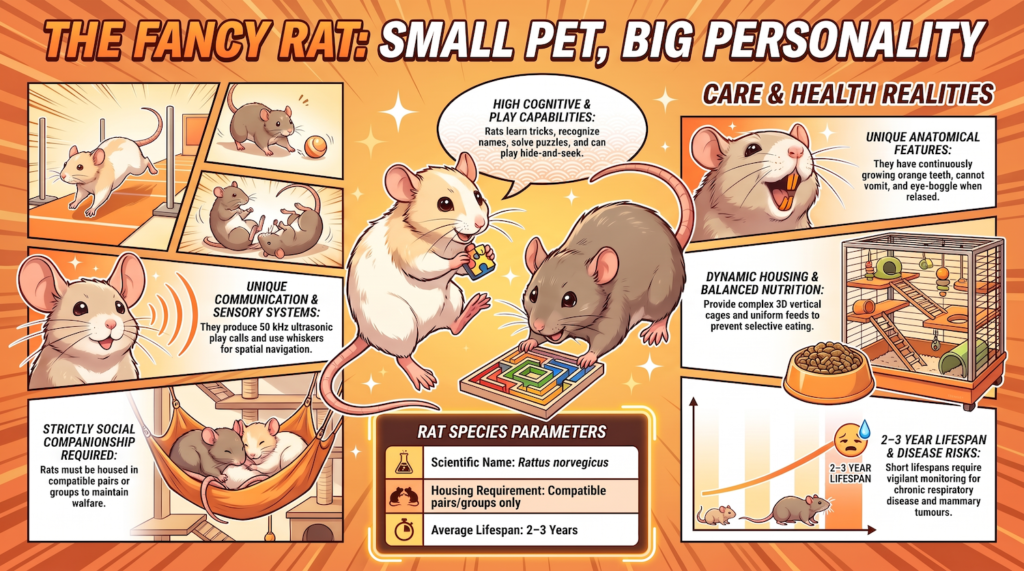
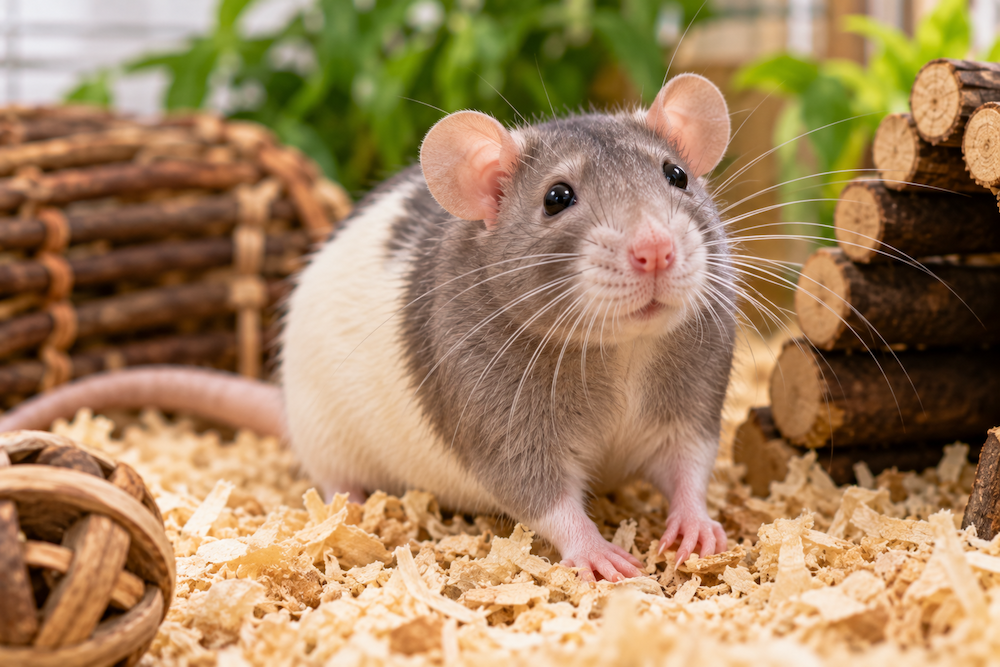







Intelligent, affectionate and remarkably social, pet rats are far more like tiny companion animals than many people realise — they can learn their names, master tricks, form strong relationships and genuinely enjoy interacting with their owners.
🧠 QUICK SNAPSHOT
| Trait | Pet Rat |
|---|---|
| Scientific Name | Rattus norvegicus domestica |
| Pet Type | Small mammal / Rodent |
| Domestic Ancestor | Brown or Norway Rat |
| Typical Lifespan | Around 2–3 years |
| Adult Size | Roughly 20–28 cm body length, plus tail |
| Typical Weight | Around 250–650 g, depending on sex and individual |
| Diet | Omnivore |
| Activity | Most active around dawn, dusk and night |
| Temperament | Social, intelligent, curious and often affectionate |
| Housing | Large, secure, well-ventilated cage |
| Social Needs | Very high — should normally live with compatible rats |
| Trainability | Excellent for a small pet |
| Beginner Friendly? | Yes, with appropriate social housing and care |
📚 OVERVIEW
For an animal that has spent centuries battling a terrible public-relations problem, the domestic rat can be an astonishingly good companion.
Pet rats are domesticated forms of the brown or Norway rat, Rattus norvegicus. Selective breeding has produced rats with many different colours, markings, coat types and ear shapes, often collectively called fancy rats.
But appearance isn’t what makes them exceptional pets.
Rats are highly intelligent and intensely social animals. They can learn routines, recognise familiar people, respond to training and solve surprisingly complex problems. Many learn their names, come when called and can be taught behaviours ranging from standing and spinning to retrieving objects.
They’re also often remarkably affectionate.
Well-socialised rats may actively seek human attention, climb onto their owners, sit inside clothing or curl up for a sleep while being stroked. Some even perform a fascinating behaviour called bruxing, gently grinding their teeth when relaxed or excited.
Rats aren’t solitary cage decorations, however.
Their social needs are substantial, and pet rats should normally be kept with at least one compatible rat, with same-sex pairs or groups being common unless animals have been appropriately desexed.
Their greatest disadvantage as companion animals is unfortunately their lifespan. A rat may become an extraordinarily interactive little member of the family but commonly lives only around two to three years.
For people who can accept that short lifespan, rats can be among the most rewarding small pets available.
✅ PROS & CONS
Pros
- Exceptionally intelligent for a small pet
- Can learn tricks and respond to training
- Often affectionate with their owners
- Usually enjoy regular human interaction
- Fascinating social behaviour
- Can recognise familiar people and routines
- Relatively easy to handle when properly socialised
- Available in many colours, markings and coat varieties
- Don’t require outdoor walks
- Can make excellent first small pets
- Often far more interactive than people expect
Cons
- Short average lifespan of around 2–3 years
- Shouldn’t normally be kept alone
- Need a large, stimulating enclosure
- Require regular supervised time outside the cage
- Cage needs frequent cleaning
- Can develop respiratory problems
- Tumours become relatively common, particularly as rats age
- Veterinary treatment may require a vet experienced with small mammals
- Can chew furniture, cables and other objects during free-roaming time
- Males and females can reproduce extremely quickly if housed together
- Their reputation can make some landlords or family members reluctant to accept them
Are Rats Good Pets?
Yes. Domestic rats can make excellent companion animals.
They’re intelligent, social, trainable and often extremely affectionate with people.
For owners wanting a small animal that actively interacts with them, rats can be an excellent choice.
Are Rats Good Pets for Beginners?
Yes. Rats can be excellent first small pets when owners understand their social and housing requirements.
They’re generally easier to handle than many smaller rodents and can become very comfortable around humans.
The major considerations are keeping multiple compatible rats, providing sufficient space and enrichment, and accepting their relatively short lifespan.
Are Pet Rats Good With Children?
They can be excellent pets for responsible children with adult supervision.
Well-socialised rats are generally curious and relatively easy to handle.
Children should learn to support the rat’s body properly, avoid squeezing or grabbing it and always wash their hands after handling animals or cleaning their enclosure.
An adult should remain ultimately responsible for their care.
How Long Do Pet Rats Live?
Pet rats typically live around 2–3 years, although some individuals live longer.
Unfortunately, their short lifespan is one of the biggest disadvantages of keeping rats.
Because they’re capable of developing strong relationships with their owners, losing them after only a few years can be particularly difficult.
How Big Do Pet Rats Get?
Adult pet rats commonly have a body length of approximately 20–28 cm, not including the tail.
Males are generally substantially larger and heavier than females.
Individual size varies according to genetics, sex, diet and body condition.
Should Pet Rats Be Kept in Pairs?
Yes. Rats are highly social animals and should normally have compatible rat companions.
A human owner can provide valuable interaction but can’t completely replace the social behaviours rats perform with members of their own species.
Pairs or small groups are commonly kept.
Can You Keep One Rat by Itself?
Keeping a rat alone isn’t generally recommended unless there is a specific behavioural or medical reason.
Rats naturally interact, sleep, groom, play and communicate with other rats.
Human attention is valuable, but even a devoted owner can’t realistically provide rat companionship 24 hours a day.
Is It Better to Have Two or Three Rats?
Both pairs and small groups can work well.
Three rats can have an advantage because if one dies, the remaining rat isn’t suddenly left completely alone.
Larger groups can also create interesting social dynamics, provided the enclosure is sufficiently large and the animals are compatible.
Can Male and Female Rats Live Together?
Entire males and females shouldn’t be housed together unless breeding is deliberately intended.
Rats can reproduce extremely quickly.
Same-sex groups are common, while appropriately desexed rats may sometimes be housed in mixed-sex groups.
Are Male or Female Rats Better Pets?
Both can make excellent pets, but there are some general tendencies.
Adult males are often larger and may become relatively relaxed and cuddly as they mature.
Females are frequently smaller, highly active and interested in exploring.
Individual personality matters more than sex alone.
Do Pet Rats Smell?
Healthy rats themselves aren’t necessarily particularly smelly, but an inadequately maintained enclosure certainly can be.
Odour depends heavily on cage size, ventilation, bedding, number of rats and cleaning routine.
Over-cleaning can also be counterproductive if it encourages territorial scent marking, so good cage management is more important than constantly stripping away every scent.
Do Rats Bite Their Owners?
Well-socialised pet rats generally aren’t aggressive towards people.
A frightened, injured, poorly socialised or threatened rat can bite, however.
Young rats may also investigate hands with their mouths without necessarily attempting to injure someone.
Gentle handling and appropriate socialisation reduce the likelihood of biting.
Are Pet Rats Affectionate?
Yes. Many pet rats become remarkably affectionate.
They may actively approach their owners, climb onto them, lick their hands, sit on their shoulders or relax while being stroked.
Individual personalities vary, but strong human-rat relationships are common among well-socialised pets.
Do Rats Recognise Their Owners?
Rats can learn to recognise familiar people using a combination of smell, sound, appearance and experience.
They can associate particular people with food, play and positive interactions.
Many owners notice their rats responding differently to familiar people than to strangers.
Can Rats Learn Their Names?
Yes. Rats can learn to associate a name or particular sound with attention or a reward.
With consistent positive reinforcement, many can be trained to approach when called.
This makes recall one of the simplest and most useful behaviours to teach a pet rat.
Can You Train a Pet Rat?
Absolutely.
Rats are exceptionally trainable for small animals and can learn behaviours such as:
- Coming when called
- Standing up
- Spinning
- Jumping through hoops
- Following targets
- Retrieving objects
- Navigating obstacle courses
Reward-based training also provides excellent mental stimulation.
How Smart Are Rats?
Rats are highly intelligent mammals with impressive learning, memory and problem-solving abilities.
Their cognitive abilities are one reason rats have been extensively studied in behavioural and neuroscience research.
As pets, that intelligence means they benefit enormously from puzzles, exploration, training and changing enrichment rather than spending their lives in an empty cage.
What Size Cage Do Pet Rats Need?
Rats need a large, secure and well-ventilated enclosure with enough room to climb, explore, sleep and move away from one another when desired.
Because cage requirements depend on the number and size of rats, bigger is generally better.
Multi-level cages can provide useful additional space, but safe horizontal floor area is also important.
What Should Be in a Rat Cage?
A good rat enclosure should provide opportunities for natural behaviours.
Useful enrichment can include hammocks, hides, tunnels, climbing structures, ropes, nesting materials, chew items and foraging activities.
The layout can be changed periodically to provide additional mental stimulation.
Do Pet Rats Need Time Outside Their Cage?
Yes. Rats benefit from regular supervised exercise and exploration outside their enclosure.
A rat-proofed room or secure play area allows them to climb, investigate, interact with their owners and exercise.
Electrical cables, toxic plants, gaps, furniture and anything valuable enough to be chewed should be secured first.
What Do Pet Rats Eat?
Pet rats are omnivores.
A nutritionally complete commercial rat food can provide the foundation of the diet, supplemented appropriately with suitable fresh foods.
Simply feeding a random mixture of seeds and human leftovers can lead to nutritional imbalance and selective eating.
What Foods Should Rats Not Eat?
Pet rats shouldn’t be given foods known to be toxic or unsafe for them, spoiled food, excessive sugary or fatty foods, or foods that create an obvious choking hazard.
Their small body size means excessive treats can quickly contribute to obesity.
A balanced diet should remain the priority.
Do Pet Rats Need Baths?
Rats generally don’t need routine baths.
They’re naturally clean animals and spend considerable time grooming themselves and each other.
Bathing unnecessarily can cause stress and potentially interfere with the natural condition of their skin and coat.
Why Do Rats Grind Their Teeth?
Rats commonly grind their teeth in a behaviour known as bruxing.
It helps wear down their continuously growing incisors and can occur when they’re relaxed, content, excited or sometimes stressed.
The surrounding context helps indicate what the behaviour means.
Why Do Rats’ Eyes Bulge When They’re Happy?
Rats sometimes rapidly move their eyes in and out of their sockets during intense bruxing.
This extraordinary-looking behaviour is called boggling.
The jaw muscles involved in tooth grinding pass behind the eye sockets, and vigorous bruxing can cause the eyes to move.
Boggling is often seen when a rat is extremely relaxed or excited.
Why Do Rats Have Such Long Tails?
A rat’s tail serves several important functions.
It assists with balance and movement and also plays an important role in thermoregulation because the tail can help the animal dissipate body heat.
A rat’s tail should never be used as a convenient handle for picking it up.
Do Pet Rats Sleep During the Day?
Often, yes.
Rats tend to be most active during the evening, night and around dawn and dusk, although domestic rats frequently adjust some of their activity around household routines.
It’s perfectly normal to find a group of rats piled together asleep during parts of the day.
What Health Problems Are Common in Pet Rats?
Common health concerns include respiratory disease, mammary tumours and other growths, dental problems, skin conditions and age-related disease.
Rats can deteriorate relatively quickly when sick.
Changes in breathing, appetite, activity, weight or behaviour warrant prompt veterinary attention.
Why Do Pet Rats Get Respiratory Problems?
Respiratory disease is relatively common in domestic rats and can involve infectious organisms as well as environmental factors.
Poor ventilation, dusty bedding, ammonia from dirty bedding and other respiratory irritants can worsen problems.
Persistent sneezing, noisy breathing, discharge or breathing difficulty should be assessed by a veterinarian.
What Is a Fancy Rat?
A fancy rat is simply a domesticated pet rat, rather than a separate species.
Selective breeding has produced numerous coat colours, markings, textures and physical varieties.
The word “fancy” comes from the tradition of animal keeping and exhibition rather than meaning the rat is necessarily expensive or unusually glamorous.
What Colours Do Pet Rats Come In?
Domestic rats occur in a huge variety of colours and patterns.
These can include black, blue-grey, chocolate, beige, cream, white and numerous combinations and markings.
Selective breeding has also produced different coat types and other physical characteristics.
What Is a Dumbo Rat?
A Dumbo rat is a domestic rat with ears positioned lower on the sides of the head than those of standard-eared rats.
The ears are often relatively large and rounded, creating the characteristic Dumbo appearance.
Dumbo rats aren’t a separate species and don’t require fundamentally different care from other domestic rats.
What Is the Difference Between a Pet Rat and a Wild Rat?
Pet rats have been selectively bred for generations for characteristics including temperament, colour, coat and appearance.
A well-socialised domestic rat is therefore very different behaviourally from a wild rat that has had little or no positive contact with humans.
Wild rats shouldn’t be captured and treated as substitutes for purpose-bred domestic pets.
Are Rats Cleaner Than People Think?
Yes. Rats devote substantial time to grooming themselves and one another.
Their poor reputation for cleanliness largely comes from wild rats’ ability to survive around human rubbish, sewers and other unsanitary environments.
Living somewhere dirty doesn’t mean the animal itself prefers being dirty.
Domestic rats provided with appropriate housing are enthusiastic groomers.
Are Rats Good First Pets?
Yes — particularly for someone who wants a small pet that provides genuine interaction rather than simply being observed.
They’re intelligent, social, trainable and usually relatively easy to handle.
The two biggest considerations are their need for rat companionship and their heartbreakingly short lifespan.
What Makes the Pet Rat Unique?
The most surprising thing about pet rats may be just how badly we’ve underestimated them.
Mention a rat and many people immediately imagine sewers, rubbish and disease.
Spend time with well-socialised domestic rats and a completely different animal appears.
They can learn their names, solve problems, master tricks, recognise familiar people, groom their friends and actively seek interaction with their owners.
They even have behaviours with wonderfully strange names.
A relaxed rat may brux by grinding its teeth.
If the bruxing becomes enthusiastic enough, its eyes can appear to pop gently in and out — boggling.
And after all that intelligence and athleticism?
A group of rats may climb into the same hammock and collapse into an enormous furry pile.
For such a small and frequently misunderstood animal, the domestic rat packs an extraordinary amount of intelligence, affection and personality into a very tiny package.
Discover how intelligent pet rats really are, why they make such interactive companions and the behaviours that make these misunderstood animals so fascinating.
Watch our Pet Rat video and discover what living with rats is really like.