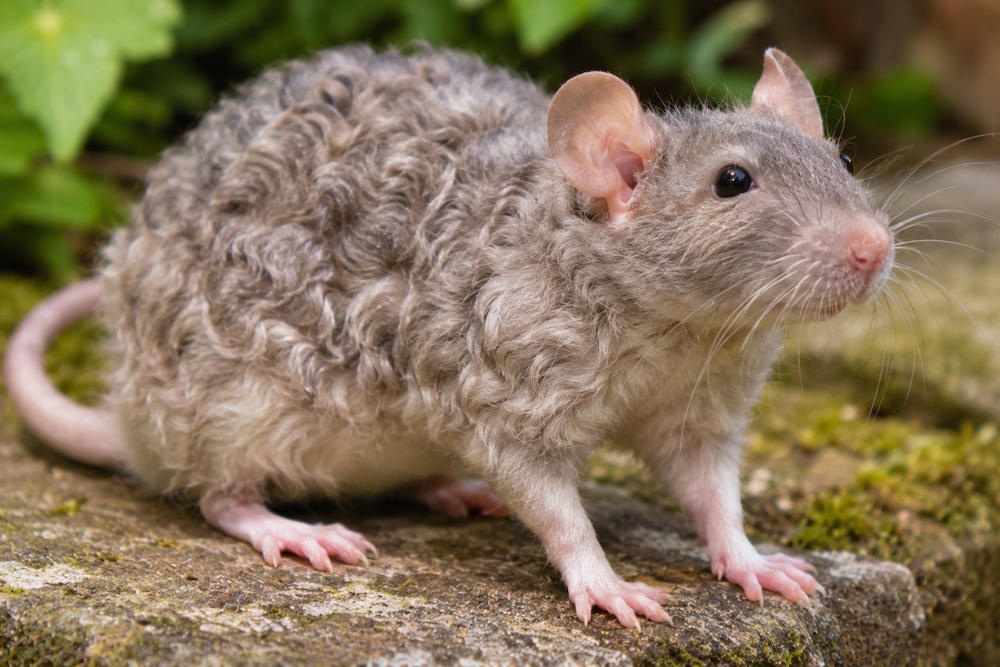







Curly-coated, clever and wonderfully affectionate, the Rex Rat is a charming variety of domestic fancy rat famous for its soft, wavy fur, distinctive curled whiskers, playful personality and remarkable intelligence.
🧠 QUICK SNAPSHOT
Trait | Rex Rat |
|---|---|
Scientific Name | Rattus norvegicus domestica |
Other Names | Rex Fancy Rat, Curly-Coated Rat, Rex Domestic Rat |
Pet Type | Domestic Rat / Small Mammal |
Variety Origin | Developed through selective breeding of domestic fancy rats |
Classification | Coat variety rather than a separate species |
Typical Lifespan | Approximately 2–3 years |
Adult Size | Approximately 20–28 cm body length, excluding tail |
Adult Weight | Commonly 250–650 g, depending on sex and genetics |
Coat Type | Short to medium-length, soft, curly or wavy |
Whiskers | Often curled, crinkled or wavy |
Coat Colours | Black, blue, chocolate, champagne, agouti, cream and many others |
Distinctive Feature | Curly coat and curled whiskers |
Diet | Omnivore |
Activity | Primarily crepuscular and nocturnal |
Temperament | Intelligent, curious, social, playful and often affectionate |
Noise Level | Generally quiet; communicates through squeaks and ultrasonic sounds |
Social Needs | Very high; requires compatible rat companionship |
Grooming | Low to moderate, with regular skin and coat checks |
Housing | Spacious, secure, multi-level rat enclosure |
Exercise Needs | High; requires daily supervised exploration |
Training Ability | Excellent; can learn tricks, routines and problem-solving tasks |
Beginner Friendly? | Yes, for prepared owners willing to provide daily care |
Famous Feature | Distinctive curly fur combined with exceptional intelligence |
📚 OVERVIEW
The Rex Rat is a distinctive coat variety of the domestic fancy rat, recognised for its unusual curly or wavy fur and characteristic crinkled whiskers. Unlike some small pets that are bred primarily for their appearance, Rex Rats combine their striking coat with the intelligence, curiosity and social nature that make domestic rats such engaging companions.
The Rex coat results from an inherited variation affecting the structure and growth of the hair. Instead of lying smoothly against the body, the fur forms waves or curls, creating a soft, textured appearance. The whiskers are often curled as well, giving Rex Rats an especially distinctive face.
Like other domestic rats, Rex Rats are highly social animals that generally thrive in compatible same-sex groups or carefully managed mixed-sex groups with appropriate neutering. Many develop close relationships with their caregivers, learn to recognise familiar voices and enjoy interactive play, exploration and reward-based training.
Their care requires compatible rat companionship, a spacious and enriching enclosure, a balanced diet, daily supervised exercise, gentle handling and regular veterinary attention. Their curly coats also benefit from occasional inspection because some individuals develop sparse patches or skin irritation.
✅ PROS & CONS
👍 Pros
Beautiful curly or wavy coat
Distinctive curled whiskers
Highly intelligent and trainable
Often affectionate with familiar caregivers
Playful, curious and entertaining
Generally straightforward coat maintenance
Can learn tricks and recognise routines
Excellent companions for dedicated small-pet enthusiasts
👎 Cons
Relatively short lifespan
Requires compatible rat companionship
Needs daily exercise and mental stimulation
Can develop respiratory problems
Some individuals experience coat thinning
Requires frequent enclosure cleaning
May chew household items during exploration
Veterinary treatment can be expensive
Are Rex Rats Good Pets?
Yes. Rex Rats can make excellent companion animals.
They are intelligent, curious and often enjoy interacting with familiar people.
However, they require daily attention, compatible rat companions and a spacious, stimulating environment.
Are Rex Rats Good for Beginners?
Yes.
Rex Rats can be suitable for prepared beginners because their care is broadly similar to that of other domestic fancy rats.
However, owners must understand their social needs, relatively short lifespan and susceptibility to certain health problems.
How Long Do Rex Rats Live?
Rex Rats commonly live approximately 2–3 years.
Some individuals may live longer with excellent care.
Their lifespan depends on genetics, nutrition, housing conditions and veterinary attention.
How Big Do Rex Rats Get?
Adult Rex Rats generally have a body length of approximately 20–28 cm, excluding the tail.
Their tails may add another 18–25 cm.
Body size varies considerably between individuals.
How Much Do Rex Rats Weigh?
Adult females commonly weigh approximately 250–450 grams.
Adult males often weigh around 350–650 grams, although some individuals are heavier.
Regular weighing helps monitor body condition and detect possible health problems.
What Is a Rex Rat?
A Rex Rat is a domestic fancy rat with a distinctive curly or wavy coat.
Its whiskers are also commonly curled.
The Rex characteristic is an inherited coat variation rather than a separate rat species.
Where Did Rex Rats Originate?
Rex-coated rats developed within domestic fancy rat breeding populations.
The characteristic was subsequently maintained through selective breeding.
Rex Rats are now recognised in fancy rat communities in numerous countries.
Why Do Rex Rats Have Curly Fur?
Their curly coats result from inherited genetic characteristics that affect hair growth and structure.
Instead of growing relatively straight, the hair forms waves or curls.
The degree of curl varies between individuals and may change with age.
Do Rex Rats Have Curly Whiskers?
Yes.
Curled or crinkled whiskers are one of the characteristic features of Rex Rats.
Some have gently curved whiskers, while others possess more tightly curled or irregular whiskers.
Their whisker shape should be considered when designing an enclosure because whiskers are important sensory structures.
What Is the Difference Between a Rex Rat and a Standard Rat?
The principal difference is coat texture.
Standard fancy rats generally have smooth, straight coats and relatively straight whiskers.
Rex Rats possess curly or wavy fur and often curled whiskers.
Their general behaviour, diet and social requirements are otherwise very similar.
What Is the Difference Between a Rex Rat and a Dumbo Rat?
Rex describes a coat characteristic, while Dumbo describes an ear type.
Dumbo Rats have relatively large, low-set ears.
A rat can possess both characteristics and therefore be a Dumbo Rex Rat.
What Is a Double Rex Rat?
A Double Rex Rat inherits two copies of the relevant Rex coat variant in breeding lines where the trait follows the usual Rex inheritance pattern.
These rats often have sparse, patchy or unusually thin coats.
Their hair may grow and shed in changing patterns, creating a distinctive appearance.
Are Double Rex Rats Hairless?
Some Double Rex Rats appear nearly hairless.
However, many develop patches of curly fur that change over time.
They aren’t necessarily completely hairless, and their skin may require additional protection and monitoring.
Do Rex Rats Lose Their Curls?
Yes, their coat appearance may change with age.
Young Rex Rats sometimes have particularly pronounced curls.
As they mature, the fur may become looser, wavier or less dense.
What Colours Do Rex Rats Come In?
Rex Rats occur in numerous colours.
These include black, blue, chocolate, agouti, champagne, cream and many other recognised fancy rat colours.
The Rex coat characteristic can appear alongside different markings and ear types.
Are Rex Rats Friendly?
Many Rex Rats are friendly and sociable.
They often become comfortable with familiar caregivers through gentle handling and positive experiences.
However, temperament depends on individual genetics, socialisation and previous experiences rather than coat type alone.
Are Rex Rats Affectionate?
Yes.
Some Rex Rats enjoy climbing onto their caregivers, resting in clothing or seeking gentle attention.
Others are more energetic and prefer exploring.
Their individual personalities can vary considerably.
Do Rex Rats Recognise Their Owners?
Yes.
Domestic rats can learn to recognise familiar people through scent, sound and other cues.
Many respond to familiar voices and feeding routines.
They can also learn to approach when called.
Do Rex Rats Like Being Held?
Many Rex Rats become comfortable with gentle handling.
However, some prefer moving freely rather than being restrained.
Their bodies should always be properly supported, and they should never be lifted by the tail.
Are Rex Rats Good With Children?
Rex Rats can make rewarding family pets when adults supervise their care.
Their intelligence and interactive behaviour can be particularly appealing to older children.
However, gentle handling, good hygiene and responsible adult supervision are essential.
Are Rex Rats Intelligent?
Yes.
Domestic rats are among the most intelligent commonly kept small mammals.
They can learn routes, recognise cues, solve problems and perform trained behaviours.
Their intelligence makes environmental enrichment particularly important.
Can Rex Rats Learn Tricks?
Yes.
Rex Rats can learn a wide variety of behaviours through positive reinforcement.
These may include:
Coming when called
Following a target
Turning in a circle
Navigating simple obstacles
Retrieving small objects
Entering a carrier voluntarily
Performing simple agility activities
Returning to a designated location
Short, enjoyable training sessions are usually most effective.
Can Rex Rats Be Litter Trained?
Yes, to a degree.
Many rats can learn to use designated toileting areas.
However, urine marking may still occur, particularly in some males.
Providing suitable litter trays and maintaining consistent routines can help.
Do Rex Rats Need Companions?
Yes.
Rats are highly social animals and generally require compatible rat companionship.
A group of at least two rats is essential for most healthy individuals, with a well-managed group of three or more often providing additional social opportunities.
Human interaction doesn’t replace the benefits of living with other rats.
Can Two Male Rex Rats Live Together?
Yes.
Compatible male rats can live together successfully.
Males raised together or introduced carefully may form strong social relationships.
However, territorial behaviour or hormonal aggression can occasionally create problems.
Can Male and Female Rex Rats Live Together?
Yes, but only when reproduction is appropriately prevented.
Unneutered males and females can breed rapidly.
Same-sex groups are often the simplest arrangement for pet owners.
Can Rex Rats Live With Other Rat Varieties?
Yes.
Rex Rats can live with Standard, Dumbo, Satin and other domestic fancy rat varieties.
Coat type doesn’t determine social compatibility.
Individual temperament, sex, age and careful introductions are more important.
Can Rex Rats Live With Mice?
No.
Rats and mice should not be housed together.
Rats may injure or kill mice, and the species have different social and husbandry requirements.
Separate accommodation is essential.
Are Rex Rats Noisy?
Rex Rats are generally quiet pets.
They may squeak during social interactions or when startled.
Rats also communicate through ultrasonic vocalisations that humans cannot normally hear.
Why Do Rex Rats Brux?
Bruxing is the rapid grinding of a rat’s teeth.
It may occur when a rat is relaxed or content.
However, tooth grinding can also accompany stress or discomfort, so the surrounding behaviour should be considered.
What Does It Mean When a Rex Rat Boggles?
Boggling describes the rapid movement of a rat’s eyes that can occur during intense bruxing.
It happens because muscles involved in jaw movement can affect the position of the eyes.
Boggling often accompanies relaxation but should always be interpreted in context.
Are Rex Rats Active at Night?
Yes.
Domestic rats are generally most active during the evening and night.
However, they often adapt their activity patterns around familiar household routines.
They also sleep in multiple periods throughout the day.
What Size Cage Does a Rex Rat Need?
Rex Rats require spacious accommodation that allows climbing, exploring and social interaction.
For a small group, a cage approximately 80 × 50 × 80 cm is a practical starting point, but larger accommodation is strongly preferred.
Usable floor space, ventilation, climbing opportunities and safe furnishings are more important than height alone.
Do Rex Rats Need Exercise?
Yes.
Rex Rats require daily opportunities to explore outside their enclosure in a safe, supervised environment.
Exercise supports physical health and mental wellbeing.
Tunnels, climbing structures, digging boxes and puzzle feeders provide valuable enrichment.
Do Rex Rats Like Climbing?
Yes.
Many Rex Rats enjoy climbing ropes, platforms, ladders and branches.
Their agility makes multi-level enclosures particularly appealing.
However, high falls should be prevented through safe enclosure design and appropriately positioned hammocks or platforms.
What Bedding Is Best for Rex Rats?
Rex Rats benefit from clean, absorbent, low-dust bedding.
Suitable options may include appropriate paper-based bedding, hemp or carefully selected low-dust wood products.
Strongly scented, dusty or irritating materials should be avoided because rats are susceptible to respiratory problems.
What Do Rex Rats Eat?
Rex Rats are omnivores.
Their diet should be based on a complete, nutritionally balanced commercial rat food, supplemented with suitable vegetables and occasional healthy treats.
Fresh drinking water must always be available.
High-fat and high-sugar foods should be limited.
Can Rex Rats Eat Fruit?
Yes.
Rex Rats can enjoy small amounts of suitable fruit, including apple without seeds, berries and banana.
Fruit should be offered in moderation because of its sugar content.
A balanced staple diet remains essential.
Do Rex Rats Need Protein?
Yes.
Protein is essential for growth, tissue maintenance and overall health.
A suitable complete rat diet normally provides the required protein.
Additional protein-rich treats should be offered in moderation according to age and nutritional needs.
Do Rex Rats Shed?
Yes.
Rex Rats naturally shed hair.
Their curly coats may make loose hair less noticeable than in smooth-coated rats.
Some individuals experience more obvious coat thinning or changes in curl density as they age.
How Often Should You Groom a Rex Rat?
Rex Rats generally require minimal direct grooming.
They spend considerable time cleaning themselves and their companions.
However, regular gentle inspection of the coat and skin is important because sparse areas or irritation may be less obvious beneath the curls.
Do Rex Rats Need Baths?
Usually not.
Healthy rats groom themselves effectively.
Bathing can cause stress, remove natural skin oils and contribute to chilling.
Spot-cleaning with a damp cloth is often preferable when necessary.
Are Rex Rats Hypoallergenic?
No.
Rex Rats are not hypoallergenic.
Like other domestic rats, they produce allergens through saliva, urine and skin particles.
Their curly coats don’t eliminate these allergens.
What Health Problems Are Common in Rex Rats?
Potential concerns include respiratory disease, mammary tumours, skin irritation, parasites, dental problems, obesity and age-related mobility difficulties.
Some Rex and Double Rex individuals may also experience coat thinning or skin sensitivity.
A veterinarian experienced with small mammals should assess persistent sneezing, noisy breathing, lumps, weight loss or unusual behaviour.
Are Rex Rats Prone to Respiratory Problems?
Yes.
Like other domestic rats, Rex Rats can develop respiratory disease.
Factors may include infectious organisms, poor ventilation, dusty bedding and environmental irritants.
Persistent sneezing, wheezing or laboured breathing requires veterinary attention.
Are Rex Rats Legal to Keep as Pets?
Rex Rats are legal domestic pets in many countries, including much of Australia.
However, some countries or regions restrict or prohibit domestic rat ownership, and Australian state or territory rules may differ.
For example, Queensland has restrictions on keeping rats, and prospective owners should verify current requirements before obtaining one.
What Makes the Rex Rat Unique?
Imagine a tiny, intelligent companion with a soft curly coat, crinkled whiskers and an extraordinary ability to learn tricks, recognise familiar people and solve problems.
That’s the remarkable Rex Rat.
Among the many varieties of domestic fancy rats, the Rex stands out because of its unusual coat.
Instead of the smooth, straight hair associated with standard rats, Rex Rats possess fur that forms waves or curls.
Their whiskers are often curled as well, giving them a distinctive appearance.
The Rex characteristic results from an inherited variation affecting hair structure.
In many established Rex breeding lines, the trait follows a dominant inheritance pattern.
This means that a rat may display the Rex coat after inheriting a single copy of the relevant genetic variant.
When two copies are inherited, the result may be a Double Rex.
Double Rex Rats often have much sparser coats, sometimes with irregular patches of hair that appear and disappear over time.
This unusual coat development makes Rex Rats particularly interesting to people studying domestic animal genetics.
Another fascinating feature is that Rex describes the coat rather than the animal’s overall body type.
A Rex Rat may also possess Dumbo ears, different coat colours or distinctive markings.
This creates an extraordinary range of appearances.
But their curls are only part of the story.
Rex Rats share the remarkable intelligence of other domestic rats.
Scientific studies have demonstrated that rats can learn complex tasks, navigate unfamiliar environments and remember information.
They can recognise patterns, respond to training cues and solve problems involving food rewards.
Their ability to learn through experience makes them particularly engaging companion animals.
Some rats can even learn to retrieve small objects, follow targets and complete simple agility courses.
Their social intelligence is equally remarkable.
Rats naturally live in groups and communicate through scent, body language, touch and vocalisations.
Many of their vocalisations occur at ultrasonic frequencies beyond normal human hearing.
Researchers have identified ultrasonic calls associated with different emotional and social contexts.
One particularly fascinating behaviour is bruxing.
Rats may rapidly grind their teeth when relaxed or content.
Sometimes this is accompanied by boggling, a curious movement of the eyes caused by the interaction of jaw muscles and surrounding tissues.
To an unfamiliar observer, boggling may look strange.
For experienced rat owners, it can be one of the most recognisable features of relaxed rat behaviour.
Another remarkable characteristic is their sense of smell.
Rats possess highly developed olfactory abilities that help them investigate food, recognise social information and navigate their surroundings.
Their whiskers are also important sensory structures.
Whiskers help rats detect nearby objects and assess spaces, particularly in low-light environments.
The curled whiskers of Rex Rats are visually distinctive, although unusually short or tightly curled whiskers may affect their normal sensory function.
Their natural curiosity is another reason they make fascinating pets.
A Rex Rat may investigate a new tunnel, explore a cardboard maze or learn to open a simple puzzle feeder.
Providing varied enrichment allows these natural behaviours to flourish.
Domestic rats also have a fascinating history.
They descend from the Brown Rat, Rattus norvegicus, a species that spread widely around the world.
Over generations, domestication and selective breeding produced animals with numerous colours, markings, ear types and coat textures.
Rex Rats represent one of the most charming examples of this diversity.
Perhaps the most surprising thing about Rex Rats is the contrast between their unusual appearance and their familiar, engaging personalities.
Beneath the curls is an intelligent, social animal capable of learning routines, interacting with companions and developing strong relationships with familiar caregivers.
Their short lifespan can be challenging for owners, but their curiosity and social behaviour make them exceptionally rewarding companions.
The Rex Rat isn’t simply a curly-coated version of an ordinary pet rat — it’s a remarkable combination of unusual genetics, extraordinary intelligence, fascinating social behaviour and a playful personality that makes it one of the most engaging small pets.