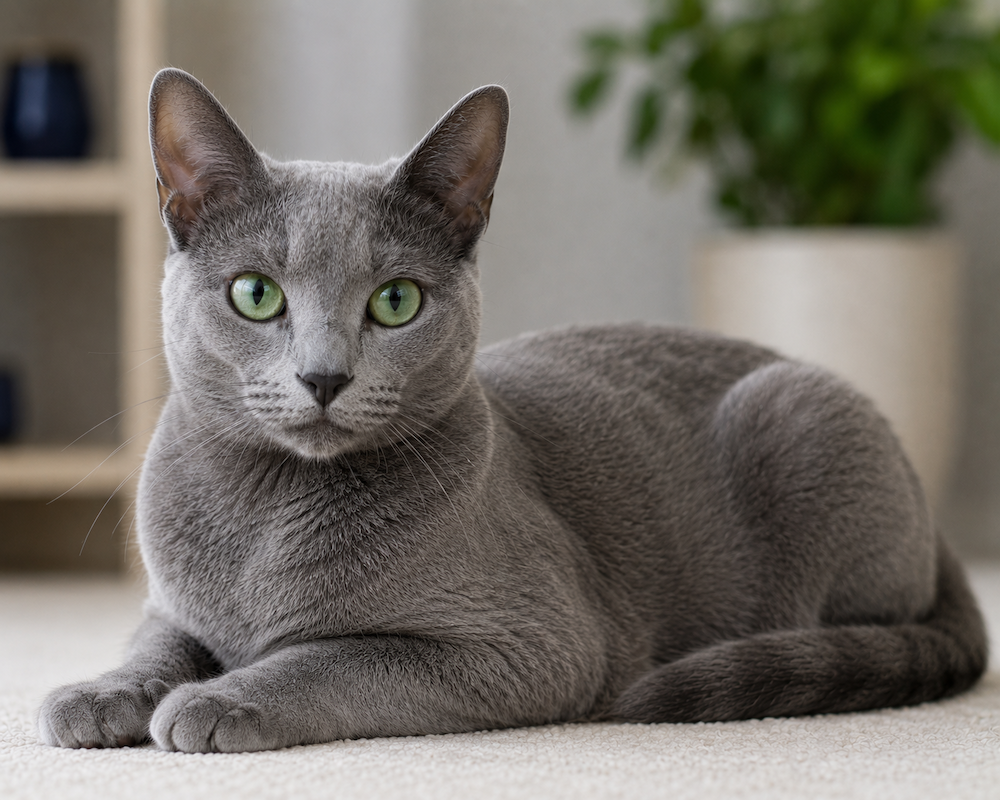







Elegant, quiet, and deeply affectionate — a graceful companion with a plush silver-blue coat and gentle nature.
🧠 QUICK SNAPSHOT
- Temperament: Gentle, intelligent, reserved
- Energy Level: Moderate
- Size: Medium
- Good With Families: Yes
- Trainability: Moderate to high
- Grooming: Low
- Best For: Indoor living, calm households, companionship
📚 OVERVIEW
The Russian Blue is a beautiful cat breed known for its plush silver-blue coat, vivid green eyes, and calm personality. They are affectionate with their family but tend to be more reserved around strangers.
They enjoy peaceful environments and form strong bonds with the people they trust.
✅ PROS & CONS
Pros
- Calm and gentle temperament
- Low grooming requirements
- Intelligent and affectionate
- Quiet and well suited to indoor living
Cons
- Can be shy around strangers
- Prefers routine and calm environments
- Needs companionship and interaction
- Sensitive personality
Is a Russian Blue a Good Family Cat?
Yes. Russian Blues are generally gentle, affectionate, intelligent and loyal cats that can make excellent family companions.
They often form particularly strong bonds with their favourite people while remaining more reserved around strangers.
Their quiet nature makes them especially appealing to households wanting an affectionate cat without the constant activity or vocalisation of some breeds.
Are Russian Blue Cats Good With Children?
Generally, yes, particularly with calm, respectful children.
Russian Blues tend to prefer predictable environments and may retreat when a household becomes extremely noisy or chaotic.
Children who understand when a cat wants space are likely to have the best relationship with them.
Are Russian Blue Cats Affectionate?
Yes. Russian Blues can be extremely affectionate with people they trust.
They’re sometimes described as reserved because they may initially be cautious around strangers, but this shouldn’t be confused with being aloof toward their families.
Many follow their owners around the house and enjoy sitting beside or near them.
Are Russian Blue Cats Lap Cats?
Many are, although individual personalities vary.
A Russian Blue may initially seem independent but become very physically affectionate once it develops trust.
Some prefer sitting beside their owners rather than directly on them, while others become enthusiastic lap cats.
How Much Exercise Does a Russian Blue Need?
Russian Blues have moderate exercise needs and benefit from daily interactive play.
Wand toys, climbing structures, puzzle feeders and chasing games can help keep them physically and mentally stimulated.
They’re athletic cats but generally aren’t as relentlessly active as breeds such as Bengals or Abyssinians.
Are Russian Blue Cats Intelligent?
Yes. Russian Blues are considered highly intelligent cats.
They can learn household routines quickly, solve food puzzles and often work out how doors, cupboards and toys operate.
Their intelligence also means they benefit from environmental enrichment rather than spending every day without stimulation.
Are Russian Blue Cats Easy to Train?
Yes. Many Russian Blues respond well to positive reinforcement.
They can learn their names, household rules and simple tricks, and some can be taught to retrieve toys or come when called.
Food can be a particularly effective training reward, although portions should be controlled carefully.
Do Russian Blue Cats Shed a Lot?
Russian Blues shed, but generally not as heavily as their extraordinarily dense coat might suggest.
They have a short, plush double coat that can shed more noticeably during seasonal changes.
Weekly brushing is usually sufficient to remove loose hair.
Are Russian Blue Cats Hypoallergenic?
No. Russian Blues aren’t truly hypoallergenic.
Claims are sometimes made that they produce lower levels of the Fel d 1 allergen, but there isn’t sufficient evidence to guarantee that a Russian Blue will be suitable for someone with cat allergies.
Individual people can also react very differently to individual cats.
How Often Should You Groom a Russian Blue?
Russian Blues are relatively low-maintenance cats to groom.
Their short coat usually needs brushing only about once a week, with additional grooming during periods of heavier shedding.
Routine nail trimming, dental care and ear checks are also important.
What Health Problems Are Common in Russian Blue Cats?
Russian Blues are generally regarded as a relatively healthy breed without an unusually large list of breed-specific inherited disorders.
However, they can still develop health problems affecting cats generally, including dental disease, obesity, urinary problems and kidney disease.
Responsible breeding and regular veterinary examinations remain important.
How Long Do Russian Blue Cats Live?
Russian Blues commonly live around 15–20 years, although individual lifespan varies.
Indoor living, appropriate nutrition, healthy weight, dental care and preventive veterinary attention can contribute to a long life.
Their potential longevity means adopting one can be a commitment lasting well into its late teens.
How Big Do Russian Blue Cats Get?
Russian Blues are medium-sized cats, commonly weighing approximately 3–5.5 kg, with males generally larger than females.
Their dense plush coat can make them appear heavier than they actually are.
They should have an elegant, muscular and athletic build rather than appearing bulky.
Can Russian Blue Cats Live Indoors?
Yes. Russian Blues are particularly well suited to indoor living.
They’re generally content in a secure home provided they have climbing areas, scratching posts, toys, window views and regular interaction.
Their adaptable size also makes them suitable for apartments.
Can Russian Blue Cats Be Left Alone?
Russian Blues can usually tolerate reasonable periods alone, particularly when gradually accustomed to the household routine.
However, they form strong bonds with their owners and still need regular companionship.
Interactive toys, puzzle feeders and climbing spaces can help keep them occupied when nobody is home.
Are Russian Blue Cats Quiet?
Generally, yes.
Russian Blues aren’t usually considered excessively vocal and often communicate using relatively soft meows.
They can certainly become talkative with their owners, particularly around mealtimes, but they’re generally quieter than famously vocal breeds such as Siamese cats.
Are Russian Blue Cats Shy Around Strangers?
They can be.
Russian Blues often take time to assess unfamiliar people before approaching them.
Once they decide someone is trustworthy, their affectionate personality may become much more obvious. Early positive socialisation can help kittens become more confident around visitors.
Are Russian Blue Cats Good With Other Cats?
Generally, yes, particularly with gradual introductions.
Their calm temperament can make them good companions for other friendly cats.
Individual personality matters, and some Russian Blues may prefer a peaceful household rather than living with an extremely boisterous companion.
Are Russian Blue Cats Good With Dogs?
Many Russian Blues can live successfully with calm, cat-friendly dogs.
Their somewhat cautious nature means slow introductions are particularly useful.
A dog that constantly chases or overwhelms the cat is unlikely to be a good match.
Do Russian Blue Cats Have Green Eyes?
Yes. Mature Russian Blues are famous for their striking green eyes.
Kittens aren’t necessarily born with the brilliant green eye colour seen in adults. Their eye colour changes as they mature, eventually developing the characteristic green associated with the breed.
Why Is a Russian Blue Cat Blue?
In cat terminology, “blue” describes a diluted form of black pigmentation that creates a blue-grey or slate-grey appearance.
The Russian Blue’s coat is particularly distinctive because each hair can have lighter, silvery tipping.
This produces the shimmering silver-blue appearance for which the breed is famous.
What Does a Russian Blue Cat Look Like?
A Russian Blue has a short, exceptionally dense blue-grey coat, vivid green eyes, large ears and an elegant athletic body.
Its wedge-shaped head and slightly upturned mouth can create an expression sometimes described as the “Russian Blue smile.”
The plush double coat is one of the breed’s most distinctive physical characteristics.
What Is the Difference Between a Russian Blue and a British Shorthair?
Both can have blue-grey coats, but they’re very different breeds.
Russian Blues are generally slenderer and more athletic with green eyes and wedge-shaped heads, while British Shorthairs are stockier, rounder cats with broad faces and dense plush coats.
Blue British Shorthairs commonly have copper or gold eyes rather than the Russian Blue’s characteristic green.
What Is the Difference Between a Russian Blue and a Chartreux?
Russian Blues and Chartreux cats can both have blue-grey coats, but their appearance differs considerably.
The Russian Blue typically has green eyes and an elegant body, while the Chartreux is more robustly built and traditionally has copper-to-gold eyes.
They’re separate breeds with different histories.
How Can You Tell if a Cat Is a Russian Blue?
A blue-grey coat alone doesn’t make a cat a Russian Blue.
Many domestic cats can have similar colouring without Russian Blue ancestry.
Pedigree documentation is the most reliable way to establish breed identity. Characteristic features such as the dense silver-blue coat, green eyes and body type can suggest resemblance but can’t prove ancestry.
Where Do Russian Blue Cats Come From?
The breed is traditionally associated with northern Russia, particularly the port city of Arkhangelsk (Archangel).
Cats resembling the modern Russian Blue were historically known as Archangel Cats and were brought to Britain and elsewhere in Europe during the 19th century.
The modern pedigree breed was subsequently refined through organised breeding outside Russia as well.
Why Were Russian Blues Called Archangel Cats?
The name Archangel Cat refers to the breed’s historical association with Arkhangelsk, a Russian port whose English name was commonly rendered as Archangel.
According to breed tradition, sailors transported these distinctive blue cats from the region to Britain and other parts of Europe.
The modern name Russian Blue eventually became established.
Is a Russian Blue a Good First Cat?
Yes. Russian Blues can be excellent first cats.
They’re generally clean, intelligent, relatively quiet and easy to groom, while still being affectionate with their families.
Their main consideration is temperament: they often appreciate routine and may take longer than extremely outgoing breeds to become comfortable with unfamiliar people or major changes.
What Makes the Russian Blue Unique?
The Russian Blue has one of those appearances that seems simple until you look closely.
At first, it’s just a grey cat.
Except technically, it’s blue.
The colour results from diluted black pigmentation, while lighter tipping on the hairs gives the coat its characteristic silvery shimmer. Add vivid green eyes and an extraordinarily dense plush coat, and the result is difficult to mistake once you know what you’re looking for.
The breed’s traditional history leads back to Arkhangelsk in northern Russia, which explains its old name, the Archangel Cat.
But perhaps the most characteristic thing about a Russian Blue isn’t its colour.
It’s the contrast in personality.
A visitor may see a cautious cat watching quietly from across the room and conclude that it’s rather aloof.
Its owner may know an entirely different animal — one that follows them from room to room, knows precisely when dinner should arrive and has quietly reorganised the entire household around its preferred routine.
The Russian Blue doesn’t necessarily love everybody immediately. It simply takes its time deciding who’s worth the effort.