
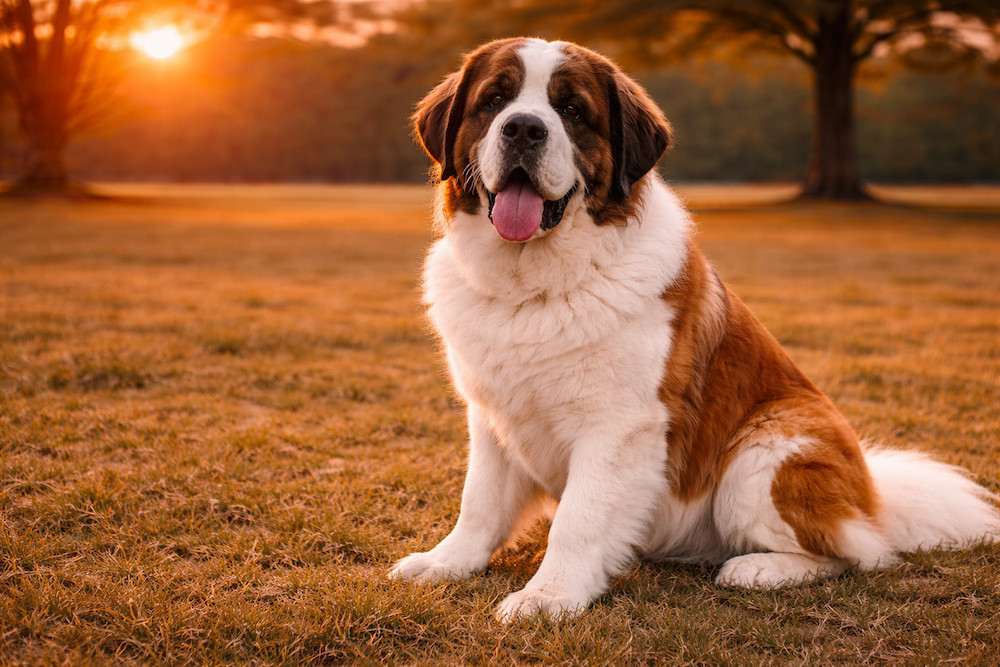







Gentle giant, loyal protector, and family favourite — a big dog with an even bigger heart.
🧠 QUICK SNAPSHOT
- Temperament: Gentle, Loyal, Calm
- Energy Level: Moderate
- Size: Giant
- Good with Families: Excellent
- Training Difficulty: Moderate
📚 OVERVIEW
Saint Bernards are famous for their history as rescue dogs in the Swiss Alps. Known for their massive size and gentle temperament, they are affectionate, patient, and excellent with families. Despite their size, they are generally calm and enjoy relaxed environments.
✅ PROS & CONS
Pros
- Extremely gentle and great with children
- Loyal and affectionate
- Calm and relaxed temperament
Cons
- Very large size requires space
- Heavy drooling and shedding
- Higher food and care costs
Is a Saint Bernard a Good Family Dog?
Yes. Saint Bernards are generally gentle, affectionate and devoted family dogs.
Despite their enormous size, they’re typically calm and patient around the home and enjoy being close to their families.
Their size does require consideration, however. Even a friendly Saint Bernard can accidentally knock over a small child or fragile furniture.
Are Saint Bernards Good With Children?
Generally, yes. Saint Bernards have a strong reputation for being patient and gentle with children.
Their calm temperament can make them wonderful family companions, but interactions with young children should always be supervised because an adult Saint Bernard may weigh more than some adults.
How Much Exercise Does a Saint Bernard Need?
Most adult Saint Bernards need around 30–60 minutes of moderate exercise each day.
Regular walks and gentle play are usually preferable to prolonged high-impact exercise.
Growing puppies require particular care because excessive exercise can place unnecessary stress on developing bones and joints.
Are Saint Bernards Easy to Train?
Saint Bernards are intelligent and trainable, although they can sometimes be independent.
Training should begin while they’re still small enough to manage easily.
Basic behaviours such as walking politely on a lead, greeting people calmly and responding reliably to commands become extremely important when the puppy eventually weighs 60 kg or more.
Do Saint Bernards Shed a Lot?
Yes. Saint Bernards are moderate-to-heavy shedders.
Both short-haired and long-haired varieties have dense coats and can shed particularly heavily during seasonal coat changes.
Regular brushing helps control loose hair but won’t eliminate shedding.
Are Saint Bernards Hypoallergenic?
No.
Saint Bernards aren’t considered hypoallergenic and can produce substantial amounts of hair and dander.
They’re unlikely to be a suitable choice for someone specifically seeking a low-shedding breed.
How Often Should You Groom a Saint Bernard?
Saint Bernards should generally be brushed several times a week, with more frequent grooming during periods of heavy shedding.
Long-haired Saint Bernards require additional attention to prevent tangles.
Nail care, dental hygiene and regular checks of the ears, eyes and skin are also important.
Do Saint Bernards Drool a Lot?
Yes. Drooling is one of the realities of Saint Bernard ownership.
Their large heads and loose lips allow saliva to escape easily, particularly after drinking, eating or exercising.
Some individuals drool more than others, but anyone considering the breed should expect to keep a few strategically positioned towels around the house.
What Health Problems Are Common in Saint Bernards?
Important health concerns include hip and elbow dysplasia, gastric dilatation-volvulus (bloat), heart disease, eye disorders and certain cancers.
Their giant size also places substantial stress on their joints and skeletal system.
Responsible breeding, appropriate nutrition and maintaining a healthy body condition are particularly important.
How Long Do Saint Bernards Live?
Saint Bernards commonly live around 8–10 years.
Unfortunately, giant breeds generally have shorter lifespans than smaller dogs.
Good nutrition, appropriate exercise, maintaining a healthy weight and regular veterinary care can help support their health throughout life.
How Big Does a Saint Bernard Get?
Saint Bernards are giant dogs.
Adult males commonly weigh around 64–82 kg or more, while females are generally somewhat lighter.
Males can stand approximately 70–90 cm at the shoulder, making the Saint Bernard one of the world’s largest recognisable dog breeds.
When Is a Saint Bernard Fully Grown?
Saint Bernards grow for considerably longer than small breeds.
They may approach their adult height by around 18 months, but can continue filling out and developing physically until two or even three years old.
Careful nutrition during this extended growth period is particularly important.
Can a Saint Bernard Live in an Apartment?
Potentially, but their enormous size makes apartment living challenging.
Adult Saint Bernards are often surprisingly calm indoors and don’t require extreme amounts of exercise.
The practical issues are space, stairs, heat, drool and simply accommodating a dog that can occupy a substantial portion of a small room.
Can Saint Bernards Be Left Alone?
Adult Saint Bernards can learn to tolerate reasonable periods alone, but they’re typically people-oriented dogs that enjoy family companionship.
Regularly leaving them isolated for very long periods isn’t ideal.
Training puppies gradually to feel comfortable alone can help reduce separation-related problems later.
Do Saint Bernards Bark a Lot?
Usually not.
Saint Bernards tend to be relatively calm dogs and aren’t generally known for constant barking.
They may bark to alert their owners to visitors or unusual activity, and their enormous size ensures that even occasional barking can sound impressive.
Are Saint Bernards Protective?
Saint Bernards can be naturally watchful and devoted to their families, but they aren’t typically aggressive guard dogs.
Their sheer size and deep bark can provide considerable deterrence without aggression.
A well-bred Saint Bernard should generally display a stable, calm and friendly temperament.
Are Saint Bernards Good With Other Dogs?
Generally, yes.
Properly socialised Saint Bernards can live very successfully with other dogs.
Their huge size should be considered when pairing them with extremely small dogs, particularly during energetic play.
Are Saint Bernards Good With Cats?
Many Saint Bernards can live peacefully with cats, especially when introduced appropriately.
They aren’t primarily a high-prey-drive hunting breed, although individual behaviour varies.
Their size means even playful chasing should be discouraged.
Can Saint Bernards Handle Hot Weather?
Saint Bernards are poorly suited to extreme heat.
Their large bodies and dense coats were developed for cold Alpine conditions, making overheating a significant concern in hot climates.
In warm weather they need shade, cool indoor areas, constant fresh water and exercise restricted to cooler parts of the day.
Do Saint Bernards Like Cold Weather?
Yes. Saint Bernards are extremely well adapted to cold and snowy conditions.
Their dense coats provide substantial insulation, and the breed developed in the Swiss Alps.
Many Saint Bernards become noticeably more energetic and comfortable when temperatures fall.
Are There Long-Haired and Short-Haired Saint Bernards?
Yes. Saint Bernards occur in both short-haired and long-haired varieties.
The short-haired coat is dense and relatively smooth, while the long-haired variety has a longer outer coat.
Both varieties have substantial coats and shed.
What Colours Do Saint Bernards Come In?
Saint Bernards are characteristically white with red, reddish-brown or brindle markings, often with darker shading around the face and ears.
The exact distribution of markings varies between individual dogs and kennel-club standards.
Their white chest, feet and facial markings contribute to the breed’s instantly recognisable appearance.
Were Saint Bernards Really Rescue Dogs?
Yes. Dogs kept by the monks at the Great St Bernard Pass in the Swiss Alps became famous for helping locate travellers lost or buried in dangerous snow conditions.
Their extraordinary rescue history eventually became central to the breed’s international reputation.
The early hospice dogs didn’t necessarily look exactly like today’s enormous show-bred Saint Bernards.
Did Saint Bernards Carry Brandy Barrels Around Their Necks?
Probably not.
The famous image of a Saint Bernard rescuing stranded travellers while carrying a small barrel of brandy around its neck is largely a myth.
The image became popular through art and storytelling rather than documented Alpine rescue practice.
It remains one of the most recognisable symbols associated with the breed.
Who Was Barry the Saint Bernard?
Barry was one of the most famous Alpine rescue dogs associated with the Great St Bernard Hospice.
He lived during the early 19th century and became legendary for helping rescue travellers in the mountains.
Barry became such an important symbol of Alpine rescue dogs that his preserved body remains associated with the history of the breed in Switzerland.
Where Does the Saint Bernard Come From?
The Saint Bernard developed in the Swiss Alps, particularly around the Great St Bernard Pass between Switzerland and Italy.
Dogs were kept at the hospice established there to assist travellers crossing the dangerous mountain route.
Over time, these dogs became internationally famous for their ability to help locate people lost in snow and severe weather.
Why Is It Called a Saint Bernard?
The breed takes its name from the Great St Bernard Pass and its hospice, which were themselves associated with Bernard of Menthon, the saint traditionally linked with establishing the hospice for Alpine travellers.
The dogs eventually became so closely identified with the hospice that the Saint Bernard name became attached to the breed.
Is a Saint Bernard a Good First Dog?
A Saint Bernard can be a wonderful companion, but it isn’t necessarily the easiest first dog.
The temperament is often gentle, but giant size changes almost everything — food bills, veterinary costs, transport, training, grooming and the amount of space required.
A first-time owner prepared for those practical realities can certainly succeed.
What Makes the Saint Bernard Unique?
Few breeds have an image as instantly recognisable as the Saint Bernard: an enormous dog battling through Alpine snow with a tiny barrel of brandy hanging from its collar.
Only one problem.
The barrel is probably fiction.
The rescue dogs themselves were very real.
Dogs from the Great St Bernard Hospice became famous for helping find travellers lost in treacherous mountain conditions, and one named Barry became a legend of Alpine rescue history.
Modern Saint Bernards are much more likely to rescue a sandwich from the kitchen bench than a traveller from an avalanche.
But their combination of enormous physical size and famously gentle temperament remains remarkable.
They’re powerful enough to occupy most of a sofa, hairy enough to redecorate it and capable of producing quantities of drool that probably deserve their own weather forecast.
Yet underneath all of that is why the Saint Bernard has remained so loved:
one of the dog world’s biggest bodies often comes with one of its gentlest personalities.