






Noble, gentle, and incredibly graceful — a giant sighthound with a calm heart and a rich Scottish heritage.
🧠 QUICK SNAPSHOT
- Temperament: Gentle, dignified, loyal
- Energy Level: Moderate
- Size: Giant
- Good With Families: Yes
- Trainability: Moderate
- Grooming: Moderate
- Best For: Active families, spacious homes, experienced owners
📚 OVERVIEW
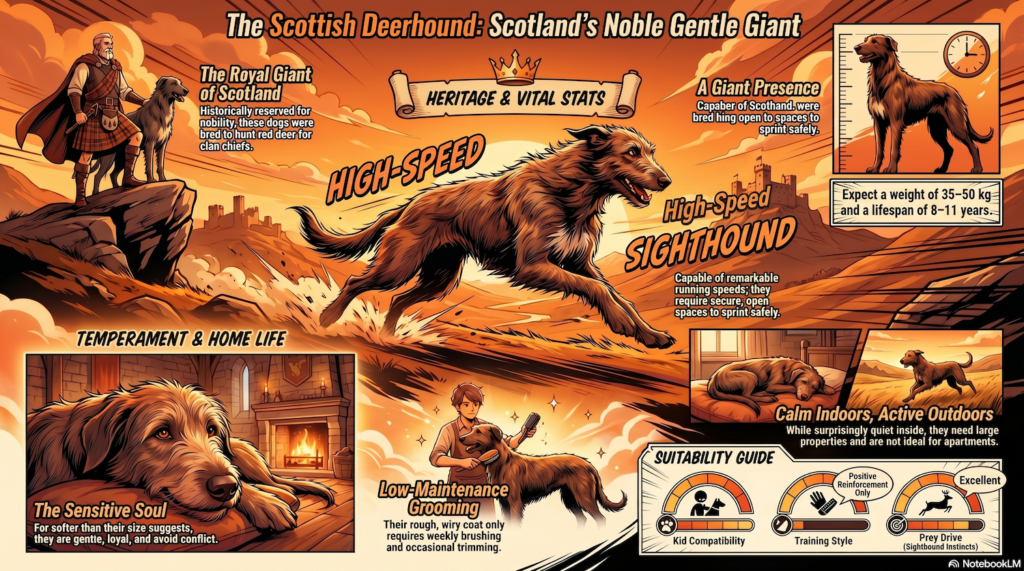
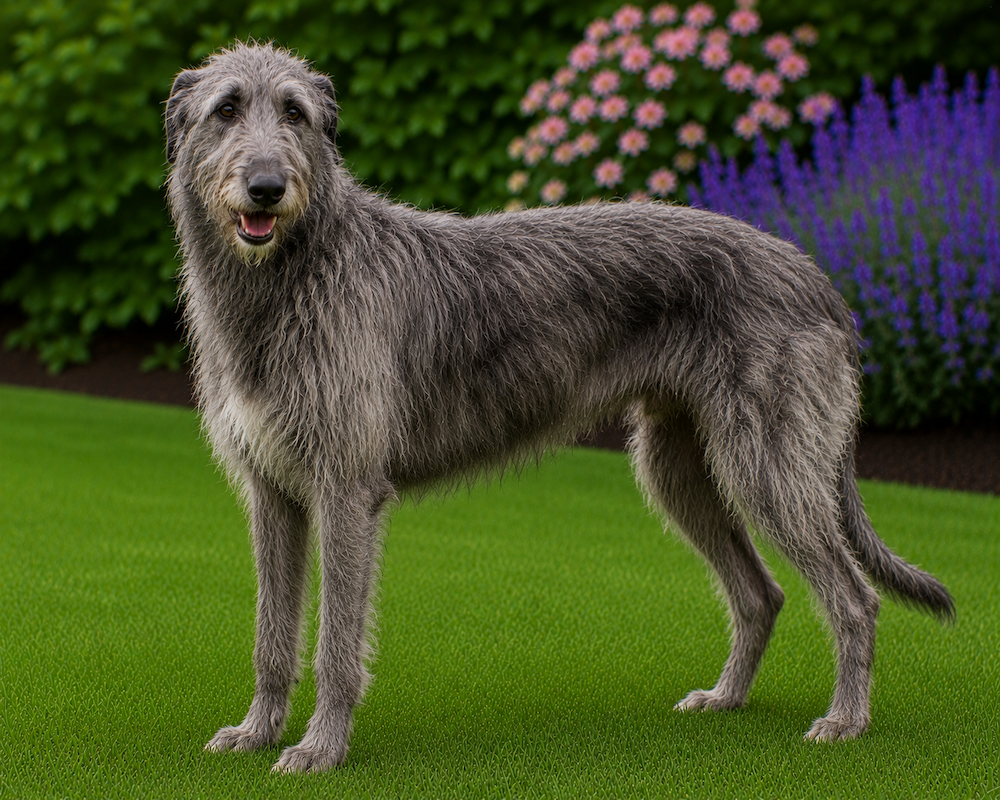
The Scottish Deerhound is one of the world’s oldest sighthound breeds, originally bred to hunt red deer across the rugged Scottish Highlands. Known for its tall, elegant build and rough coat, the Deerhound combines remarkable speed with a calm and affectionate temperament.
Despite their impressive size, Scottish Deerhounds are gentle, friendly companions that enjoy relaxing with their family as much as they enjoy opportunities to stretch their long legs outdoors.
✅ PROS & CONS
Pros
- Gentle and affectionate nature
- Calm indoors despite impressive size
- Loyal and devoted to family
- Graceful, athletic, and dignified
Cons
- Needs plenty of space to move
- Strong prey drive
- Shorter lifespan than many breeds
- Large size can make ownership more expensive
Is a Scottish Deerhound a Good Family Dog?
Yes. Scottish Deerhounds are generally gentle, affectionate and calm family dogs.
Despite their impressive size, they’re typically soft-natured and devoted to their families rather than boisterous or demanding.
They need plenty of space and appropriate exercise, but mature Deerhounds can be remarkably relaxed around the home.
Are Scottish Deerhounds Good With Children?
Generally, yes. Scottish Deerhounds are usually gentle and patient with respectful children.
Their enormous size is the main consideration. A young, enthusiastic Deerhound can accidentally knock over a small child without intending any harm.
Interactions between dogs and young children should always be supervised.
How Much Exercise Does a Scottish Deerhound Need?
Adult Scottish Deerhounds generally need around 60–90 minutes of exercise each day, ideally including opportunities to run safely.
They’re sighthounds built for speed and pursuit, but aren’t constantly active.
After appropriate exercise, many are perfectly happy spending much of the day relaxing.
Are Scottish Deerhounds Easy to Train?
Scottish Deerhounds are intelligent but can be independent and sensitive.
They were developed to pursue game rather than repeatedly wait for human instructions, so they don’t always display the eager obedience seen in some working breeds.
Patient, positive training is usually much more effective than harsh or repetitive methods.
Do Scottish Deerhounds Shed?
Yes, although generally not excessively.
Their rough, wiry coat sheds a moderate amount throughout the year.
Regular brushing removes dead hair and helps keep the coat tidy.
Are Scottish Deerhounds Hypoallergenic?
No.
Scottish Deerhounds aren’t considered hypoallergenic.
Although their rough coat may shed less dramatically than some heavy-coated breeds, they still produce allergens through dander and saliva.
How Often Should You Groom a Scottish Deerhound?
A thorough brushing once or twice a week is generally sufficient.
Their harsh coat is relatively straightforward to maintain, although occasional tidying may be useful.
Routine nail trimming, dental care and ear checks are also important.
What Health Problems Are Common in Scottish Deerhounds?
Important health concerns include dilated cardiomyopathy, certain cancers, gastric dilatation-volvulus (bloat) and bone and joint problems.
The breed can also experience sensitivity to certain anaesthetic drugs, as can some other sighthounds.
Responsible health screening and veterinary care familiar with giant sighthounds are valuable.
How Long Do Scottish Deerhounds Live?
Scottish Deerhounds commonly live around 8–11 years.
As with many giant breeds, their average lifespan is shorter than that of smaller dogs.
Maintaining a healthy weight, appropriate exercise and regular veterinary care are particularly important.
How Big Does a Scottish Deerhound Get?
Scottish Deerhounds are very large, tall dogs.
Adult males are generally at least around 76 cm at the shoulder and commonly weigh approximately 39–50 kg, while females are usually somewhat smaller.
Their long legs and lean sighthound build make them appear particularly imposing.
Can a Scottish Deerhound Live in an Apartment?
It’s possible, but generally not ideal.
Adult Deerhounds can be extremely calm indoors, but their sheer physical size makes a spacious home much easier.
They also need access to appropriate exercise and safe areas where they can occasionally stretch their legs at speed.
Can Scottish Deerhounds Be Left Alone?
Adult Deerhounds can usually learn to tolerate reasonable periods alone.
However, they’re affectionate dogs that enjoy being close to their families and aren’t best suited to spending most of every day isolated.
Young Deerhounds in particular need exercise, companionship and appropriate stimulation.
Do Scottish Deerhounds Bark a Lot?
Usually not.
Scottish Deerhounds tend to be relatively quiet dogs and aren’t generally known for excessive barking.
Their calm nature makes them quite different from highly vocal watchdog breeds.
Are Scottish Deerhounds Good Guard Dogs?
Usually not.
Their size may look intimidating, but Scottish Deerhounds are generally gentle rather than naturally suspicious or territorial.
They weren’t developed primarily for guarding property, and many are relatively welcoming or reserved rather than confrontational with strangers.
Are Scottish Deerhounds Good With Other Dogs?
Generally, yes.
Scottish Deerhounds are usually sociable and can live very successfully with other dogs.
Many particularly enjoy the company of other sighthounds that share their style of running and play.
Are Scottish Deerhounds Good With Cats?
Some can live successfully with cats, especially when raised with them, but caution is essential.
Scottish Deerhounds were bred to pursue large, fast-moving game and retain a powerful chase instinct.
A dog that accepts its own household cat may still chase unfamiliar cats outdoors.
Do Scottish Deerhounds Have a High Prey Drive?
Yes.
Strong prey drive is a fundamental part of the breed’s history.
Scottish Deerhounds were developed to sight, pursue and bring down deer, so rapidly moving animals can trigger an instinctive chase.
Can Scottish Deerhounds Be Trusted Off Leash?
Caution is necessary.
A well-trained Deerhound may have good recall under ordinary circumstances, but spotting wildlife can instantly change the situation.
Securely fenced areas are the safest places for unrestricted running.
How Fast Can a Scottish Deerhound Run?
Scottish Deerhounds are extremely fast sighthounds capable of reaching speeds of roughly 55–65 km/h over short distances.
Their historical work required a combination of speed, strength and endurance rather than simply explosive sprinting.
Their long stride can cover ground remarkably quickly.
What Were Scottish Deerhounds Originally Bred For?
Scottish Deerhounds were bred to hunt red deer, particularly through coursing.
They needed enough speed to pursue deer across difficult Scottish terrain and enough size and strength to tackle very large quarry.
Their historical role explains their combination of Greyhound-like athleticism and substantial size.
What Is the Difference Between a Scottish Deerhound and a Greyhound?
Both are sighthounds, but Scottish Deerhounds are generally larger, heavier and rough-coated.
Greyhounds have short, smooth coats and are famous for extraordinary sprinting speed.
Deerhounds were developed for pursuing large deer across challenging terrain, requiring greater size, strength and endurance.
What Is the Difference Between a Scottish Deerhound and an Irish Wolfhound?
The two breeds can look remarkably similar.
Irish Wolfhounds are generally heavier and more powerfully built, while Scottish Deerhounds tend to have a lighter, more Greyhound-like outline.
Their historical quarry also differed: Deerhounds became particularly associated with hunting deer, while Irish Wolfhounds are famous for hunting wolves and other large game.
What Colours Do Scottish Deerhounds Come In?
The breed is particularly associated with blue-grey and darker shades of grey, although brindle, fawn and reddish-fawn shades can also occur.
The rough coat contributes significantly to the Deerhound’s distinctive, somewhat windswept appearance.
Why Does the Scottish Deerhound Look Like a Rough-Coated Greyhound?
That’s actually a useful way to understand its appearance.
The Deerhound has the deep chest, narrow waist, long legs and aerodynamic outline characteristic of a sighthound, combined with a harsh, weather-resistant coat.
That rough coat provided additional protection while working in Scotland’s demanding climate and terrain.
Where Does the Scottish Deerhound Come From?
The Scottish Deerhound developed in Scotland, where large sighthounds were used for hunting deer for centuries.
Its exact ancient ancestry is difficult to reconstruct, but dogs recognisably associated with Scottish deer coursing eventually developed into the breed known today.
The Deerhound became closely connected with Scotland’s hunting estates and aristocracy.
Why Was the Scottish Deerhound Called the Royal Dog of Scotland?
Historically, ownership and use of deer-hunting dogs became strongly associated with Scottish nobility and the aristocratic deer hunt.
The breed consequently acquired the romantic title “Royal Dog of Scotland.”
Its association with prestigious hunting estates contributed significantly to the Deerhound’s historical image.
Is a Scottish Deerhound a Good First Dog?
A Scottish Deerhound can suit a dedicated first-time owner, but its giant size, prey drive, exercise needs and relatively short lifespan require careful consideration.
They’re often easier-tempered than their size suggests, but managing such a large and fast dog requires preparation.
Owners also need to budget for the higher food and veterinary costs associated with giant breeds.
What Makes the Scottish Deerhound Unique?
The Scottish Deerhound looks rather like someone took a Greyhound, made it considerably larger and then prepared it for a lifetime of running through the Scottish Highlands in terrible weather.
Which isn’t actually that far from the truth.
These enormous sighthounds were developed to pursue red deer across difficult terrain, requiring an extraordinary combination of speed, endurance, strength and agility.
Yet the contrast between working history and modern home life is perhaps the most surprising part.
A dog capable of racing after a deer at extraordinary speed can spend an impressive portion of its day stretched across the most comfortable furniture available.
That’s the Scottish Deerhound contradiction:
built like a four-legged athlete, equipped with the instincts of an ancient hunter — and often happiest living like an oversized couch ornament.