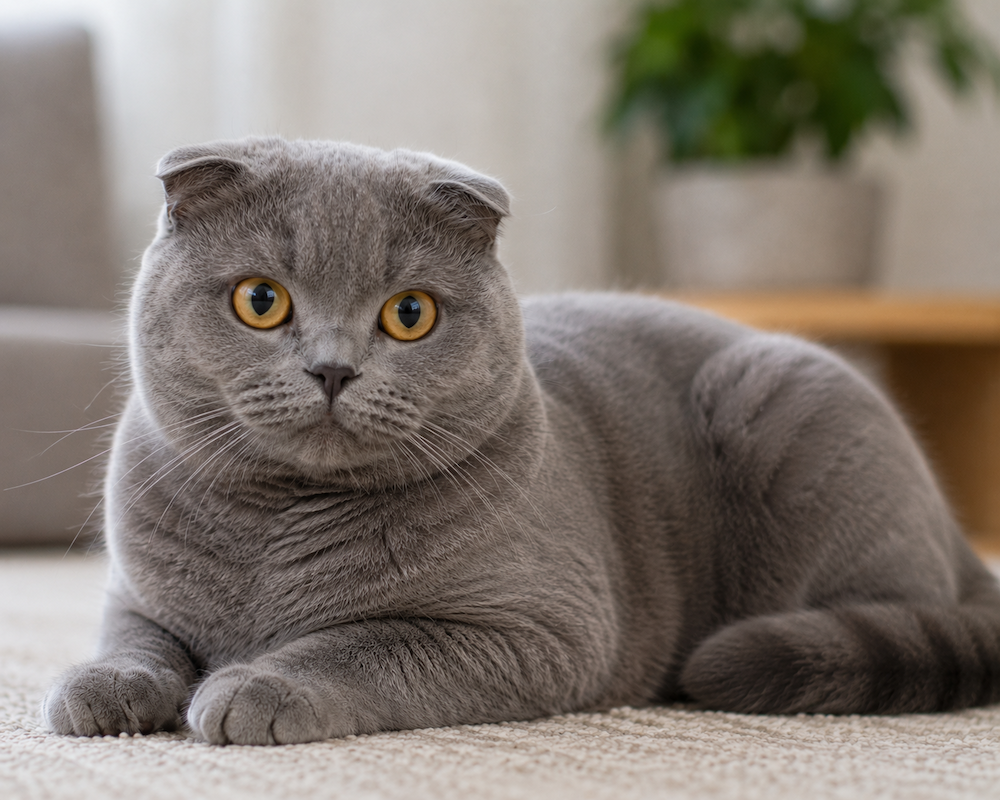







Sweet, calm, and instantly recognisable — a gentle companion famous for its folded ears and adorable expression.
🧠 QUICK SNAPSHOT
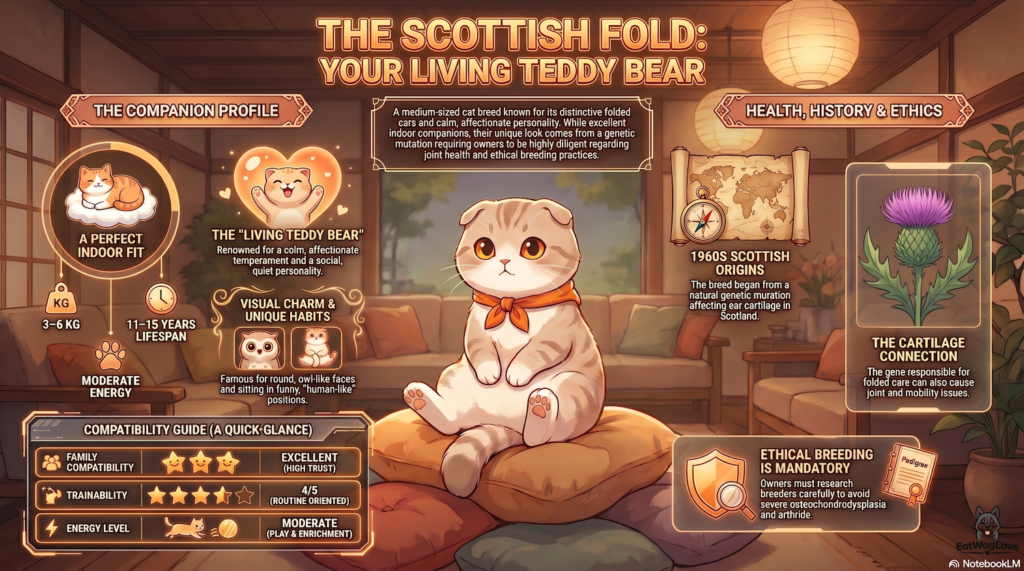
- Temperament: Gentle, affectionate, relaxed
- Energy Level: Low to moderate
- Size: Medium
- Good With Families: Yes
- Trainability: Moderate
- Grooming: Low to moderate
- Best For: Indoor living, companionship, relaxed households
📚 OVERVIEW
The Scottish Fold is a unique cat breed known for its folded ears and round, expressive face. They are affectionate and easy-going cats that enjoy spending time close to their family without being overly demanding.
They adapt well to indoor living and are known for their calm and gentle nature.
✅ PROS & CONS
Pros
- Very affectionate and friendly
- Calm indoor temperament
- Unique and adorable appearance
- Great family companion
Cons
- Can be prone to joint issues
- Needs regular play and activity
- Prefers companionship
- Not suited to rough handling
Is a Scottish Fold a Good Family Cat?
Yes. Scottish Folds are generally affectionate, calm and people-oriented cats that can fit well into family homes.
They often enjoy being near their owners without being excessively demanding and can develop strong bonds with several family members.
However, prospective owners should understand the breed’s significant inherited health and welfare issue associated with the same gene that produces its folded ears.
Are Scottish Folds Good With Children?
Generally, yes. Scottish Folds can be gentle and tolerant companions for respectful children.
They usually prefer relatively calm handling rather than rough play.
Children should be taught to handle them carefully, particularly because Scottish Folds can develop painful joint and cartilage disease.
Are Scottish Fold Cats Affectionate?
Yes. Scottish Folds are typically affectionate and enjoy spending time with their families.
Many follow their owners from room to room, sit nearby and enjoy attention.
Individual personalities vary, but they’re often described as loving without being constantly demanding.
Do Scottish Fold Cats Like to Sit on Your Lap?
Some do, although not every Scottish Fold is a dedicated lap cat.
Many prefer simply sitting or sleeping close to their favourite people.
Their willingness to cuddle depends more on individual temperament than on the folded-ear characteristic.
How Much Exercise Does a Scottish Fold Need?
Scottish Folds generally have moderate exercise needs.
Interactive toys, climbing structures, puzzle feeders and daily play help maintain physical and mental health.
Exercise becomes particularly important for weight management, although cats experiencing joint pain may become less active.
Are Scottish Fold Cats Easy to Train?
Yes. Scottish Folds are intelligent cats and can learn household routines, use scratching posts and respond to reward-based training.
Some can learn tricks or interactive games.
Puzzle toys and food-dispensing activities can provide useful mental stimulation.
Do Scottish Fold Cats Shed a Lot?
Scottish Folds generally shed a moderate amount.
Short-haired Folds require relatively straightforward coat care, while long-haired Scottish Folds shed more noticeably and need additional brushing.
Seasonal shedding can increase the amount of loose hair.
Are Scottish Fold Cats Hypoallergenic?
No.
Scottish Folds aren’t considered hypoallergenic.
They produce the proteins responsible for cat allergies through their saliva and skin secretions, regardless of whether they have short or long hair.
How Often Should You Groom a Scottish Fold?
Short-haired Scottish Folds generally benefit from weekly brushing, while long-haired individuals may require brushing several times a week.
Their folded ears should also be checked regularly for excessive wax, irritation or other problems.
Routine nail trimming and dental care are important as well.
What Health Problems Are Common in Scottish Fold Cats?
The most important health concern is osteochondrodysplasia, an inherited disorder affecting cartilage and bone development.
This condition is directly associated with the genetic mutation responsible for the breed’s folded ears.
Affected cats can develop abnormal bones, stiff joints, shortened or inflexible tails, lameness and painful arthritis.
This isn’t simply a separate disease that occasionally occurs in the breed — it’s fundamentally connected with the Fold mutation itself.
Why Do Scottish Fold Cats Have Folded Ears?
Their distinctive ears result from a genetic mutation affecting cartilage development.
Because cartilage helps support the ears, the mutation causes them to fold forward rather than remain upright.
Unfortunately, cartilage is found throughout the body, not just in the ears, which is why the same mutation can cause skeletal and joint abnormalities.
Are Scottish Fold Cats in Pain?
Not every Scottish Fold will display the same severity of symptoms, but the Fold mutation can cause progressive and potentially painful skeletal disease.
Cats inheriting two copies of the mutation are generally much more severely affected, while cats with one copy can still develop osteochondrodysplasia.
Signs may include stiffness, reluctance to jump, abnormal walking, lameness or sensitivity when handled.
How Long Do Scottish Fold Cats Live?
Scottish Folds are often reported to live around 11–15 years, although individual lifespan varies considerably.
Their quality of life can be affected by the severity of inherited skeletal disease as well as other common feline health conditions.
Regular veterinary monitoring is particularly important.
How Big Does a Scottish Fold Get?
Scottish Folds are medium-sized cats.
Adults commonly weigh around 3–6 kg, with males generally larger than females.
Their rounded heads, dense coats and compact bodies can make them appear quite substantial.
Are All Scottish Fold Kittens Born With Folded Ears?
No. In fact, Scottish Fold kittens are born with straight ears.
In kittens that inherit the Fold mutation, the ears typically begin folding during the first few weeks of life.
Some kittens from Scottish Fold breeding programmes retain straight ears and are often referred to as Scottish Straights.
What Is a Scottish Straight?
A Scottish Straight is a cat from Scottish Fold breeding lines that has upright rather than folded ears.
Scottish Straights can share many physical and temperament characteristics with Scottish Folds but don’t have the characteristic ear fold.
The distinction is particularly important because the folded ears are associated with the problematic cartilage mutation.
Can Two Scottish Fold Cats Be Bred Together?
Breeding two fold-eared cats together is considered particularly problematic.
Kittens inheriting two copies of the Fold mutation are at much greater risk of severe skeletal abnormalities and painful osteochondrodysplasia.
For this reason, responsible breeding programmes that permit Scottish Fold breeding don’t pair two folded-ear cats together.
Can Scottish Folds Live Indoors?
Yes. Scottish Folds are generally well suited to indoor life.
Providing climbing areas, scratching posts, interactive toys and daily play helps keep them physically and mentally stimulated.
A secure outdoor enclosure can provide additional enrichment without exposing the cat to traffic, predators or other outdoor hazards.
Can Scottish Folds Be Left Alone?
Adult Scottish Folds can usually tolerate reasonable periods alone, but they’re typically social cats that enjoy human companionship.
They shouldn’t routinely be left without interaction or enrichment for very long periods.
Many enjoy having a compatible feline companion.
Are Scottish Folds Vocal?
Scottish Folds are generally considered relatively quiet cats.
They can communicate with soft meows and other sounds but aren’t usually known for the persistent vocalisation associated with breeds such as Siamese or Oriental Shorthairs.
Individual cats naturally vary.
Are Scottish Folds Good With Other Cats?
Generally, yes.
Their typically calm and sociable nature can make Scottish Folds compatible with other friendly cats.
Gradual introductions remain important whenever unfamiliar cats are brought together.
Are Scottish Folds Good With Dogs?
Many Scottish Folds can live successfully with calm, cat-friendly dogs.
Their relatively easygoing temperament can help, particularly when they’re introduced to dogs while young.
Introductions should always be controlled and gradual.
Why Do Scottish Fold Cats Sit in Funny Positions?
Scottish Folds have become famous online for sitting upright with their hind legs extended, sometimes called the “Buddha sit.”
While some cats simply adopt unusual resting positions, owners shouldn’t automatically assume an odd posture is just a cute breed characteristic.
Stiffness, reluctance to move or unusual positioning can potentially be associated with joint discomfort and deserves veterinary attention if persistent.
What Is the Difference Between a Scottish Fold and a British Shorthair?
The breeds can look similar because both may have round faces, sturdy bodies and dense coats.
The obvious difference is the Scottish Fold’s folded ears.
British Shorthairs have upright ears and don’t carry the Scottish Fold mutation responsible for osteochondrodysplasia.
British Shorthairs have also historically been used in some Scottish Fold breeding programmes.
Where Does the Scottish Fold Come From?
The breed originated in Scotland during the 1960s.
Its history began with a white barn cat named Susie, who had naturally folded ears.
One of Susie’s kittens inherited the same unusual ears, and selective breeding eventually established the Scottish Fold.
Why Are Scottish Fold Cats Controversial?
The controversy centres on the fact that their signature physical feature isn’t merely cosmetic.
The mutation producing the folded ears affects cartilage and bone throughout the body and can cause osteochondrodysplasia and painful joint disease.
For this reason, breeding Scottish Folds is opposed by many veterinary and animal-welfare organisations and is restricted or prohibited in some jurisdictions.
Is a Scottish Fold a Good First Cat?
Their temperament can make them appear ideal for first-time cat owners because they’re often affectionate, quiet and adaptable.
However, prospective owners need to understand the significant welfare issue associated with the Fold mutation and the potential for ongoing veterinary care.
Someone primarily attracted to their temperament may wish to consider healthy straight-eared breeds or domestic cats with similar personalities.
What Makes the Scottish Fold Unique?
Few cats are as instantly recognisable as the Scottish Fold.
Its story began with Susie, a Scottish farm cat discovered in the 1960s with naturally folded ears. That unusual appearance eventually inspired an entire breed.
Unfortunately, the feature that made the Scottish Fold famous is also its greatest problem.
The ears fold because of a mutation affecting cartilage — and cartilage doesn’t exist only in the ears. The same genetic change can affect joints and bones throughout the cat’s body.
That makes the Scottish Fold very different from a breed whose unusual appearance is purely cosmetic.
Those tiny folded ears may look adorable, but understanding why they fold is one of the most important things any prospective Scottish Fold owner should know.