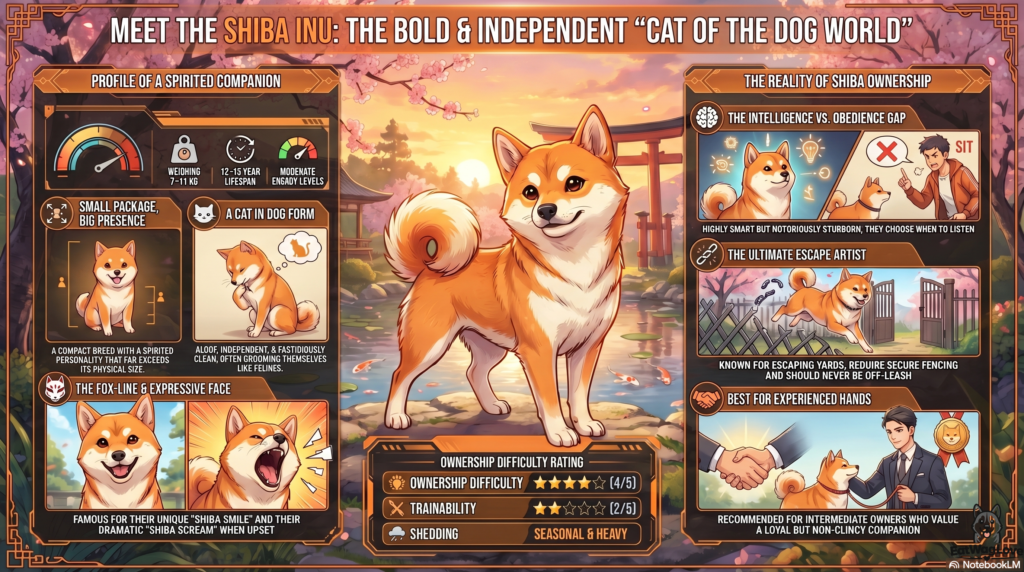
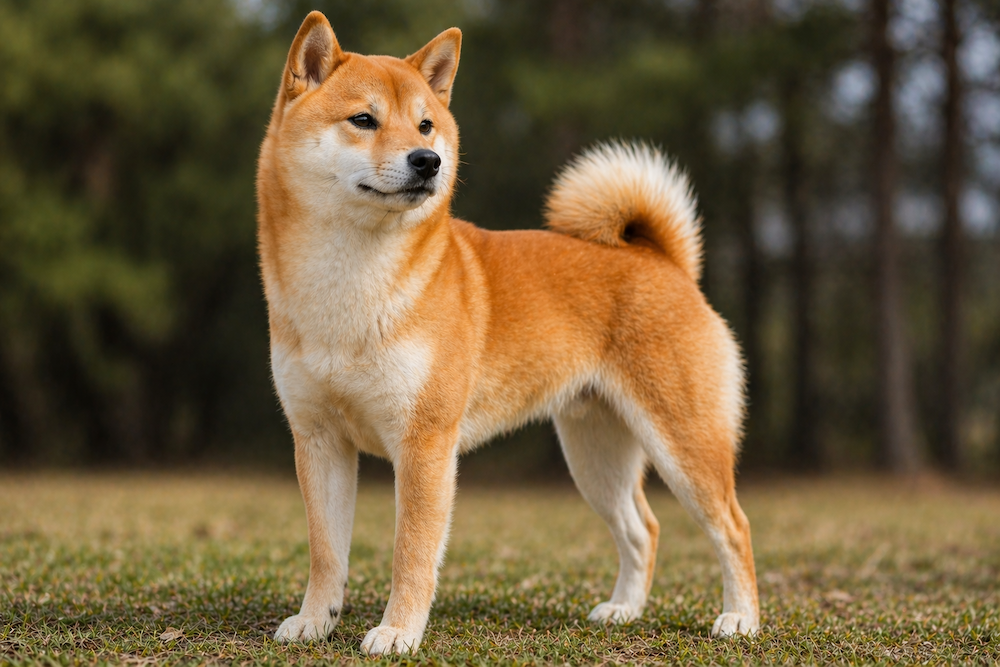






Bold, independent, and full of personality — a small dog with a big attitude and fox-like charm.
🧠 QUICK SNAPSHOT
- Temperament: Independent, alert, confident
- Energy Level: Moderate
- Size: Small to medium
- Good With Families: Yes (with training)
- Trainability: Moderate to low
- Grooming: Moderate (heavy shedding seasonally)
- Best For: Experienced or patient owners
📚 OVERVIEW
The Shiba Inu is a popular Japanese breed known for its fox-like appearance, clean habits, and strong personality. They are highly alert and often form deep bonds with their owners, but they also have an independent streak that sets them apart from more eager-to-please breeds.
They are compact, agile, and surprisingly bold for their size.
✅ PROS & CONS
Pros
- Clean and low-odour coat
- Loyal and devoted to owners
- Compact and adaptable size
- Very alert and aware
Cons
- Strong-willed and stubborn
- Can be difficult to train
- High prey drive
- Known for the “Shiba scream”
Is a Shiba Inu a Good Family Dog?
A Shiba Inu can be a good family dog for the right household.
Shibas are intelligent, loyal, clean and independent, but they’re generally less eager to please than many popular family breeds.
They tend to suit owners who appreciate a dog with a strong personality rather than one that constantly seeks direction or attention.
Are Shiba Inus Good With Children?
Shiba Inus can live successfully with respectful children, particularly when raised alongside them.
However, many Shibas dislike rough handling, grabbing or excessive physical attention.
They generally suit children who understand how to respect a dog’s personal space.
How Much Exercise Does a Shiba Inu Need?
Most adult Shiba Inus need around 60 minutes of exercise each day, with some requiring more.
Daily walks, exploration, games and mental stimulation are important.
They’re athletic dogs that often enjoy hiking and outdoor activities.
Are Shiba Inus Easy to Train?
Shiba Inus are extremely intelligent, but they’re not necessarily easy to train.
They’re famous for being independent and strong-minded, and may understand exactly what you’re asking without feeling particularly compelled to do it.
Short, rewarding and consistent training sessions usually work best.
Do Shiba Inus Shed a Lot?
Yes. Shiba Inus can be very heavy shedders.
Their dense double coat sheds throughout the year and typically undergoes major seasonal coat blows.
During these periods, surprisingly large quantities of undercoat can come out.
Are Shiba Inus Hypoallergenic?
No.
Shiba Inus aren’t hypoallergenic and can produce considerable amounts of loose hair and dander.
They’re generally unsuitable for someone specifically looking for a low-shedding dog.
How Often Should You Groom a Shiba Inu?
Weekly brushing is usually sufficient during normal periods, but much more frequent brushing can be helpful during seasonal shedding.
Their naturally clean coat doesn’t generally require frequent bathing.
Routine nail trimming, dental care and ear checks are also important.
What Health Problems Are Common in Shiba Inus?
Potential health concerns include allergies, patellar luxation, hip dysplasia and certain eye disorders, including glaucoma.
Responsible breeders should screen breeding dogs for relevant inherited conditions.
Regular veterinary care and maintaining a healthy weight are also important.
How Long Do Shiba Inus Live?
Shiba Inus commonly live around 13–16 years.
They’re generally a relatively long-lived breed.
Genetics, diet, body condition, exercise and preventive veterinary care can all influence lifespan.
How Big Does a Shiba Inu Get?
Shiba Inus are small-to-medium dogs.
Adults generally stand around 34–42 cm at the shoulder and typically weigh approximately 7–11 kg, with males usually larger than females.
Their compact, muscular build makes them surprisingly substantial for their size.
Can a Shiba Inu Live in an Apartment?
Yes. Shiba Inus can adapt well to apartment living if they receive sufficient exercise and stimulation.
Their compact size and generally clean nature can make them suitable indoor companions.
However, their vocalisations and need for regular outdoor exercise still need consideration.
Can Shiba Inus Be Left Alone?
Adult Shibas can often tolerate reasonable periods alone better than highly dependent companion breeds.
Their naturally independent personality can help in this respect.
However, they still need regular exercise, enrichment and interaction and shouldn’t routinely spend extremely long periods alone.
Do Shiba Inus Bark a Lot?
Shiba Inus aren’t generally considered constant barkers.
They can be alert and will vocalise when something attracts their attention.
They’re also famous for producing a very different and considerably more dramatic sound — the Shiba scream.
What Is the Shiba Scream?
The “Shiba scream” is an unusually loud, high-pitched vocalisation for which the breed has become famous.
A Shiba may produce it when extremely excited, frightened, frustrated or strongly objecting to something.
Not every Shiba screams frequently, but owners who have heard one rarely forget it.
Are Shiba Inus Affectionate?
Yes, but Shiba affection is often on their own terms.
Many form extremely strong bonds with their owners without becoming conventional lap dogs.
A Shiba may enjoy sitting nearby rather than constantly demanding cuddles.
Do Shiba Inus Like to Cuddle?
Some do, but Shiba Inus aren’t generally known as exceptionally cuddly dogs.
Many value their personal space and prefer choosing when physical affection occurs.
Individual personalities vary considerably.
Are Shiba Inus Good With Other Dogs?
It depends heavily on the individual dog and its socialisation.
Some Shibas live happily with other dogs, while others can be selective, assertive or intolerant of unfamiliar dogs.
Early positive socialisation is particularly important.
Are Shiba Inus Good With Cats?
Some Shiba Inus can live successfully with cats, especially when raised with them.
However, the breed can have a strong prey drive, so compatibility isn’t guaranteed.
Care is particularly important around unfamiliar cats and smaller animals.
Do Shiba Inus Have a High Prey Drive?
Yes. Shiba Inus were historically used for hunting, and many retain strong instincts to chase smaller animals.
Birds, rodents, rabbits and other fast-moving animals can trigger pursuit.
Secure fencing and careful leash management are important.
Can Shiba Inus Be Trusted Off Leash?
Shiba Inus are notoriously challenging off leash.
Their independence, hunting instincts and prey drive can override even well-practised recall when something interesting appears.
For many Shibas, securely fenced areas are the safest option for unrestricted running.
Are Shiba Inus Escape Artists?
They can be.
Shibas are agile, intelligent and determined, and some quickly discover weaknesses in fencing or opportunities to slip through open doors.
A secure yard and careful management around entrances are important.
Are Shiba Inus Aggressive?
Shiba Inus shouldn’t automatically be considered aggressive, but they can be assertive, territorial and selective about handling or unfamiliar dogs.
Good breeding, early socialisation and positive training have a major influence on behaviour.
Owners should also learn to recognise when their dog wants space rather than forcing interaction.
Are Shiba Inus Easy to House Train?
Many Shiba Inus are relatively easy to house train.
The breed is famously clean, and puppies often develop strong preferences about where they toilet.
Consistent routines and positive reinforcement still make the process easier.
Why Are Shiba Inus So Clean?
Shiba Inus have a reputation for being unusually clean dogs.
Many spend considerable time grooming themselves and dislike becoming dirty or wet.
Their self-grooming behaviour is one reason they’re sometimes described as “cat-like.”
Why Does a Shiba Inu Have a Curled Tail?
The Shiba Inu’s curled or sickle-shaped tail is a characteristic feature of the breed and many other Japanese and northern spitz-type dogs.
It should be thickly coated and carried over or above the back.
Together with the small upright ears, it creates the classic Shiba silhouette.
What Colours Do Shiba Inus Come In?
Common recognised colours include red, black and tan, and sesame, with cream also occurring.
A distinctive feature of standard Shiba colouring is urajiro — lighter cream or white colouring on areas including the cheeks, underside of the jaw, chest and belly.
Is a Shiba Inu a Mini Akita?
No.
Although Shiba Inus and Akitas share some obvious Japanese spitz characteristics, they’re separate breeds with different histories and dramatically different sizes.
An adult Akita can weigh several times as much as a Shiba Inu.
What Were Shiba Inus Originally Bred For?
Shiba Inus were developed in Japan as hunting dogs.
Their compact size and agility helped them work through mountainous terrain and dense vegetation, where they were used to flush and hunt small game and birds.
Their hunting background helps explain the modern breed’s alertness, agility and strong prey drive.
Where Does the Shiba Inu Come From?
The Shiba Inu originated in Japan and is one of the country’s native dog breeds.
Dogs of Shiba type have a long history in Japan, although the modern breed was standardised during the 20th century from surviving regional populations.
Today, the Shiba is one of Japan’s best-known dogs internationally.
What Does Shiba Inu Mean?
“Inu” simply means dog in Japanese.
The exact historical origin of “Shiba” is less certain. It’s commonly associated with meanings such as brushwood, potentially referring to terrain where the dogs hunted or the reddish colour of brushwood.
Another interpretation connects it with an older meaning relating to small size.
Why Are Shiba Inus So Popular on the Internet?
Their expressive faces and distinctive personalities made Shiba Inus unusually well suited to internet culture.
The famous Doge meme featured a Shiba Inu named Kabosu and became one of the internet’s most recognisable memes.
The breed’s popularity online subsequently introduced millions of people to the Shiba Inu.
Is a Shiba Inu a Good First Dog?
A Shiba Inu can be challenging for a first-time owner.
They’re intelligent and relatively compact, but their independence, prey drive, handling preferences and unreliable off-leash behaviour require patient management.
An owner expecting Labrador-like obedience may find the Shiba particularly surprising.
What Makes the Shiba Inu Unique?
The Shiba Inu has achieved something few ancient hunting breeds could have anticipated:
it became an internet superstar.
Long before Doge memes existed, however, these compact Japanese dogs were navigating difficult terrain and hunting game. That heritage produced an agile, observant and remarkably independent little dog.
Then there’s the personality.
Shibas are famous for keeping themselves clean, choosing affection on their own terms and sometimes behaving more like cats than conventional companion dogs.
And when they strongly disagree with something?
They have the Shiba scream — a noise spectacularly disproportionate to the size of the animal producing it.
Add the curled tail, fox-like expression and enormous personality, and it’s easy to understand why the breed attracts so much attention.
Just don’t confuse internet fame with easy ownership.
A Shiba may become your best friend. It simply prefers to believe that the decision was entirely its own.