






Unique, affectionate, and full of personality — a hairless companion that loves warmth, attention, and human connection.
🧠 QUICK SNAPSHOT
- Temperament: Affectionate, social, playful
- Energy Level: Moderate to high
- Size: Medium
- Good With Families: Yes
- Trainability: Moderate
- Grooming: Moderate (skin care required)
- Best For: Indoor living, affectionate households
📚 OVERVIEW
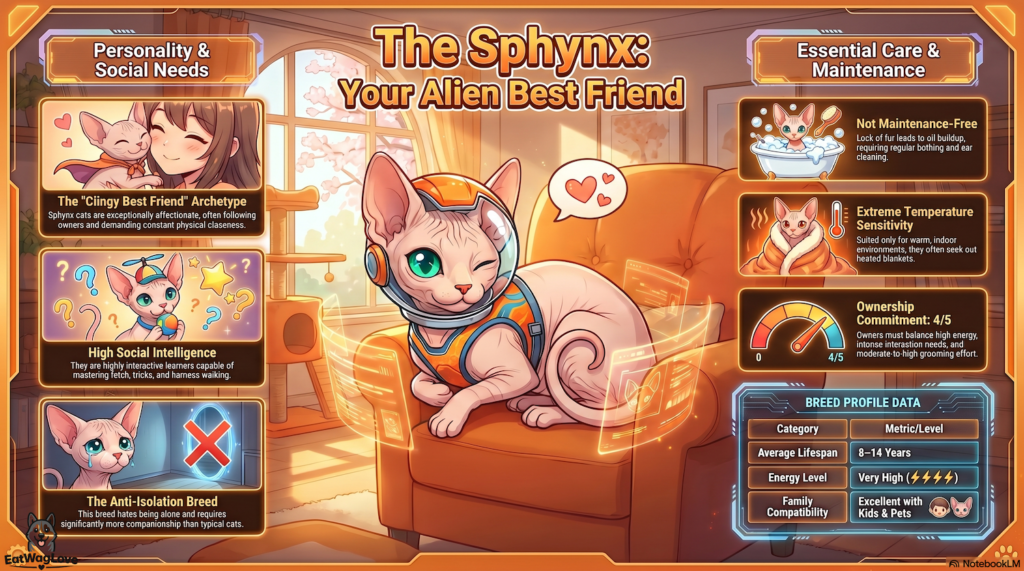
The Sphynx is one of the world’s most distinctive cat breeds, famous for its hairless appearance and outgoing personality. Despite lacking a traditional coat, they are warm, affectionate cats that love being around people.
They are playful, curious, and thrive in homes where they receive plenty of interaction and attention.
✅ PROS & CONS
Pros
- Extremely affectionate and social
- Unique and eye-catching appearance
- Highly interactive personality
- Minimal shedding
Cons
- Needs regular skin care and bathing
- Sensitive to cold and sun exposure
- Requires companionship and attention
- Can become bored if left alone often
Is a Sphynx Cat a Good Family Pet?
Yes. Sphynx cats are generally affectionate, outgoing and highly people-oriented, making them excellent family pets for households that can give them plenty of attention.
Despite their unusual appearance, they’re typically warm, playful companions that enjoy being involved in everyday family life.
Are Sphynx Cats Good With Children?
Generally, yes. Sphynx cats are often playful and sociable with respectful children.
Their energetic personalities can make them entertaining companions, but their exposed skin needs gentle handling and protection from scratches and rough play.
Are Sphynx Cats Affectionate?
Very. The Sphynx is famous for being exceptionally affectionate and people-focused.
Many follow their owners around the home, climb onto laps and seek physical contact whenever possible.
Their desire for warmth may make cuddling particularly appealing.
Do Sphynx Cats Like to Cuddle?
Yes. Many Sphynx cats are enthusiastic cuddlers.
They frequently seek out warm laps, blankets and sleeping companions.
A Sphynx tucked underneath a blanket beside its owner is a very typical sight.
Are Sphynx Cats Completely Hairless?
Not always.
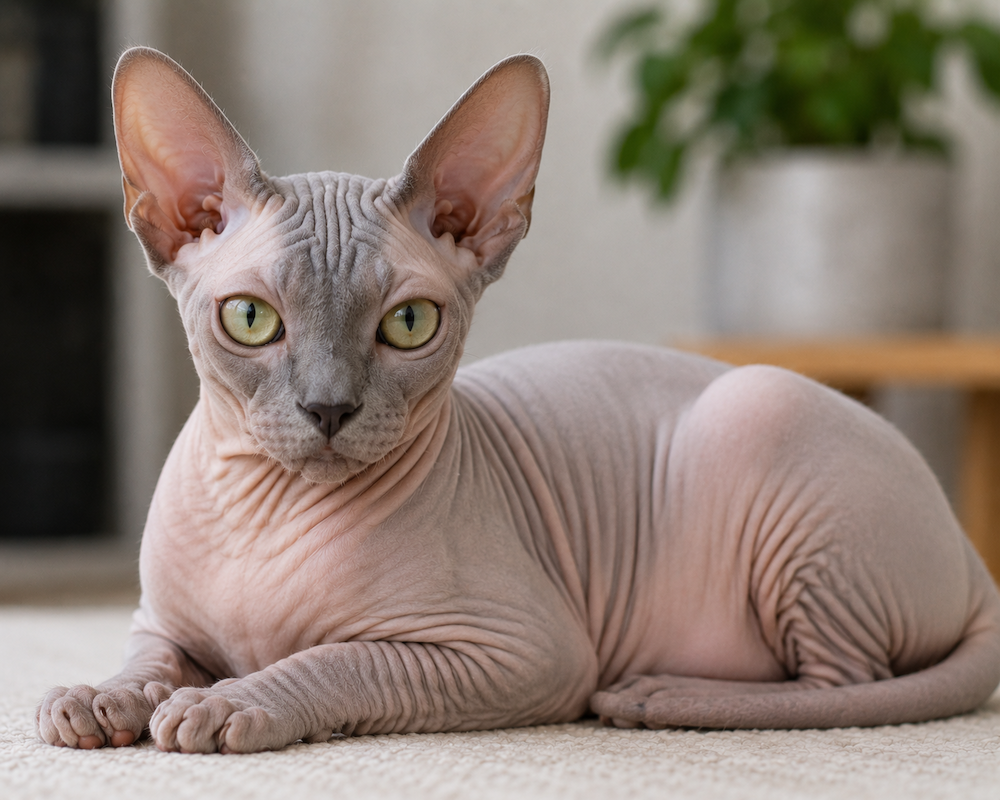
Most Sphynx cats have a very fine layer of soft, down-like hair, sometimes described as feeling similar to warm suede or a peach.
The amount of hair varies between individual cats, and some have more noticeable fuzz around areas such as the ears, nose, feet or tail.
Do Sphynx Cats Shed?
Sphynx cats shed very little compared with conventionally coated cats.
However, they’re not necessarily completely hairless, so small amounts of fine hair may still be present.
Their lack of a normal coat creates different grooming requirements rather than eliminating grooming altogether.
Are Sphynx Cats Hypoallergenic?
No. Sphynx cats are not truly hypoallergenic.
Cat allergies are primarily caused by proteins found in saliva and skin secretions rather than the hair itself.
A Sphynx may leave less hair around the home, but it still produces allergens capable of triggering reactions.
Do Sphynx Cats Need Baths?
Yes, some Sphynx cats require periodic bathing because they lack the normal coat that absorbs and distributes skin oils.
Oil can accumulate on the skin and transfer onto bedding and furniture.
Bathing frequency varies considerably between individual cats, and excessive bathing can also irritate or dry the skin.
How Do You Groom a Sphynx Cat?
Sphynx grooming involves skin care, ear cleaning, nail maintenance and dental care rather than brushing a conventional coat.
Their ears can accumulate wax and oily debris, while oils may also collect around the nails.
Owners should establish an appropriate grooming routine with guidance from their breeder and veterinarian.
Do Sphynx Cats Get Cold?
Yes. Without a normal insulating coat, Sphynx cats can become cold more easily than coated cats.
They should have access to warm indoor areas, comfortable bedding and blankets, particularly during cooler weather.
Many naturally seek warm places around the home.
Do Sphynx Cats Need Clothes?
Not necessarily.
Some Sphynx cats tolerate lightweight clothing during cooler conditions, but clothes aren’t a substitute for maintaining a comfortably warm indoor environment.
Clothing should fit correctly, remain clean and never restrict movement or cause skin irritation.
Can Sphynx Cats Get Sunburnt?
Yes. Their exposed skin can be vulnerable to sun damage and sunburn.
They shouldn’t be allowed to spend prolonged periods in strong direct sunlight, including intense sunlight through windows.
Keeping them indoors or providing carefully controlled sun exposure is generally safest.
What Health Problems Are Common in Sphynx Cats?
One of the most important health concerns is hypertrophic cardiomyopathy (HCM), a disease in which the heart muscle becomes abnormally thickened.
Sphynx cats can also experience skin conditions, dental problems and other inherited health concerns.
Responsible breeding and appropriate veterinary screening are particularly important.
How Long Do Sphynx Cats Live?
Sphynx cats commonly live around 9–15 years, although individual lifespan varies considerably.
Genetics, heart health, nutrition, body condition and regular veterinary care can all influence longevity.
How Big Does a Sphynx Cat Get?
Sphynx cats are generally medium-sized, commonly weighing around 3–6 kg.
They’re surprisingly muscular and substantial beneath their hairless appearance.
Their large ears, prominent cheekbones and wrinkled skin contribute to their distinctive appearance.
Can Sphynx Cats Live Indoors?
Yes. In fact, Sphynx cats are particularly well suited to indoor living.
Indoor life helps protect their exposed skin from extreme temperatures, sunburn and other environmental hazards.
They still need climbing structures, toys, scratching areas and plenty of interactive play.
Can Sphynx Cats Be Left Alone?
Sphynx cats generally don’t enjoy spending very long periods alone.
They’re highly social and often strongly attached to their owners.
Households where everyone is away for long periods may consider whether a compatible feline companion could provide additional company.
Are Sphynx Cats Vocal?
Many are quite communicative.
Sphynx cats may use meows, chirps and other vocalisations to request food, warmth, play or attention.
Their outgoing personalities often extend to having quite a lot to say to their owners.
Are Sphynx Cats High-Energy?
Yes. Sphynx cats are generally active, playful and curious.
Many enjoy climbing, chasing toys and investigating whatever their owners are doing.
Daily interactive play and environmental enrichment help satisfy their physical and mental needs.
Are Sphynx Cats Intelligent?
Yes. Sphynx cats are typically intelligent, curious and highly interactive.
They can learn household routines quickly and often enjoy puzzle feeders, training games and exploring new objects.
Their combination of intelligence and sociability can make them remarkably entertaining companions.
Are Sphynx Cats Good With Other Cats?
Generally, yes.
Sphynx cats tend to be social and can enjoy living with compatible feline companions.
Their energetic play style means another playful cat can sometimes make an excellent companion.
Are Sphynx Cats Good With Dogs?
Many Sphynx cats can live successfully with cat-friendly dogs.
Their confident and outgoing temperament can help them adapt to canine companions.
Introductions should still be gradual and carefully supervised.
Do Sphynx Cats Eat More Than Other Cats?
Some Sphynx cats appear to have high energy requirements, partly because maintaining body temperature without a normal insulating coat requires energy.
However, they shouldn’t simply be fed unlimited food.
Diet should be based on the individual cat’s age, activity, body condition and veterinary advice.
Why Does a Sphynx Cat Feel So Warm?
A Sphynx can feel unusually warm because you’re touching its skin directly rather than through an insulating layer of fur.
Cats naturally have a higher normal body temperature than humans.
The absence of a conventional coat makes that warmth much more noticeable when you touch a Sphynx.
Why Do Sphynx Cats Have Wrinkles?
Wrinkled skin is a characteristic part of the Sphynx appearance.
Wrinkles are particularly noticeable around the head, shoulders and legs, although the amount varies between individuals.
Their lack of a normal coat makes folds that would be less obvious on a furry cat much easier to see.
What Colours Do Sphynx Cats Come In?
Sphynx cats can occur in many colours and patterns.
Even without a normal coat, their skin pigmentation and fine hair reflect the colours and markings they would have if fully coated.
This can include solid, tabby, tortoiseshell, pointed and other patterns.
Where Does the Sphynx Cat Come From?
Despite its ancient Egyptian-sounding name, the modern Sphynx breed didn’t originate in Egypt.
Its development began in Canada during the 1960s, following naturally occurring hairless mutations in domestic cats.
Later breeding programmes used additional naturally hairless cats and selected outcrosses to establish the modern breed.
Why Is It Called a Sphynx Cat?
The name refers to the breed’s resemblance to the Great Sphinx and other imagery associated with ancient Egypt.
The name is therefore about appearance rather than geographical origin.
The modern Sphynx is fundamentally a Canadian-developed breed.
Is a Sphynx Cat a Good First Cat?
A Sphynx can be a good first cat for someone prepared for its specialised care.
They’re affectionate, intelligent and relatively easy to integrate into family life, but their skin care, temperature sensitivity, social needs and potential heart problems require more attention than many prospective owners expect.
Hairless doesn’t mean maintenance-free.
What Makes the Sphynx Cat Unique?
The Sphynx looks like a cat from ancient Egypt.
It actually comes from Canada.
It looks completely hairless.
Most actually have at least a fine layer of fuzz.
And it looks like grooming should be incredibly easy because there’s almost no coat.
That’s where the Sphynx delivers perhaps its biggest surprise.
Without fur to absorb normal skin oils, owners may instead need to manage oily skin, bathing, ear cleaning and nail-area buildup.
Then there’s the personality.
Behind that extraordinary appearance is usually a warm, energetic and intensely social cat that often wants to be wherever its humans are — preferably somewhere warm and ideally directly on top of them.
So while the Sphynx may resemble a mysterious feline statue from an ancient civilisation, the reality is often considerably less mysterious:
it’s a warm little attention-seeker looking for the nearest lap, blanket or patch of sunshine.