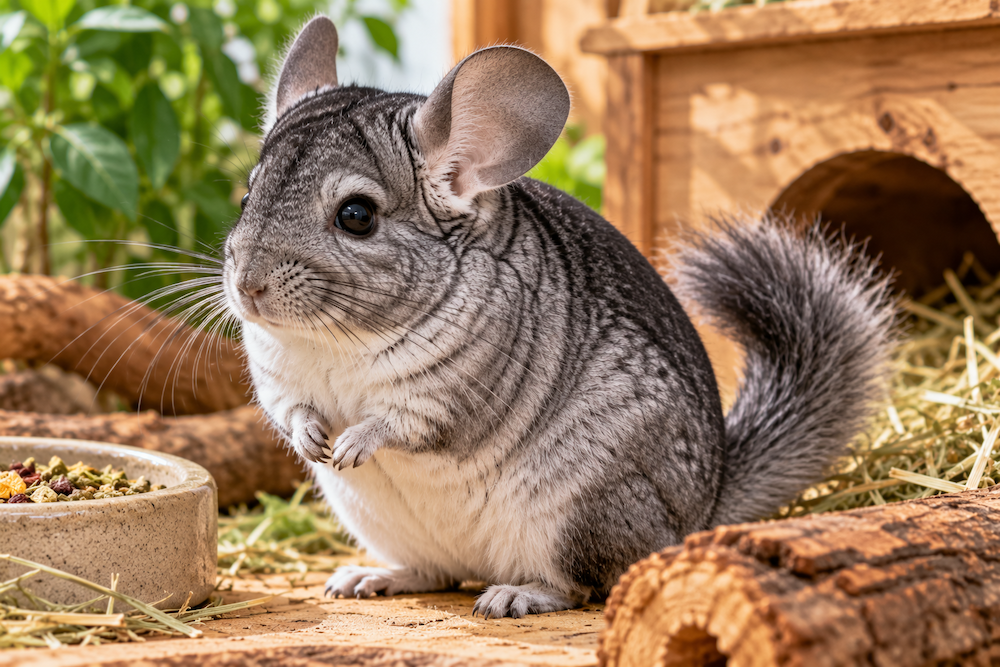







Soft, energetic and surprisingly athletic, the Standard Grey Chinchilla is the classic natural-coloured chinchilla.
🧠 QUICK SNAPSHOT
| Trait | Standard Grey Chinchilla |
|---|---|
| Scientific Name | Chinchilla lanigera |
| Pet Type | Small mammal / Rodent |
| Natural Heritage | Andes Mountains of South America |
| Typical Lifespan | Around 10–20 years |
| Adult Size | Around 22–38 cm body length, plus tail |
| Typical Weight | Roughly 400–800 g |
| Diet | Herbivore |
| Activity | Most active around dusk and night |
| Temperament | Curious, active and often cautious |
| Coat | Extremely dense grey fur |
| Housing | Large, secure, well-ventilated enclosure |
| Beginner Friendly? | Moderate |
| Famous Feature | Exceptionally dense, soft fur |
📚 OVERVIEW
The Standard Grey Chinchilla represents the classic natural colouring of the domestic long-tailed chinchilla, Chinchilla lanigera.
Its incredibly dense coat evolved in the cool, dry conditions of the Andes. That spectacular fur creates some unusual care requirements: chinchillas shouldn’t be routinely bathed in water and instead keep their coats clean with special dust baths.
They’re energetic animals capable of impressive jumps and need far more than a small cage. A large enclosure, safe exercise, chewing opportunities and environmental enrichment are essential.
Chinchillas can also live 10–20 years, making them one of the longer-lived small companion mammals.
✅ PROS & CONS
Pros
- Remarkably soft and distinctive coat
- Intelligent and curious
- Generally quiet
- Relatively low body odour
- Entertaining jumping and climbing behaviour
- Can develop trust with patient owners
- Long lifespan for a small mammal
- Standard Grey has the classic chinchilla appearance
Cons
- Highly sensitive to excessive heat
- Needs specialised dust baths
- Requires a large, stimulating enclosure
- Usually prefers exploring to cuddling
- Needs constant safe chewing opportunities
- Can be stressed by rough handling
- Veterinary care may require an exotic-pet specialist
- Potential 10–20 year commitment
Are Standard Grey Chinchillas Good Pets?
Yes. Chinchillas can make fascinating and rewarding pets for owners who understand their specialised needs.
They’re active, intelligent and entertaining, but aren’t necessarily ideal for someone wanting a cuddly lap animal.
Are Chinchillas Good Pets for Beginners?
They can be, although they’re more specialised than hamsters or gerbils.
Owners need to understand temperature control, diet, dental health, dust bathing and safe handling.
Their long lifespan also requires considerable commitment.
How Long Do Standard Grey Chinchillas Live?
Chinchillas commonly live around 10–20 years in captivity, with some individuals reaching the upper end of that range or beyond.
That’s an unusually long lifespan for a small rodent.
How Big Do Chinchillas Get?
Adult long-tailed chinchillas commonly have a body length of around 22–38 cm, plus their furry tail.
Adults may weigh roughly 400–800 grams, although size varies with sex, genetics and body condition.
What Is a Standard Grey Chinchilla?
Standard Grey describes the classic natural-style colour from which many domestic chinchilla colour mutations have been developed.
The coat is generally grey across the back and sides with darker shading and a lighter or white underside.
It’s a colour variety rather than a separate chinchilla species.
Why Are Chinchillas So Soft?
Chinchillas have an extraordinarily dense coat, with many fine hairs growing from individual follicles.
This dense fur helped their wild ancestors survive the cool environment of the Andes.
It’s also why their coat requires very different care from that of most mammals.
Why Do Chinchillas Take Dust Baths?
Chinchillas use fine dust to help absorb oils and moisture from their exceptionally dense fur.
They roll enthusiastically through specially formulated chinchilla bathing dust.
It’s both an important grooming behaviour and one of the most entertaining things to watch them do.
Can You Bathe a Chinchilla in Water?
Routine water bathing should be avoided.
Because chinchilla fur is so dense, it can be extremely difficult to dry thoroughly, potentially creating skin and coat problems.
Proper chinchilla dust is the normal method of maintaining the coat.
What Do Chinchillas Eat?
The foundation of a chinchilla’s diet should include unlimited good-quality grass hay together with an appropriate nutritionally balanced chinchilla pellet.
Their digestive systems are adapted to a high-fibre diet.
Sugary and fatty treats should be limited or avoided.
Why Is Hay Important for Chinchillas?
Hay provides essential fibre for healthy digestion and encourages prolonged chewing.
This matters because chinchillas have continuously growing teeth that require appropriate wear.
Dental problems can become serious if the teeth don’t wear correctly.
What Size Cage Does a Chinchilla Need?
Chinchillas need a large enclosure providing room for movement, jumping and exploration.
Safe platforms, hiding places, chew items and enrichment make better use of the available space.
They shouldn’t spend their lives confined to a tiny cage simply because they’re small animals.
Do Chinchillas Need Exercise?
Yes. Chinchillas are surprisingly energetic and athletic.
They benefit from a large enclosure and regular opportunities for safe exercise and exploration.
Any free-roaming area must be carefully chinchilla-proofed because they’re enthusiastic chewers.
How High Can a Chinchilla Jump?
Chinchillas are powerful jumpers and can leap well over a metre under the right circumstances.
Their strong hind legs reflect their ancestry in rocky mountain environments.
This athletic ability should be considered when designing safe housing.
Are Chinchillas Nocturnal?
Chinchillas are often most active around dusk, evening and nighttime, although captive animals may adapt some activity around household routines.
Owners should expect much of their energetic behaviour to occur when humans are beginning to wind down.
Do Chinchillas Like Being Held?
Many chinchillas prefer exploring and interacting without being tightly held.
Some become comfortable climbing onto their owners or accepting gentle handling, while others remain more independent.
Trust should be developed gradually rather than forcing physical contact.
Are Chinchillas Affectionate?
They can form strong relationships with familiar people, although their affection may look different from that of a dog or rat.
A comfortable chinchilla may approach its owner, accept scratches, climb onto them or eagerly appear when they hear a familiar routine.
Do Chinchillas Bite?
They can bite if frightened, stressed or restrained in a way they dislike, but biting isn’t generally their first response.
Patient handling and learning the animal’s body language can greatly reduce defensive behaviour.
Can Chinchillas Live Alone?
Chinchillas can sometimes live successfully alone when given substantial enrichment and human interaction.
Others benefit from a compatible chinchilla companion.
Introducing unfamiliar adults requires care because not every pair will accept one another.
What Temperature Is Safe for a Chinchilla?
Chinchillas are adapted to cool, dry conditions and can be highly vulnerable to overheating.
Their extremely dense fur makes hot and humid environments particularly dangerous.
Owners need to ensure the enclosure remains safely cool, especially during warm weather.
Can Chinchillas Get Heatstroke?
Yes. Heatstroke is a serious risk for chinchillas.
Their dense fur makes it difficult for them to cope with excessive heat, particularly when humidity is also high.
Lethargy, weakness, abnormal breathing or suspected overheating require immediate attention.
Why Do Chinchillas Chew Everything?
Chinchillas are rodents with continuously growing teeth.
Chewing suitable materials helps wear those teeth and provides important mental stimulation.
Safe wooden chew items and appropriate enrichment should always be available.
Do Chinchillas Need an Exercise Wheel?
A properly designed large, solid-surface wheel can provide additional exercise, although it doesn’t replace a spacious enclosure.
Small wheels can force the spine into an unnatural curve, while mesh or wire surfaces may create injury risks.
What Health Problems Are Common in Chinchillas?
Important health concerns include dental disease, gastrointestinal problems, respiratory illness, heat stress and fur or skin conditions.
Changes in eating, droppings, weight or activity should be taken seriously.
Because chinchillas can hide illness, early veterinary attention is important.
What Colours Do Chinchillas Come In?
Standard Grey is the classic colouring, but selective breeding has produced numerous additional variations including beige, ebony, white, violet and combinations of these colours.
Standard Grey remains particularly recognisable because it closely reflects the species’ natural ancestral appearance.
Where Do Chinchillas Come From?
Chinchillas originate from the Andes Mountains of South America, where their ancestors evolved for life in cool, dry and rocky environments.
Their dense fur, powerful hind legs and preference for dry conditions all reflect that mountain heritage.
Are Chinchillas Legal to Keep as Pets?
That depends on location.
Some countries or regions restrict or prohibit chinchilla ownership, while they’re common companion animals elsewhere.
Prospective owners should always check current local regulations.
Is a Standard Grey Chinchilla a Good First Pet?
It can be for someone prepared to meet its specific needs.
The biggest considerations are temperature control, dental and digestive health, suitable housing and a lifespan that can approach two decades.
A Chinchilla may be small, but it isn’t a short-term pet.
What Makes the Standard Grey Chinchilla Unique?
Few animals feel quite like a chinchilla.
Its coat is so extraordinarily dense that ordinary water bathing becomes a bad idea. Instead, give it a container of fine chinchilla dust and watch what happens.
The animal dives in.
Roll. Twist. Shake. Repeat.
Within seconds, there’s dust everywhere and one apparently delighted chinchilla in the middle of it.
Then there are those powerful back legs.
Chinchillas evolved among rocky mountain terrain, and that heritage remains obvious when one suddenly launches itself onto a platform you thought was impossibly high.
Add enormous ears, long whiskers, a fluffy tail and potentially two decades of companionship, and the Standard Grey Chinchilla becomes far more than a particularly soft rodent.
It’s a little piece of the Andes — complete with its own dust cloud.
Discover why Chinchillas take dust baths, what makes their fur extraordinarily soft, how they became such powerful jumpers and what it’s really like to live with one.
Watch our Standard Grey Chinchilla video and discover what makes this remarkable mountain rodent so unusual.