






Tiny, social and capable of gliding through the air, the Standard Sugar Glider is an extraordinary little marsupial.
🧠 QUICK SNAPSHOT
| Trait | Standard Sugar Glider |
|---|---|
| Scientific Name | Petaurus breviceps |
| Pet Type | Small marsupial / Exotic pet |
| Natural Range | Australia and parts of New Guinea and surrounding islands |
| Typical Lifespan | Around 10–15 years in captivity |
| Body Length | Around 12–18 cm, plus tail |
| Typical Weight | Roughly 80–160 g |
| Diet | Omnivorous — specialised diet required |
| Activity | Nocturnal |
| Temperament | Social, active, curious and vocal |
| Housing | Large, tall, secure enclosure |
| Social Needs | Very high |
| Beginner Friendly? | Generally no |
| Famous Feature | Gliding membrane between front and hind legs |
📚 OVERVIEW
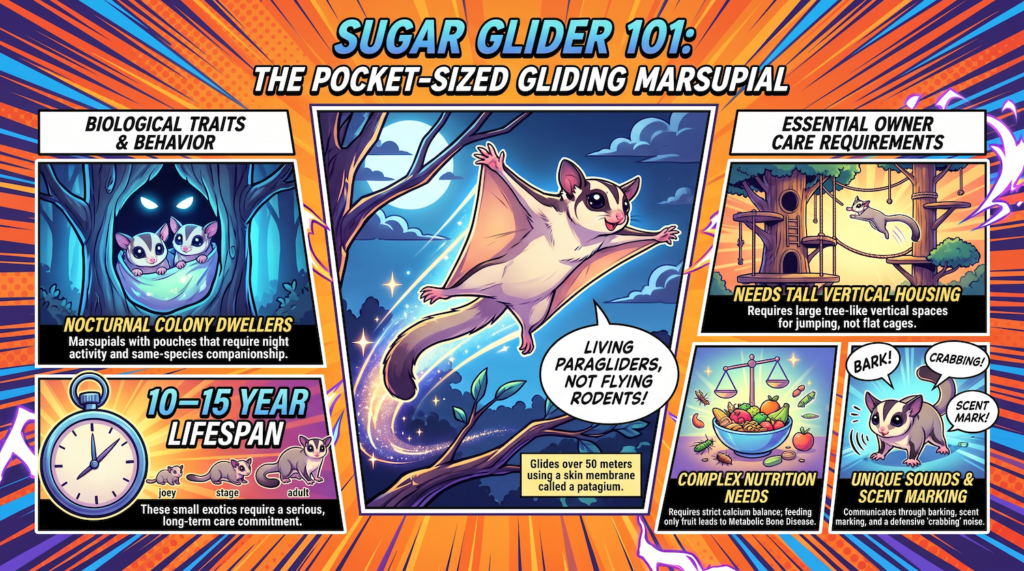
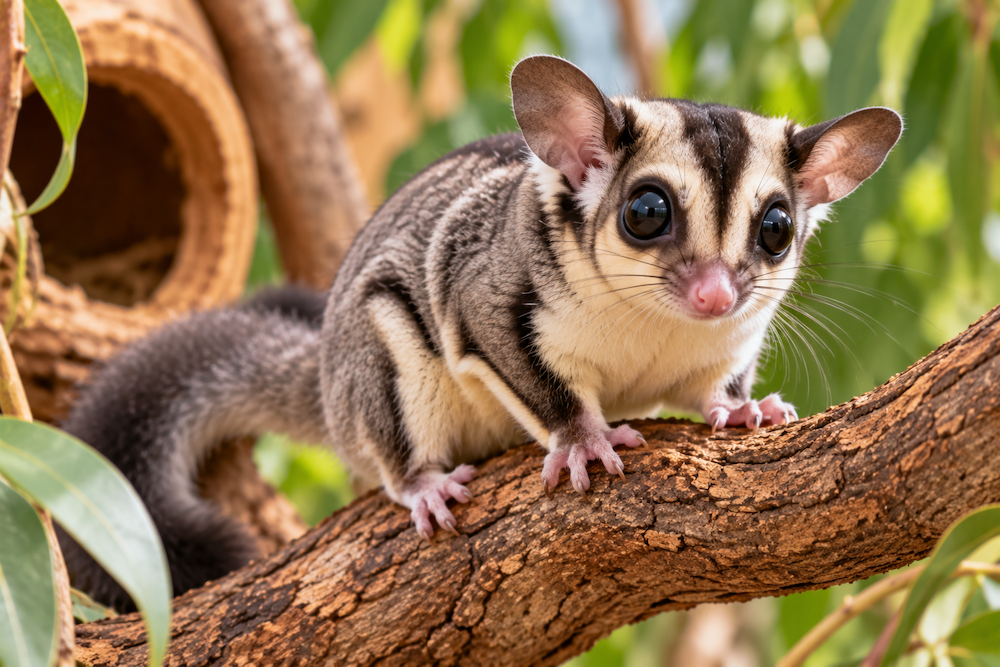
The Sugar Glider (Petaurus breviceps) is a small nocturnal marsupial famous for its ability to glide between trees using a membrane of skin called the patagium.
Standard Sugar Gliders typically have grey fur, a darker stripe running along the head and back, a pale underside and enormous dark eyes adapted for nighttime activity.
Despite their small size, these aren’t simple cage pets. Sugar Gliders are intensely social, highly active animals that need companionship, climbing opportunities, enrichment and carefully managed nutrition.
They can form strong relationships with both other gliders and familiar humans, but their specialised requirements and potential 10–15 year lifespan make them a serious commitment.
✅ PROS & CONS
Pros
- Fascinating gliding behaviour
- Highly social and interactive
- Intelligent and curious
- Can form strong bonds with familiar people
- Small body size
- Entertaining climbing and exploration
- Distinctive vocalisations and behaviours
- Long lifespan for a small companion animal
Cons
- Complex dietary requirements
- Shouldn’t normally be kept alone
- Needs a large, tall enclosure
- Primarily active at night
- Can be surprisingly noisy
- Requires substantial daily enrichment
- Exotic veterinary care may be necessary
- Long-term commitment
- Ownership is restricted in some regions
Are Sugar Gliders Good Pets?
Sugar Gliders can be rewarding pets for experienced and well-prepared owners, but they aren’t suitable for everyone.
Their social, dietary, housing and enrichment requirements are considerably more specialised than those of many common small mammals.
Are Sugar Gliders Good for Beginners?
Generally, they’re not ideal beginner pets.
Their specialised diet, intense social needs, nocturnal lifestyle and requirement for a large enriched environment create a relatively demanding care routine.
Extensive research should come before obtaining them.
How Long Do Sugar Gliders Live?
Pet Sugar Gliders can live around 10–15 years with excellent care.
This makes them a surprisingly long commitment for such a tiny animal.
How Big Do Sugar Gliders Get?
The body is typically around 12–18 cm long, with a tail that adds roughly another similar length.
Adults often weigh somewhere around 80–160 grams, although size varies between individuals and sexes.
What Is a Standard Sugar Glider?
“Standard” usually describes the classic grey appearance associated with Sugar Gliders.
They typically have grey fur, a cream or pale underside and a dark stripe extending from the head along the back.
Selective breeding has produced various other colour forms, but Standard Grey remains the familiar appearance.
Can Sugar Gliders Really Fly?
No — they glide rather than fly.
A membrane called the patagium stretches between the front and hind limbs.
When a Sugar Glider leaps from a height and extends its legs, this membrane forms a gliding surface that allows the animal to travel through the air.
How Far Can a Sugar Glider Glide?
Wild Sugar Gliders can make impressive glides of many tens of metres between trees under suitable conditions.
Their long tail helps provide stability and control while airborne.
This remarkable ability allows them to move efficiently through the forest canopy.
Why Are They Called Sugar Gliders?
The name describes two of their most famous characteristics.
“Sugar” refers to their natural consumption of sweet plant products such as sap and nectar.
“Glider” refers to their ability to glide between trees.
It’s one of those animal names that’s unusually descriptive.
What Do Sugar Gliders Eat?
Sugar Gliders are omnivorous and have a complex natural diet that can include insects, plant exudates such as sap and gum, nectar and other foods.
Captive nutrition needs to provide appropriate balances of protein, vitamins and minerals.
Simply feeding fruit isn’t nutritionally adequate.
Can Sugar Gliders Eat Fruit?
Yes, suitable fruit can form part of an appropriately designed diet.
However, Sugar Gliders shouldn’t live primarily on fruit, despite the “sugar” in their name.
An unbalanced diet can contribute to serious nutritional problems.
Do Sugar Gliders Need Calcium?
Yes. Maintaining an appropriate nutritional balance, including calcium and phosphorus, is extremely important.
Poorly formulated diets can contribute to metabolic and skeletal problems.
Owners should follow a reputable, nutritionally complete feeding plan rather than improvising the diet from favourite foods.
Should Sugar Gliders Be Kept in Pairs?
Sugar Gliders are highly social and generally shouldn’t be kept alone.
In nature they live in social groups and communicate, sleep and interact closely with other gliders.
Compatible pairs or groups allow important natural social behaviours that human attention cannot completely replace.
Can a Sugar Glider Become Lonely?
Yes. Social isolation can be a serious welfare concern.
A human owner cannot realistically provide another Sugar Glider’s companionship around the clock — particularly when the animal becomes active during the night.
Social housing is therefore an important consideration.
What Size Cage Does a Sugar Glider Need?
Sugar Gliders need a large, tall and secure enclosure that provides opportunities for climbing, jumping and exploration.
Vertical space is particularly valuable because these are arboreal animals.
Branches, sleeping pouches, safe toys and enrichment help create a more stimulating environment.
Are Sugar Gliders Nocturnal?
Yes. Sugar Gliders are strongly nocturnal.
Their enormous eyes are adapted for seeing in low-light conditions, and much of their climbing, feeding and social activity occurs after dark.
Their schedule can be challenging for people who expect a pet that’s active during the day.
Do Sugar Gliders Make Noise?
Yes — and they have an impressive vocabulary.
Sugar Gliders can bark, chirp, hiss and produce a distinctive defensive sound often called crabbing.
Some of these sounds can be surprisingly loud for such a small animal, particularly during the night.
Why Do Sugar Gliders Bark?
A Sugar Glider’s bark can be used for social communication or gaining attention.
To a new owner, hearing a tiny marsupial apparently barking somewhere in the darkness can be rather unexpected.
It’s a normal part of their communication repertoire.
What Is Sugar Glider Crabbing?
“Crabbing” is the name commonly given to a loud, repetitive defensive vocalisation.
A frightened or disturbed Sugar Glider may produce the sound from inside its sleeping pouch.
It’s essentially a very small animal making it extremely clear that it would prefer you to go away.
Do Sugar Gliders Bond With Their Owners?
They can develop strong familiarity and trust with regular, positive interaction.
Some owners use a bonding pouch to allow a sleeping glider to become accustomed to their scent and presence.
Bonding should happen gradually and never replace companionship with other Sugar Gliders.
Do Sugar Gliders Like Being Held?
Individual personalities vary.
Some well-socialised Sugar Gliders become comfortable climbing over familiar people or resting inside a pouch close to them.
They’re generally better suited to interactive exploration than being restrained like a cuddly toy.
Do Sugar Gliders Bite?
They can.
Biting may occur when a Sugar Glider is frightened, stressed, poorly socialised or feels threatened.
Patient interaction and respecting the animal’s signals can help build trust.
Why Do Sugar Gliders Have Such Big Eyes?
Their enormous eyes are an adaptation to their nocturnal lifestyle.
Large eyes help gather available light, assisting the animal as it moves through trees after dark.
The resulting appearance also happens to make Sugar Gliders look permanently surprised.
What Is the Sugar Glider’s Gliding Membrane?
The patagium is a thin membrane of skin extending along each side of the body between the front and hind limbs.
When the animal stretches out its legs, the membrane opens like a living parachute or wing.
By adjusting its body and limbs, the glider can influence its direction while airborne.
What Health Problems Are Common in Sugar Gliders?
Potential concerns include nutritional disorders, obesity, dental problems, parasites and injuries, along with conditions related to inappropriate housing or social stress.
Nutritional deficiencies can be particularly serious.
Access to a veterinarian experienced with exotic mammals is important.
Are Sugar Gliders Related to Flying Squirrels?
No.
They look remarkably similar and both glide using membranes between their limbs, but Sugar Gliders are marsupials, while flying squirrels are placental mammals.
Their similar body designs evolved independently — a striking example of convergent evolution.
Are Sugar Gliders Legal to Keep as Pets?
It depends on where you live.
Ownership is restricted or prohibited in some countries or regions, while Sugar Gliders are legally kept as pets elsewhere.
Always check current local regulations before obtaining one.
Is a Sugar Glider a Good First Exotic Pet?
Usually not.
Their adorable appearance can disguise how specialised their care actually is.
Prospective owners need to be prepared for multiple animals, nocturnal activity, specialised nutrition, a substantial enclosure and potentially 10–15 years of care.
What Makes the Sugar Glider Unique?
Imagine being smaller than a person’s hand and standing high in a tree at night.
The next tree is a considerable distance away.
A mouse would need another route.
The Sugar Glider simply jumps.
Its legs stretch outward, the membranes along its sides unfold and suddenly this tiny marsupial becomes a living glider.
Then there are the sounds.
One moment it’s chirping.
Another moment it’s barking.
Disturb an uncertain Sugar Glider inside its sleeping pouch and you may encounter the extraordinary noise known as crabbing — a sound that seems far too large to have come from such a tiny animal.
And despite looking remarkably like a flying squirrel, it’s not a squirrel at all.
A female Sugar Glider is a marsupial with a pouch, and her tiny young — called joeys — continue developing there after birth.
So this miniature nocturnal animal can climb, bark, live in social colonies, carry its young in a pouch and glide between trees.
For something weighing around 100 grams, the Sugar Glider has an impressive résumé.
Discover how Sugar Gliders glide between trees, why they bark and crab, what makes them completely different from flying squirrels and why these tiny marsupials are much more demanding pets than they first appear.
Watch our Sugar Glider video and discover what makes this extraordinary little glider so fascinating.