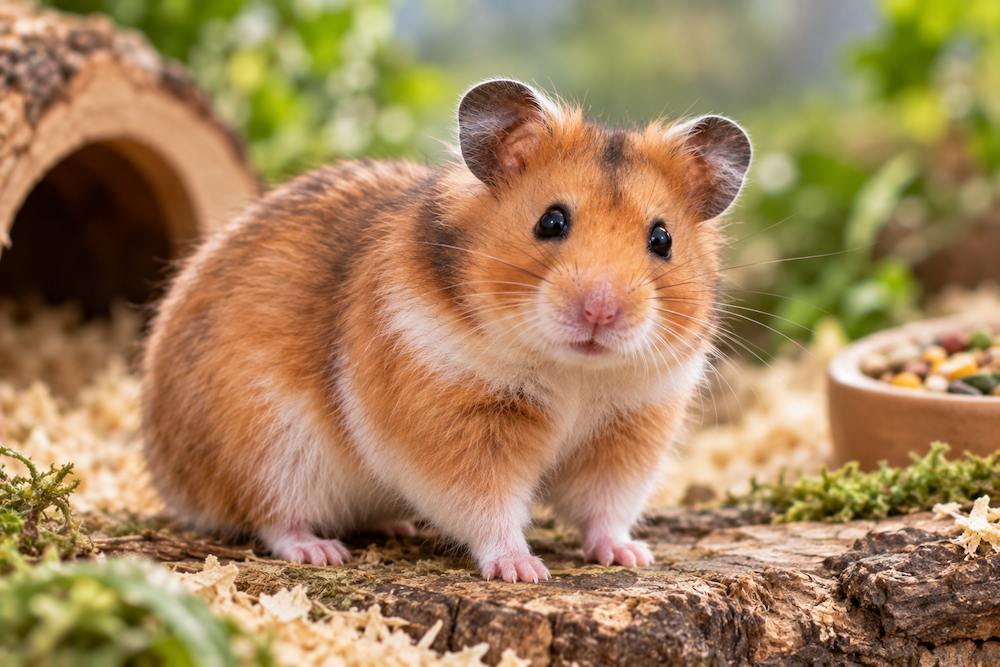







Round-cheeked, curious, and surprisingly full of personality — the Syrian Hamster is the world's best-known pet hamster, famous for its expandable cheek pouches, solitary lifestyle, nighttime adventures, and an extraordinary history that traces much of today's pet population back to a tiny group of hamsters collected in Syria.
🧠 QUICK SNAPSHOT
- Temperament: Curious, independent, generally easy to tame
- Activity Level: High, especially after dark
- Size: Around 13–18 cm long
- Adult Weight: Commonly around 100–200 g
- Good With Families: Very Good with appropriate supervision
- Housing: Must generally live alone
- Trainability: Moderate
- Handling: Usually good once properly socialised
- Grooming: Low
- Typical Lifespan: Around 2–3 years
- Best For: First-time hamster owners, older children with supervision, adults wanting a small interactive pet
📚 OVERVIEW
The Syrian Hamster is probably the animal most people picture when someone says “pet hamster.”
Also known as the Golden Hamster, it is the largest of the commonly kept pet hamster species and comes in an extraordinary variety of colours, patterns and coat types.
Syrian Hamsters are native to a relatively restricted region around Syria and southern Turkey, where their wild ancestors evolved to survive in dry environments by digging extensive underground burrows.
That ancestry explains much of what owners see at home.
They dig.
They hoard food.
They travel considerable distances.
They become active primarily around dusk and during the night.
And most importantly, adult Syrian Hamsters are strongly solitary.
Two Syrians that appear friendly as youngsters can become seriously aggressive as they mature. Each adult should therefore normally have its own enclosure.
Their relatively large size and ability to become comfortable with gentle handling make Syrians popular first hamsters.
But “small pet” should never be confused with “small needs”.
A hamster living in a tiny cage with a wheel and food bowl isn’t experiencing much of what its biology evolved to do.
Give a Syrian enough bedding to burrow, enough space to explore and enough enrichment to forage, and you discover something very different from the stereotypical children’s cage pet.
You discover a tiny nocturnal engineer with an entire underground construction project to manage.
✅ PROS & CONS
Pros
- Usually easier to handle than smaller hamster species
- Can become very comfortable around humans
- Fascinating natural behaviours
- Relatively straightforward feeding requirements
- Doesn’t need another hamster for companionship
- Available in many colours and coat types
- Quiet pet for most of the day
- Doesn’t require outdoor walking
- Can be highly entertaining to observe
Cons
- Short lifespan
- Primarily active during evening and nighttime
- Must generally be housed alone
- Needs much more enclosure space than traditional hamster cages suggest
- Requires deep bedding for natural burrowing
- Can bite if frightened or awakened suddenly
- Excellent escape artist
- Nocturnal wheel running can be noisy
- Veterinary care can be harder to access than for cats and dogs
- Not ideal for very young children wanting a daytime pet
Is a Syrian Hamster a Good Family Pet?
Yes, a Syrian Hamster can be an excellent family pet, particularly for older children and adults who understand its natural behaviour.
Their relatively large size makes Syrians easier to handle than many dwarf hamsters, and well-socialised individuals can become calm and confident around humans.
However, hamsters aren’t naturally cuddly toys.
They’re prey animals.
A hamster suddenly grabbed from above may instinctively react as though a predator has caught it.
Gentle handling should therefore be introduced gradually, preferably when the hamster is already awake.
Young children should always be supervised because hamsters are physically delicate and can be injured if squeezed or dropped.
Timing also matters.
A child expecting an enthusiastic pet at 10 o’clock in the morning may be disappointed to discover the hamster has absolutely no intention of attending the meeting.
For families comfortable with an evening-active pet, however, Syrians can be fascinating companions.
How Big Should a Syrian Hamster Enclosure Be?
A Syrian Hamster needs far more space than many traditional pet-shop hamster cages provide.
Floor area is particularly important because hamsters naturally travel considerable distances while foraging.
Current welfare guidance increasingly favours large, uninterrupted floor spaces rather than small multi-level cages connected by plastic tubes.
The enclosure also needs enough depth to accommodate substantial bedding.
Aim to provide at least around 20–25 cm of suitable bedding in a significant area, with deeper sections where practical, so the hamster can construct stable burrows.
The enclosure should also contain a properly sized wheel, hides, tunnels, nesting material, chew items, sand bath and opportunities to forage.
More usable space is generally better.
A hamster may only be 15 centimetres long.
That doesn’t mean its entire world should be only a few hamster-lengths wide.
How Much Exercise Does a Syrian Hamster Need?
Syrian Hamsters are remarkably active animals.
In the wild, hamsters may travel substantial distances while searching for food and patrolling their territory.
A large exercise wheel is therefore essential.
For an adult Syrian, the wheel should generally be around 28–30 cm in diameter or larger, depending on the individual, so the hamster can run without significantly arching its back.
Solid running surfaces are preferable to wire or mesh wheels that can injure feet.
Exercise shouldn’t stop at the wheel.
Deep bedding encourages digging.
Scatter feeding encourages foraging.
Tunnels, cork logs, cardboard structures, sprays and changing enrichment provide opportunities to investigate.
A secure play area can provide additional exploration when properly supervised.
The goal isn’t simply to make the hamster run.
It’s to create an environment where it can dig, forage, climb modestly, investigate, hide and make choices.
Can Syrian Hamsters Live Together?
No. Adult Syrian Hamsters should generally be housed individually.
This is one of the most important facts every prospective owner needs to know.
Young Syrian Hamsters may tolerate littermates temporarily, which can create the mistaken impression that they enjoy company.
As they mature, however, they become strongly territorial.
Fights can be sudden and severe and may result in serious injury or death.
A Syrian doesn’t need a hamster friend to prevent loneliness in the way a social species might.
Solitary living is normal for the species.
Human interaction and environmental enrichment can provide stimulation without forcing another hamster into its territory.
Putting two adult Syrians together because they “look lonely” is applying human social expectations to an animal with very different rules.
To a Syrian Hamster, the second hamster isn’t necessarily a friend.
It’s an intruder.
Are Syrian Hamsters Easy to Tame?
Yes. Syrian Hamsters can usually become quite comfortable with gentle human handling, although individuals differ.
The key is patience.
A newly arrived hamster should first have time to settle into its enclosure.
Owners can then introduce their scent and presence gradually, using treats and allowing the hamster to approach voluntarily.
Hands should generally approach from the side rather than suddenly descending from above.
Once confident, many Syrians will willingly walk onto a person’s hands.
Sessions should initially be short and take place close to the floor or another safe surface in case the hamster jumps.
Never wake a sleeping hamster purely because you want to play with it.
Imagine being dragged from bed at 3 a.m. by a giant who then announces:
“Don’t worry. I’m just socialising you.”
You might bite too.
What Do Syrian Hamsters Eat?
Syrian Hamsters are omnivores and need a nutritionally balanced diet rather than a bowl filled only with sunflower seeds.
A quality hamster food should provide the nutritional foundation.
Depending on the product and veterinary guidance, this may be a balanced pellet/lab block, an appropriately formulated seed mixture, or a combination designed specifically for hamsters.
Small amounts of suitable fresh vegetables can add variety.
Hamsters can also consume small amounts of animal protein, reflecting their natural omnivorous diet.
Sugary and highly processed human foods should be avoided.
Fresh water must always be available.
Scatter feeding some dry food through the enclosure encourages natural foraging behaviour rather than putting everything into a bowl.
And don’t panic when food disappears.
There’s a reasonable chance your hamster hasn’t eaten all of it.
It has simply transferred the groceries into a private underground pantry you weren’t authorised to inspect.
How Long Do Syrian Hamsters Live?
Syrian Hamsters typically live around 2–3 years, although individual lifespan varies.
Some live longer, while illness can unfortunately shorten life considerably.
Their short lifespan is one of the most difficult aspects of hamster ownership.
A Syrian can become a familiar and surprisingly interactive family member, yet its entire life unfolds over only a few years.
Good nutrition, appropriate housing, a healthy body weight, low-stress handling and prompt veterinary treatment all help provide the best chance of a healthy life.
The short lifespan is also something parents should discuss realistically before getting a hamster for a child.
A hamster isn’t a temporary pet because it matters less.
It simply experiences a much faster version of life than we do.
What Health Problems Are Common in Syrian Hamsters?
Syrian Hamsters can develop several important health problems, and illness may progress quickly because of their small body size.
Wet tail, commonly associated with proliferative ileitis in young hamsters, can cause severe diarrhoea, dehydration and rapid deterioration. A hamster with diarrhoea, lethargy or a wet/soiled rear end requires urgent veterinary attention.
Respiratory infections can also occur.
Other concerns include dental problems caused by continuously growing teeth, skin conditions, mites, abscesses and tumours.
Older Syrian Hamsters may develop various cancers and age-related disorders.
Obesity can occur when animals receive inappropriate diets or insufficient activity.
Owners should become familiar with their hamster’s normal behaviour and appearance.
Reduced eating, unexplained weight loss, breathing difficulty, abnormal discharge, diarrhoea, lumps or sudden inactivity should never simply be dismissed because “it’s only a hamster”.
For an animal weighing roughly 150 grams, small health changes can become big problems remarkably quickly.
⭐ Why Does a Syrian Hamster Stuff Food Into Its Cheeks?
Those enormous hamster cheeks aren’t simply cute.
They’re highly specialised expandable cheek pouches used for transporting food.
The pouches extend surprisingly far backwards along the sides of the body.
A hamster can gather seeds and other food while away from its burrow, pack them into its cheeks and transport the haul back to a secure storage location.
The food can then be pushed out and stored.
This behaviour makes perfect evolutionary sense.
Remaining exposed while eating would leave a small prey animal vulnerable.
Collecting food rapidly and eating later underground is safer.
Pet Syrians retain the same instinct even when nobody is competing for their dinner.
That’s why a hamster with a perfectly full food bowl can still behave as though it has thirty seconds to evacuate an entire supermarket.
⭐ Do Syrian Hamsters Really Store Food Underground?
Absolutely.
Food hoarding is a fundamental part of hamster behaviour.
The word hamster itself is associated with the German verb hamstern, meaning to hoard or stockpile.
Wild hamsters create underground storage chambers where collected food can be kept safely.
Pet hamsters often do exactly the same thing.
Owners may find impressive collections of dry food hidden beneath bedding, inside nests or behind enclosure furniture.
Some hoarding is completely normal and should be allowed.
However, fresh foods that can spoil need monitoring and removal when necessary.
Constantly destroying a hamster’s carefully constructed food stores can also create stress.
From the hamster’s perspective, that pile isn’t clutter.
It’s retirement planning.
⭐ Are Syrian Hamsters Really From Syria?
Yes — although their natural range extends beyond the modern political border implied by their name.
The wild Syrian Hamster, Mesocricetus auratus, is associated particularly with parts of northern Syria and southern Turkey.
Its natural distribution is relatively restricted.
The landscape includes dry agricultural and steppe environments where hamsters construct underground burrows and forage for seeds, plants and other foods.
This makes the global success of the Syrian Hamster as a pet particularly remarkable.
An animal originating from a relatively small region became one of the world’s most familiar companion rodents.
⭐ Did Most Pet Syrian Hamsters Really Descend From One Wild Family?
This is one of the most extraordinary stories in the history of domestic pets.
In 1930, zoologist Israel Aharoni obtained a female Syrian Hamster and her litter near Aleppo, Syria, during an expedition associated with the Hebrew University of Jerusalem.
Not all of the captured hamsters survived or reproduced.
However, a small number successfully established a breeding population.
Descendants were distributed to research laboratories and eventually entered the pet trade.
Much of the traditional laboratory and pet Syrian Hamster population has therefore been traced back to this remarkably small founder group.
Additional wild Syrian Hamsters have subsequently been collected and introduced into some populations, so it isn’t accurate to say every Syrian Hamster alive today must descend exclusively from one female.
But the genetic bottleneck behind the early domesticated population was extraordinary.
Millions of pet hamsters owe much of their family history to a very small number of animals collected nearly a century ago.
⭐ Why Are Syrian Hamsters Also Called Golden Hamsters?
The wild-type Syrian Hamster has a beautiful golden-brown coat, which explains the alternative name Golden Hamster.
Early domesticated Syrians largely resembled this natural colouring.
Selective breeding subsequently produced an extraordinary variety of colours and patterns.
Modern Syrians can be cream, black, cinnamon, grey, white and many other shades, with banded, dominant-spot, tortoiseshell and other patterns appearing in established lines.
So a “Golden Hamster” doesn’t necessarily need to look golden anymore.
“Syrian Hamster” is generally the more useful species name.
⭐ What Is a Teddy Bear Hamster?
A “Teddy Bear Hamster” isn’t a separate hamster species.
The name is commonly used by pet shops and breeders for long-haired Syrian Hamsters.
Long-haired males can develop particularly impressive coats, sometimes with long skirts of hair extending around the rear of the body.
You may also encounter names such as “Fancy Hamster”, “Black Bear Hamster” or other marketing terms.
These generally describe Syrian Hamsters with particular coat types or colours rather than separate breeds or species.
This is worth knowing when researching care.
A Teddy Bear Hamster doesn’t need a special “Teddy Bear” diet or fundamentally different enclosure.
Underneath the hairstyle is still a Syrian Hamster.
⭐ Can Syrian Hamsters See in the Dark?
Not perfectly.
Syrian Hamsters are adapted to being active in low-light conditions, but describing them as possessing perfect night vision would be misleading.
Their eyesight isn’t especially strong compared with some animals.
Instead, hamsters rely heavily on smell, hearing and their whiskers to understand their surroundings.
Whiskers provide tactile information about nearby surfaces and spaces, which is particularly useful while navigating tunnels and darkness.
Their strong sense of smell helps them locate food, recognise familiar environments and detect other hamsters.
So your hamster isn’t secretly wearing biological night-vision goggles.
It’s navigating using an impressive combination of senses that humans barely notice.
⭐ Are Syrian Hamsters Nocturnal?
Syrian Hamsters are commonly called nocturnal, but crepuscular behaviour — activity concentrated around dusk and dawn — can also describe their natural rhythms, and individual captive hamsters vary.
What matters to an owner is simple:
They’re generally not daytime pets.
Many spend much of the day sleeping and emerge during the evening.
Some become extremely active late at night.
Artificial household lighting, feeding routines and individual behaviour can influence exactly when a captive hamster becomes active.
Owners should work with the hamster’s natural schedule rather than repeatedly waking it during the day.
This is particularly important when choosing a hamster as a child’s pet.
If bedtime is 7:30 p.m., there’s a distinct possibility that the child and the hamster will operate opposite shifts.
⭐ Why Do Syrian Hamsters Need Such Deep Bedding?
Because wild Syrian Hamsters are burrowing animals.
A natural burrow isn’t simply somewhere to sleep.
It can contain nesting areas, food-storage chambers and other sections connected by tunnels.
Burrowing helps provide protection from predators and environmental temperature extremes.
Pet hamsters retain this powerful instinct.
Given sufficiently deep, structurally suitable bedding, many will create elaborate tunnel systems.
Shallow bedding prevents this entire category of natural behaviour.
The bedding also needs to hold tunnels reasonably well. Paper-based bedding and other hamster-safe materials can work effectively, sometimes combined appropriately to improve structure.
Watching a hamster disappear underground and later emerge from an entirely different location reveals something important:
The enclosure above the bedding is only half the hamster’s home.
⭐ Do Syrian Hamsters Hibernate?
Syrian Hamsters can enter a dangerous state known as torpor when environmental conditions become too cold or otherwise unfavourable.
This can make a hamster appear almost dead.
Its body temperature drops, breathing becomes extremely slow and movement may become difficult to detect.
This isn’t something owners should deliberately encourage.
Pet Syrian Hamsters should be maintained in a stable, appropriate indoor temperature range and protected from cold drafts and sudden temperature changes.
If a hamster is unexpectedly cold, limp or apparently unresponsive, veterinary advice should be sought rather than simply assuming it is safely “hibernating”.
A tiny animal dramatically slowing its metabolism may be fascinating biology.
In a pet enclosure, it can also indicate a serious husbandry problem requiring immediate attention.
⭐ Why Are Hamster Balls No Longer Considered Ideal Exercise?
The traditional plastic hamster ball was once almost synonymous with hamster ownership, but modern welfare thinking has increasingly questioned its use.
Inside a closed ball, the hamster has limited ability to choose when to stop, hide, investigate normally or use its whiskers and senses in the usual way.
Ventilation can also be limited, and feet may potentially be injured around ventilation openings depending on the design.
The animal rolling around the room doesn’t necessarily prove it’s enjoying itself — movement is required to make the ball move at all.
A better option is a secure, enriched playpen where the hamster can voluntarily explore, hide, forage and interact with objects while remaining supervised.
This reflects a broader change in hamster care.
We’re moving away from asking:
“Can the hamster physically use this?”
and towards asking:
“Does this allow the hamster to behave naturally and make choices?”
⭐ How Rare Is the Syrian Hamster?
The Syrian Hamster is extremely common in captivity but much less secure in the wild.
That’s an unusual contrast.
Millions of people recognise the species as a familiar household pet, yet its natural geographic range is small and wild populations face pressures including agricultural activity, habitat change and deliberate control because hamsters can damage crops.
This creates one of the stranger situations in domestication.
An animal can be readily available in pet shops thousands of kilometres from its ancestral home while its wild relatives remain restricted to a comparatively tiny part of the world.
The Syrian Hamster may be ordinary in our homes.
In evolutionary and conservation terms, it’s anything but ordinary.