Is Your Non Stick Pan Killing Your Bird?
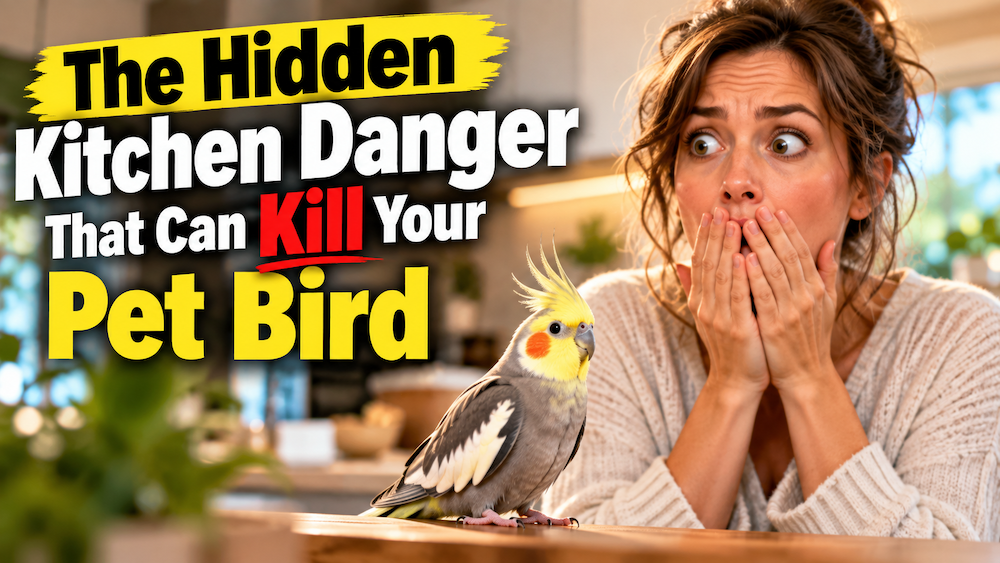
The Hidden Kitchen Danger That Can Kill Your Pet Bird
You’re cooking dinner.
Your frying pan is heating on the stove. Your pet bird is happily sitting in another room. There’s no obvious smoke, no fire and perhaps no smell to warn you that anything is wrong.
It sounds like an ordinary evening.
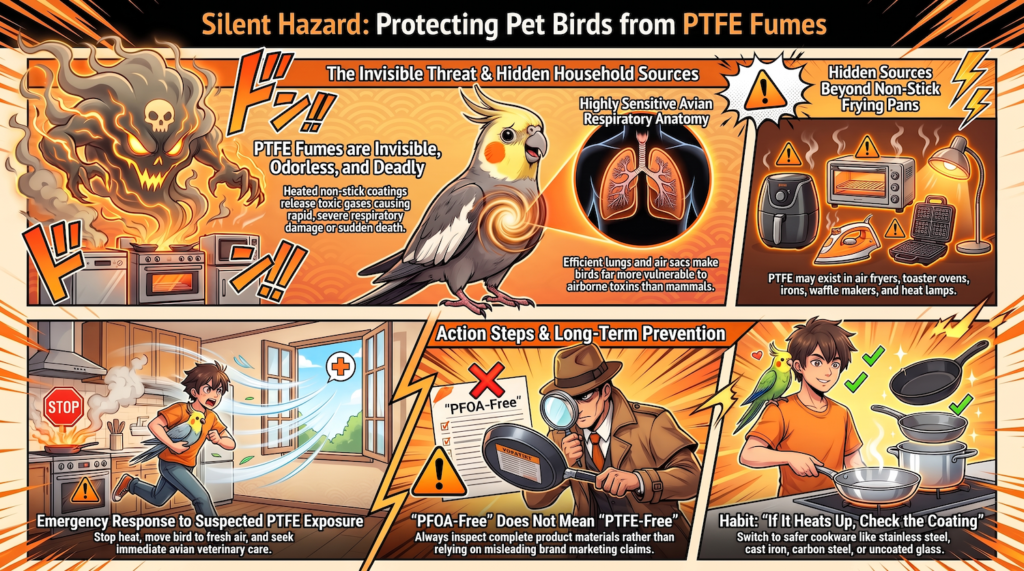
But if that cookware contains PTFE — a chemical widely used in non-stick coatings — overheating it can create an emergency for a pet bird.
Birds have exceptionally efficient respiratory systems, but that also makes them highly vulnerable to certain airborne toxins. Fumes from overheated PTFE can cause severe respiratory injury and, tragically, some birds die before their owners realise they have been exposed.
And the frying pan may not be the only thing bird owners need to think about.
This is one household danger that every bird owner should understand.
Are Non-Stick Pans Toxic to Birds?
They can be extremely dangerous.
The chemical at the centre of the problem is polytetrafluoroethylene, better known as PTFE.
PTFE is a fluoropolymer commonly used to create non-stick surfaces. Teflon is the best-known brand name associated with PTFE, but focusing only on the word “Teflon” can be misleading because PTFE and related non-stick coatings may appear in products carrying many different brand names.
Under ordinary conditions, the danger isn’t simply that a non-stick frying pan exists in your house.
The major concern is heating PTFE-containing products, particularly when they become overheated. Veterinary sources report that at high temperatures PTFE can break down and release invisible fumes and particles that are highly toxic to birds.
Why are the fumes so dangerous to birds?
A bird’s respiratory system is very different from ours.
Birds have lungs working together with a system of air sacs, creating an extraordinarily efficient respiratory system.
That’s wonderful for flight.
It’s considerably less wonderful when the air contains something toxic.
Birds can be extremely sensitive to inhaled contaminants, and PTFE fumes can cause devastating injury to the respiratory system. Veterinary descriptions of PTFE toxicosis include severe pulmonary congestion, oedema and haemorrhage.
Small birds may be particularly vulnerable.
And there’s another frightening aspect:
You may not smell the danger.
The fumes associated with overheated PTFE can be colourless and odourless. A bird can therefore be exposed even though there isn’t a dramatic cloud of smoke filling the kitchen.
Your bird doesn’t necessarily have to be beside the pan
Moving your bird’s cage from one side of the kitchen to the other isn’t an adequate solution.
VCA notes that birds can potentially be poisoned even when they aren’t in the same room as the PTFE-containing item.
Air moves throughout a home.
Open-plan living can make the distinction between “kitchen” and “living room” particularly meaningless.
For bird owners, the safer mindset is therefore not:
“My bird isn’t next to the stove.”
It’s:
“What could be entering the air my bird breathes?”
It can happen frighteningly quickly
One of the most dangerous situations is an empty non-stick pan accidentally left heating.
With food or liquid in a pan, some of the heat is being absorbed by its contents.
An empty pan can become extremely hot.
Another scenario is a pot boiling dry and continuing to heat unattended.
Veterinary sources report that many PTFE poisoning cases involve non-stick cookware being overheated or burned, although exposures involving other PTFE-containing heated products have also been documented.
The lesson is simple:
Never leave cookware heating unattended — especially in a home with birds.

What Household Fumes Are Toxic to Birds?
This is where the story becomes bigger than a frying pan.
When people hear “non-stick”, they naturally think of cookware.
But PTFE has been used in numerous heated household products.
Veterinary sources identify potential sources including some:
- Drip pans.
- Waffle irons.
- Clothing irons and ironing-board covers.
- Heating elements.
- Heat lamps.
- Self-cleaning ovens.
- Air fryers.
- Toaster ovens.
- Hairdryers.
This doesn’t mean every air fryer, iron, oven or hairdryer contains PTFE.
It means bird owners should check rather than assume.
When buying an appliance that becomes hot, investigate what coatings and materials it contains. Product documentation or the manufacturer may be able to clarify whether PTFE or other fluoropolymer non-stick coatings are present.
It’s not just non-stick cookware
Bird owners also need to think more broadly about air quality.
The Association of Avian Veterinarians warns that the avian respiratory tract is extremely sensitive to inhaled chemicals and identifies a range of potential airborne household hazards, including smoke, aerosols, air fresheners, scented candles, paints, cleaning products and other strong fumes.
Other potential hazards identified by veterinary sources include:
- Cigarette and other smoke.
- Vaping.
- Burnt food.
- Aerosol sprays.
- Perfumes and deodorisers.
- Paint and varnish fumes.
- Some cleaning-product fumes.
- Burning or melting plastics.
- Fireplace smoke.
- Certain essential-oil diffusers and vaporisers.
These hazards aren’t all identical and they don’t all carry the same degree or mechanism of risk.
But they reinforce an important principle:
For a bird owner, air quality is part of pet safety.
Should you keep a pet bird in the kitchen?
A kitchen may seem like a lovely social location for a bird.
Everyone passes through it. Interesting things happen. Your bird gets to be part of family life.
Unfortunately, kitchens contain far more than airborne hazards.
There are also:
- Hot stovetops.
- Boiling water.
- Hot oil.
- Open pots.
- Sharp utensils.
- Cleaning chemicals.
- Sinks containing water.
- Hot appliances.
Veterinary guidance therefore advises against housing birds in kitchens.
Your bird can still be part of family life.
Their permanent living area simply doesn’t need to be beside the stove.
What Should I Do If My Bird Is Exposed to Non-Stick Fumes?
Treat suspected PTFE exposure as an emergency.
Don’t wait until tomorrow to see whether your bird seems better.
Don’t assume everything is fine because your bird looks normal immediately after the incident.
And don’t waste valuable time searching online for a home remedy.
Watch for signs of PTFE poisoning
Possible signs reported by veterinary sources include:
- Rapid or difficult breathing.
- Wheezing.
- Agitation.
- Weakness.
- Poor coordination.
- Lethargy or reduced responsiveness.
- Difficulty remaining upright on a perch.
- Seizures.
- Collapse.
Tragically, sudden death can sometimes occur before obvious warning signs develop.
What to do immediately
If you suspect your bird has inhaled fumes from overheated non-stick cookware or another PTFE-containing product:
- Stop the source if you can do so safely.
Turn off the heat without exposing yourself unnecessarily.
- Move your bird away from the contaminated air and into fresh, clean air.
Do this calmly and safely.
- Contact an avian veterinarian, emergency veterinarian experienced with birds, or appropriate animal poison service immediately.
Tell them exactly what happened, what product was involved if known, approximately when the exposure occurred and whether your bird is showing symptoms.
- Follow their instructions and seek veterinary treatment promptly.
Birds exposed to PTFE fumes may require hospital treatment and oxygen/supportive care. Prognosis can be poor in severe exposures, which is why prevention and rapid action are so important.
How can you make your kitchen safer for your bird?
The simplest strategy is to remove uncertainty wherever practical.
Consider cookware made from materials such as:
- Stainless steel.
- Cast iron.
- Carbon steel.
- Uncoated glass cookware where appropriate.
But don’t rely purely on how a product looks.
If something is marketed as “non-stick”, “easy release” or has an unfamiliar coating, check what the coating actually contains.
And remember the lesson extends beyond cookware.
Before bringing a new heated appliance into a bird household, ask:
Does this contain PTFE or another fluoropolymer coating?
Keep your bird well away from cooking and other sources of fumes, maintain good ventilation, never deliberately expose them to smoke or aerosols, and never leave cookware heating unattended.
Final Thoughts
The frightening thing about PTFE toxicity isn’t that bird owners are knowingly doing something dangerous.
It’s precisely the opposite.
They’re doing something completely ordinary.
They’re making dinner.
Heating a pan.
Using an appliance they’ve used hundreds of times.
And they may have no idea that an invisible airborne hazard could be affecting the bird they love in another part of the house.
That’s why this information matters.
You don’t need to become frightened of your kitchen.
You need to understand what’s in it.
Check your cookware.
Check heated appliances.
Think carefully about sprays, smoke and fumes.
Keep your bird’s living area away from the kitchen.
And make sure everyone in your household understands why.
Because when it comes to protecting a pet bird, we spend plenty of time thinking about what’s in their cage, what’s in their food bowl and what they might accidentally eat.
But sometimes the danger isn’t something they eat at all.
Sometimes it’s simply in the air they breathe.