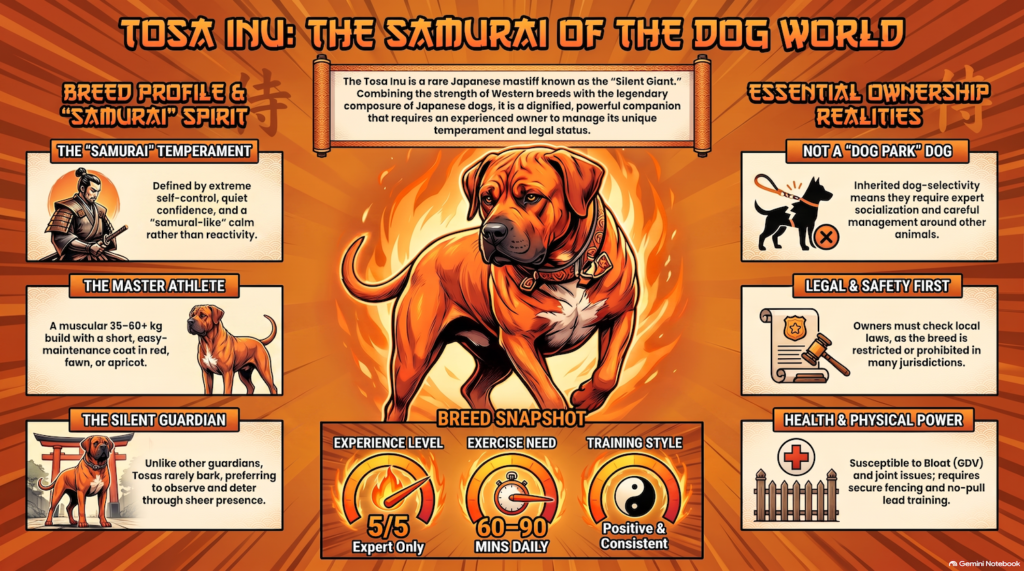







Powerful, composed, and intensely loyal — the Tosa Inu is a rare Japanese mastiff known for its remarkable strength, quiet confidence, and deep devotion to experienced owners.
🧠 QUICK SNAPSHOT
- Temperament: Calm, loyal, confident
- Energy Level: Moderate
- Size: Large to Giant
- Good With Families: Potentially, with experienced owners
- Trainability: Moderate
- Grooming: Low
- Best For: Highly experienced owners, secure homes, households familiar with powerful guardian breeds
- Important: Ownership is restricted or prohibited in some countries and regions
📚 OVERVIEW
The Tosa Inu, also known as the Tosa Ken, Tosa Dog, or Japanese Mastiff, originated in Japan’s Tosa region, now part of Kochi Prefecture. The breed was developed during the 19th century by crossing native Japanese dogs with imported breeds that included mastiff and other large European dogs. The objective was to produce an exceptionally powerful, courageous, and composed dog.
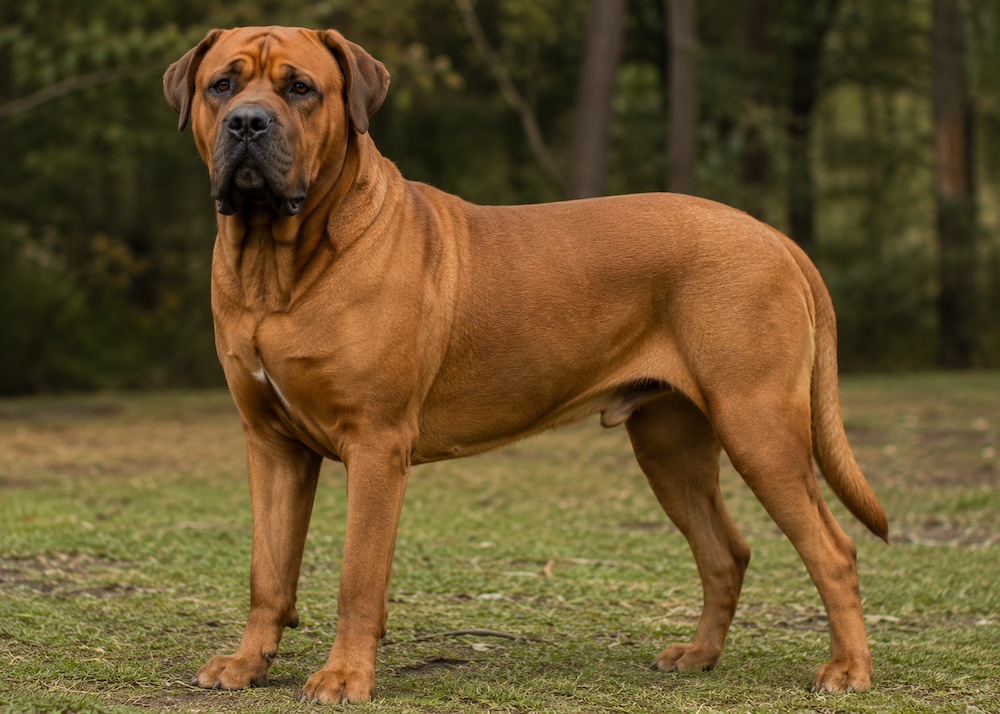
The modern Tosa is a substantial mastiff-type breed with a muscular frame, broad head, short coat, and calm, watchful demeanour. It is typically reserved rather than exuberant and tends to develop strong attachments to its household.
This is not, however, a breed suited to the average pet owner. Its tremendous physical strength, confidence, and potential for dog-directed aggression require knowledgeable handling, extensive socialisation, secure management, and lifelong training.
Prospective owners must also investigate local legislation before considering a Tosa Inu. The breed is prohibited or subject to specific legal restrictions in a number of jurisdictions.
✅ PROS & CONS
Pros
- Deeply loyal to its household
- Calm and composed when appropriately raised
- Intelligent and observant
- Naturally watchful
- Very low-maintenance coat
Cons
- Requires highly experienced ownership
- Extremely powerful physically
- Can be intolerant of unfamiliar dogs
- Early and ongoing socialisation is essential
- Ownership is legally restricted in some locations
- Not suitable for dog parks or casual off-lead socialisation
Is a Tosa Inu a Good Family Dog?
A Tosa Inu can live successfully within a family, but it is not an appropriate family dog for most households. With knowledgeable ownership, careful socialisation, and consistent management, an individual Tosa can be calm, loyal, and affectionate towards the people it knows.
Its enormous strength means interactions with children require particularly careful supervision. Even friendly behaviour from such a powerful dog can accidentally injure a small child. Households should also consider how visiting children and unfamiliar adults will be managed.
Relationships with other dogs require even greater caution. The breed’s history means some individuals can show significant dog-directed aggression, and owners should never assume that puppy socialisation guarantees tolerance of unfamiliar dogs in adulthood. Homes with other animals require thoughtful assessment and management.
For an experienced owner capable of providing structure, security, and responsible lifelong handling, the Tosa can become deeply devoted. It should not, however, be selected simply because someone wants an impressive-looking guardian.
How Much Exercise Does a Tosa Inu Need?
An adult Tosa Inu generally needs around 60 to 90 minutes of controlled exercise each day, adjusted for age, health, size, and weather conditions. The breed benefits more from structured activity than relentless high-intensity exercise.
Daily walks, controlled exploration, obedience exercises, scent games, and appropriate play can help maintain physical and mental fitness. Exercise should also reinforce calm behaviour and responsiveness to the handler.
Growing puppies need particular care. As a large, heavy breed, excessive running, repeated jumping, and other high-impact activities can place unnecessary stress on developing joints. Exercise should increase gradually as the dog matures.
Secure containment is essential, and public exercise requires responsible handling. A physically mature Tosa can be extraordinarily strong, making reliable lead manners one of the most important skills to establish during puppyhood.
Mental enrichment through training and problem-solving activities also helps provide a satisfying daily routine without placing unnecessary strain on the dog’s body.
Is a Tosa Inu Easy to Train?
The Tosa Inu is intelligent and capable of learning well, but it is not considered an easy breed for inexperienced owners to train. Its combination of confidence, independence, physical power, and reserved temperament requires a handler who understands large guardian and mastiff-type dogs.
Training should begin immediately and concentrate on practical everyday behaviour: loose-lead walking, recall, calm greetings, handling, impulse control, settling, and responsiveness around distractions.
Positive reinforcement, clear boundaries, and calm consistency are preferable to confrontational methods. Attempting to dominate or physically overpower a Tosa is both ineffective and potentially dangerous.
Socialisation must also be carefully planned. Puppies need positive exposure to different people, environments, sounds, surfaces, and controlled encounters with suitable dogs. Socialisation means teaching calm, appropriate responses—not expecting the adult Tosa to become indiscriminately friendly.
For capable owners, the Tosa can become a controlled, responsive companion, but training and responsible management must continue throughout its life.
Does a Tosa Inu Shed?
Yes, the Tosa Inu sheds, but its short, dense coat is relatively low maintenance. Most dogs shed lightly to moderately throughout the year, with some increase during seasonal coat changes.
Weekly brushing with a rubber grooming mitt or short-coat brush is usually sufficient to remove loose hair and distribute natural oils through the coat. Bathing is needed only occasionally unless the dog becomes particularly dirty.
The Tosa’s ears should be checked regularly, while nail trimming and dental care should form part of its normal grooming routine. Some individuals may drool, although the amount varies considerably between dogs.
Despite having a simple coat, the Tosa Inu is not hypoallergenic. Owners looking for a genuinely low-shedding dog should consider other breeds rather than choosing the Tosa primarily for its straightforward grooming requirements.
What Health Problems Are Common in a Tosa Inu?
The Tosa Inu is generally a robust breed, but its large size creates susceptibility to several conditions commonly encountered in heavy dogs. Its typical lifespan is approximately 10 to 12 years, although individual longevity varies.
Potential health concerns include hip dysplasia, elbow dysplasia, and other orthopaedic problems. Responsible breeders should screen breeding dogs for relevant joint conditions rather than relying solely on physical appearance or pedigree.
As a large, deep-chested breed, the Tosa may also be at risk of gastric dilatation-volvulus (GDV or bloat), a rapidly developing and potentially fatal emergency. Owners should understand the symptoms and discuss individual risk and preventative strategies with their veterinarian.
Maintaining a lean body condition is particularly important because excess weight increases stress on joints and can worsen mobility problems. Appropriate nutrition during puppyhood is also essential for controlled growth.
Choosing health-tested parents, providing age-appropriate exercise, maintaining a healthy weight, and arranging regular veterinary care give a Tosa Inu the best opportunity for a long and comfortable life.
⚠️ Tosa Inu Ownership Laws
Before considering a Tosa Inu, prospective owners should check the current laws where they live. The breed is prohibited, controlled, or subject to special requirements in some countries and jurisdictions.
These rules can affect ownership, importation, breeding, insurance, housing, public handling, and travel. Legislation can also change, so owners should verify current requirements with the relevant government authority rather than relying on general breed information online.